
Grief Counseling for Loss: Your 2026 Healing Guide

TL;DR:
Grief counseling is a structured, clinical support process that helps adults process emotional pain through evidence-based therapy. It involves licensed therapists, personalized treatment plans, and modalities like CBT, ACT, or EMDR, focusing on reintegration rather than closure. Professional help is recommended when grief impairs daily functioning or persists beyond several months.
Grief counseling for loss is defined as structured, clinical support that helps adults process the emotional pain of losing someone through evidence-based therapy and validated coping tools. Unlike talking to a friend or joining a community group, professional grief counseling involves a licensed therapist, a formal treatment plan, and modalities like Cognitive Behavioral Therapy (CBT), Acceptance and Commitment Therapy (ACT), or Dialectical Behavior Therapy (DBT). Practices like Alvaradotherapy and programs referenced by the Mayo Clinic both confirm that this kind of structured support produces measurable outcomes. Grief counseling does not promise closure. It offers something more realistic: the ability to carry your loss while rebuilding your life.
What is grief counseling for loss, and how does it work?
Grief counseling is a professional, evidence-based process where a licensed therapist helps you understand, express, and manage the emotional weight of loss. The industry term is bereavement therapy, though grief counseling is the phrase most people search for and use in everyday conversation. Both terms describe the same clinical service.

Grief counseling typically starts with a free 15-minute consultation to assess your needs, followed by structured sessions using approaches like CBT or ACT. Many California-based practices, including Alvaradotherapy, offer same-day admission options for people in acute grief. That accessibility matters because grief does not wait for a convenient appointment slot.
Sessions are not open-ended venting. A therapist guides you through specific goals: identifying grief triggers, building coping strategies, and processing emotions that feel too large to hold alone. The duration varies, but most structured programs run anywhere from several weeks to several months, depending on the complexity of your loss and your response to treatment.
How does grief counseling differ from bereavement support?
Grief counseling involves clinical diagnosis and a formal treatment plan, while bereavement support is peer-based and focused on community connection without clinical pressure. Confusing the two leads people to seek the wrong kind of help, which can extend suffering unnecessarily.
Bereavement support programs, such as those offered through hospice organizations or peer networks like Soaring Spirits International, provide education, shared experience, and emotional validation. They are not designed to treat complicated grief or co-occurring conditions like depression or PTSD. Some hospice-based bereavement programs provide help up to 13 months post-loss, and peer programs often run in 12-week cycles at no cost. That structure works well for uncomplicated grief.
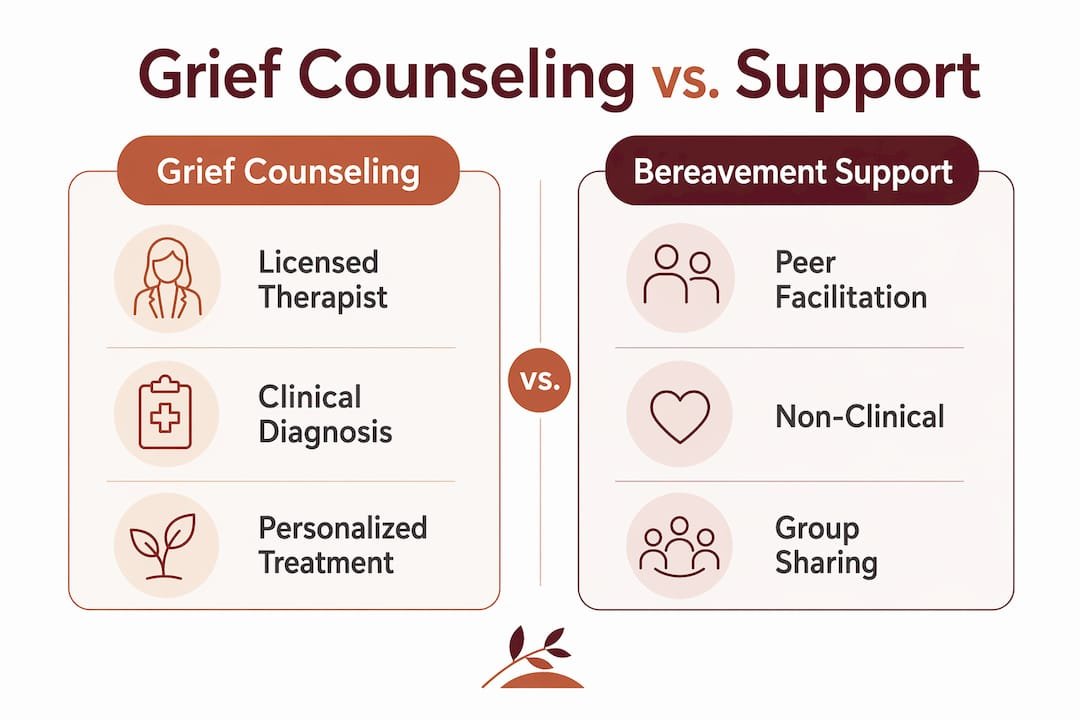
Clinical grief counseling, by contrast, includes a formal intake assessment, a diagnosis if warranted, and a personalized treatment plan. A therapist tracks your progress, adjusts the approach, and can coordinate care with a psychiatrist if medication becomes relevant.
| Feature | Grief counseling | Bereavement support |
|---|---|---|
| Provider | Licensed therapist | Peer facilitator or counselor |
| Clinical diagnosis | Yes | No |
| Treatment plan | Individualized | Group-based curriculum |
| Cost | Insurance or private pay | Often free or low-cost |
| Best suited for | Complicated or prolonged grief | Uncomplicated grief, community connection |
| Duration | Weeks to months, individualized | Fixed cycles, often 12 weeks |
The clearest signal for choosing clinical counseling over peer support is functional impairment. If grief is affecting your ability to work, sleep, or care for yourself, a licensed therapist is the right starting point.
What types of therapy approaches are available?
Evidence-based therapy for loss draws from several well-researched modalities, each suited to different grief presentations. Understanding your options helps you ask better questions when choosing a therapist.
Cognitive Behavioral Therapy (CBT): Targets unhelpful thought patterns around loss, such as guilt, self-blame, or catastrophic thinking. CBT is one of the most studied approaches for grief and produces consistent results across age groups.
Acceptance and Commitment Therapy (ACT): Focuses on accepting painful emotions rather than fighting them, and reconnecting with personal values even while grieving. ACT is particularly effective for people who feel stuck or who resist the idea that life can continue after loss.
Dialectical Behavior Therapy (DBT): Builds distress tolerance and emotional regulation skills. DBT works well when grief is accompanied by intense emotional swings or self-destructive behaviors.
EMDR (Eye Movement Desensitization and Reprocessing): Processes traumatic grief memories stored in the nervous system. Alvaradotherapy specializes in EMDR, which is especially relevant when the loss was sudden, violent, or traumatic.
Pro Tip: When interviewing a potential therapist, ask directly: "What modality do you use for grief, and how will you measure my progress?" A therapist who cannot answer clearly may not have specialized grief training.
You can learn more about grief counseling approaches in California to compare modalities before your first session. Choosing the right fit from the start reduces the likelihood of switching therapists mid-process, which can disrupt momentum.
When should you consider professional grief counseling?
Clinical guidelines recommend professional grief counseling when grief impairs daily functioning or basic self-care continues to decline several months after a loss. That threshold is not about how long you have been grieving. It is about whether grief is preventing you from living.
Watch for these warning signs:
Persistent inability to work, eat, or maintain basic hygiene
Intense grief symptoms that show no reduction after several months
Social withdrawal that has become complete isolation
Intrusive thoughts or images of the deceased that disrupt daily life
Substance use as a primary coping tool
Thoughts of self-harm or not wanting to continue living
Complicated grief can develop suddenly, even in people who seemed to be coping well initially. The signs of complicated grief are distinct from normal grief and require a trained clinician to assess and treat.
"Grief is not a problem to be solved. It is a process to be supported. When that process stalls, professional intervention is not a last resort. It is the most direct path back to functioning." — Grief Support Center
Early intervention also matters for physical reasons. Grief consumes significant metabolic energy, and reducing regular commitments by 30%–50% during acute grief phases is often advised by clinicians. Waiting until you are completely depleted before seeking help makes recovery harder and longer.
How can grief counseling support your healing process?
Therapy aims for reintegration of loss into life, not closure or forgetting. This distinction changes everything about how you approach counseling. You are not trying to stop loving the person you lost. You are learning to carry that love while rebuilding your capacity to function and find meaning.
Here is what grief counseling actually produces in practice:
Emotional validation: A therapist confirms that your feelings, however intense or contradictory, are normal responses to loss. This alone reduces shame and self-judgment significantly.
Pacing strategies: You learn to manage grief in doses rather than being overwhelmed by it. Prioritizing rest during acute grief is a clinical skill, not a sign of weakness.
Crying as a tool: Crying speeds grief processing physiologically. Most clients fear they will cry endlessly, but the body's response is self-limiting. A therapist helps you understand this so you stop fighting your own healing.
Support plan development: Building a support plan before grief overwhelms you is far more effective than crisis problem-solving in the middle of a breakdown. Your therapist helps you identify people, activities, and environments that soothe you before you need them.
Identity reconstruction: Loss often disrupts your sense of who you are, especially after losing a spouse, parent, or child. Counseling helps you rebuild a coherent identity that includes the loss without being defined by it.
Pro Tip: Between sessions, keep a brief grief journal. Write one sentence about what you felt that day and one sentence about what helped. This gives your therapist real data and gives you a record of your own progress.
For practical daily strategies, the grief support tips for California adults resource from Alvaradotherapy offers a structured starting point you can use alongside formal counseling.
What should you expect in your grief counseling sessions?
Starting grief counseling feels unfamiliar for most people. Knowing the structure in advance reduces the anxiety of that first appointment.
A typical counseling process looks like this:
Initial consultation (15–20 minutes): A brief call or meeting to assess your situation and confirm the therapist is a good fit. Many practices offer this at no charge.
Intake assessment (first full session): The therapist gathers a detailed history of your loss, your current symptoms, your support network, and your goals for therapy.
Ongoing sessions (weekly or biweekly): Sessions typically run 50 minutes. You may receive between-session tasks such as journaling, reading, or practicing a specific coping skill.
Progress reviews: Every few weeks, your therapist checks in on whether the approach is working and adjusts the plan if needed.
Online therapy formats are now standard and fully effective for grief work. Alvaradotherapy offers online sessions throughout California, which removes the barrier of travel during a period when leaving the house can feel impossible.
Sessions address more than raw emotion. Therapists also work on practical areas like how grief affects your relationships, your sense of purpose, and your ability to make decisions. Grief touches every part of life, and good therapy accounts for that.
Key takeaways
Grief counseling for loss works because it combines clinical structure, evidence-based therapy, and personalized pacing to help adults reintegrate loss into life rather than simply endure it.
| Point | Details |
|---|---|
| Counseling vs. bereavement support | Clinical grief counseling includes diagnosis and treatment; bereavement support offers peer connection without clinical structure. |
| Therapy modalities | CBT, ACT, DBT, and EMDR each address grief differently; matching the modality to your needs improves outcomes. |
| When to seek help | Seek professional counseling when grief impairs daily functioning or self-care declines several months after loss. |
| Reintegration, not closure | Effective grief therapy helps you carry loss while rebuilding life, not erase it. |
| Pacing and rest | Reducing commitments by 30%–50% during acute grief is a clinical recommendation, not a personal failure. |
What I have learned about grief counseling that most articles miss
People come into grief therapy expecting to feel better quickly. What they actually experience, at first, is feeling more. That surprises them. It surprises their families. And it sometimes makes them want to quit before the work has had a chance to take hold.
The goal of grief counseling is not to reduce your pain as fast as possible. It is to help you stop fighting your pain, which is what actually prolongs it. The clients I have seen make the most progress are not the ones who push hardest. They are the ones who learn to pace, to rest, and to let the grief move through them rather than trying to manage it into submission.
The other thing most articles skip over is the physical reality of grief. Fatigue, brain fog, appetite changes, and immune suppression are not side effects of grief. They are grief. When a therapist tells you to reduce your commitments and sleep more, that is not soft advice. It is physiologically grounded clinical guidance.
Seeking professional help for grief is not a sign that you loved someone too much or that you are not strong enough to handle loss. It is a sign that you understand what loss actually costs, and you are choosing to invest in your own recovery rather than white-knuckling through it alone.
— Juiced
Start your healing with Alvaradotherapy

Alvaradotherapy is a trauma-informed practice serving adults across California with licensed therapists who specialize in grief, trauma, and loss. The team uses evidence-based approaches including EMDR, CBT, and ACT, delivered through secure online sessions that fit your schedule and location. Whether your grief is recent or has been building for years, the process starts with one conversation. You can schedule a consultation to speak with a therapist and understand what to expect before committing to a full session. For a detailed look at the therapy process, the what to expect page walks you through every step from intake to ongoing care. Healing is not linear, but it does not have to be faced alone.
FAQ
What is the difference between grief counseling and therapy for loss?
Grief counseling and therapy for loss refer to the same clinical service. Both involve a licensed therapist, a treatment plan, and evidence-based methods like CBT or EMDR to help you process and manage grief.
How long does grief counseling typically last?
Session length varies by individual, but most structured grief counseling programs run from several weeks to several months. Complicated grief cases may require longer treatment, adjusted based on your progress and goals.
When is grief considered complicated enough to need professional help?
Clinical guidelines recommend professional counseling when grief impairs daily functioning or self-care continues to decline several months after a loss. Sudden onset of intense symptoms at any point also warrants professional assessment.
Can grief counseling be done online?
Online grief counseling is fully effective and widely available. Practices like Alvaradotherapy offer secure video sessions throughout California, making professional support accessible regardless of your location or mobility.
What is the goal of grief counseling?
The goal is reintegration, not closure. Effective grief counseling helps you carry your loss while rebuilding your capacity to function, find meaning, and reconnect with life.
