
The EMDR Session Process: A Step-by-Step Guide

TL;DR:
EMDR is a structured, evidence-based therapy that helps process traumatic memories using bilateral stimulation. It involves eight phases aimed at safely reducing emotional distress without requiring detailed trauma narration. The therapy can be conducted online, making it accessible across California for a range of trauma-related conditions.
Eye Movement Desensitization and Reprocessing, known as EMDR, is a structured, evidence-based therapy that helps people reprocess traumatic memories through guided bilateral stimulation. The EMDR session process follows an eight-phase protocol designed to move clients safely from distress to resolution. Sessions typically last 60–90 minutes, and most people working through a single traumatic event see significant relief within 6–12 sessions. For adults managing PTSD, anxiety, depression, or complex childhood trauma, understanding what happens in each phase removes the fear of the unknown and makes starting therapy far less daunting.
What happens in a typical EMDR therapy session?
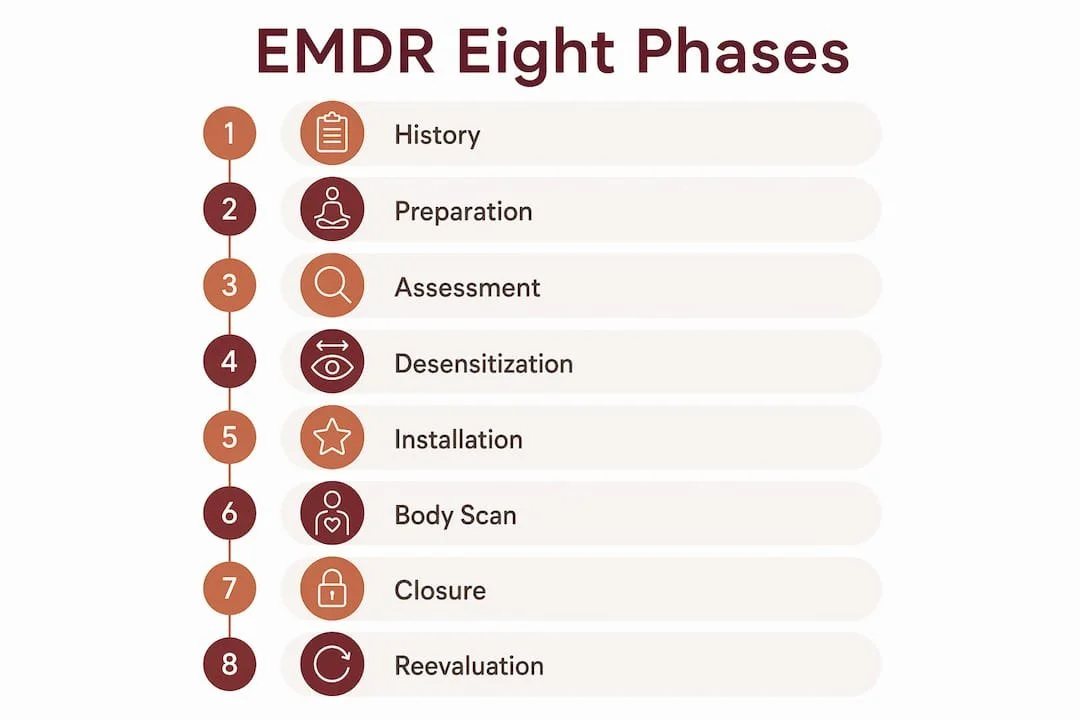
The EMDR therapy process is organized into eight distinct phases. Each phase has a specific purpose, and therapists move through them at a pace that matches each client's readiness.
The eight phases, in order
History-taking and treatment planning. The therapist gathers background information, identifies target memories, and maps out a treatment plan. No deep processing happens yet.
Preparation. The therapist explains how EMDR works, teaches grounding and calming techniques, and builds the trust needed for safe processing. This phase can span several sessions for clients with complex trauma.
Assessment. The therapist and client identify a specific target memory, the negative belief attached to it (such as "I am powerless"), and a positive belief the client wants to hold instead (such as "I have choices"). The client rates emotional distress using the Subjective Units of Disturbance (SUD) scale from 0 to 10.
Desensitization. This is the core processing phase. The therapist guides bilateral stimulation, which may be eye movements following a moving finger or light bar, alternating taps on the knees, or auditory tones through headphones. The client holds the target memory in mind while the stimulation runs. Clients report lower SUD ratings after each set, meaning the memory loses its emotional charge progressively.
Installation. Once distress drops, the therapist helps the client strengthen the positive belief using continued bilateral stimulation. The goal is for the new belief to feel genuinely true, not just intellectually accepted.
Body scan. The client scans from head to toe for any residual physical tension. Trauma lives in the body as much as the mind, and this phase catches what verbal processing misses.
Closure. Every session ends with a return to calm. The therapist uses grounding techniques to make sure the client leaves feeling stable, even if processing is not complete.
Reevaluation. At the start of the next session, the therapist checks whether gains held and whether new material has surfaced.
Pro Tip: Write down any images, thoughts, or feelings that come up between sessions. Therapists at Alvaradotherapy use this material in reevaluation to guide the next phase of treatment.
Clients do not need to narrate their entire trauma during any of these phases. Therapists ask "What do you notice?" rather than requesting detailed storytelling. A few words during pauses are enough. This design significantly lowers the emotional burden of engaging with painful memories.

How does EMDR facilitate trauma processing and emotional healing?
EMDR works by changing the emotional weight of a memory, not by erasing it. The goal is for a traumatic event to feel like something that happened in the past rather than a threat happening right now.
Bilateral stimulation is the engine behind this shift. Rapid eye movements activate both brain hemispheres, which researchers believe mimics the brain's natural memory consolidation process during REM sleep. Holding a distressing memory in mind while simultaneously tracking external stimulation appears to reduce the memory's vividness and emotional intensity. Clients consistently report that memories feel more distant and less charged after processing sets.
Several misconceptions about EMDR are worth addressing directly:
EMDR is not hypnosis. Clients remain fully awake and in control throughout every session. They can stop at any time.
EMDR does not erase memories. The memory stays intact. What changes is how much distress it triggers.
EMDR does not require graphic disclosure. Clients hold the memory mentally while bilateral stimulation does the work. Detailed verbalization is not required.
The therapist does not direct the client's thoughts. The therapist facilitates the brain's natural healing capacity. The client's own nervous system leads the process.
"EMDR is not about erasing memories but shifting their emotional impact, allowing clients to reclaim control over their traumatic past." — Harvard Health
The body scan phase reinforces this by catching physical responses that linger after cognitive processing. Tightness in the chest, tension in the shoulders, or a knot in the stomach are all signals that processing is not yet complete. Addressing these physical markers is what separates EMDR from purely talk-based approaches.
Many clients find bilateral stimulation unusual at first. Clinicians emphasize that this response is normal and that the oddness typically fades within the first session or two as the brain begins to engage with the process.
What should clients expect after an EMDR session?
Processing does not stop when the session ends. Emotional and cognitive shifts continue for days after a session, which is both normal and a sign that healing is happening.
Common post-session experiences include:
Vivid or unusual dreams
New memories or images surfacing unexpectedly
Temporary mood shifts, including sadness, irritability, or emotional numbness
Heightened sensitivity to stress or sensory input
Moments of unexpected clarity or relief
Pro Tip: Plan lighter activities after an EMDR session. Avoid high-stakes meetings, difficult conversations, or intense physical exertion on the same day. Give your nervous system time to settle.
The closure phase of each session is designed to prevent clients from leaving in a destabilized state. Therapists teach containment techniques, such as the "container" visualization where distressing material is mentally placed in a secure box until the next session. Grounding exercises like the 5-4-3-2-1 sensory method help clients return to the present moment quickly. Clients continue processing memories outside sessions, which makes these stabilization tools critical between appointments.
Knowing the difference between normal processing and a sign that you need extra support matters. Reaching out to your therapist between sessions is appropriate if distress becomes unmanageable, if you feel unsafe, or if grounding techniques stop working. Alvaradotherapy encourages clients to maintain open communication with their therapist throughout treatment, not just during scheduled sessions.
How many sessions does EMDR take, and who benefits most?
Treatment length in EMDR varies based on trauma type, history, and individual readiness. For a single traumatic incident, 8–16 sessions often lead to remission. Complex trauma, including childhood abuse, repeated relational trauma, or dissociative presentations, requires a longer preparation phase and more sessions overall.
The table below outlines general treatment expectations by trauma type:
| Trauma type | Typical session range | Key consideration |
|---|---|---|
| Single-incident trauma | 8–16 sessions | Faster progress with clear memory targets |
| Chronic PTSD | 16+ sessions | Multiple targets require sequential processing |
| Complex childhood trauma | Extended, individualized | Preparation phase may span several sessions |
| Anxiety and depression | Variable | Underlying traumatic roots often identified first |
| Dissociative presentations | Specialized protocol | Experienced clinicians only |
EMDR's clinical reach extends well beyond PTSD. A 2021 review of 90 studies confirmed Level 1 evidence for EMDR in treating depression, anxiety, chronic pain, and OCD. Level 1 evidence is the highest standard in clinical research, meaning multiple well-designed trials support the treatment's effectiveness. This positions EMDR as a first-line option for many adults who have not responded fully to talk therapy alone.
Personalization is central to the EMDR treatment protocol. Therapists at Alvaradotherapy assess each client's window of tolerance, meaning their capacity to engage with distressing material without becoming overwhelmed, before moving into active processing. For clients with complex PTSD and trauma, the preparation phase may include months of stabilization work before any memory targeting begins. This is not a delay. It is the therapy working correctly.
For clients who want to accelerate treatment, EMDR Intensives compress multiple sessions into a shorter timeframe. This format suits adults with demanding schedules or those who want to move through a specific trauma cluster more quickly. You can read more about preparing for EMDR therapy to understand what readiness looks like before your first session.
Key Takeaways
The EMDR session process is an eight-phase, evidence-based protocol that uses bilateral stimulation to reduce the emotional charge of traumatic memories without requiring detailed verbal disclosure.
| Point | Details |
|---|---|
| Eight structured phases | Each phase has a defined purpose, from history-taking through reevaluation, ensuring safe and systematic processing. |
| Bilateral stimulation drives change | Eye movements, tapping, or auditory tones reduce memory distress by engaging both brain hemispheres simultaneously. |
| No graphic disclosure required | Clients hold memories mentally; a few words during pauses are enough for the therapist to guide processing. |
| Post-session processing is normal | Vivid dreams, mood shifts, and new memories surfacing after sessions are signs that healing is continuing. |
| Treatment length varies by trauma type | Single-incident trauma may resolve in 8–16 sessions; complex trauma requires a longer, individualized approach. |
What I've learned watching clients move through EMDR
The question I hear most often before a first session is some version of: "Will I have to talk about everything that happened?" The relief on a client's face when I explain that the answer is no is one of the most consistent moments in this work. EMDR's design protects people from re-traumatization in a way that traditional talk therapy simply cannot replicate.
What surprises clients most is how physical the process feels. They expect something cognitive, something verbal. Instead, they notice their shoulders dropping, their breathing slowing, a tightness in their chest releasing. The body scan phase is not a formality. It catches real, measurable change.
The therapeutic relationship matters more in EMDR than many people expect. Bilateral stimulation is a tool. The safety a client feels with their therapist determines whether they can actually use it. Clients who feel rushed, unheard, or pressured to process before they are ready do not get the same results as those who move at their own pace. A good EMDR therapist follows the client's lead, always.
The lasting benefit I see most often is not just symptom reduction. Clients describe a shift in how they relate to their own history. The past stops feeling like a current emergency. That change in relationship to memory is what makes EMDR genuinely different from managing symptoms indefinitely.
For a deeper look at how the steps connect across a full course of treatment, the EMDR therapy guide at Alvaradotherapy walks through each stage in detail.
— Juiced
EMDR therapy available online across California
Adults ready to start EMDR therapy do not need to live near a clinic to access quality care. Alvaradotherapy offers online EMDR trauma therapy for clients throughout California, with licensed therapists who specialize in PTSD, complex trauma, anxiety, and depression.

Sessions are conducted via secure video, and the full eight-phase protocol is available remotely. Alvaradotherapy's bilingual team provides care in both English and Spanish, with a trauma-informed approach that respects each client's cultural identity and pace. Whether you are working through a single traumatic event or years of complex trauma, a free consultation is the first step toward finding out whether EMDR is the right fit for you.
FAQ
What is the EMDR eight-phase protocol?
The eight phases are history-taking, preparation, assessment, desensitization, installation, body scan, closure, and reevaluation. Each phase serves a specific purpose in guiding clients safely through trauma processing.
Does EMDR require talking about trauma in detail?
No. Clients hold the memory in mind while bilateral stimulation runs. Therapists ask "What do you notice?" rather than requesting a full account, which significantly reduces the emotional burden of sessions.
How long does an EMDR session last?
EMDR sessions typically last 60–90 minutes. The desensitization and installation phases take the most time, while closure ensures clients leave each session feeling grounded and stable.
Who is EMDR therapy most effective for?
EMDR has Level 1 evidence for PTSD and strong research support for depression, anxiety, chronic pain, and OCD. It is effective for both single-incident trauma and complex childhood trauma, though complex cases require longer preparation.
Can EMDR be done online?
Yes. The full EMDR protocol, including bilateral stimulation using screen-based eye movement tools or auditory tones, is available via secure video sessions. Alvaradotherapy provides online EMDR therapy to clients across California.
