
What to Expect in Couples Therapy: A Practical Guide

TL;DR:
Couples therapy aims to identify and change negative interaction patterns between partners through structured, evidence-based methods. The process begins with assessment sessions, followed by active work involving communication exercises and emotional regulation techniques, lasting typically 8 to 20 sessions. Most couples see lasting improvements in communication, trust, and conflict resolution, especially when both partners are committed and practice skills outside therapy.
Couples therapy is a structured, evidence-based process designed to identify and reshape negative interaction patterns between partners. Knowing what to expect in couples therapy removes the guesswork and makes it easier to commit. The most widely used approaches include Emotionally Focused Therapy (EFT) and the Gottman Method, both of which target communication breakdowns and emotional disconnection. This guide walks you through every stage of the couples counseling process, from the first session to lasting results, so you can walk in prepared.
What happens during the first couples therapy sessions?
The first one or two sessions are an assessment phase, not a crisis intervention. Your therapist will meet with both of you together and may also schedule brief individual sessions to hear each partner's perspective privately. This structure lets the therapist understand the full picture without either partner filtering their experience.
During these early meetings, you will share your relationship history, describe current concerns, and identify patterns that keep repeating. The therapist asks structured questions designed to surface both the problems and the strengths in your relationship. Therapist neutrality is non-negotiable here. A good therapist does not take sides. The goal is to facilitate understanding, not to assign blame.
By the end of the assessment phase, you and your therapist will set one to three realistic goals together. These goals anchor the rest of the work and give both partners a shared direction. Common goals include improving daily communication, rebuilding trust after a rupture, or learning to manage conflict without escalation.
Here is what the initial phase typically covers:
Relationship history: How you met, major milestones, and turning points
Current concerns: What brought you to therapy now, not just in general
Individual perspectives: Each partner's emotional experience of the relationship
Strengths inventory: What is already working that therapy can build on
Goal setting: One to three specific, measurable outcomes to work toward
Pro Tip: Go into the first session with one concrete example of a recurring conflict. Specific examples help the therapist identify patterns far faster than general descriptions.
How does the ongoing couples therapy process work?
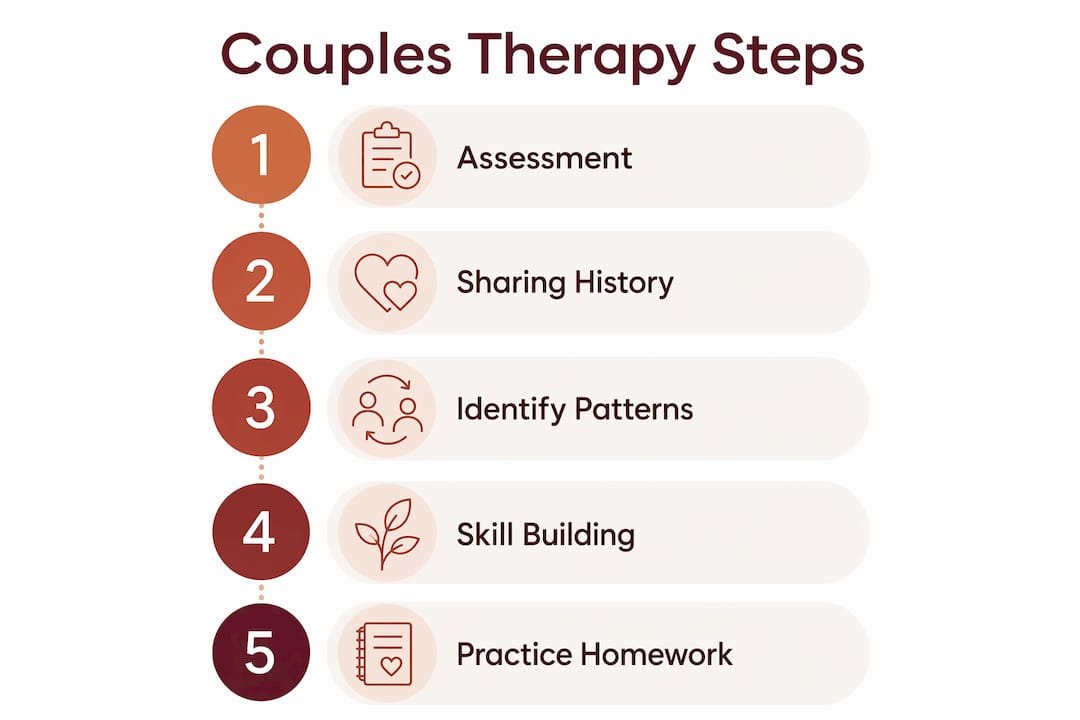
Once the assessment is complete, the active working phase begins. This is where the real change happens, and it looks different from what most couples expect. Sessions are not just open-ended conversations. The therapist coaches you in real time, interrupting destructive cycles as they unfold and guiding you toward healthier responses.
The working phase typically includes four types of structured activity:
Dialogue exercises: Guided conversations where each partner speaks and listens without interrupting, building the habit of hearing rather than reacting.
Communication skill building: Techniques like using "I" statements, naming emotions precisely, and slowing down before responding.
Negative cycle mapping: The therapist helps you identify the specific trigger-response loop that drives most of your conflicts, so you can recognize it before it escalates.
Emotional regulation practice: Tools for managing the physiological arousal that makes productive conversation impossible during a fight.
The Gottman Method adds structured exercises such as building "love maps" (detailed knowledge of your partner's inner world), recognizing harmful patterns like contempt and stonewalling, and practicing deliberate acts of appreciation. EFT focuses more on the attachment needs underneath the conflict, helping partners express vulnerability instead of defensiveness.
Couples therapy generally spans 8 to 20 sessions, with the range depending on the complexity of the issues. Couples dealing with a single communication problem may resolve it in eight sessions. Couples working through infidelity or long-term emotional distance typically need more time.
"Therapy is not a magic cure. Benefits depend heavily on both partners' motivation and their willingness to apply what they learn between sessions." — The Conversation
That quote captures the single most important variable in the couples counseling process. What happens outside the therapy room matters as much as what happens inside it.
What benefits and outcomes can couples expect from therapy?

The research on couples therapy effectiveness is strong. 70–80% of couples report higher relationship satisfaction after therapy compared to those who do not participate. That figure comes from 2022 research and reflects outcomes across multiple therapy models. Studies specifically on EFT show that 70–75% of couples experience significant improvement that lasts beyond the end of treatment.
The benefits of couples therapy extend well beyond conflict reduction. Couples consistently report gains in four areas:
Communication clarity. Partners learn to express needs without criticism and to listen without defensiveness. These are learnable skills, not personality traits, and therapy teaches them directly.
Emotional understanding. Each partner develops a clearer picture of what drives the other's reactions. This reduces the assumption that difficult behavior is intentional or malicious.
Trust and intimacy. Therapy supports emotional development by examining each partner's perspective in a structured, safe environment. For couples recovering from infidelity or betrayal, this structured examination is often the only path back to genuine trust.
Conflict resolution skills. Couples leave therapy with a repeatable process for handling disagreements, not just a temporary ceasefire. This is what makes gains last.
The catch is that improvements can diminish if the lessons learned in therapy are not practiced consistently. Therapy builds the skills. Daily life is where those skills either take root or fade. Couples who treat therapy as a starting point rather than a finish line see the most durable results. You can read more about what the research shows on therapy outcomes at Alvaradotherapy.
Common challenges and realistic expectations during couples therapy
The most common misconception about couples therapy is that it should feel better immediately. For many couples, the first few weeks of the working phase feel harder, not easier. Suppressed grievances surface. Old wounds get named out loud for the first time. This is normal and expected.
Experienced therapists understand that emotional destabilization is part of the trajectory, not a sign that therapy is failing. They actively work to prevent premature dropout by preparing couples for this phase in advance and providing support when it arrives.
Here is a realistic picture of what the working phase can look like:
Temporary increase in conflict as both partners become more honest about unmet needs
Emotional fatigue after sessions that cover difficult material
Uneven progress where one partner moves faster than the other
Resistance from one or both partners when patterns feel too familiar to change
Pro Tip: If a session feels particularly hard, write down one thing you heard your partner say that surprised you. Reflection between sessions accelerates progress more than any single in-session exercise.
Couples therapy is not appropriate in every situation. When one partner is experiencing coercive control or domestic violence, joint therapy can increase risk rather than reduce it. A qualified therapist will screen for this during the assessment phase and recommend individual therapy or safety planning instead.
The table below outlines the difference between productive discomfort and a genuine red flag during the couples therapy process:
| Situation | What it means |
|---|---|
| Sessions feel emotionally draining | Normal working phase; continue with therapist support |
| One partner feels consistently blamed | Discuss therapist neutrality directly; consider a different fit |
| Conflict increases briefly at home | Expected during active phase; temporary |
| One partner refuses all exercises | Motivation gap; address openly with therapist |
| Safety concerns arise | Stop joint sessions; seek individual support immediately |
Finding the right therapist fit matters as much as the method. A therapist who balances challenge and support for both partners produces better outcomes than one who defaults to validating only one side. You can explore how couples counseling works in more detail at Alvaradotherapy to get a clearer sense of what to look for.
Key takeaways
Couples therapy works best when both partners enter with realistic expectations, commit to the full process, and practice new skills between sessions.
| Point | Details |
|---|---|
| Assessment comes first | The first 1–2 sessions focus on history, patterns, and goal-setting before active work begins. |
| Expect 8–20 sessions | Session count depends on issue complexity; simpler concerns resolve faster. |
| Discomfort is part of progress | Feeling worse briefly during the working phase is normal and temporary. |
| Research backs the outcomes | 70–80% of couples report higher satisfaction after therapy compared to those who skip it. |
| Practice outside sessions is required | Gains from therapy fade without consistent daily application of new skills. |
What I have learned from watching couples do this work
Couples therapy is one of the most misunderstood services in mental health. People arrive expecting a referee and leave having found a translator. The shift from "you always do this" to "when this happens, I feel that" sounds small on paper. In practice, it rewires how two people relate to each other.
The couples I have seen benefit most are not the ones with the smallest problems. They are the ones where both partners show up willing to be wrong. That willingness is rarer than it sounds, and it is the single strongest predictor of whether therapy sticks.
The "worse before better" phase trips up a lot of couples who were already on the fence. If you go in knowing it is coming, you are far less likely to quit when it arrives. Experienced therapists at practices like Alvaradotherapy prepare couples for this explicitly, which is one reason a good therapist fit matters so much.
Therapy is not a destination. The couples who maintain their gains treat the skills they learned as ongoing habits, not a course they completed. The communication exercises that feel awkward in session become natural over months of practice at home.
— Juiced
Alvaradotherapy's approach to couples therapy
Alvaradotherapy offers online couples therapy for clients across California and New York, with licensed therapists trained in trauma-informed, evidence-based methods. The practice works with couples navigating communication breakdowns, trust issues, grief, and the relational effects of trauma.
Sessions are available in English and Spanish, with therapists who bring cultural responsiveness to every appointment. If you are ready to understand exactly what the process looks like before your first session, the what to expect page at Alvaradotherapy walks you through the full experience. Booking a consultation takes minutes, and knowing what you are walking into makes the first session significantly easier.
FAQ
How long does couples therapy usually take?
Couples therapy spans 8 to 20 sessions on average, depending on the complexity of the issues. Couples with focused communication concerns often see results in fewer sessions than those working through infidelity or long-term disconnection.
Will the therapist take sides?
A qualified therapist does not take sides. Therapist neutrality means challenging both partners equally and facilitating understanding rather than assigning blame.
What issues can couples therapy address?
Couples therapy helps with communication problems, infidelity, parenting conflicts, trust issues, and major life transitions. It supports behavioral change by examining each partner's perspective in a structured setting.
Is couples therapy effective?
Yes. Research shows 70–80% of couples report higher relationship satisfaction after therapy. EFT studies show those gains typically last beyond the end of treatment.
What if therapy feels harder before it gets better?
That is a normal part of the working phase. Experienced therapists prepare couples for this emotional destabilization and provide active support to prevent dropout during the most difficult stretch.
