
Couples Therapy Effectiveness: What the Research Shows
TL;DR:
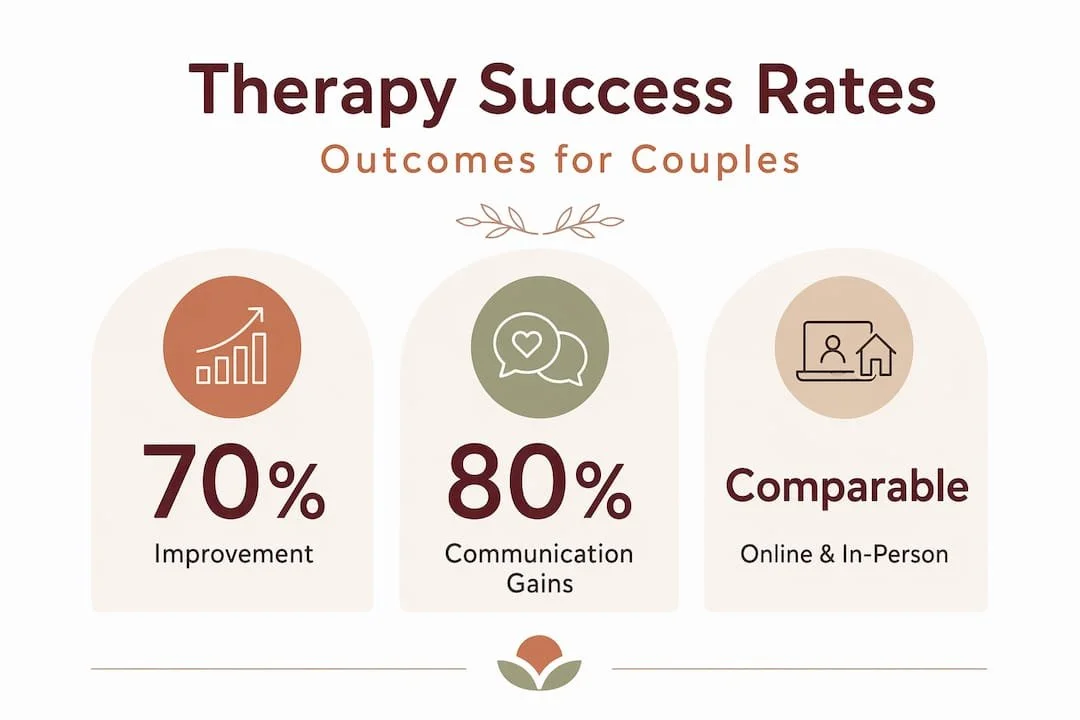
Studies show that 70 to 80 percent of couples experience meaningful improvements after therapy, especially when started early. Effective couples therapy provides a structured space for honest communication, identifies destructive cycles, and requires both partners' motivation and a good therapist fit. Initiating therapy within two years of relationship issues arising yields the best long-term results and relationship satisfaction.
If you've ever wondered whether couples therapy actually works or whether it's worth the time and money, the research may surprise you. Studies on couples therapy effectiveness consistently show that 70 to 80% of couples report meaningful improvement after treatment compared to couples who go without any professional support. That's not a minor uptick. That's a statistically significant shift in how partners communicate, handle conflict, and connect. The question isn't really whether therapy works. It's whether you're approaching it the right way.
Table of Contents
Key Takeaways
| Point | Details |
|---|---|
| High success rates | Research shows 70–80% of couples improve after therapy, with gains in communication and satisfaction. |
| Timing changes outcomes | Starting therapy within two years of a problem’s onset significantly improves results and lowers conflict. |
| Method matters less than fit | EFT and Gottman Method both show strong outcomes; therapist match and couple engagement matter more. |
| Online therapy is equally effective | Studies confirm comparable outcomes for in-person and online formats, with better attendance rates online. |
| Sustaining gains requires planning | Tracking progress and maintaining habits post-therapy is what separates short-term relief from lasting change. |
Couples therapy effectiveness: what actually happens in sessions
A lot of couples walk into therapy expecting the therapist to act as referee. That's not how it works. Effective therapy gives both partners a structured space to slow down, say what's actually happening, and hear each other without the usual defensive spiraling that happens at home. The therapist's job is to guide the process, not pick a side.
Couples therapy helps partners work through conflict, improve communication, and build stronger bonds well beyond situations where the relationship feels like it's already falling apart. That matters because most couples delay seeking help until things get critical, but therapy works just as well, often better, when you come in proactively during a major life transition, adjustment to parenthood, or a period of emotional distance.
Different models work through different mechanisms. Here's how the most common approaches target change:
Emotionally Focused Therapy (EFT) focuses on attachment patterns. It helps partners identify the emotional cycles driving their conflict and create new patterns of closeness and security.
Gottman Method is grounded in decades of observational research. It targets specific behaviors like contempt, criticism, and stonewalling, training couples in concrete communication skills.
Behavioral approaches work on changing interaction habits directly, using structured exercises and feedback to shift patterns in real time.
The mechanism that matters most across all these models is the same: identifying and interrupting the destructive cycles. Research shows that stonewalling and emotional disengagement actively reduce therapy effectiveness if left unaddressed. A good therapist doesn't just facilitate conversation. They help couples map the cycle that keeps pulling them apart and build a concrete plan to break it.
Pro Tip: Before your first session, both partners should independently write down one specific pattern they want to change, not just a general complaint. Bringing that level of specificity into the room accelerates progress significantly.
Therapist quality and couple motivation are the two levers you control most. A therapist whose approach matches your specific relational dynamics and goals will move therapy forward far more effectively than a mismatch in style or method.
What the research actually says about success rates
The numbers on couples therapy success rates are more encouraging than most people expect. The 70-80% improvement rate reported in research isn't just about couples deciding to stay together. It reflects measurable gains across communication quality, conflict frequency, emotional intimacy, and relationship satisfaction. Those are distinct, trackable outcomes.
Here's a snapshot of what the research shows across key outcome categories:
| Outcome area | What the research shows |
|---|---|
| Communication quality | Significant improvement across most evidence-based therapy models |
| Conflict frequency | Reduced after therapy, especially when emotional cycles are targeted |
| Sexual intimacy | Statistically significant gains reported even in short-term counseling programs |
| Relationship satisfaction | Improvement in majority of treated couples vs. untreated controls |
| Divorce risk | Reduced when therapy begins within two years of problem onset |
Timing is one of the most underappreciated factors in the effectiveness of relationship counseling. Early intervention, meaning starting therapy within roughly two years of when problems began, is consistently linked to lower conflict levels, better relationship quality, and lower rates of separation compared to couples who wait until the damage is severe.
"The couples who benefit most from therapy are often not the ones in the deepest crisis. They're the ones who showed up before the resentment calcified." — Reflecting a pattern seen across multiple longitudinal studies on relationship intervention timing.
The question of how effective couples therapy really is also depends on what you define as success. For some couples, success means rebuilding intimacy after infidelity. For others, it means learning to argue without it turning into a three-day cold war. Setting clear, specific goals before you begin is not just helpful. It's what lets you actually measure whether therapy is working for your specific relationship.
Comparing therapy approaches and delivery formats
Does it matter which specific model your therapist uses? Less than you might think. A study comparing EFT and Gottman Method found both produced significant, durable improvements in sexual intimacy and connection, with no meaningful difference between the two at three-month follow-up. Large effect sizes for both methods. That tells you something important: the leading evidence-based approaches all work. What matters more is the fit between the method, the therapist's skill, and your specific relational dynamics.
You can read about the different types of therapy available to get a sense of which model resonates before you commit to a therapist who only practices one approach.
Here's a quick comparison of the most common formats and what to expect from each:
| Format | Best for | Key consideration |
|---|---|---|
| In-person therapy | Couples who prefer face-to-face connection | Logistics can be a barrier; scheduling both partners is harder |
| Online therapy | Busy couples, rural areas, those in different locations | Comparable outcomes, fewer missed sessions, easier scheduling |
| Intensive sessions | High-conflict couples or those with limited time | Compressed format; strong for breakthroughs but requires commitment |
| Group couples therapy | Couples wanting peer modeling and shared learning | Less individualized; works best alongside individual couples work |
The online vs. in-person question has been largely settled by research. A study of 1,157 couples found that clinical outcomes for relationship satisfaction and therapeutic alliance were comparable across formats, with differences that were small and clinically insignificant. Beyond outcomes, online therapy reduces dropout and missed appointments. That matters because consistent attendance is one of the strongest predictors of positive results.
The single most important variable across all formats is the quality of the therapeutic alliance, meaning how much both partners trust and feel heard by the therapist. Alliance accounts for a larger share of outcomes than any specific technique or delivery format. If one partner doesn't feel safe with the therapist, results will stall regardless of how evidence-based the model is.

Pro Tip: If after three sessions one partner consistently feels unheard or dismissed by the therapist, that's not a rough patch. That's a sign to discuss the fit openly or find someone else. Good therapists will welcome that conversation.
How to evaluate progress and sustain the gains
Knowing that therapy works is one thing. Knowing whether it's working for your relationship is another. You need concrete markers to track, not just a vague sense that things feel better or worse this week. Here's a practical framework for getting the most out of therapy and protecting what you build:
Set specific, measurable goals at the start. "Better communication" is too vague. "We want to resolve disagreements without one of us shutting down" is trackable. Write the goals down together and revisit them monthly.
Track interaction patterns between sessions. Notice when the old cycle shows up. How quickly did you catch it? Did you use any of the tools from therapy? This awareness itself creates change.
Do the homework. Most evidence-based approaches include between-session exercises. Consistent tracking of those exercises, and whether they're actually happening during stressful weeks, is one of the clearest predictors of lasting change.
Plan for hard periods. Therapy gains don't hold automatically when life gets stressful. Before you end or pause therapy, build a specific plan for what to do when conflict escalates during a high-stress period at work, with family, or around finances.
Schedule a maintenance check-in. Even if you feel great at the end of therapy, one or two check-in sessions three to six months later can catch backsliding before it takes hold. Think of it the way you'd think about dental cleanings. Preventing decay is easier than treating it.
The couples who sustain the gains from therapy are almost always the ones who treated the work as ongoing, not as a course with a fixed end date. The skills you build in therapy only work if you keep using them under pressure.
For structured support on putting communication tools into practice between sessions, the step-by-step communication guide from Alvarado Therapy offers practical exercises grounded in the same principles covered in therapy.
My take on what actually makes therapy work
I've seen couples come in expecting therapy to do the work for them, and I've seen couples who showed up genuinely ready to be uncomfortable and change. The outcomes are not even close. Couples therapy effectiveness is real and well-supported by research, but the research doesn't capture the ingredient that makes the biggest difference: both partners have to decide the relationship is worth the discomfort of real honesty.
The biggest misconception I encounter is the belief that therapy is a last resort, something you do when you're days away from separation. That framing almost guarantees worse outcomes. By the time resentment has built up over years, the emotional cycles are deeply grooved. Starting earlier, when you still have goodwill and curiosity toward each other, is not a sign that something is wrong. It's one of the smartest investments you can make in your relationship.
I also want to be direct about something the research supports but rarely says plainly: a bad therapist fit will not just waste your time. It can actually reinforce the dynamic you came in to change, particularly if one partner uses sessions as another arena for winning arguments. Therapist fit is not a preference. It's a clinical variable. Trust your instincts on it.
The best outcomes I've seen always share one thing: both people left therapy with a map of their pattern and a real practice for interrupting it. Not just better feelings after sessions. A working system. That's the goal.
— Alvaradotherapy
Ready to take the next step with couples therapy?
If the research has answered your question about whether couples therapy really works, the next step is finding the right support for your specific relationship. At Alvarado Therapy, our licensed therapists offer online couples therapy to couples across California, with flexible scheduling that removes the logistical barriers that cause so many couples to keep delaying help.
Our trauma-informed approach means we understand that many relationship difficulties are shaped by individual and shared histories, not just surface-level conflict. Whether you're dealing with communication breakdowns, trust issues after betrayal, or a period of emotional disconnection, our bilingual team brings clinical skill and genuine care to every session. You don't have to be in crisis to benefit. You just have to be ready to do the work together. Book a consultation to get started.
FAQ
Does couples therapy really work?
Yes. Research consistently shows that 70-80% of couples report meaningful improvement in communication, conflict management, and relationship satisfaction following therapy compared to untreated couples.
How effective is couples therapy compared to doing nothing?
Couples who pursue therapy show significantly better outcomes than those who don't, including lower conflict frequency, higher relationship satisfaction, and reduced divorce risk, particularly when therapy begins early in the problem's development.
Which couples therapy approach has the best success rate?
Both Emotionally Focused Therapy and the Gottman Method show strong, durable results with large effect sizes. The best approach depends on your specific relational patterns and therapist fit, not the model alone.
Is online couples therapy as effective as in-person?
Yes. A study of over 1,000 couples found comparable outcomes between online and in-person therapy formats, with online therapy offering the added advantage of better attendance and fewer missed sessions.
When is the best time to start couples therapy?
The earlier the better. Starting within two years of when problems first appeared is consistently linked to better outcomes, lower conflict escalation, and stronger long-term relationship quality.
Recommended
Effective Couples Counseling: Methods, Results, and What Works — Alvarado Therapy
Effective couples therapy: trauma-informed approaches to rebuilding trust — Alvarado Therapy
7 Key Benefits of Couples Counseling for Healing Together — Alvarado Therapy
Couples Therapy in Trauma Recovery: Rebuilding Trust — Alvarado Therapy
