
Effective couples therapy: trauma-informed approaches to rebuilding trust
TL;DR:
Trauma-informed couples therapy emphasizes safety, trust, and structured repair to rebuild trust in trauma-affected relationships. It utilizes frameworks like EFT and Gottman, tailored to address specific trauma and trust issues through evidence-based methods. Standard therapy often fails for trauma couples due to lack of structure, making specialized, certified approaches essential for meaningful healing.
Most couples sitting down for their first therapy session assume the process is straightforward: talk about problems, learn some communication tips, and leave feeling better. That assumption, while understandable, is exactly why so many couples walk away from therapy feeling like nothing really changed. When trauma, betrayal, or deep emotional disconnect is at the root of a relationship's struggles, generic talk therapy can actually make things worse by triggering defensive responses and escalating conflict. Trauma-informed couples therapy works differently, and for couples in California navigating infidelity, childhood trauma, or years of emotional distance, understanding that difference can be the turning point.
Table of Contents
What makes couples therapy effective for trauma and trust repair
Frameworks for healing: EFT and Gottman pathways in trauma-informed couples therapy
Tailoring therapy for complex trauma: dual-trauma couples and nuanced interventions
Benchmarks for outcomes: what 'success' looks like and therapist credentials
Why generic couples therapy rarely works for trauma-affected relationships
Ready to rebuild your relationship? Trauma-informed couples therapy in California
Key Takeaways
| Point | Details |
|---|---|
| Trauma-informed principles | Safety, trustworthiness, and structured repair are essential for couples facing trauma. |
| Evidence-based frameworks | EFT and Gottman pathways offer proven steps for intimacy and trust repair. |
| Customized interventions | Dual-trauma couples require personalized therapy approaches for lasting results. |
| Success benchmarks | Improvements in intimacy, reduced shame, and therapist credentials are key indicators. |
| Choose specialist providers | Select trauma-informed therapists with certification in leading models for optimal outcomes. |
What makes couples therapy effective for trauma and trust repair
Now that you know why trauma-informed care matters, let's break down the specific mechanics that make couples therapy effective for rebuilding trust, especially after betrayal or long-standing disconnect.
Not all couples therapy is created equal. What separates effective trauma-informed care from a generic session is its foundational commitment to safety before anything else. When one or both partners carry trauma, the nervous system responds to perceived threats automatically. Without intentional safety structures built into the therapy itself, sessions can quickly become re-traumatizing rather than healing.
SAMHSA's key principles for trauma-informed care include safety; trustworthiness and transparency; peer support; collaboration and mutuality; empowerment, voice, and choice; and cultural humility. These aren't abstract values. They show up as concrete practices: a therapist who explains every step, who invites both partners to set boundaries on topics before they're raised, and who actively avoids creating a courtroom dynamic where one person is labeled the problem.
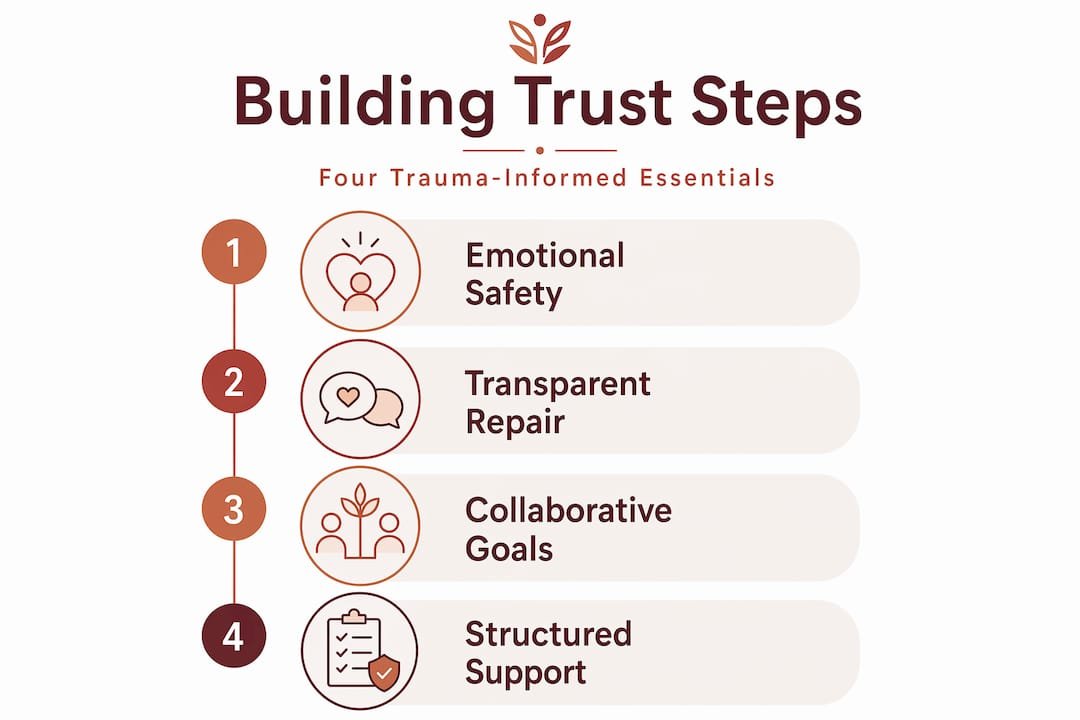
A 2025 review published by Springer identified four key mechanics of effective trauma-informed couples therapy: (1) emotional and psychological safety first, (2) explicit trust-building norms, (3) structured repair of ruptures, and (4) attunement-focused conversation rather than escalation or blame. Each mechanic builds on the last. You cannot do meaningful rupture repair in a session where one partner still doesn't feel emotionally safe enough to speak honestly.
For a broader look at how these foundations shape healing, this trauma-informed care overview unpacks the principles in more depth.
| Principle | What it looks like in practice |
|---|---|
| Safety | Therapist co-creates session norms; both partners agree on communication ground rules |
| Trustworthiness | Consistent structure, no surprises; transparent about therapy goals |
| Collaboration | Decisions about pacing and topics are shared, not imposed |
| Empowerment | Each partner has voice; validation is offered before correction |
| Cultural humility | Therapist acknowledges identity, background, and lived experience |
For couples who want to start applying these principles outside of sessions, these trauma-informed steps for conflict offer a practical starting point.
Frameworks for healing: EFT and Gottman pathways in trauma-informed couples therapy
With a clear sense of trauma-informed principles, let's examine two leading frameworks that turn theory into practice: EFT and Gottman.
Two approaches consistently rise to the top when it comes to evidence-based couples work with trauma histories: Emotionally Focused Couples Therapy (EFCT) and the Gottman Method. They are not interchangeable. Each has a distinct structure, and understanding their differences helps you and your partner choose the right fit.
Emotionally Focused Couples Therapy (EFCT) is built on attachment theory. It helps partners identify the negative interaction cycles that keep them stuck, understand the deeper attachment needs underneath conflict, and gradually reshape how they reach for each other in vulnerable moments. What makes EFCT particularly valuable for trauma-affected couples is its direct focus on shame. Research shows that EFT/EFCT has randomized controlled trial evidence for improving intimacy and reducing shame, two of the most common casualties of relational trauma. In practice, couples report being able to recognize that their partner's anger is actually fear, and their own shutdown is actually grief. That shift changes everything.
The Gottman approach, developed through decades of observational research, uses a structured repair pathway that is especially relevant for couples dealing with infidelity or a major breach of trust. The Gottman betrayal repair model describes three phases: Atone, Attune, Attach. In the Atone phase, the partner who caused harm takes full accountability without minimizing. In the Attune phase, both partners rebuild emotional attunement and safe dialogue. In the Attach phase, the couple cultivates a new shared identity that includes the wound but is not defined by it.
"Trust is not rebuilt with promises. It is rebuilt through repeated, consistent, observable behavior over time." This Gottman-aligned insight reflects what couples working through betrayal consistently discover: the road back is slower than expected, but it is real.
Here is how the two frameworks compare for trauma-informed couples work:
| Feature | EFCT | Gottman method |
|---|---|---|
| Core focus | Attachment bonds and emotional cycles | Trust repair and relationship skills |
| Best for | Emotional disconnect, shame, fear-based patterns | Infidelity, betrayal, communication breakdown |
| Structure | Stage-based softening of defenses | Phase-based repair (Atone, Attune, Attach) |
| Evidence base | RCT evidence for intimacy and shame reduction | Longitudinal research on relationship stability |
| Trauma lens | Explicit attachment and affect regulation | Explicit betrayal and trust science |
A typical EFCT sequence for a trauma-affected couple might look like this:
Identify the negative cycle (for example, one partner pursues, the other withdraws)
Uncover the underlying emotion driving the behavior (fear of abandonment, shame)
Share the vulnerable emotion with the partner in a structured, safe context
Receive a new response that breaks the old cycle
Gradually build new patterns of reaching and responding
Pro Tip: Before your first session, ask any potential therapist whether they have specific training in EFCT or Gottman methods. General "couples counseling" without a structured model is far less predictable in outcomes. For a closer look at what this means in practice, these couples counseling outcomes can help frame your expectations.
Both approaches support trauma recovery and trust rebuilding, but the path looks different depending on where your relationship is starting from. And for couples specifically navigating infidelity, this detailed healing after infidelity guide walks through what the process genuinely involves.
Tailoring therapy for complex trauma: dual-trauma couples and nuanced interventions
While leading frameworks provide structure, real-life couples often need therapy tailored to their unique trauma histories. Here's how expert-backed customization works.
Here is an uncomfortable reality that not enough therapists acknowledge upfront: when both partners carry significant trauma histories, standard couples therapy models, even EFT and Gottman, may need substantial modification. Research published in Sage Journals confirms that trauma can meaningfully affect couples therapy needs in ways that require tailoring, including in couples where both partners have trauma histories. The term for this is "dual-trauma couple," and it describes relationships where both people's nervous systems are frequently activated, where triggers are unpredictable, and where even well-intentioned repair attempts can land as threats.

In dual-trauma relationships, the most common mistake is moving too fast. A therapist who pushes emotional vulnerability before both partners have developed basic regulation skills is likely to see sessions spiral into escalation rather than connection.
SAMHSA's TIP-57 guidance recommends a sequential or integrated approach in cases like these: de-escalation and emotional regulation skills first, followed by deeper relational processing. In some situations, individual trauma treatment may need to happen alongside or even before couples work, particularly when one partner's symptoms are acute enough that couples sessions feel destabilizing.
"Timing is a clinical skill. Pushing two trauma-activated people to be vulnerable before they can regulate is not therapy. It is retraumatization."
Practical tailoring strategies for complex trauma couples include:
Psychoeducation first: Teaching both partners about trauma responses (fight, flight, freeze, fawn) reduces blame and increases compassion
Window of tolerance work: Helping each partner identify their personal warning signs of emotional flooding before conflict escalates
Grounding tools in session: Therapists incorporate breathwork or sensory grounding so that activated partners can return to baseline during difficult conversations
Pacing agreements: Explicit agreements about slowing down or pausing when either partner reaches overwhelm
Individual sessions alongside couples sessions: Particularly useful when one partner needs more individual support without shifting the dynamic in joint sessions
These communication tips for trauma healing translate many of these strategies into daily practice between sessions.
Pro Tip: If you notice that couples sessions consistently leave you or your partner feeling more triggered and hopeless rather than more connected, that is important feedback. It may mean the current approach needs modification, not that therapy itself is a failure. Understanding how trauma impacts relationships can help you communicate more clearly with your therapist about what adjustments are needed.
Benchmarks for outcomes: what 'success' looks like and therapist credentials
Once therapy is tailored to your unique needs, the next question is: how do you measure progress and ensure your therapist is equipped for trauma-informed couples work?
One of the most overlooked conversations in couples therapy is this one: what does success actually look like for us? Many couples enter therapy with a vague goal like "communicate better" and leave six months later unsure whether they actually improved. Setting measurable outcome benchmarks from the beginning creates accountability for both partners and the therapist.
The Gottman Institute recommends prioritizing outcome evidence tied to specific targets rather than relying on generic claims. That means tracking intimacy, shame reduction, and relational satisfaction using measurable markers, and choosing therapists whose credentials match the specific model being used. For trauma-informed couples therapy, those credentials include certification in EFT/EFCT, Gottman Level 1, 2, or 3 training, and documented training in trauma-informed care principles.
Concrete success indicators to track throughout your couples therapy:
Reduced emotional flooding: Both partners can stay regulated during difficult conversations rather than shutting down or escalating
Increased bids for connection: The frequency of small, warm attempts to connect (asking about your partner's day, reaching for their hand) actually goes up
Shorter repair cycles: After a conflict, the time it takes to reconnect genuinely decreases over months
Reduced shame: Partners report feeling less fundamentally broken, defective, or unlovable in the context of the relationship
Improved communication specificity: Both partners can name feelings and needs more precisely rather than speaking in generalizations
Greater relational trust: Trust is rebuilt incrementally through consistent behavior, and partners begin noticing and naming evidence of that
Achieving these outcomes depends on transforming connection after trauma being a shared priority. If you are curious about how this work looks in 2026 specifically, this guide on couples therapy today is worth reviewing.
Why generic couples therapy rarely works for trauma-affected relationships
We have worked alongside many couples in California who describe the same frustrating pattern: they tried couples therapy before, sat in sessions that felt like referee meetings, and left feeling judged or unheard. One partner walked away believing they were labeled "the problem." The other walked away feeling guilty but not actually closer to their partner. Nothing shifted at the root level.
Generic couples therapy often misses trauma because it isn't designed to look for it. A therapist without trauma-informed training might interpret a partner's emotional shutdown as avoidance or lack of caring when it is actually a freeze response rooted in early relational trauma. They might push for emotional openness before the nervous system is safe enough to offer it. The result is couples who try harder and feel worse.
What we have seen consistently is that couples who switch to trauma-informed, structured approaches find progress that feels different from the start. Not easier, necessarily, but more predictable. There is a reason for that: trauma-informed therapy explicitly maps the terrain. It tells you what to expect, why certain conversations feel impossible, and how to build toward them step by step. That roadmap for trauma-informed care results often makes the difference between couples who give up and couples who rebuild something genuinely stronger than what they had before. The couples who do the best work are usually the ones who were most skeptical that anything could change.
Ready to rebuild your relationship? Trauma-informed couples therapy in California
If you and your partner are ready to move beyond generic conversations and into structured, evidence-based healing, Alvarado Therapy is here to support that journey across California.
Our licensed therapists specialize in trauma-informed couples therapy for couples navigating infidelity recovery, emotional disconnect, and the complex layers of shared and individual trauma histories. We also offer EMDR and PTSD and complex trauma support for partners who need individual trauma processing alongside their couples work. Whether you are in Pasadena, Ventura, or anywhere else in California, we offer online sessions with bilingual, culturally responsive clinicians who understand what real repair looks like. The first step is a trauma-informed consultation where we listen before we recommend anything. Reach out today, your relationship deserves a framework that actually fits your story.
Frequently asked questions
What is trauma-informed couples therapy?
Trauma-informed couples therapy applies principles of safety, trustworthiness, and structured repair to address trauma-linked patterns and rebuild healthy connection, following SAMHSA's core guidelines for trauma-sensitive practice.
How does couples therapy address infidelity?
Structured models like the Gottman approach use stepwise repair, specifically Atone, Attune, Attach, to rebuild trust and emotional safety after betrayal in a methodical, accountable process.
Can couples therapy help if both partners have trauma histories?
Yes, but couples with dual trauma histories need personalized, tailored interventions because trauma meaningfully affects therapy needs in ways that require more careful pacing and individualized clinical decisions.
What outcomes should couples look for from therapy?
Look for increased intimacy, reduced shame, improved communication, and lasting trust, since EFT/EFCT has RCT evidence specifically supporting those outcomes in trauma-affected couples.
How important are therapist credentials for trauma-informed couples therapy?
Therapist certification in EFT/EFCT, Gottman methods, or trauma-informed care is essential, as the Gottman Institute recommends matching therapist training to specific outcome targets rather than relying on general claims of competence.
