
TL;DR:
EMDR therapy effectively targets unresolved memories that contribute to anxiety, offering long-lasting relief. It follows an eight-phase protocol utilizing bilateral stimulation to reprocess distressing memories without requiring detailed trauma narration. Many clients experience significant symptom reduction in just a few sessions, with treatment accessible across California via telehealth options.
Anxiety is not always what it appears to be. For millions of adults, persistent worry, panic, and avoidance are not personality traits or chemical imbalances alone. They are the nervous system's response to unresolved memories and experiences the brain never fully processed. EMDR for anxiety treatment is a structured, evidence-based therapy that targets exactly this: the stored distress driving your anxiety from the inside out. If talk therapy or medication has helped but not resolved your symptoms, this guide will show you how EMDR works, what research says about its effectiveness, what to expect in sessions, and how to find qualified care anywhere in California.
Table of Contents
Key Takeaways
| Point | Details |
|---|---|
| Root cause focus | EMDR targets underlying traumatic memories driving anxiety rather than only surface symptoms. |
| Evidence backed | Research shows EMDR significantly reduces anxiety symptoms, comparable to established therapies like CBT in some cases. |
| Treatment length varies | Single-incident anxiety may improve in 3–6 sessions; complex cases often need 8–12 or more sessions. |
| Qualified therapists matter | Choosing EMDRIA-certified and trauma-informed therapists in California ensures safe, effective therapy. |
| Accessible care options | Telehealth and free consultations increase access to EMDR therapy throughout California. |
Understanding EMDR therapy and how it works for anxiety
EMDR stands for Eye Movement Desensitization and Reprocessing. It was developed in the late 1980s by psychologist Francine Shapiro and has since grown into one of the most studied therapies for trauma and anxiety. The core idea is straightforward: your brain stores distressing memories in a fragmented, unprocessed state. When triggered, those memories activate the same fear response you felt in the original experience. EMDR helps your brain finish what it started.
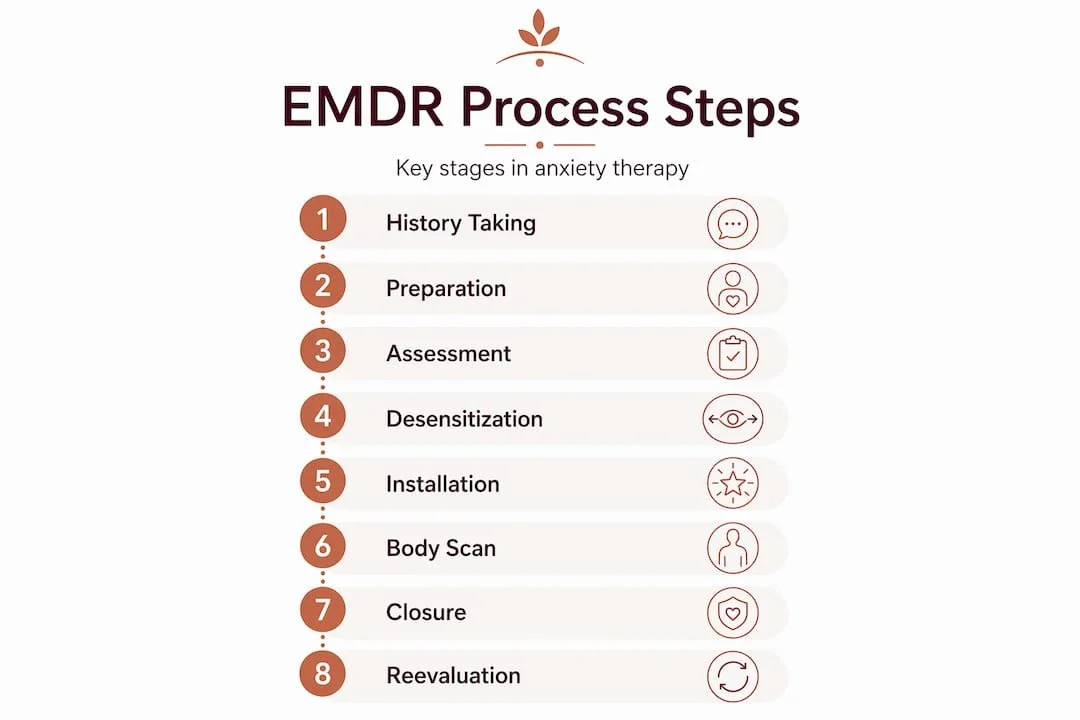
The therapy follows a structured 8-phase protocol that includes history-taking, preparation with coping resources, assessment using SUD and VOC scales, desensitization through bilateral stimulation, installation of positive beliefs, a body scan, closure, and reevaluation across sessions. Each phase has a specific purpose, and your therapist moves through them at a pace calibrated to your readiness.
The eight phases of EMDR therapy:
History taking — Your therapist gathers your background, identifies the memories or experiences driving your anxiety, and maps out a treatment plan.
Preparation — You learn grounding skills and coping tools to manage distress between and during sessions.
Assessment — The target memory is identified. You rate your distress using the SUD scale (0 to 10) and the strength of a negative belief using the VOC scale (1 to 7).
Desensitization — Bilateral stimulation begins. This is the core processing phase.
Installation — A positive belief replaces the old negative one, reinforced through additional bilateral stimulation.
Body scan — You check for any remaining physical tension linked to the memory.
Closure — The session ends with stabilization, whether or not processing is complete.
Reevaluation — The next session checks what has shifted and what still needs attention.
Bilateral stimulation is what makes EMDR visually distinct from other therapies. Your therapist guides your eyes back and forth, taps alternately on your hands or knees, or uses audio tones through headphones. Harvard Health explains that this bilateral input appears to mimic the brain activity that occurs during REM sleep, when memories are naturally consolidated and sorted. The result is that the distressing memory loses its emotional charge without disappearing from your autobiographical history.
One of the most common misconceptions about EMDR therapy for anxiety is that you will need to narrate your trauma in detail. You do not. You hold the memory in mind while bilateral stimulation does the work. Many clients find this significantly less overwhelming than exposure-based approaches.
Pro Tip: Before your first EMDR session, write down the three experiences or memories that feel most connected to your anxiety. You do not need to share them all at once. This simply helps you arrive with clarity about where your distress lives.
Sessions typically run 60 to 90 minutes. The preparation phases may take several sessions before active memory processing begins, particularly if you are working through complex or layered anxiety.
Scientific evidence and effectiveness of EMDR for anxiety treatment
The research base for EMDR therapy for anxiety has grown substantially over the past two decades. A 2026 meta-analysis of 40 randomized controlled trials found that EMDR is associated with significant symptom reductions in anxiety disorders, with a standardized mean difference of -1.10 compared to control conditions. That is a large effect size by clinical standards.
The same research indicates that EMDR shows maintained benefits at follow-up, but with smaller effects compared to active treatments like CBT, particularly for generalized anxiety. This is important context. EMDR is not a replacement for every therapeutic tool. It is especially powerful when anxiety has identifiable traumatic or experiential roots.
Here is how EMDR compares across key metrics for anxiety treatment:
| Factor | EMDR | CBT | Medication |
|---|---|---|---|
| Targets root memories | Yes | Partially | No |
| Requires detailed narration | No | Often | No |
| Speed of improvement | Faster for trauma-linked anxiety | Moderate | Variable |
| Long-term maintenance | Strong at follow-up | Strong | Depends on continued use |
| Best suited for | Trauma-linked anxiety | Generalized anxiety, OCD | Moderate to severe symptom relief |
The EMDR therapy benefits research supports its use across panic disorder, specific phobias, PTSD-related anxiety, and social anxiety. Generalized anxiety disorder (GAD) has fewer EMDR-specific trials, but evidence is growing. The therapy's effectiveness appears stronger when anxiety is tied to specific memories or events rather than diffuse, chronic worry with no identifiable origin.
"EMDR's utility is clearest when a patient can identify pivotal experiences linked to their anxiety. The more specific the memory target, the more direct the processing pathway."
What this means practically: if your anxiety spikes in specific situations, relationships, or environments, EMDR has a strong evidence basis for you. If your anxiety feels more like background noise with no clear trigger, EMDR may still help but will likely be combined with other approaches.
What to expect during EMDR therapy for anxiety: session structure and duration
Knowing what happens inside a session removes a significant barrier to starting. Many people delay seeking EMDR because they do not know what they are walking into. Here is a realistic picture.
A typical EMDR treatment course for anxiety looks like this:
Sessions 1 to 2 — History taking and treatment planning. Your therapist learns about your anxiety, its history, and its current impact on your life.
Sessions 2 to 3 — Preparation and stabilization. You build an internal toolkit: safe place imagery, grounding techniques, and distress tolerance skills.
Sessions 3 to 6 — Active processing begins. You target specific memories using bilateral stimulation. SUD scores drop as the memory loses intensity.
Sessions 6 onward — Installation of positive beliefs, body scans, and reevaluation. Progress is consolidated.
EMDR sessions for single-incident anxiety typically run 60 to 90 minutes, with meaningful improvement often occurring within 3 to 6 sessions. Complex anxiety tied to chronic stress, childhood experiences, or multiple traumatic events may require 8 to 12 sessions or more.
What clients often describe during processing: a sense of emotional distance from the memory, unexpected connections surfacing between past and present experiences, physical sensations releasing from the body, and a gradual quieting of the anxious thoughts that previously felt automatic.
Pro Tip: Emotional intensity often increases slightly during the first one or two processing sessions before it drops. This is normal and expected. It signals that the memory is being activated and reprocessed, not that the therapy is making things worse.
One feature of EMDR that distinguishes it from CBT-based approaches is the absence of assigned homework. You are not asked to practice exposures or complete thought records between sessions. Processing happens within the session, and the gains carry forward on their own. If you have felt overwhelmed by homework-heavy therapy in the past, this matters.
Review EMDR preparation tips before your first appointment to set yourself up for the most productive sessions from the start.

Finding qualified EMDR therapists and accessing treatment in California
California has a large and growing pool of trained EMDR therapists, but not all are equally qualified to handle anxiety rooted in trauma. Here is what to look for and how to navigate your search.
What to look for in a California EMDR therapist:
EMDRIA certification — The EMDR International Association offers a Certified Therapist credential that requires extensive supervised training hours beyond basic training.
State licensure — Your therapist should be licensed in California as an LMFT (Licensed Marriage and Family Therapist), LCSW (Licensed Clinical Social Worker), or psychologist.
Trauma-informed training — EMDR without a trauma-informed framework can miss the relational and developmental roots of anxiety, especially for complex presentations.
Telehealth availability — Many California-based therapists now offer online EMDR sessions statewide, which matters if you are in a rural area or prefer the privacy of home.
Free consultations — A 15-minute consultation call lets you assess fit, ask about experience with your specific anxiety concerns, and understand costs before committing.
On insurance: California EMDR therapists frequently operate on private pay or offer superbills for out-of-network insurance reimbursement. Many EMDRIA-certified therapists, including those in California, offer telehealth and superbills as standard practice. Check with your insurance provider about out-of-network mental health benefits before your first session.
The EMDRIA therapist directory is a strong starting point for finding verified providers. You can also consult choosing EMDR specialists tips to ask the right questions when you make that first call.
Why EMDR holds a unique place in anxiety treatment options
Here is something most anxiety treatment articles skip over: not all anxiety has the same roots, and treating them all with the same protocol is why so many people cycle through therapies without lasting relief.
CBT is excellent at restructuring thought patterns. Medication can reduce the physiological intensity of anxiety. But neither of those approaches goes back to the specific experiences that taught your nervous system to be afraid. EMDR does. And EMDR works as an adjunct to psychotherapy by helping people move past the pivotal negative events that disrupt daily life, even when those events do not technically qualify as trauma in the clinical sense.
This last point matters more than most people realize. You do not need to have survived a disaster, an assault, or a catastrophic loss for EMDR to apply to you. Chronic criticism, early rejection, humiliation, or powerlessness in relationships can all create the kind of stored memories that EMDR is built to address.
The other underappreciated factor is pacing. EMDR's effectiveness depends on bilateral stimulation inducing cortical changes while you hold the memory in focus, but patient preparation is essential, especially when memories are unclear or access to them is inconsistent. Rushing into processing before stabilization is achieved is where EMDR can feel overwhelming or ineffective. A skilled therapist will not push you through phases faster than your system can handle.
What we see consistently at Alvarado Therapy is that clients who have spent years managing anxiety through willpower, avoidance, or coping strategies finally experience something different with EMDR: not just relief, but a genuine shift in how they relate to their own history. Anxiety reduction with EMDR tends to be durable precisely because it addresses what generated the anxiety in the first place, not just the surface-level response. Read more about the EMDR therapy benefits that make this approach stand out.
Get started with expert EMDR therapy for anxiety in California
If you have been carrying anxiety that has not responded fully to talk therapy or medication, EMDR may be the approach that finally reaches the root of it.

At Alvarado Therapy, our licensed, EMDRIA-certified therapists provide trauma-informed care for adults across California, from Pasadena and Ventura to clients statewide via telehealth. We specialize in anxiety, PTSD, complex trauma, and the intersection of identity and healing. Whether you are new to therapy or returning after previous treatment that fell short, we start with understanding your specific experience. Learn what to expect from EMDR therapy before your first session, or schedule a free 15-minute consultation to discuss whether EMDR is the right fit. We also offer specialized trauma therapy programs for PTSD and complex trauma. Care in both English and Spanish is available.
Frequently asked questions
How many EMDR sessions does it typically take to see improvement in anxiety symptoms?
Most adults notice significant anxiety relief within 3 to 6 sessions for single-incident anxiety, while complex anxiety may require 8 to 12 or more sessions depending on the number and nature of the memories being processed.
Is EMDR therapy effective for all types of anxiety disorders?
EMDR has strong evidence for panic disorder, specific phobias, and trauma-linked anxiety. Research also shows it is efficacious for reducing anxiety, panic, and phobia symptoms across a range of presentations, with emerging support for generalized and social anxiety disorders.
Can I find EMDR therapists offering telehealth sessions in California?
Yes. Many EMDRIA-certified therapists in California offer telehealth, and telehealth and superbills are common practice among certified providers, making quality EMDR therapy accessible regardless of where you are in the state.
What makes EMDR different from traditional talk therapy for anxiety?
EMDR uses bilateral stimulation and a structured 8-phase protocol to reprocess distressing memories that fuel anxious thoughts and feelings, targeting anxiety at its root rather than managing symptoms through conversation alone.
Recommended
How to prepare for EMDR therapy in California — Alvarado Therapy
EMDR Therapy for Trauma: Steps, Effectiveness & Help in California — Alvarado Therapy
Step-by-step trauma healing: EMDR guide for Californians — Alvarado Therapy
Manage anxiety with EMDR therapy: a trauma-informed guide — Alvarado Therapy
