
EMDR for trauma: steps, effectiveness & finding help

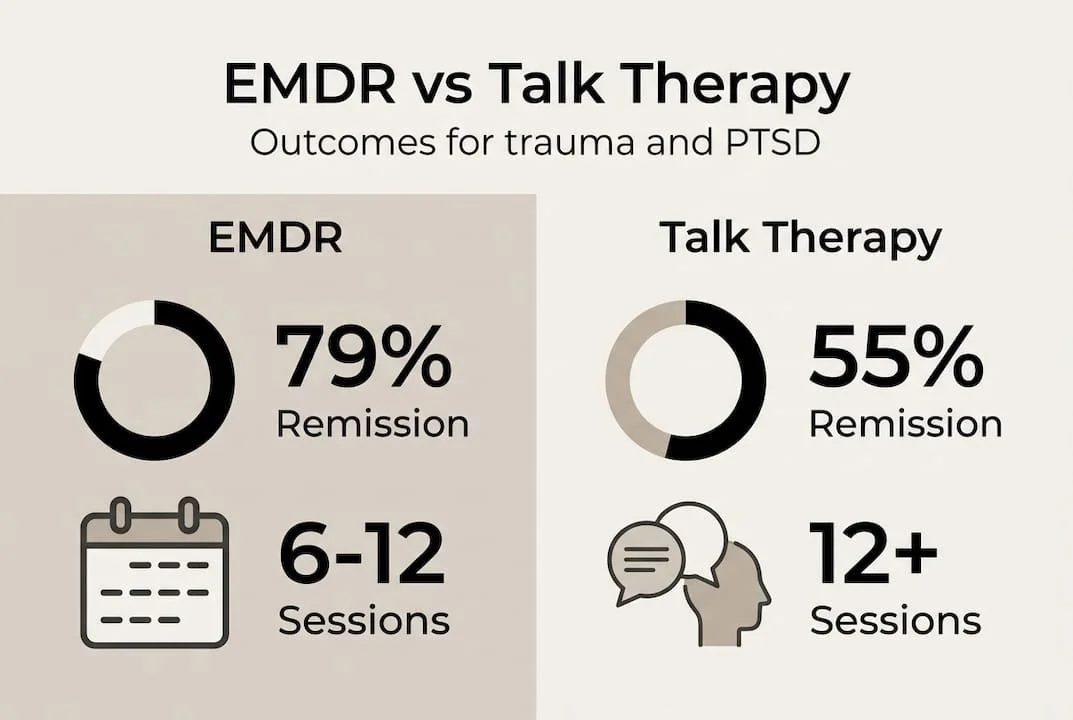
You've tried talking about it. You've journaled, you've pushed through, and still the memories surface at the worst moments. For many adults in California living with PTSD, childhood trauma, anxiety, or grief, traditional talk therapy can feel like circling the same painful territory without ever landing somewhere new. EMDR (Eye Movement Desensitization and Reprocessing) offers a different path. Research shows 79% PTSD remission in clinical studies, with many adults experiencing meaningful relief in just 6 to 12 sessions. This guide walks you through exactly how EMDR works, what the process looks like, and how to find a qualified therapist in California.
Table of Contents
Key Takeaways
| Point | Details |
|---|---|
| EMDR explained | EMDR is a research-proven therapy that uses guided eye movements to help your brain reprocess trauma for lasting relief. |
| 8-step process | EMDR follows an eight-phase structure so you always know what to expect in therapy sessions. |
| Strong effectiveness | Most adults feel better within 6-12 sessions, with high rates of recovery for PTSD, anxiety, and grief. |
| Find the right therapist | Choosing an EMDRIA-certified provider in California ensures safety and cultural fit as you begin your healing journey. |
What is EMDR and how does it work?
EMDR is not just another form of talk therapy. It was developed in the late 1980s by psychologist Francine Shapiro, who noticed that certain eye movements seemed to reduce the emotional charge of distressing thoughts. Since then, it has grown into one of the most rigorously studied trauma treatments available.
At its core, EMDR uses bilateral stimulation (eye movements, tapping, or auditory tones) to help the brain reprocess traumatic memories, mimicking the natural processing that happens during REM sleep. Think of it like a filing system that got jammed. Traumatic memories often get stored in a raw, unprocessed state, which is why a smell, a sound, or a look from a stranger can send you right back to a moment you thought you had moved past. EMDR helps the brain finally file those memories correctly, so they lose their grip on your daily life.
A real-world example: imagine someone who experienced a car accident years ago. They've talked about it in therapy, they know logically they are safe now, but their body still tenses every time they hear tires screech. EMDR targets that stuck response directly, not just the story around it.
For a deeper look at how sessions are structured, our step-by-step EMDR guide walks through the full process, and you can also explore EMDR interventions examples to see how techniques are applied in practice.
"EMDR does not require you to talk in detail about the distressing event. Instead, it focuses on changing the emotions, thoughts, and behaviors that result from the traumatic experience."
EMDR is endorsed for a wide range of mental health challenges, including:
Post-traumatic stress disorder (PTSD)
Complex PTSD
Childhood trauma and abuse
Anxiety and panic disorders
Grief and loss
Phobias
Depression linked to traumatic experiences
The 8-phase EMDR process explained
With a basic understanding in place, you might wonder what actually happens in an EMDR session from start to finish. EMDR follows a structured 8-phase protocol that guides both therapist and client through a careful, methodical process.
History taking — Your therapist gathers background information about your trauma history and identifies target memories to work on.
Preparation — You learn grounding and stabilization techniques so you feel safe before processing begins.
Assessment — The specific memory is identified, along with the negative belief attached to it (for example, "I am powerless") and a preferred positive belief.
Desensitization — Bilateral stimulation begins while you hold the memory in mind. Distress levels are tracked using a scale called the SUD (Subjective Units of Disturbance).
Installation — The positive belief is strengthened and linked to the memory.
Body scan — You check for any remaining physical tension or discomfort connected to the memory.
Closure — Each session ends with grounding exercises to ensure you leave feeling stable.
Reevaluation — At the start of the next session, your therapist checks progress and adjusts the plan.
Pro Tip: Many people feel intense emotions during early desensitization sessions. This is completely normal and actually signals that your brain is actively reprocessing. It does not mean something is going wrong.
To know what your first appointment will look like, visit our page on what to expect in EMDR, or read our guide on EMDR therapy preparation before your first session. If you are dealing with PTSD and complex trauma, the 8-phase model is specifically designed to handle layered, long-standing trauma safely.
| Feature | EMDR | Traditional talk therapy |
|---|---|---|
| Requires detailed verbal retelling | No | Often yes |
| Uses bilateral stimulation | Yes | No |
| Targets body-based trauma responses | Yes | Sometimes |
| Average sessions for PTSD relief | 6 to 12 | 20 or more |
| Endorsed by APA and WHO for PTSD | Yes | Varies by method |
How effective is EMDR for trauma?
Now that you know the process, it is natural to ask: does EMDR really work better than other options? The short answer is yes, especially for PTSD and trauma-linked conditions.
Major meta-analyses show that EMDR results in 79% PTSD remission and matches the outcomes of Trauma-Focused Cognitive Behavioral Therapy (TF-CBT) in head-to-head comparisons. The American Psychological Association, the World Health Organization, and the U.S. Department of Veterans Affairs all endorse EMDR as a first-line treatment for PTSD in adults.
Research also suggests that EMDR may work faster in the short term compared to exposure-based therapies, while producing equivalent long-term results. That matters when you have been carrying trauma for years and want relief sooner rather than later.
79% of adults with PTSD achieved remission in clinical studies of EMDR, with many reporting noticeable improvement by session 6.
For anxiety, grief, and complex trauma, the evidence is also strong, particularly when those conditions are rooted in unresolved traumatic experiences. Some researchers have raised questions about whether the eye movement component specifically drives results or whether the structured exposure element does the heavy lifting. Either way, the outcomes are consistent and clinically significant.
| Therapy type | PTSD remission rate | Average sessions | WHO endorsed |
|---|---|---|---|
| EMDR | Up to 79% | 6 to 12 | Yes |
| TF-CBT | Similar | 12 to 20 | Yes |
| Prolonged exposure | Similar | 8 to 15 | Yes |
| Standard talk therapy | Lower | 20 or more | No |
For more on what lasting recovery looks like, read about lasting change through EMDR and see EMDR examples from real clinical practice.
Choosing an EMDR therapist in California
With EMDR's proven track record, the next step is ensuring you find the right therapist for your unique needs. Not every therapist who mentions EMDR has completed formal training, so knowing what to look for protects you.
Start by verifying credentials. EMDRIA-certified therapists meet rigorous training and ethics standards set by the EMDR International Association. In California, your therapist should also hold a valid state license, such as LMFT (Licensed Marriage and Family Therapist), LCSW (Licensed Clinical Social Worker), or Psychologist. You can search the EMDRIA therapist directory to find certified providers near you or offering telehealth across California.
California's therapy community places a strong emphasis on cultural humility, and that matters in trauma work. Your therapist should understand how identity, immigration history, language, and community context shape your experience of trauma. The APA guideline recommends prioritizing providers who integrate somatic and mindfulness approaches alongside EMDR, which is especially common in California's holistic mental health landscape.
Pro Tip: Use the EMDRIA "Find a Therapist" tool and filter for therapists with experience in diverse California populations. Bilingual therapists or those with cultural specializations can make a significant difference in how safe and understood you feel during sessions.
Here are essential questions to ask before committing to a therapist:
Are you licensed in California, and what is your license type?
Have you completed formal EMDR training through an EMDRIA-approved program?
How many clients with my specific trauma history have you worked with?
Do you offer sessions in my preferred language?
How do you approach cultural identity and lived experience in your work?
Do you offer online sessions, and how do you adapt EMDR for telehealth?
In your initial consultation, you do not need to share everything right away. It is completely appropriate to raise questions about your identity, previous therapy experiences, or specific preferences before committing. You can meet our EMDR therapists at Alvarado Therapy to get a sense of our team's backgrounds and specializations, or find trauma-informed therapists across California using our curated resource. When you are ready to take the first step, prepare for EMDR with our practical guide so your first session feels less daunting.
Book a free EMDR consultation to ask questions and get a feel for the process before committing.
Take the next step toward trauma recovery
You now have a clear picture of what EMDR is, how it works, and what the research says. The hardest part is often just deciding to start. At Alvarado Therapy, we offer both in-person and online EMDR sessions for Californians living with PTSD, complex trauma, childhood trauma, anxiety, and grief. Our licensed, bilingual therapists bring cultural sensitivity and trauma-informed care to every session, whether you are in Pasadena, Ventura, or anywhere else in California.

If you are curious about what to expect with EMDR or want to learn more about our approach to help for PTSD and complex trauma, our website has detailed information to guide your decision. When you feel ready, book your EMDR consultation and take the first step toward feeling like yourself again. You do not have to keep carrying this alone.
Frequently asked questions
How quickly does EMDR work for PTSD or trauma?
Many adults notice meaningful improvements within 6 to 12 sessions, with up to 79% remission reported for PTSD in clinical studies. Some people feel a shift as early as session 6.
Can EMDR be done online in California?
Yes. Many California therapists offer secure telehealth EMDR sessions that follow the same 8-phase protocol and produce comparable outcomes to in-person care.
Is EMDR safe for childhood trauma or complex PTSD?
Research strongly supports EMDR for complex PTSD and childhood trauma, particularly when delivered by a trained therapist who paces the work carefully.
How do I find a certified EMDR therapist in California?
Start with the EMDRIA therapist directory and confirm the therapist holds a valid California license, completed formal EMDR training, and has experience with your specific type of trauma.
