
How cultural identity improves trauma therapy results in CA

When therapy ignores who you are, it often fails you. Identity affirmation lowers dropout rates by 20 to 30% in BIPOC therapy, and bilingual therapy improves PTSD symptom management by nearly 60% for Latinx clients. These numbers challenge the idea that a one-size-fits-all approach to mental health care is good enough. For adults in California navigating trauma while also carrying the weight of cultural identity, immigration stress, or language barriers, the type of therapy you receive matters enormously. This guide breaks down why cultural identity is central to trauma recovery and how to find care that truly fits.
Table of Contents
Key Takeaways
| Point | Details |
|---|---|
| Cultural adaptations improve outcomes | Therapy tailored to your cultural identity significantly boosts healing and lowers dropout risks. |
| Bilingual care accelerates recovery | Spanish-speaking and bilingual clients see up to 60% better PTSD symptom management with adapted therapy. |
| Expert frameworks guide adaptation | Models like MSJCC and cultural humility frameworks shape modern, inclusive trauma therapy. |
| Finding the right therapist is key | Seeking culturally responsive, bilingual, and trauma-informed practitioners leads to better long-term well-being. |
Why cultural identity matters in trauma therapy
Trauma does not exist in a vacuum. It lives inside a person's history, family, community, and sense of self. When a therapist understands that context, healing moves faster and feels safer. When they don't, clients often disengage or drop out entirely.
Cultural adaptations in therapy reduce dropout rates and enhance engagement, especially for BIPOC and Spanish-speaking adults. This is not a small effect. It reflects a fundamental truth: people heal better when they feel seen. For many Latinx clients, values like familismo (the deep importance of family loyalty) and personalismo (preference for warm, personal relationships) are not just cultural preferences. They are core to how trust is built and how healing happens.
PTSD symptom reduction is nearly 60% more successful with bilingual therapy for Latinx clients. That kind of outcome difference is hard to ignore. Therapy delivered in a client's primary language allows for more precise emotional expression, which is critical when processing trauma.
Here is what culturally responsive trauma therapy typically addresses:
Language access: Sessions in Spanish or with Spanglish flexibility
Cultural values: Incorporating familismo, respeto, and community-based healing
Immigration stress: Recognizing the trauma of displacement, documentation anxiety, and acculturation
Systemic racism: Naming and validating the impact of discrimination on mental health
Identity affirmation: Treating cultural background as a strength, not a barrier
"Healing is not just about reducing symptoms. It is about restoring a sense of self that trauma has fractured, and that self is always cultural." This is the foundation of identity-affirming therapy.
For anyone wondering how to start, finding culturally sensitive therapists in California is more accessible than it used to be, especially with telehealth options expanding statewide.
Core frameworks: Models and adaptations in culturally responsive care
Clinicians working in culturally responsive care rely on specific frameworks to guide their practice. Two of the most important are the Multicultural and Social Justice Counseling Competencies (MSJCC) and the concept of cultural humility.
Frameworks like the MSJCC guide culturally responsive practice through four steps: awareness of one's own biases, knowledge of diverse cultural experiences, development of cross-cultural skills, and action toward social justice. This is not just theory. It shapes how a therapist listens, responds, and adapts their approach in every session.
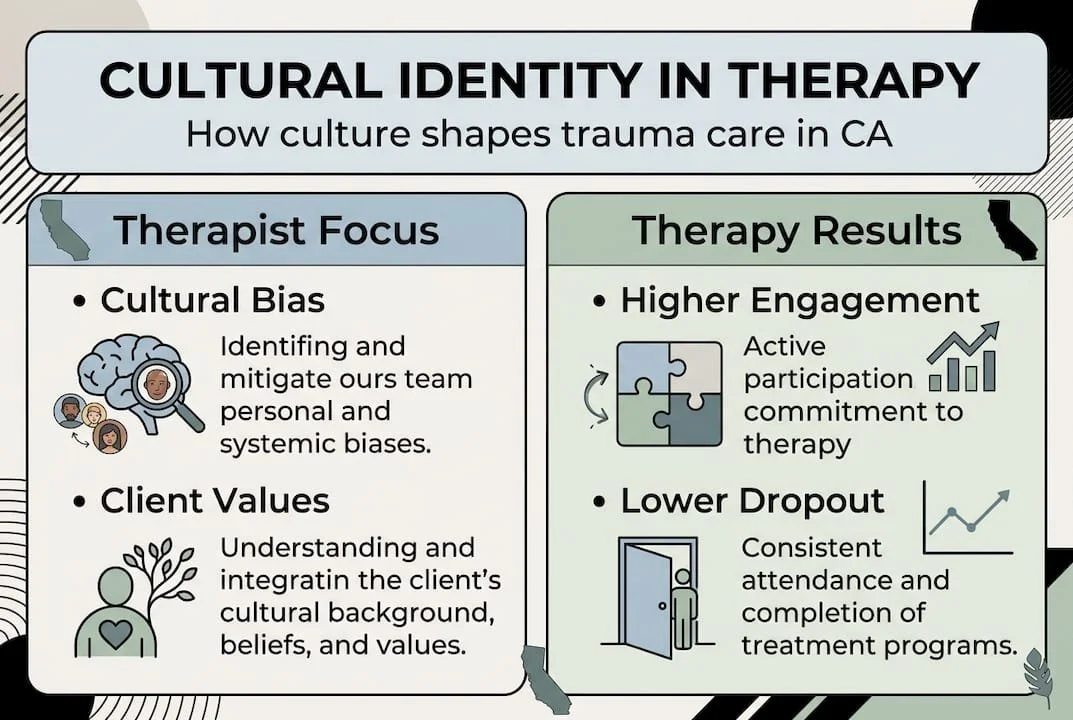
Cultural humility is equally important. It means the therapist does not position themselves as the expert on your identity. You are the expert on your own experience. The therapist's job is to follow your lead, ask curious questions, and avoid harmful assumptions.
Here is a comparison of standard therapy versus culturally adapted therapy:
| Feature | Standard therapy | Culturally adapted therapy |
|---|---|---|
| Language | English only | Bilingual or Spanglish |
| Cultural values | Not addressed | Integrated into treatment |
| Therapist background | Not considered | Bicultural match preferred |
| Immigration stress | Rarely explored | Directly addressed |
| Family involvement | Individual focus | Family-centered when appropriate |
Practical adaptations used in bilingual therapy approaches include:
Conducting sessions fully in Spanish when preferred
Allowing natural code-switching between English and Spanish
Using culturally relevant metaphors and storytelling
Incorporating family members into the healing process when appropriate
Addressing immigration-related trauma as a distinct clinical concern
Pro Tip: When interviewing a potential therapist, ask directly: "How do you incorporate my cultural background into our work?" A therapist practicing cultural humility will welcome this question and give a thoughtful, specific answer.
The role of bilingual therapist strategies goes beyond translation. It is about creating a space where your full self, language included, is welcome.
What the evidence says: Outcomes for culturally adapted vs. standard therapy
The research on culturally adapted therapy is growing, and the results are striking. Meta-analyses show culturally adapted interventions reduce PTSD (SMD of negative 0.67) and anxiety (SMD of negative 1.92) more than standard models, and identity-affirming care accelerates recovery by 25 to 30%.

A separate meta-analysis of adapted interventions found an effect size of d=0.50 for culturally adapted mental health services, with 60% better PTSD management reported in Spanish-language therapy. These are meaningful, real-world differences.
| Outcome measure | Standard therapy | Culturally adapted therapy |
|---|---|---|
| PTSD symptom reduction | Moderate | Up to 60% greater improvement |
| Anxiety reduction | Moderate | SMD of negative 1.92 |
| Therapy dropout rate | Higher | 20 to 30% lower |
| Recovery speed | Standard | 25 to 30% faster |
The outcomes of culturally responsive therapy are especially strong for Spanish-speaking adults and those from communities with high rates of historical trauma. However, it is important to be honest: some direct comparisons between adapted and standard trauma therapies show mixed results, and long-term outcome data remain limited.
"The evidence supports cultural adaptation as a meaningful enhancement to trauma care, not a replacement for evidence-based treatment, but a powerful complement to it."
For those exploring identity-affirming therapy in California, the bilingual therapy meta-analysis provides a strong evidence base for asking your provider about culturally adapted options.
Key challenges and nuances: What works, what's debated
The numbers are compelling, but there are still challenges and debates practitioners should recognize. Not every study shows a clear advantage for culturally adapted therapy over standard care.
Some trials show no significant PTSD reduction with culturally adapted Prolonged Exposure therapy compared to standard versions. The APA stresses that cultural humility and ongoing collaboration are essential, but they are not a guaranteed formula for better outcomes in every case.
What does seem to consistently help:
Ethnic pride as a buffer: Ethnic pride can reduce the link between discrimination and depression, making identity affirmation a protective factor
Spanglish flexibility: Allowing natural language mixing reduces cognitive load and emotional distance during sessions
Immigration-specific support: Addressing documentation anxiety, family separation, and acculturation stress as distinct trauma sources
Bicultural therapist availability: Matching clients with therapists who share cultural context improves trust and engagement
"Cultural adaptation is not a checklist. It is an ongoing, collaborative process between therapist and client."
Bilingual therapists in trauma recovery play a unique role in bridging these gaps. They bring lived cultural knowledge that no training alone can fully replicate.
Pro Tip: If you are working with a therapist who does not share your cultural background, ask them how they stay informed about your community's specific experiences. Ongoing education and supervision are signs of a committed, humble clinician.
The field of trauma-informed care continues to evolve, and more long-term research is needed. For Spanish-speaking adults in trauma recovery, the current evidence still strongly supports seeking culturally adapted care whenever possible.
How to access culturally responsive trauma therapy in California
Finding the right therapist can feel overwhelming, especially when you need someone who understands both trauma and your cultural world. Here is a practical path forward.
Telehealth and bilingual options have expanded significantly, but they require culturally informed, ongoing training to be truly effective. Not every online therapist who lists Spanish as a language is equipped to provide culturally responsive trauma care.
Steps to find the right fit:
Search specifically for therapists listing "bilingual," "culturally responsive," or "trauma-informed" in their profiles
Ask during a consultation whether they have experience with your specific cultural community
Inquire about their training in frameworks like MSJCC or cultural humility
Check whether they offer telehealth, which expands your options across California
Review APA trauma guidelines to understand what evidence-based trauma care should look like
Questions to ask a potential therapist:
Do you offer sessions in Spanish or with Spanglish flexibility?
How do you address immigration stress or acculturation in your work?
Have you worked with clients from my cultural background before?
How do you incorporate family or community values into therapy?
Pro Tip: Accessing online therapy in California means you are not limited to therapists in your city. A bilingual, trauma-informed therapist in Pasadena or Ventura can serve you from anywhere in the state.
Trust your instincts in the first session. If you feel unseen or misunderstood, it is okay to keep looking. The right therapeutic relationship is one where your full identity is welcomed from the start.
Take the next step: Trauma-informed support built for you
You deserve therapy that meets you where you are, in your language, with your values, and with full respect for your story. At Alvarado Therapy, we offer bilingual trauma care in English and Spanish, with a team trained in EMDR, identity-affirming approaches, and culturally responsive practice.
Whether you are navigating PTSD, complex trauma, grief, or the layered stress of immigration and acculturation, our licensed therapists are here to support you. We serve clients across Pasadena, Ventura, and throughout California via telehealth. You can learn what to expect in trauma therapy, explore our PTSD and complex trauma care options, or go ahead and schedule a consultation today. Healing that honors who you are is not just possible. It is what we do.
Frequently asked questions
What is cultural identity in the context of trauma therapy?
Cultural identity refers to a client's sense of belonging to specific cultural groups, which shapes their values, communication style, and healing needs. Cultural identity impacts therapy engagement and the pace of recovery in meaningful ways.
Are bilingual therapists more effective for Spanish-speaking adults?
Yes. Bilingual therapy improves PTSD symptom management by nearly 60% for Latinx clients, making language access one of the most impactful factors in trauma care.
What adaptations make trauma therapy culturally responsive?
Adaptations include language flexibility, use of Spanglish, integration of cultural values like familismo, and working with bicultural therapists in recovery who bring lived cultural knowledge.
Does culturally adapted therapy always work better than standard therapy?
Not always. Research shows strong short-term benefits, but some studies find no significant advantage over standard trauma therapy, and long-term outcome data are still limited.
How can I find a culturally responsive trauma therapist in California?
Look for therapists who advertise bilingual services, cultural humility, and trauma-informed care. Telehealth has expanded access to culturally responsive therapy statewide, so you are not limited to your immediate area.
Recommended
Why Cultural Competence in Therapy Leads to Better Outcomes — Alvarado Therapy
Identity-affirming therapy: 60% better PTSD relief in 2026 — Alvarado Therapy
Culturally Responsive Therapy: 30% Better Trauma Recovery — Alvarado Therapy
Trauma-informed care: 40% faster PTSD healing in 2026 — Alvarado Therapy
