
Why choose bilingual therapy? 2x more effective healing

Healing from trauma is hard enough without the added burden of searching for the right words in a second language. Research shows that native-language therapy doubles the effectiveness of trauma treatment for non-native English speakers, and that gap is not just about comfort. It is about how your brain stores pain, fear, and memory. For Spanish-speaking adults in California navigating childhood trauma, PTSD, or anxiety, choosing a bilingual therapist is not a preference. It is a clinical decision that can change the entire trajectory of your healing.
Table of Contents
Key Takeaways
PointDetailsLanguage unlocks healingProcessing trauma in your native language enables deeper emotional access and faster PTSD recovery.Culturally responsive care mattersTherapists who understand your culture support higher retention, trust, and faster progress.Evidence-based Spanish therapyCBT, EMDR, and other proven trauma treatments work as well or better in your native language.Avoid interpreter pitfallsDirect bilingual therapy preserves confidentiality and emotional nuance, while interpreters can impede healing.
Understanding bilingual therapy and its unique power
Bilingual therapy is not simply a translated version of standard therapy. It is a clinical approach where the therapist is fully fluent in both languages and can move fluidly between them based on what the client needs in any given moment. That flexibility matters more than most people realize.
Trauma memories are stored in the brain alongside the sensory and emotional context in which they occurred, including the language spoken at the time. When you try to process a childhood memory in English, but that memory was lived in Spanish, something gets lost. The emotional texture, the specific words your abuser used, the way fear felt in your body, all of it is encoded in Spanish. Processing trauma in your native language allows deeper emotional access and removes the translation barrier that can keep healing at arm's length.
Here is what sets a truly bilingual therapist apart:
They understand the emotional weight of Spanish idioms and cultural expressions
They can follow you when you switch between Spanish and English mid-sentence
They recognize when code-switching signals emotional avoidance or closeness
They do not require you to explain your cultural context from scratch
"Language is not just a tool for communication in therapy. It is the medium through which trauma was experienced and through which it must be healed."
The bilingual therapy benefits go far beyond convenience. They are rooted in neuroscience, attachment theory, and decades of clinical practice with Latinx communities.
Why language choice matters for trauma recovery
When trauma happens, the brain encodes the experience in a specific emotional and linguistic context. Trying to access that memory through a different language is like trying to open a lock with the wrong key. You might get close, but you will not fully open it.

Studies confirm this. Native-language therapy is twice as effective for non-native English speakers, enabling nuanced emotional expression, deeper trust, and genuine psychological safety. That is not a small difference. That is the difference between surface-level coping and real, lasting change.
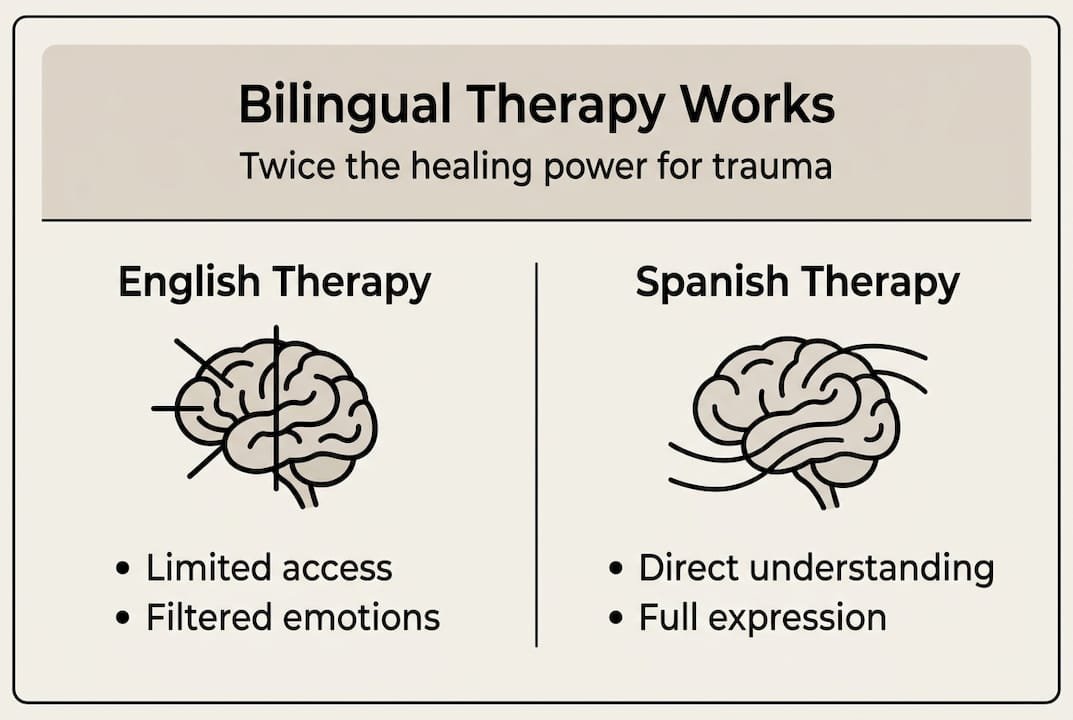
Here is a side-by-side look at how language choice shapes the therapy experience:
| Factor | Therapy in English | Therapy in Spanish |
|---|---|---|
| Emotional access | Limited, filtered | Direct and unfiltered |
| Trust-building speed | Slower | Faster |
| Trauma memory processing | Partial | Full and contextual |
| Cultural understanding | Often absent | Built into the session |
| Dropout risk | Higher | Significantly lower |
For Spanish-speaking adults pursuing trauma recovery in California, this data is not abstract. It reflects real experiences of people who spent years in therapy that never quite reached the wound.
Pro Tip: If you find yourself simplifying your emotions or avoiding certain topics because you cannot find the right English words, that is a sign you may benefit from working with a bilingual therapist.
Culturally responsive care: Beyond language
Language opens the door, but culture is what makes the room feel safe. For Latinx adults in California, therapy that ignores cultural context can feel foreign, even when it is conducted in Spanish.
Acculturation stress, the psychological strain of navigating between two cultures, is a real and often unaddressed source of trauma. Many Spanish-speaking Californians carry the weight of immigration experiences, family separation, discrimination, and the pressure to assimilate, all while managing the symptoms of PTSD or childhood trauma. A therapist who does not understand this context cannot fully support your healing.
Culturally responsive therapy addresses:
The role of familismo (family loyalty and obligation) in your emotional life
Shame and stigma around mental health in Latinx communities
Immigration-related trauma and legal stress
Intergenerational trauma passed down through family systems
The tension between cultural identity and assimilation pressure
"Culturally responsive therapy is not about making assumptions. It is about creating a space where your full identity, not just your symptoms, is seen and respected."
The numbers back this up. Latinx clients in Spanish-language therapy report nearly 60% better PTSD symptom management. Culturally responsive care also yields 30 to 40% higher retention rates and 25% faster symptom reduction compared to standard approaches. That means fewer sessions lost to misunderstanding and more progress toward actual healing.
For a deeper look at how cultural competence in therapy shapes outcomes, the research is clear: matching cultural context to clinical care is not optional. It is essential. And for those exploring trauma recovery for Spanish speakers, culturally attuned care is the foundation everything else is built on.
Evidence-based trauma treatments in Spanish: What works?
Some people worry that choosing therapy in Spanish means settling for less rigorous treatment. The opposite is true. Evidence-based approaches like Cognitive Behavioral Therapy (CBT), Eye Movement Desensitization and Reprocessing (EMDR), and Prolonged Exposure (PE) are all validated and highly effective when delivered in Spanish by trained bilingual clinicians.
Here is what the research shows:
Trauma-focused CBT in Spanish produces large effect sizes when delivered by culturally trained therapists, with strong engagement and low dropout rates.
EMDR in Spanish allows clients to access and reprocess traumatic memories in the language where they were stored, which is where the real work happens.
Prolonged Exposure in Spanish has been shown to significantly reduce PTSD symptoms when the therapist understands the cultural context of the trauma.
Culturally adapted treatments for Latinx clients, including language flexibility like Spanglish, lead to significant symptom reductions with effect sizes as high as d=1.37 on standard PTSD measures.
Spanish-speaking therapists who complete evidence-based training show CBT competence equivalent to or better than their monolingual counterparts. This means you do not have to choose between quality and language. You can have both.
If you are curious about what EMDR healing results look like in practice, or want to understand how culturally sensitive therapists reduce dropout by up to 45%, the evidence is compelling. And if you are ready to explore individual EMDR therapy, bilingual options are available throughout California.
Pitfalls of using interpreters versus direct bilingual therapy
When a therapist does not speak Spanish, some clinics offer interpreter services as a workaround. It sounds reasonable, but in trauma therapy, it creates serious problems.
Using an interpreter in a trauma session means:
A third person is present, which breaks the sense of confidentiality and safety
Emotional nuance gets lost in translation, sometimes critically so
The pace of the session slows, disrupting the flow of trauma processing
The interpreter may not have clinical training and can misread emotional cues
Clients often self-censor because they feel less private
Interpreters hinder trauma therapy by creating barriers to the direct emotional communication that healing requires. A bilingual therapist, by contrast, can catch the tremor in your voice when you switch languages, follow the meaning behind a culturally specific phrase, and respond in real time without a filter.
Pro Tip: When searching for a Spanish-speaking therapist, ask specifically whether they are trauma-trained and bilingual, not just conversationally fluent. Fluency in Spanish is not the same as clinical competence in trauma-informed bilingual care.
Common concerns: Myths and realities of bilingual therapy
If you have hesitated to seek bilingual therapy, you are not alone. There are real misconceptions that keep people from accessing the care they deserve. Let's address the most common ones.
"Therapy in Spanish is less professional or rigorous." False. The therapy effectiveness data shows the opposite. Native-language therapy produces better outcomes, not worse.
"Switching between Spanish and English will confuse my therapist." Not with a trained bilingual clinician. Code-switching is actually a clinical tool. It can signal when you are moving closer to or further from an emotional topic, and a skilled therapist uses that information.
"I should just push through in English to practice." Therapy is not a language class. Forcing yourself to process trauma in a second language adds cognitive load and emotional distance at exactly the moment you need clarity and closeness.
"My therapist needs to share my exact background to help me." Not exactly, but they do need cultural training and genuine curiosity about your experience. Identity-affirming therapy is built on that foundation.
"Therapy in your native language matches how trauma was encoded, supports symbolic integration, and fosters the empathy and congruence that person-centered healing requires."
The role of bilingual therapists is not just to translate words. It is to hold the full emotional and cultural weight of your story without asking you to shrink it into a second language.
Ready for trauma-focused bilingual therapy in California?
If this article has resonated with you, it may be time to take the next step toward care that truly fits who you are. At Alvarado Therapy, we offer trauma-informed, bilingual therapy in both English and Spanish, serving clients across Pasadena, Ventura, and online throughout California.
Our licensed therapists specialize in EMDR, childhood trauma, PTSD, and complex trauma, and they bring both clinical training and cultural understanding to every session. You can learn what to expect in trauma therapy before your first appointment, explore our dedicated PTSD and complex trauma therapy services, or simply book a consultation to talk with someone who gets it. Healing in your language, on your terms, is possible. We are here when you are ready.
Frequently asked questions
What is the biggest benefit of bilingual therapy for trauma?
Bilingual therapy lets you process emotions in the language where your trauma was stored, which means deeper access and more effective healing. Processing trauma in your native language removes the translation barrier that often keeps recovery shallow.
Does bilingual therapy really work better than therapy in English for Spanish-speaking clients?
Yes. Native-language therapy is twice as effective for non-native English speakers, particularly when treating trauma, PTSD, and anxiety. The difference shows up in engagement, retention, and symptom reduction.
Will my therapist understand cultural issues unique to Spanish-speaking Californians?
A trained, culturally responsive bilingual therapist understands acculturation stress, immigration-related trauma, and the cultural dynamics that shape your experience. Latinx clients in Spanish therapy report nearly 60% better PTSD symptom management as a result.
Do interpreters help if the therapist does not speak Spanish?
No. Interpreters hinder trauma therapy by breaking confidentiality, slowing communication, and filtering the emotional nuance that trauma processing depends on. Direct bilingual therapy is always the better option.
Is evidence-based trauma therapy like EMDR or CBT available in Spanish?
Yes. Culturally adapted trauma treatments delivered by trained Spanish-speaking therapists produce strong results, including significant PTSD symptom reductions with effect sizes as high as d=1.37.
Recommended
Bilingual therapy boosts trauma recovery in California — Alvarado Therapy
Why Cultural Competence in Therapy Leads to Better Outcomes — Alvarado Therapy
Culturally Responsive Therapy: 30% Better Trauma Recovery — Alvarado Therapy
EMDR Intensives for Trauma: 70% Faster Healing Results — Alvarado Therapy
