
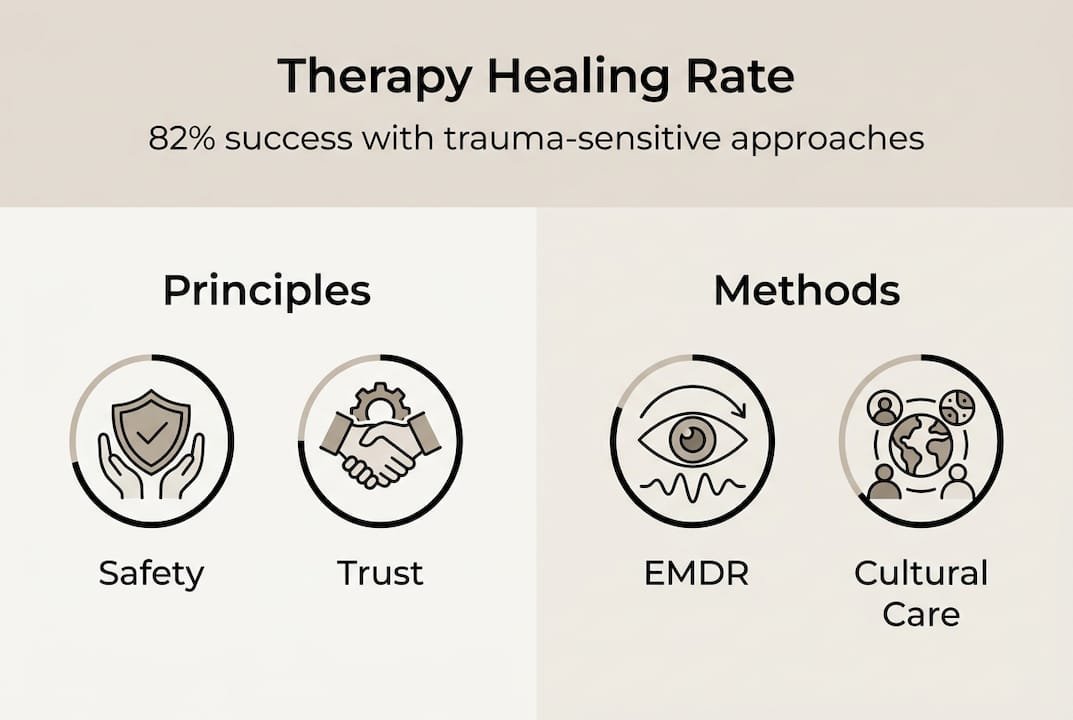
Why trauma-sensitive counseling matters: 82% healing rate

Many adults walk into their first therapy session bracing for judgment. They worry a counselor will reduce their pain to a diagnosis, miss the cultural weight behind their experiences, or push them to relive memories before they feel safe. Trauma-informed care recognizes the pervasive impact of trauma and reframes the entire therapeutic relationship around safety, not symptom management. This article breaks down what trauma-sensitive counseling actually is, why it works, and why approaches like EMDR are changing lives for diverse adults across California.
Table of Contents
Key Takeaways
| Point | Details |
|---|---|
| Shifts focus from blame | Trauma-sensitive counseling prioritizes understanding 'what happened' to you over 'what's wrong.' |
| Evidence-based healing | Approaches like EMDR and trauma-informed therapy reliably improve PTSD and anxiety. |
| Cultural identity affirmation matters | Tailored, culturally sensitive therapy yields deeper trust and better outcomes for diverse adults. |
| Limits and nuances exist | Not all trauma cases are alike—some need blended or adapted therapeutic models. |
| Help is accessible | Specialists in California offer trauma-sensitive, EMDR-based therapy for true healing. |
What is trauma-sensitive counseling and why does it matter?
Trauma-sensitive counseling, often called trauma-informed care, is a clinical framework that shifts the central question from "What is wrong with you?" to "What happened to you?" That single shift changes everything. It removes blame, reduces shame, and creates the psychological safety that healing actually requires.
Traditional therapy models were often built around symptom reduction without accounting for how trauma rewires the nervous system or how cultural identity shapes a person's experience of pain. A California adult who grew up navigating immigration stress, racial microaggressions, or family trauma may have spent years in therapy feeling fundamentally misunderstood. Trauma-sensitive counseling addresses that gap directly.
The benefits of trauma-informed therapy are well documented. Research shows that trauma-informed care reduces shame, prevents retraumatization, and improves measurable outcomes compared to conventional models. For adults healing from PTSD, anxiety, or complex trauma, this is not a minor upgrade. It is a fundamentally different kind of care.
Here is what trauma-sensitive therapy looks like in practice:
Safety first: Every session is structured to avoid triggering overwhelm before the client is ready.
Collaboration over authority: The therapist and client make decisions together, not top-down.
Strengths-based lens: The focus stays on resilience and capacity, not deficits.
Cultural awareness: The therapist actively accounts for identity, history, and community context.
"Trauma-sensitive care is not a specialty add-on. It is the baseline standard for ethical, effective mental health treatment for anyone who has experienced adversity."
The APA's trauma guidelines reinforce this, recommending trauma-focused approaches as the standard of care for adults with PTSD and related conditions.
Core principles: Building true safety and trust
The Substance Abuse and Mental Health Services Administration (SAMHSA) identified six core principles that define trauma-informed care. These are not abstract ideals. They are practical commitments that shape every interaction between a therapist and client.
SAMHSA's six principles are: Safety, Trustworthiness and Transparency, Peer Support, Collaboration and Mutuality, Empowerment Voice and Choice, and Cultural, Historical, and Gender Issues.
| Principle | What it means in practice | Why it matters for diverse Californians |
|---|---|---|
| Safety | Physical and emotional safety in every session | Reduces hypervigilance common in trauma survivors |
| Trustworthiness | Clear boundaries, honest communication | Builds trust for clients who have experienced systemic betrayal |
| Peer support | Community and shared experience valued | Reduces isolation for LGBTQ+ and immigrant clients |
| Collaboration | Shared power between therapist and client | Counters historical power imbalances for BIPOC clients |
| Empowerment | Client voice drives the process | Restores agency lost through trauma |
| Cultural issues | Race, gender, and history are centered | Makes therapy relevant and safe for marginalized identities |
When a counselor applies these principles during intake, the experience feels noticeably different. Here is what a culturally safe intake process might look like:
Ask about pronouns and preferred name before any clinical questions.
Explain confidentiality clearly in the client's preferred language.
Invite the client to set the pace rather than following a rigid intake script.
Ask about cultural or community context that shapes how the client understands their experience.
Normalize the option to pause or stop at any point without consequence.
Pro Tip: Even small gestures, like using a client's correct pronouns consistently or asking how their cultural background shapes their healing goals, can dramatically increase trust and engagement in therapy. These are not extras. They are the foundation of culturally responsive therapy.
How trauma-sensitive EMDR therapy works for healing trauma, PTSD, and anxiety
Eye Movement Desensitization and Reprocessing, known as EMDR, is one of the most rigorously studied trauma treatments available. It does not ask you to talk through every detail of what happened. Instead, it uses bilateral stimulation (alternating left-right sensory input through eye movements, taps, or tones) to help the brain reprocess traumatic memories so they lose their emotional charge.

Think of it this way: a traumatic memory that has not been fully processed stays "stuck" in the nervous system, triggering the same fear response years later. EMDR helps the brain file that memory correctly, so it becomes part of your history rather than a constant threat.
EMDR for PTSD has strong empirical backing. A Cochrane review found that EMDR reduces PTSD symptoms with robust effect sizes, outperforming many traditional talk therapy approaches for trauma. A 2024 study found 82.91% reliable improvement or recovery in blended care trauma therapy, with evidence-based practices averaging 11.82 sessions compared to 7.31 for enhanced individual protocols.
| Outcome measure | EMDR result | Comparison therapy |
|---|---|---|
| PTSD symptom reduction | Large effect size | Moderate (CBT) |
| Sessions to reliable improvement | 7 to 12 average | 12 to 20 (talk therapy) |
| Dropout rate | Lower | Higher in prolonged exposure |
| Suitable for complex trauma | Yes, with phased approach | Variable |
Why does EMDR for anxiety and trauma outperform many alternatives? A few key reasons:
It does not require detailed verbal retelling, which reduces retraumatization risk.
It works at the neurological level, not just the cognitive level.
It is adaptable for clients with dissociation, cultural trauma, or complex PTSD.
Sessions are structured but client-paced, preserving autonomy.
For adults from marginalized communities, who EMDR helps includes those carrying intergenerational trauma, immigration-related stress, and identity-based wounds that talk therapy alone often cannot reach. EMDR's non-verbal processing component makes it especially accessible for clients who struggle to put their trauma into words, whether due to language barriers, cultural norms around emotional expression, or the nature of the trauma itself.
Learn more about trauma therapy for adults and how structured approaches compare across different trauma presentations.
The impact of culturally sensitive, identity-affirming therapy in California
California is one of the most diverse states in the country, and that diversity shows up in the therapy room. BIPOC adults, LGBTQ+ individuals, immigrants, and those navigating multiple marginalized identities often carry layers of trauma that standard therapy models were never designed to address.
Identity-affirming therapy goes beyond cultural competence. It actively centers a client's racial, ethnic, gender, and community identity as strengths rather than complications. It names systemic oppression as a real source of harm, not a background detail.
"California EMDR providers increasingly emphasize culturally sensitive, identity-affirming approaches for adults healing from trauma, PTSD, and anxiety, recognizing that identity is not separate from healing. It is central to it."
Here is how a culturally responsive therapist actively integrates identity into trauma work:
Language access: Offering sessions in the client's primary language, including Spanish, removes a major barrier to authentic expression.
Naming cultural trauma: Acknowledging that racism, homophobia, and immigration stress are real traumatic stressors, not just personal sensitivities.
Avoiding cultural assumptions: Asking rather than assuming how a client's background shapes their values, family dynamics, and healing goals.
Representation: Working with a therapist who shares or deeply understands your community context builds faster, deeper trust.
For PTSD in LGBTQ+ adults, identity-affirming care is not optional. Research consistently shows that LGBTQ+ individuals experience higher rates of trauma and PTSD, and that therapy outcomes improve significantly when providers affirm rather than pathologize identity. The same holds true for BIPOC clients navigating racial trauma alongside personal trauma histories.
Finding LGBTQ+ and POC affirming therapists who specialize in EMDR and trauma is increasingly possible in California, and it makes a measurable difference in outcomes.
Nuances, limitations, and contrasting viewpoints
Trauma-sensitive counseling is powerful, but it is not a universal solution. Being honest about its limits is part of what makes this approach trustworthy.
One important area of debate involves military and veteran populations. Research on trauma-informed efficacy shows that effect sizes in military samples (around g=0.95) are less robust than in civilian trauma populations (g=1.41). This does not mean trauma-informed care fails veterans. It means the model may need stronger adaptation for military culture, institutional trauma, and moral injury.
Other situations that call for extra care include:
Severe dissociative disorders: Standard EMDR protocols may need significant modification before trauma processing begins.
Active psychosis or unstable mood disorders: Stabilization must come before trauma-focused work.
Highly politicized or institutional trauma: Clients navigating ongoing systemic harm (not just past events) need approaches that address present-day safety, not just memory reprocessing.
Overgeneralization risk: Applying a trauma lens to every presenting problem can sometimes pathologize normal stress responses.
A trauma therapy study also highlights that blended models combining trauma-informed principles with culturally adapted interventions often outperform single-modality approaches for complex presentations.
Pro Tip: Before starting therapy, ask your provider directly: "Have you worked with clients who share my background or identity?" and "How do you adapt your approach for complex trauma or comorbid conditions?" A skilled, trauma-sensitive clinician will welcome these questions, not deflect them.
Explore trauma-sensitive counseling and EMDR with a specialist
If this article has helped you see your healing journey differently, that clarity deserves a next step. Knowing what trauma-sensitive, identity-affirming care looks like is one thing. Experiencing it with a skilled clinician is where real change begins.
At Alvarado Therapy, our licensed therapists specialize in EMDR, complex trauma, and culturally responsive care for adults across Pasadena, Ventura, and throughout California via telehealth. We offer services in both English and Spanish, and we are committed to affirming every dimension of your identity in the healing process. Whether you are navigating PTSD, anxiety, grief, or the weight of intergenerational trauma, we meet you where you are. Explore PTSD and complex trauma care, learn what to expect in your first session, or book a consultation today to take the first step toward safety and clarity.
Frequently asked questions
How is trauma-sensitive counseling different from traditional counseling?
Trauma-sensitive counseling shifts the focus from "what is wrong with you" to "what happened to you," building safety and avoiding retraumatization at every stage. Traditional models often address symptoms without accounting for how trauma, culture, or identity shape a person's experience.
Will EMDR work for everyone with trauma or anxiety?
EMDR is highly effective for most adults with PTSD and anxiety, but complex comorbidities or certain military trauma presentations may require adapted or phased approaches. A skilled clinician will assess your needs before beginning trauma processing.
Why is culturally sensitive, identity-affirming therapy important for trauma recovery?
Identity-based wounds, including racial trauma, homophobia, and immigration stress, are real traumatic stressors. California EMDR providers who center cultural identity in their work consistently see stronger trust, engagement, and healing outcomes.
How do I know if a therapist is truly trauma-sensitive?
Ask whether they follow SAMHSA's six principles of trauma-informed care and whether they have direct experience working with your community. A genuinely trauma-sensitive therapist will answer those questions openly and specifically.
