
Manage anxiety with EMDR therapy: a trauma-informed guide

TL;DR:
Trauma-rooted anxiety involves the nervous system replaying unprocessed traumatic memories.
EMDR therapy uses bilateral stimulation to reprocess and resolve trauma-related anxiety.
Preparing properly and choosing a qualified trauma-informed therapist enhances EMDR's effectiveness.
Anxiety that doesn't respond to breathing exercises or positive thinking often has a deeper root. For many Californians, that root is unresolved trauma, and standard approaches simply don't reach it. EMDR therapy, which stands for Eye Movement Desensitization and Reprocessing, was designed specifically to address that gap. This guide walks you through the trauma-anxiety connection, how to prepare for EMDR, what each phase of treatment actually looks like, and how to measure your own progress. If you've tried managing anxiety before without lasting results, this is where to start.
Table of Contents
Key Takeaways
| Point | Details |
|---|---|
| Address anxiety at the root | Trauma-informed EMDR therapy offers targeted relief for anxiety stemming from unresolved experiences. |
| Qualified EMDR therapists matter | Choose an EMDRIA-certified, trauma-informed professional in California for safe, effective care. |
| Track real progress | Monitoring your SUD and VOC scores helps you and your therapist measure healing and growth. |
| Preparation boosts results | Build coping skills and resourcing before EMDR to get the most from every session. |
Understand the trauma-anxiety connection
Anxiety isn't always just stress. Sometimes it's your nervous system replaying a threat that never got fully processed. Traumatic experiences, whether a car accident, childhood neglect, a difficult immigration experience, or prolonged emotional abuse, can leave the brain in a state of chronic alert. That's not a character flaw. It's biology.
Standard anxiety treatments often focus on symptoms: slowing your breathing, challenging negative thoughts, reducing avoidance. These tools have real value, but they work on the surface. If trauma is a root cause of your persistent anxiety, symptom-focused approaches may offer temporary relief without lasting change. That's why trauma-informed care exists.
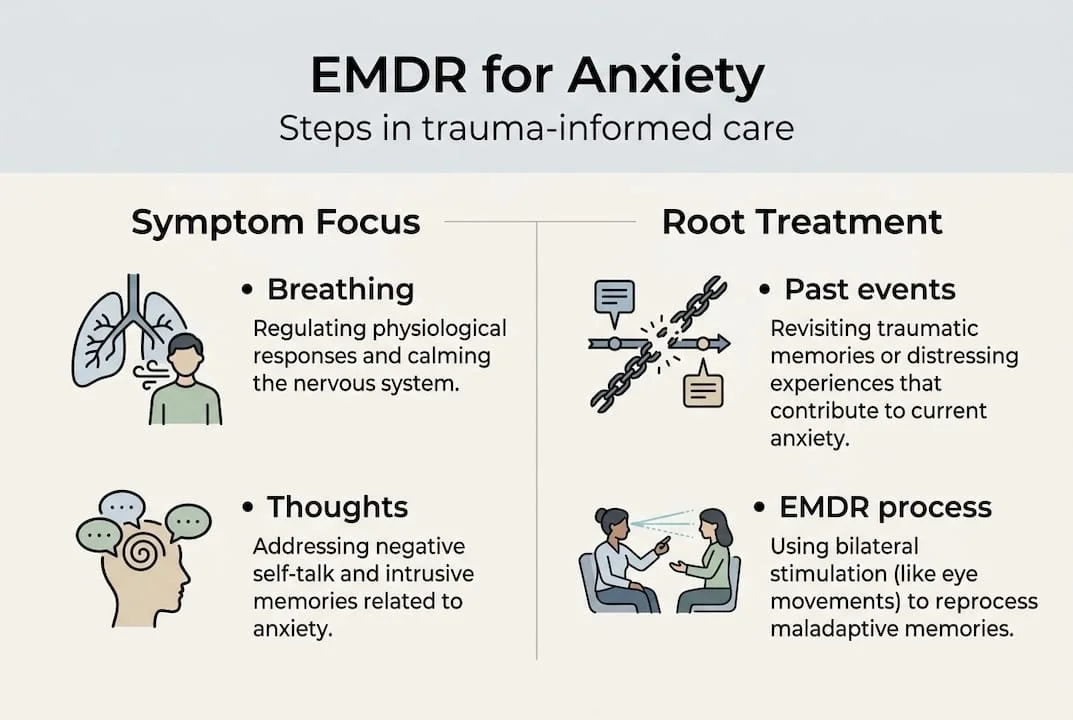
A trauma-informed therapist doesn't just treat what you're feeling right now. They understand how past experiences shape your current nervous system responses, and they create a safe, paced environment where healing is actually possible. This matters because pushing too hard, too fast can retraumatize rather than heal.
EMDR fits into this landscape as one of the most evidence-backed options available. Developed by Francine Shapiro in 1987, EMDR is an 8-phase structured psychotherapy that uses bilateral stimulation, typically eye movements or tapping, to help the brain reprocess traumatic memories. Unlike traditional talk therapy, EMDR doesn't require you to narrate your trauma in detail. The APA trauma guidelines recognize it as a first-line treatment for PTSD and trauma-related conditions.
You might recognize trauma-rooted anxiety by these signs:
Anxiety that seems disproportionate to current circumstances
Triggers that feel physical: racing heart, frozen feeling, sudden dread
Anxiety that started after a specific difficult period or event
Persistent negative beliefs like "I'm not safe" or "I'm not good enough"
Anxiety that hasn't improved with general therapy or medication alone
"Healing doesn't mean the damage never existed. It means the damage no longer controls your life." This is the shift EMDR is designed to create.
If several of those signs feel familiar, the complete guide to EMDR can help you understand whether this approach fits your situation.
Prepare for trauma-informed EMDR therapy
Now that you understand what drives anxiety, you're ready to take the first steps toward effective trauma-focused care. Preparation isn't just logistics. It's part of the healing itself.

Choosing the right therapist is the single most important step. In California, look for therapists who are EMDRIA-certified and hold a license as an LMFT, LCSW, or psychologist. EMDRIA therapist standards require specific training hours and supervised practice before certification is granted. Telehealth is widely available in California, which means geography doesn't have to be a barrier.
What to look for in a qualified EMDR therapist:
| Criteria | What it means for you |
|---|---|
| EMDRIA certification | Trained and supervised in the full 8-phase protocol |
| State license (LMFT/LCSW/Psych) | Legally authorized to provide therapy in California |
| Trauma-informed framework | Prioritizes safety, pacing, and your autonomy |
| Telehealth availability | Accessible across California without commuting |
| Bilingual or culturally responsive | Especially important for Spanish-speaking clients |
Once you've identified potential therapists, here's how to prepare for EMDR therapy before your first session:
Write down your goals. What do you want to feel differently? What situations trigger your anxiety most?
Build a basic support system. Identify one or two trusted people you can reach after a difficult session.
Learn a grounding technique. Simple tools like box breathing or the 5-4-3-2-1 sensory method help you stay regulated between sessions.
Prepare questions for your initial consult. Ask about the therapist's experience with your specific concerns, their pacing approach, and what the first few sessions will look like.
Check your schedule. EMDR can bring up emotions that need processing time. Avoid scheduling sessions right before high-stakes commitments.
For help finding a therapist in California who meets these criteria, online directories and trauma-focused practices make the search more manageable. You can also browse trauma-informed EMDR providers to compare options across the state.
Pro Tip: During your initial consult, ask the therapist how they handle emotional flooding during sessions. Their answer will tell you a lot about their trauma-informed approach and whether you'll feel safe with them.
Step-by-step EMDR process for anxiety
With the groundwork laid, here's how EMDR works to help turn anxiety into an opportunity for growth. The process is structured, but it's also deeply personal.
The APA's 8-phase EMDR model includes: history-taking, preparation, assessment, desensitization, installation of positive beliefs, body scan, closure, and reevaluation. Here's what each phase means for someone managing anxiety:
History-taking. Your therapist learns about your background, current symptoms, and identifies target memories or experiences connected to your anxiety.
Preparation. You build coping skills and stabilization tools before any reprocessing begins. This phase can take multiple sessions for complex trauma.
Assessment. You identify a specific target memory, the negative belief connected to it ("I am powerless"), and a preferred positive belief ("I have choices now").
Desensitization. Using bilateral stimulation, your therapist guides you through the memory while your brain begins to reprocess it. SUD (Subjective Units of Distress, rated 0 to 10) is tracked here.
Installation. The positive belief is strengthened. VOC (Validity of Cognition, rated 1 to 7) measures how true the new belief feels.
Body scan. You check for any remaining physical tension connected to the memory.
Closure. Every session ends with stabilization, even if processing isn't complete.
Reevaluation. The next session checks whether gains held and what to target next.
EMDR vs. traditional talk therapy:
| Feature | EMDR | Traditional talk therapy |
|---|---|---|
| Requires detailed verbal narrative | No | Often yes |
| Uses bilateral stimulation | Yes | No |
| Structured phases | Yes | Varies |
| Targets memory reprocessing | Yes | Rarely directly |
| Typical session count for anxiety | 6 to 12 | Varies widely |
For those with more intensive needs, EMDR intensive therapy condenses the process into longer sessions over fewer days, which can accelerate progress significantly.
Pro Tip: Track your SUD score at the start and end of each session in a simple notebook. Seeing the number drop over time is one of the most motivating parts of the process.
Troubleshooting: Common challenges and how to overcome them
Even when following the steps, it's common to hit bumps in the road. Here's how to prepare and respond.
One of the most common experiences in EMDR is blocked processing, where the memory doesn't seem to shift during desensitization. This isn't failure. It's information. Your therapist can use cognitive interweaves, which are gentle prompts or questions, to help the brain find a new path through the material.
Another challenge is emotional flooding: suddenly feeling overwhelmed by emotion during or after a session. This happens when processing moves faster than the nervous system can integrate. Research on hyperarousal in EMDR confirms that resourcing techniques, like safe-place visualization or grounding exercises, are essential tools for managing this. A well-trained therapist will slow the pace rather than push through.
Common challenges and what to do:
Difficulty accessing memories: Try focusing on the body sensation or emotion rather than the visual memory itself.
Session avoidance: Name it with your therapist. Avoidance is often part of the trauma pattern, not a sign you're not ready.
Feeling worse after a session: Temporary increases in distress are normal during active reprocessing. Use your grounding tools and contact your therapist if it persists.
Feeling numb or disconnected: Hypoarousal (shutting down) is as common as flooding. Therapists can use movement or sensory tools to bring you back into your window of tolerance.
"The goal isn't to feel nothing. It's to feel without being overwhelmed." This distinction is what good trauma-informed EMDR therapy holds space for.
It's also worth knowing that EMDR is not appropriate for everyone. People experiencing active psychosis or severe instability may need stabilization support first. Your therapist will screen for this before beginning reprocessing. If you're considering a more concentrated format, EMDR intensive sessions can be a powerful option once you've built a solid foundation of coping skills.
Tracking progress and measuring results
With common challenges addressed, let's explore how to know if EMDR is truly working for you.
The two main tools are SUD and VOC scores. SUD (Subjective Units of Distress) measures how distressing a memory feels on a scale of 0 to 10. VOC (Validity of Cognition) measures how true your positive belief feels on a scale of 1 to 7. A successful reprocessing session moves SUD toward 0 or 1 and VOC toward 7. These aren't just numbers. They give you and your therapist concrete data about what's shifting.
What does a typical progress curve look like? Most people experience:
Sessions 1 to 3: Stabilization, skill-building, and history-taking. Anxiety may feel similar.
Sessions 4 to 6: Active reprocessing begins. Some clients feel temporarily more activated.
Sessions 6 to 12: Noticeable reduction in anxiety intensity and frequency.
Beyond session 12: Integration, generalization of gains, and stepping down in frequency.
The research behind these timelines is strong. Cochrane meta-analysis data shows 79% PTSD remission with EMDR, and 80 to 90% improvement for single-trauma cases in as few as 6 sessions. These are meaningful numbers for anyone who has felt stuck for years.
For integrating progress into daily life:
Notice your triggers differently. After reprocessing, triggers often lose their charge. Pay attention when something that used to spike your anxiety no longer does.
Reinforce positive beliefs. When your VOC for "I am safe now" reaches a 6 or 7, practice acting from that belief in low-stakes situations.
Track sleep and body tension. These often improve before you consciously notice anxiety reduction.
For more on what the EMDR anxiety statistics look like in real-world practice, the data is consistently encouraging.
A trauma-informed perspective: Sustainable healing beyond quick fixes
Here's something most anxiety content won't tell you: the preparation phases of EMDR are just as important as the reprocessing phases. Maybe more so.
We've worked with clients who came in wanting to jump straight to reprocessing their trauma. They'd read about EMDR, they were motivated, and they wanted results fast. But rushing past stabilization, especially with complex or childhood trauma, can destabilize rather than heal. The APA's updated guidelines explicitly emphasize patient preferences, pacing, and addressing barriers before diving into trauma processing.
Real transformation in anxiety isn't just about lowering your SUD score. It's about developing a fundamentally different relationship with your own nervous system. Clients who do the stabilization work first tend to move through reprocessing faster and hold their gains longer. That's not a coincidence.
The trauma-informed clinicians who get the best outcomes are the ones who treat the therapeutic relationship itself as part of the medicine. Healing happens in connection, at your pace, with someone who genuinely understands the weight of what you're carrying.
Next steps: Trauma-informed EMDR support in California
If this guide has helped you see your anxiety in a new light, the next step is finding the right support to move forward.

At Alvarado Therapy, our licensed, trauma-informed therapists specialize in EMDR for anxiety, PTSD, and complex trauma. We serve clients across Pasadena, Ventura, and throughout California via telehealth, in both English and Spanish. You can learn more about what EMDR therapy looks like before your first session, explore our support for PTSD and complex trauma, or take the simplest step and book a consultation today. You don't have to figure this out alone.
Frequently asked questions
How long does it take to see results with EMDR for anxiety?
Most people notice meaningful relief within 6 to 12 EMDR sessions, particularly for trauma-rooted anxiety. Single-trauma cases show 80 to 90% improvement in as few as 6 sessions.
Is EMDR therapy safe for everyone with anxiety?
EMDR is safe for most people, but those with unstable psychosis or active crisis may need stabilization first. A trauma-informed screening with a qualified therapist determines readiness before reprocessing begins.
What makes a therapist trauma-informed and qualified for EMDR in California?
Look for EMDRIA-certified therapists who hold a California license as an LMFT, LCSW, or psychologist, with specific trauma-focused training. Many offer telehealth services statewide.
How do I know if my anxiety is trauma-rooted?
If your anxiety began after a distressing period or hasn't improved with general approaches, trauma may be the cause. A trauma-informed therapist can help you assess this in an initial consultation.
