

An emotional flashback is a sudden return to an old emotional state, usually shame, terror, or helplessness, without any picture-memory attached to it. It hijacks your body and mood as if the past were happening right now, even though you can't point to what triggered it. If you're in one right now, here's what to do:
Name it. Say to yourself, silently or out loud, "This is an emotional flashback. I am not in danger right now."
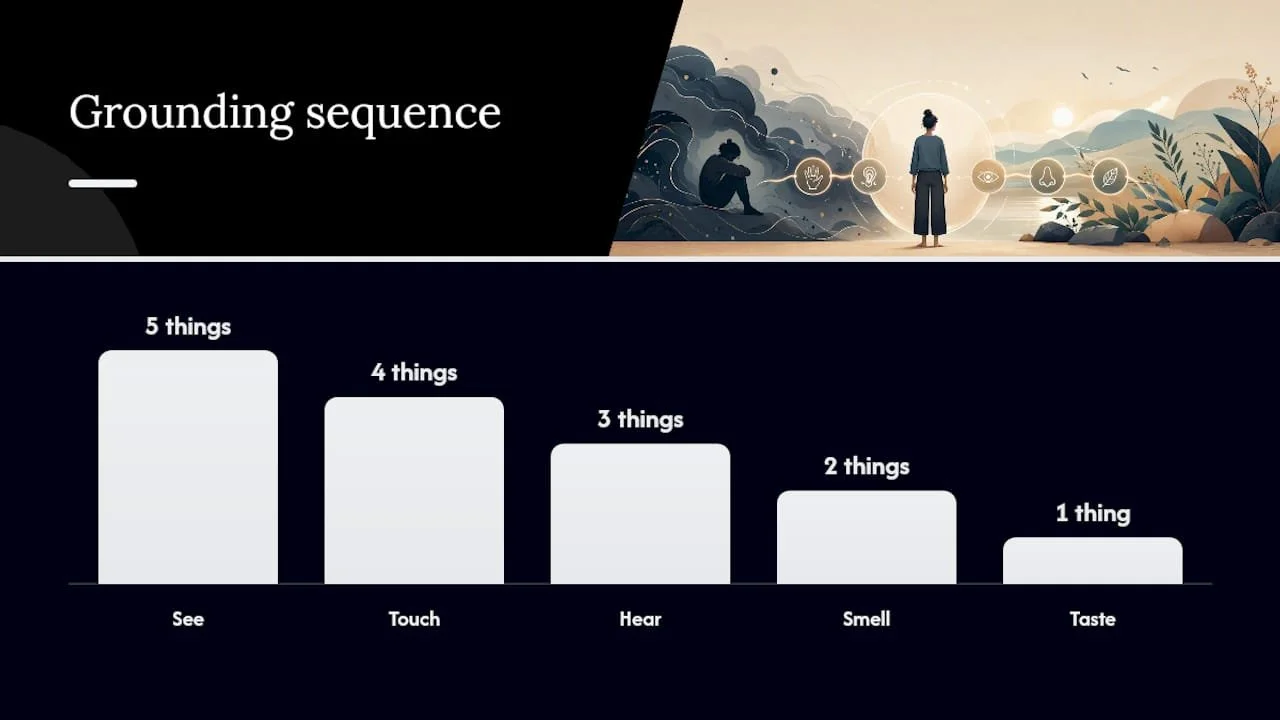
Ground your senses. Look around and name 5 things you see, 4 you can touch, 3 you hear, 2 you smell, 1 you taste.
Slow your breath. Inhale for 4 counts, hold for 4, exhale for 6. Repeat until your shoulders drop.
Get cold water on your skin. Splash your face or hold an ice cube; it interrupts the body's panic signal fast.
These episodes are common among people with complex PTSD (CPTSD) rooted in childhood trauma, and they respond well to the right combination of grounding skills and trauma-focused therapy. They pass. What you do in the first sixty seconds determines how long they last.
Key Takeaways
Emotional flashbacks are treatable childhood-trauma responses that shrink in frequency and intensity once you pair in-the-moment grounding with trauma-focused therapy like EMDR.
| Point | Details |
|---|---|
| No image, still real | Emotional flashbacks bring old feelings and body sensations without a visual memory attached. |
| Name it fast | Saying "this is a flashback" out loud activates dual awareness and shortens the episode. |
| Grounding works | 5–4–3–2–1, paced breathing, cold water, and bilateral tapping calm the nervous system quickly. |
| Walker's steps help | Pete Walker's 13-step protocol gives a repeatable sequence for both crisis moments and daily practice. |
| Therapy changes frequency | EMDR, IFS, somatic therapy, and trauma-focused CBT target the root pattern, not just the symptom. |
Table of Contents
What Are Emotional Flashbacks, and How Are They Different?
An emotional flashback pulls you back into a childhood feeling state, usually fear, shame, or abandonment, without the visual memory that goes with a classic PTSD flashback. You don't see the scene. You just suddenly feel six years old, worthless, or trapped, often with no clear reason why. That absence of a narrative image is exactly what confuses people, and why so many go years misdiagnosed with mood disorders or generalized anxiety before anyone names what's actually happening.
The mechanism behind this involves how trauma gets stored in memory. Sensory-rich, involuntary intrusions with a strong sense of "nowness" behave differently from ordinary memories; they can range from a brief jolt of unreality to a full loss of contact with the present moment, according to research on traumatic memory. Clinical explainers describe emotional flashbacks as relying on nonhippocampal, prereflective "hotspots" of memory rather than organized narrative recall, which is why the body reacts before the mind has any story to explain it. Your amygdala fires the alarm; the part of your brain responsible for context and time (the prefrontal cortex) lags behind, so you're left with intense feeling and no obvious cause.
This is a hallmark symptom of CPTSD, a condition that develops from prolonged childhood trauma, neglect, or an unsafe attachment environment rather than a single traumatic event. It's worth separating emotional flashbacks from two things people often confuse them with:
Emotional flashback vs. classic PTSD flashback: A classic flashback comes with vivid sensory images or scenes (you see, hear, or smell the traumatic event). An emotional flashback comes with pure feeling and body sensation, no scene.
Emotional flashback vs. panic attack: Panic attacks tend to have an identifiable trigger and a physical symptom (a racing heart, chest tightness) but keep the person aware they're panicking. An emotional flashback often carries a distorted sense of age, shame, or smallness alongside the physical arousal.
Emotional flashback vs. mood episode: A depressive dip builds gradually. An emotional flashback tends to switch on abruptly, often within seconds, then fade over minutes to hours once regulated.
Signs and Symptoms of an Emotional Flashback
Emotional flashbacks show up across four domains, and recognizing them early is what shortens the episode.
Emotional: a wave of toxic shame, sudden despair, or a feeling of being fundamentally unlovable that seems disproportionate to what just happened.
Bodily: racing heart, nausea, a collapsed posture, or a strange heaviness that makes you want to curl up or disappear.
Cognitive: the unmistakable sense of being very young again, sometimes described as "nowness," where the present moment feels indistinguishable from a childhood memory.
Behavioral: shutting down mid-conversation, withdrawing from people who love you, or overreacting to a minor comment as though it were a threat.
A common vignette: your partner sighs during a disagreement, and within seconds you're flooded with the exact dread you felt as a kid when a parent went cold and silent. Or a manager gives mild feedback in a meeting, and you spend the rest of the day convinced you're about to be fired and that you're fundamentally incompetent.
These episodes look different depending on the underlying diagnosis. In CPTSD, emotional flashbacks usually track back to attachment wounds and tend to include intense shame and self-blame. In borderline personality disorder, similar surges of emotion happen but are often shorter, tied more directly to fear of abandonment in the moment, and paired with more impulsive urges. Dissociation, that foggy, detached "not quite here" sensation, can ride alongside either, and its presence usually means grounding needs to happen before anything else.

What Triggers Emotional Flashbacks?
Triggers rarely look dramatic from the outside. Something ordinary lands on an old wound, and your nervous system reacts to the memory, not the moment. Grouping triggers by category makes them easier to catch before they take hold.
Relational: criticism, a raised eyebrow, silence after conflict, or any hint of rejection or abandonment.
Sensory: a particular smell, a specific tone of voice, unexpected touch, or even certain lighting that resembles a childhood environment.
Situational: being ignored in a group, being put on the spot, or any moment of high-stakes vulnerability, like asking for help or admitting a mistake.
Internal: hunger, exhaustion, illness, or intrusive thoughts that lower your baseline resilience before anything external even happens.
Sometimes the match is subtle almost to the point of being invisible. A partner's clipped tone during a busy morning can land exactly like a caregiver's voice before a blowup decades ago, even though the partner has no idea anything happened. Common triggers also include success or visibility that once brought punishment rather than praise, which is why some people flinch at compliments or sabotage good news.
Start tracking your own patterns with a few quick prompts: What was happening right before I felt the shift? Who was in the room, or what did I just remember? What does this feeling remind me of from childhood? For a deeper look at how relational cues shape these reactions, Mastering Conflict's primer on emotional triggers breaks down the mechanics well.
Pro Tip: Keep a running note on your phone titled "Flashback Log." Even three words jotted down in the moment, "sighed, felt 8," build a pattern you can bring straight into therapy.
How to Cope With Flashbacks in the Moment
The goal in the first few minutes isn't to understand the flashback. It's to bring your nervous system back into the present so your thinking brain comes back online.
Say the anchor phrase out loud or in your head: "This is a flashback. It will pass. I am an adult, and I am safe right now."
Run the 5-4-3-2-1 grounding sequence: 5 things you see, 4 you can touch, 3 you hear, 2 you smell, 1 you can taste.
Slow your breathing: inhale 4 counts, hold 4, exhale 6, for at least six full cycles.
Add a sensory anchor: cold water on your wrists or face, or squeeze something with texture, a stress ball, a cold water bottle, a rough stone.
Reorient in space: state your actual age, the date, and your physical location out loud. "I am 34. It is 2026. I am in my kitchen."
A few more tools worth having on hand:
Self-soothing scripts: short, spoken phrases like "I've got you" or "You're not in trouble" can be surprisingly effective when said in your own voice, almost like talking to the younger part of yourself that's flooding.
Cold water and texture: these work because they interrupt the sympathetic nervous system's alarm response fast, giving your prefrontal cortex a chance to catch up.
Bilateral tapping: alternating taps on your left and right knees, shoulders, or arms (sometimes called butterfly tapping) mimics the bilateral stimulation used in EMDR therapy and can help regulate the nervous system even outside a clinical session.
According to Charlie Health's overview of emotional flashbacks, grounding techniques like 5-4-3-2-1, paced breathing, cold-water stimulation, and bilateral tapping work by engaging the parasympathetic system or giving the brain a concrete sensory anchor, both of which reduce the intensity of the fight-or-flight surge. Mindfulness-based breathing patterns can be practiced ahead of time so they're automatic when you need them; Mindpanda's grounding exercises for anxiety offer a few simple ones worth rehearsing on a calm day.
When grounding isn't enough: if you're experiencing severe dissociation (losing time, feeling completely detached from your body, not knowing where you are) or any thoughts of self-harm or suicide, grounding alone is not a substitute for immediate help. Call or text 988 (the Suicide & Crisis Lifeline) right away, or go to your nearest emergency room.
Pro Tip: Practice the 5-4-3-2-1 sequence when you're calm, not just during a flashback. Rehearsed skills fire faster under stress than skills you're learning for the first time mid-crisis.
Pete Walker's 13 Steps for Managing Flashbacks
Pete Walker, a therapist who specializes in CPTSD, built a practical 13-step protocol that remains one of the most widely used frameworks for managing emotional flashbacks in U.S. clinical practice. Here's a condensed version you can actually use:
Say to yourself: "I am having a flashback."
Remind yourself: this is a normal response to abnormal childhood events.
Affirm you're an adult now, in a safe (or at least survivable) present moment.
Remind yourself: the feelings are old. They belong to the past, not right now.
Speak reassuringly to your inner child; they need comfort, not criticism.
Deconstruct the feeling of "eternal danger." This will pass, like it always has.
Remind yourself you're allowed to set boundaries; you're not helpless anymore.
Ease self-blame; the shame you feel belongs to what happened, not to who you are.
Slow everything down. Rushed thoughts and reactions feed the panic.
Find safe, gentle touch or warmth if available, a blanket, a pet, your own hand on your chest.
Track any bodily tension and consciously release it, jaw, shoulders, fists.
Resist the urge to isolate; reach for a safe person or support instead.
Understand that recovery is gradual; each flashback survived is evidence you're healing.
Say a work email lands wrong and you're suddenly convinced you're about to lose your job and that you're fundamentally incompetent. Step 1 (naming it) and step 4 (recognizing the feeling as old) can happen almost simultaneously, followed by step 9 (slowing down before you respond) and step 12 (texting a friend instead of spiraling alone). Naming the flashback out loud activates what clinicians call dual awareness, holding the adult self and the flooded inner-child feeling at the same time, which is a big part of why step 1 works as well as it does.
When to Seek Professional Help
Occasional flashbacks that respond to grounding are manageable on your own. Certain patterns mean it's time to bring in professional support.
Flashbacks happening daily or multiple times a day
Any thoughts of suicide or self-harm
Dissociation severe enough that you lose time or can't recall what happened
Flashbacks interfering with your ability to work, parent, or maintain relationships
Using substances to numb or avoid the episodes
A basic safety plan takes ten minutes to write and can change how a bad night goes:
Warning signs: list your personal early cues (racing heart, sudden shame, urge to isolate).
Coping strategies: your go-to grounding steps, written down so you don't have to think during a crisis.
Contacts: two or three people you trust, plus your therapist's number if you have one.
Environment changes: what to remove or add to your space (dim lights, a weighted blanket, turning off notifications).
Emergency backup: 988 (Suicide & Crisis Lifeline) or your nearest ER if things escalate.
A short script for telling someone what you need mid-flashback: "I'm having a flashback right now. I don't need advice, just stay with me for a few minutes and talk to me like everything's okay."
Therapy Options That Actually Address Emotional Flashbacks
General talk therapy can help you understand your history, but it doesn't always reach the implicit, body-level memory driving emotional flashbacks. A few approaches are built specifically for that.
EMDR (Eye Movement Desensitization and Reprocessing): uses bilateral stimulation, eye movements, tapping, or tones, while you briefly focus on a distressing memory, helping the brain reprocess it so it stops firing the alarm. EMDR is often the most direct route to reducing flashback frequency because it targets the nonverbal, sensory memory storage described earlier.
Internal Family Systems (IFS): treats the mind as made up of "parts," including a wounded inner child and a protective adult self, and works to build communication between them rather than suppressing either.
Somatic therapy: focuses on releasing trauma stored in the body through breath, movement, and nervous system regulation rather than talking alone.
Trauma-focused CBT: helps identify and restructure the distorted beliefs ("I'm worthless," "I'm in danger") that flashbacks reinforce.
Imagery rescripting: guides you through revisiting a difficult memory and consciously changing its outcome in imagination, often paired with EMDR or IFS work.
Medication can be a useful adjunct, particularly for underlying anxiety or depression that makes flashbacks harder to regulate, but it works best in collaboration with a prescriber who understands trauma, not as a stand-alone fix.
When you're vetting a therapist, ask direct questions: How many years have you worked specifically with complex trauma? Do you use EMDR, IFS, or somatic approaches, and how do you decide which fits a given client? What does pacing look like if I get overwhelmed in session? A typical first three to six months usually focuses on stabilization and building coping skills before any deep reprocessing work begins; rushing that stage tends to backfire.
Early translational research on intrusive memories, the broader category flashbacks belong to, has found that targeted cognitive interventions can meaningfully reduce memory intrusion frequency in early trials, with some reporting moderate effect sizes. That's a coherent but still-developing signal, not proof that any single technique works for everyone, and it's part of why trauma therapists tend to combine approaches rather than rely on one tool alone.
Building Long-Term Resilience Against Flashbacks
Grounding techniques handle the crisis. Reducing how often flashbacks happen in the first place takes steadier, less glamorous work.
A weekly self-care checklist worth actually using: consistent sleep (same bedtime, most nights), regular meals so blood sugar doesn't add fuel to dysregulation, some form of movement, contact with at least one safe person, and, if you're in therapy, showing up even on weeks you'd rather skip it.
A short reparenting exercise: picture yourself at the age you tend to feel during flashbacks. Say to that version of you, out loud or internally, what you needed to hear back then, "You didn't do anything wrong," "I'm not leaving." Then consciously return to your adult body, noticing your actual age, height, and surroundings. This practice of holding both perspectives at once, described by clinicians as dual awareness, is a core part of what reduces a flashback's grip over time.
Track patterns with a simple log: date, what happened right before, what you felt, and what helped. Reviewing this monthly with a therapist turns scattered bad days into a map you can actually work with.
How EMDR Therapy Works, Step by Step
EMDR follows a fairly predictable path: stabilization first (building coping skills before touching anything painful), then identifying a specific target memory, then bilateral stimulation while briefly focusing on that memory, followed by reprocessing where the memory's emotional charge starts to shift, and finally integration, where the new, less charged version of the memory settles in. Each phase can take multiple sessions; nobody rushes into reprocessing the first week.
A first appointment usually covers your history, current symptoms, and safety, plus a conversation about pacing so you know you're in control of how fast things move. You don't need to bring anything except a willingness to talk honestly about what's been happening.
A trauma-informed therapist's job in the first sessions isn't to make you relive the worst of it. It's to build enough safety and stability that reprocessing work can actually stick once you get there.
Alvaradotherapy offers EMDR individual sessions and intensives, along with bilingual English and Spanish care, for clients across California and New York, in person and via telehealth. If you're wondering whether your insurance covers sessions or what an intensive costs, the most direct route is a conversation with the clinic itself rather than guessing from a blog post. Details on what an EMDR session actually involves can help you walk into that conversation with better questions.
Ready to Work Through Your Flashbacks With Support?
Grounding techniques buy you minutes. Therapy changes the pattern underneath them. If emotional flashbacks are showing up weekly, disrupting your relationships, or leaving you exhausted from managing them alone, Alvaradotherapy's licensed, trauma-informed therapists specialize in exactly this work, using EMDR, and treating the complex trauma that generates these episodes in the first place. Sessions are available in English and Spanish, in person in Pasadena and Ventura, and online throughout California and New York. If flashbacks are surfacing most intensely inside a relationship, couples therapy can help both partners understand what's happening and respond differently in the moment. Book a consultation to talk through what treatment could look like for you.
Why This Explainer Takes a Different Approach
Most flashback content either stops at grounding tips or jumps straight to "see a therapist" without connecting the two. That gap is where people get stuck, they know a breathing exercise, but they don't understand why it works or what comes next once the crisis passes. Pete Walker's 13 steps deserve more credit than they usually get, not because they're novel, but because they're specific enough to actually follow while your thinking brain is offline.
Where the conventional advice falls short is treating flashbacks as an anxiety problem instead of a memory problem. Anxiety techniques help in the moment, but the underlying issue is how the brain stored something decades ago without context. That's why EMDR, IFS, and somatic work outperform generic coping skills over the long run, they target the memory itself, not just the alarm it triggers.
If you take one thing from this: track your patterns before you try to fix them. Most people jump straight to coping tools and skip the diagnostic step, which means they're managing symptoms without ever understanding their own triggers well enough to reduce them.
Sources
For deeper reading on the mechanisms and management of emotional flashbacks, see Traumatic Memory: Key Concepts, Methods, Findings and Questions, Flashback management in the treatment of Complex PTSD, and Pete Walker's foundational work summarized at Simply Psychology.
If you're in crisis or having thoughts of suicide, call or text 988 (Suicide & Crisis Lifeline) anytime, day or night. For ongoing support with CPTSD or emotional flashbacks, Alvaradotherapy offers trauma-informed care across California and New York.
