
Emotional Dysregulation: Causes, Impact & Treatment

TL;DR:
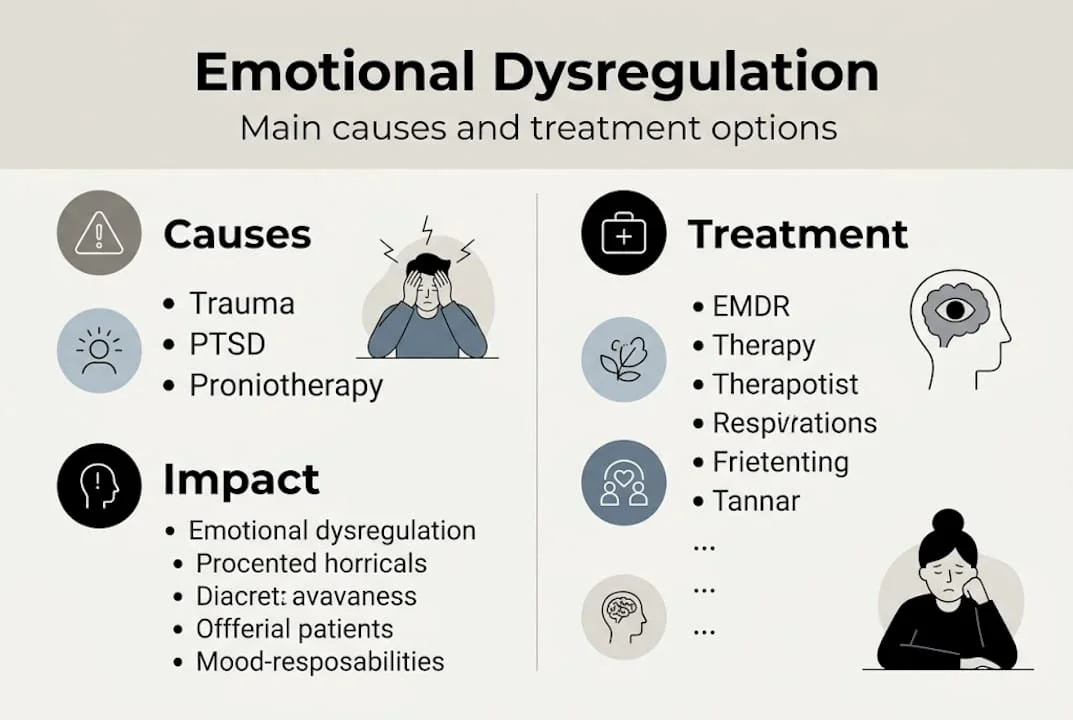
Emotional dysregulation involves intense, prolonged emotional responses often caused by trauma.
Trauma from childhood can impair brain systems that regulate emotions, leading to difficulties in adulthood.
Evidence-based therapies like EMDR and trauma-focused CBT effectively help manage trauma-related emotional dysregulation.
Emotional dysregulation is one of the most misunderstood mental health challenges adults face, especially those who grew up with trauma. It is not about being "too sensitive" or dramatic. For many Californians living with PTSD, complex trauma, or childhood wounds, emotional dysregulation is a real neurological response rooted in how the brain adapted to survive. This guide breaks down what emotional dysregulation actually is, how trauma drives it, and which evidence-based treatments, including EMDR and trauma-informed therapy, can help you move from survival mode into genuine healing.
Table of Contents
Key Takeaways
| Point | Details |
|---|---|
| Trauma changes the brain | Emotional dysregulation often results from trauma-related changes in key brain regions. |
| Healing is possible with help | Evidence-based therapies like EMDR and trauma-focused CBT offer real improvement for adults facing emotional dysregulation. |
| Specialized care matters | Working with a trauma-informed therapist is crucial for lasting progress, especially after complex trauma. |
| No one-size-fits-all | Different therapies suit different needs—phase-based approaches may help those with severe dysregulation most. |
What is emotional dysregulation?
Emotional dysregulation is the chronic difficulty managing emotional responses in proportion to what is actually happening. It is not occasional moodiness. It is not having a bad day. It is a pattern where emotions arrive too fast, feel too intense, or last far longer than expected, and where the usual strategies for calming down simply do not work.
People often confuse emotional dysregulation with personality flaws or immaturity. That misread causes real harm. When someone feels emotionally "hijacked" by anger, grief, or fear in a situation that others seem to handle easily, the issue is rarely a lack of effort or willpower. It is usually a nervous system that learned to operate in overdrive.
Common ways emotional dysregulation shows up in daily life include:
Intense mood swings that shift within minutes
Explosive anger or crying that feels impossible to stop
Emotional numbness or shutdown after conflict
Delayed emotional reactions, where feelings hit hours or days later
Difficulty returning to baseline after stress
Feeling flooded or overwhelmed in situations others find manageable
Trauma disrupts the prefrontal cortex and amygdala, the brain structures most responsible for regulating emotional responses. When these systems are altered by early or prolonged trauma, the brain's alarm system stays activated, making calm feel unreachable.
Understanding trauma informed care is a critical first step because it reframes dysregulation as a response to injury, not a character flaw.
Pro Tip: If your emotional reactions regularly feel out of proportion to the situation, and you feel shame or confusion afterward, that pattern is worth exploring with a therapist. Ordinary stress typically resolves once the stressor passes. Dysregulation lingers.
With a baseline understanding, the next step is uncovering how emotional dysregulation is linked to trauma, especially from childhood.
How trauma impacts emotional regulation
Childhood is when the brain builds its emotional regulation systems. When a child grows up in an environment marked by abuse, neglect, instability, or loss, those systems develop under constant stress. The result is a nervous system wired for threat, not connection.
Research makes this concrete. Childhood trauma produces long-term deficits in emotion regulation, with a standardized mean difference of 1.25, alongside impairments in attention and working memory. That is a large effect by any clinical standard.
"Early trauma doesn't just leave emotional scars. It changes how the brain processes, stores, and responds to experience across the entire lifespan."
| Domain | Adults without childhood trauma | Adults with childhood trauma |
|---|---|---|
| Emotional regulation | Generally intact | Significantly impaired (SMD=1.25) |
| Impulse control | Stable under moderate stress | Often disrupted under mild stress |
| PTSD risk | Lower baseline risk | Substantially elevated |
| Relationship stability | More consistent | Frequently disrupted |
Signs of trauma-related dysregulation in adulthood often include:
Rapid escalation in conflicts with partners or coworkers
Difficulty trusting others, even when they are safe
Emotional flashbacks, where old feelings resurface without warning
Chronic shame or self-blame after emotional episodes
Feeling disconnected from your own emotions
For Californians navigating diverse cultural backgrounds, the picture can be even more layered. Cultural factors in trauma recovery shape how people experience and express dysregulation, and they matter enormously in treatment.
Complex trauma and PTSD both amplify these patterns. Early intervention matters because the longer dysregulation goes unaddressed, the more it shapes relationships, work performance, and physical health. The good news is that the brain retains the capacity to change, and effective treatments exist.

Approaches to healing: EMDR, trauma therapy, and more
Not every therapy works the same way for trauma-related emotional dysregulation. The approach that fits you depends on your history, your current symptoms, and how your nervous system responds to stress.
The APA recommends EMDR and trauma-focused CBT as first-line treatments for PTSD, with EMDR showing particular effectiveness for core PTSD symptoms and some disturbances in self-organization seen in complex trauma.
Meta-analyses confirm EMDR is superior to control conditions in the short and mid-term, and broadly comparable to trauma-focused CBT. For severe emotional dysregulation tied to complex PTSD, phase-based approaches tend to produce better outcomes.
| Therapy | Best for | Structure | Key strength |
|---|---|---|---|
| EMDR | Core PTSD, trauma memories | Structured protocol, bilateral stimulation | Fast processing, less verbal |
| Trauma-focused CBT | PTSD, anxiety, avoidance | Cognitive restructuring plus exposure | Strong evidence base |
| Phase-based therapy | Complex PTSD, severe dysregulation | Stabilization first, then processing | Builds regulation skills before trauma work |
A typical EMDR treatment process looks like this:
History-taking and treatment planning
Preparation and building coping resources
Assessment of target memories
Desensitization using bilateral stimulation
Installation of positive beliefs
Body scan to check for residual tension
Closure and stabilization
Re-evaluation at each subsequent session
For a deeper breakdown, the step-by-step EMDR guide from Alvarado Therapy walks through what to expect. You can also read more about EMDR effectiveness across different trauma presentations.
Choosing the right approach means being honest with your therapist about your full history. Severity of dissociation, the presence of complex trauma, and current life stability all affect which path makes the most sense.
Choosing a trauma-informed therapist in California
Finding the right therapist is not just about credentials. It is about finding someone whose approach matches your needs and who creates genuine safety before asking you to process painful material.
A truly trauma-informed therapist does more than mention trauma in their bio. They actively structure sessions to prioritize stabilization, build the therapeutic relationship before diving into trauma content, and adjust their approach based on your window of tolerance.
Stabilization before processing is especially important when high dissociation or multiple comorbidities are present. Skipping this phase is one of the most common reasons trauma therapy stalls or causes harm.
Before committing to a therapist, consider asking:
What is your specific training in trauma-focused therapy?
How do you approach stabilization before trauma processing?
Have you worked with clients who have complex trauma or PTSD?
How do you handle dissociation if it comes up in session?
What does your approach look like for someone with my history?
Red flags to watch for include therapists who push you to recount trauma in detail before trust is established, dismiss somatic symptoms, or treat emotional dysregulation as simply "bad coping."
For Californians, a good starting point is the guide to finding trauma-informed therapists in CA, which covers over 220 options across the state. Tips on choosing an EMDR specialist and preparing for EMDR therapy can also help you walk into your first session with confidence.
Pro Tip: Spending the first few sessions building safety and rapport is not wasted time. Research consistently shows that the quality of the therapeutic relationship predicts outcomes just as strongly as the specific technique used.
A trauma therapist's perspective: What most people miss about emotional dysregulation
Here is something we see often in our work: a client completes a round of EMDR, feels significantly better, and assumes the work is done. Then life throws a curveball, and the old patterns resurface. They feel betrayed by the process.
What they are experiencing is not failure. It is the reality that affect regulation is built gradually, not installed in a single course of treatment. EMDR is genuinely powerful, but it is not a switch that permanently rewires decades of learned emotional chaos in a few sessions. For people with deeply embedded patterns from childhood trauma, skills-first and phase-based work is often what creates lasting change.
The clients who make the most durable progress are usually those who invest time in stabilization, learn concrete regulation tools, and treat therapy as a long-term relationship rather than a quick fix. Managing anxiety with EMDR is one piece of a larger picture.
If you feel stuck, that is not evidence that healing is impossible. It is often a signal that the foundation needs more attention before the deeper work can hold.
Get help for emotional dysregulation in California
If emotional dysregulation is affecting your relationships, your work, or your sense of self, trauma-informed care is accessible in California, and it works. You do not have to keep white-knuckling through emotional storms alone.

At Alvarado Therapy, our licensed clinicians specialize in EMDR, trauma-focused therapy, and culturally responsive care for adults across Pasadena, Ventura, and throughout California via telehealth. Whether you are just beginning to understand your patterns or have been in and out of therapy for years, we meet you where you are. Explore online EMDR trauma therapy in CA, learn about our PTSD & complex trauma support, or take the first step by booking a schedule a consultation today.
Frequently asked questions
What are the core signs of emotional dysregulation?
Emotional dysregulation impacts attention, impulse control, and mood. Core signs include intense emotions, impulsive reactions, difficulty calming down, and mood swings that disrupt daily life.
Which therapy is best for emotional dysregulation from trauma?
EMDR and TF-CBT are recommended for PTSD, while phase-based therapy tends to produce better results for severe emotional regulation difficulties tied to complex trauma.
How long does it take to see results from EMDR?
Some people notice shifts after a few sessions, but lasting EMDR progress in emotional regulation typically takes several months, particularly when complex trauma is involved.
Can emotional dysregulation be managed without medication?
Psychotherapy outperforms medication for trauma-related emotional dysregulation, according to APA and VA clinical guidelines, which strongly recommend trauma-focused therapies as the primary treatment.
