
Cultural responsiveness in therapy: trauma recovery in CA

Culturally adapted therapy improves trauma recovery outcomes significantly compared to standard approaches, reducing PTSD and anxiety more effectively for BIPOC, bilingual, and childhood trauma survivors. Yet many Californians still walk into therapy rooms where their language, identity, and lived experience feel invisible. That gap between standard care and truly responsive care is not a minor inconvenience. It shapes whether healing happens at all. This guide explains what cultural responsiveness actually means in therapy, why the research behind it is so compelling, how California is putting it into practice, and what you can do to find care that genuinely fits who you are.
Table of Contents
Key Takeaways
| Point | Details |
|---|---|
| Measurable outcomes | Culturally responsive therapy leads to faster, more effective trauma recovery for BIPOC, bilingual, and childhood trauma survivors. |
| California standards | State and county guidelines ensure therapists adapt care with bilingual services, cultural humility training, and trauma-informed practices. |
| Beyond competence | True cultural responsiveness means a reflective partnership focused on identity, justice, and humility—not just a checklist. |
| Practical choices | Clients should seek therapists who honor their language and background for the best trauma recovery. |
What is cultural responsiveness in therapy?
Cultural responsiveness in therapy is not a certificate a clinician earns once and frames on a wall. It is an ongoing practice of curiosity, humility, and reflection. It means a therapist actively considers how your identity, language, family structure, community history, and systemic experiences shape the way you carry trauma and the way you heal.
This is different from what older "cultural competence" models described. Competence frameworks often reduced culture to a checklist: learn a few facts about a group, apply them to every client from that group. The problem is that culturally responsive therapy recognizes that no two people share an identical cultural experience, even within the same community.
"Cultural responsiveness integrates client cultural context, humility, and reflection into therapy" rather than applying fixed cultural scripts to clients.
For trauma survivors, this distinction matters deeply. Trauma is not processed in a vacuum. It is filtered through the lens of who you are, where you come from, what your community has survived, and how systems have treated you. A therapist who skips that context is working with an incomplete picture.
Here is what cultural responsiveness actually looks like in practice:
Asking, not assuming about your background, identity, and preferences
Adapting language to your comfort, including offering sessions in your first language
Honoring family and community roles that shape your healing process
Reflecting on the therapist's own biases and how they might affect the relationship
Connecting trauma to systemic context, including racism, immigration stress, or intergenerational harm
Seeking identity-affirming therapy means finding a clinician who treats your full story as essential clinical information, not background noise.
Why cultural responsiveness matters for trauma recovery
The evidence here is striking. Culturally adapted interventions show effect sizes of d=0.47 to 0.50, with reduced PTSD symptoms (SMD -0.67) and anxiety (SMD -1.92) compared to standard care. Those are not small numbers. They represent real people recovering faster and more completely.
| Outcome | Standard therapy | Culturally adapted therapy |
|---|---|---|
| PTSD symptom reduction | Moderate | Significantly higher (SMD -0.67) |
| Anxiety reduction | Moderate | Substantially higher (SMD -1.92) |
| Client retention | Baseline | 20 to 30% higher |
| Bilingual PTSD management | Baseline | Up to 60% better |
The PATH model and culturally adapted therapies show that adaptations for BIPOC and Latine/x clients specifically enhance both retention and symptom reduction. Clients stay in therapy longer and get more out of each session when the approach fits their world.
60% better PTSD management is reported for bilingual clients receiving language-affirming, identity-focused care compared to standard English-only services.
Why does this happen? When you feel seen and understood in therapy, your nervous system is more willing to engage with difficult material. Trauma processing requires a sense of safety. For many BIPOC and bilingual clients, that safety is only possible when the therapist honors cultural identity in trauma therapy as a core part of the work.
For childhood trauma survivors in particular, cultural context shapes how early experiences were interpreted and stored. A therapist who understands the role of family loyalty, community shame, or immigration stress in a client's childhood can reach places that a culturally unaware approach simply cannot.
Pro Tip: When interviewing a potential therapist, ask directly: "How do you incorporate my cultural background into our work?" A responsive clinician will answer with curiosity and specifics, not a rehearsed line. Exploring bilingual trauma therapy options can also give you a clearer sense of what identity-centered care looks like.
How therapy is adapted for cultural responsiveness in California
California is one of the most diverse states in the country, and its mental health regulations reflect that reality. County behavioral health plans are required to address cultural equity in concrete, measurable ways.

California counties require annual cultural competence training for staff, bilingual services for Limited English Proficient (LEP) clients, and trauma-informed care protocols embedded in county mental health plans. Los Angeles and Santa Clara counties, for example, mandate continuous adaptation for equity rather than one-time compliance.
Here is how these requirements translate into real client experiences:
Intake in your preferred language: You should be offered intake forms and initial sessions in the language you are most comfortable using.
Collaborative interpreters: When a bilingual therapist is not available, trained interpreters who understand trauma-sensitive communication are used.
Multicultural hiring: Agencies actively recruit clinicians who reflect the communities they serve.
Ongoing humility training: Staff participate in regular reflection on bias, power, and systemic context, not just a single workshop.
Family and community integration: Treatment plans can include culturally relevant support structures, not just individual sessions.
| California requirement | What it means for you |
|---|---|
| Annual cultural training | Therapists stay current on responsive practices |
| LEP language access | Services available in your preferred language |
| Trauma-informed protocols | Care is designed around safety and empowerment |
| Interpreter integration | Language barriers do not block access to care |
Pro Tip: Before your first appointment, ask the practice whether they offer services in your preferred language and whether their clinicians receive ongoing cultural humility training. Understanding bilingual therapy benefits can help you know exactly what to ask for. You can also review a trauma-informed care guide to understand what quality care should feel like from the start. Practices that meet cultural competence requirements will be transparent about their training and language access policies.
Common pitfalls and advancing beyond competence
Even in California, with its high standards, cultural responsiveness can fall short in ways that are hard to spot. The most common problem is overgeneralization. A therapist who has learned about a particular culture may apply those generalizations to every client from that background, which is a form of stereotyping even when the intent is respectful.
"Stereotyping and trait models can harm; humility and reflexivity lead to better outcomes" than applying fixed cultural scripts to individual clients.
Another significant risk involves assessment tools. Many standardized diagnostic instruments were developed with predominantly white, English-speaking populations. Using them without adaptation can lead to misdiagnosis, particularly for BIPOC clients whose trauma responses or emotional expression styles differ from the assumed norm. This is not a minor technical issue. A wrong diagnosis can mean the wrong treatment for years.
Here is what to watch for when evaluating whether a therapist is truly responsive:
They ask about your cultural background with genuine curiosity, not a checklist
They acknowledge the limits of their own knowledge and experience
They connect your trauma to broader systemic or community contexts when relevant
They do not assume shared meaning for words like "family," "safety," or "healing"
They are open to cultural misunderstandings and repair them without defensiveness
Liberation psychology offers a powerful framework here. It asks therapists and clients to examine the power imbalances, historical injustices, and systemic barriers that shape mental health. For many BIPOC and bilingual clients, healing is not just personal. It is political. A therapist who ignores that dimension is missing a significant part of the picture.
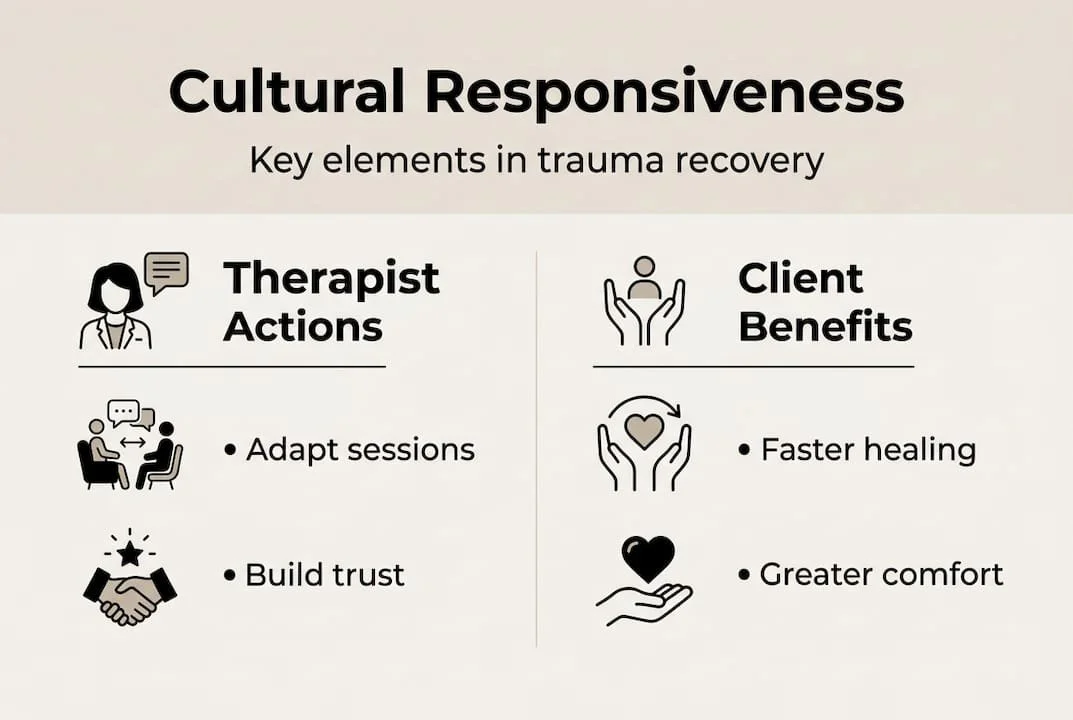
You deserve identity-affirming therapy that treats your full context as clinically relevant. Pairing that with solid mental health self-care practices between sessions can also strengthen your overall recovery.
A fresh look: Liberation, humility, and the future of trauma therapy
Here is something the field does not say loudly enough: cultural competence checklists can actually create a false sense of security. A therapist who has completed their annual training hours may feel prepared, while still missing what matters most to the person sitting across from them.
We believe the next era of trauma therapy in California will be defined not by what clinicians know about cultures, but by how willing they are to not know, and to keep asking. Cultural humility is a practice of staying curious and uncomfortable in the best possible way. It is more sustainable and more effective than any fixed knowledge base.
Liberation psychology takes this further by asking both therapist and client to name the systems that created the wound. For many trauma survivors, especially those healing from advanced cultural responsiveness frameworks, the most powerful shift comes when therapy stops being something done to you and becomes a reflective, justice-oriented partnership. BIPOC and bilingual clients deserve clinicians who are willing to question their own assumptions, including assumptions about what healing is supposed to look like.
Find culturally responsive trauma therapy in California
Understanding what cultural responsiveness looks like is the first step. Finding a therapist who actually practices it is the next one.
At Alvarado Therapy, our bilingual, trauma-informed clinicians serve clients across Pasadena, Ventura, and throughout California via telehealth. We specialize in PTSD and complex trauma support for BIPOC, bilingual, and childhood trauma survivors, with care delivered in both English and Spanish. Whether you are just starting to explore therapy or looking for a better fit, we want you to feel genuinely seen. Visit what to expect in therapy to prepare for your first session, or learn more at Alvarado Therapy about our full range of identity-affirming services.
Frequently asked questions
What does a culturally responsive therapist actually do differently?
They adapt care to your cultural background by communicating in your preferred language, honoring your identity, and tailoring trauma recovery methods to your specific cultural context rather than applying a one-size-fits-all approach.
Why are bilingual and identity-affirming therapists recommended for BIPOC and childhood trauma in California?
Language-affirming care yields up to 60% better PTSD management for bilingual clients, with higher retention and treatment satisfaction across BIPOC and Latine/x communities compared to standard approaches.
How are California therapists required to address cultural differences?
California counties require annual cultural humility training, interpreter access for LEP clients, and trauma-informed care protocols embedded in county mental health plans.
What are the risks if therapy isn't culturally responsive?
Eurocentric tools may lead to misdiagnosis, and clients who feel unseen or misunderstood are far less likely to stay in therapy long enough to experience meaningful trauma recovery.
Recommended
How cultural identity improves trauma therapy results in CA — Alvarado Therapy
Why Cultural Competence in Therapy Leads to Better Outcomes — Alvarado Therapy
Culturally Responsive Therapy: 30% Better Trauma Recovery — Alvarado Therapy
Find Culturally Sensitive Therapists in CA: 45% Dropout Cut — Alvarado Therapy
