
How to Manage Anxiety Daily: Trauma-Informed Strategies
TL;DR:
Managing anxiety involves building habits that promote nervous system regulation and resilience.
Trauma-informed therapies like CBT and EMDR are effective for underlying trauma-related anxiety.
Consistent daily routines and gradual progress tracking are essential for long-term anxiety relief.
You wake up already feeling tension in your chest, your mind racing through everything that could go wrong before 9 a.m. For millions of California adults, this is not an occasional bad morning. It is Tuesday. Managing daily anxiety is not about eliminating every worry. It is about building a nervous system that can recover faster, stay regulated longer, and respond instead of react. This guide walks you through trauma-informed strategies grounded in evidence, from understanding your anxiety roots to building daily habits, executing real-time tools, knowing when to seek therapy, and tracking what actually works for you.
Table of Contents
Key Takeaways
| Point | Details |
|---|---|
| Routine matters most | Daily consistency in habits and routines effectively lowers anxiety over time. |
| Address the root | Trauma-informed therapy helps heal underlying anxiety, not just temporary symptoms. |
| Small steps work | Start with one new habit at a time to build adherence and avoid overwhelm. |
| Progress is not linear | Tracking your anxiety and staying compassionate through setbacks leads to lasting change. |
Understand your anxiety: What you need to know before starting
Not all anxiety looks the same. Some people feel a low hum of dread all day. Others get hit with sudden panic. And for many California adults, anxiety is tangled up with past trauma in ways that make standard advice feel hollow or even triggering. Before you try to fix anything, it helps to understand what you are actually dealing with.
Common anxiety shows up as worry, restlessness, muscle tension, or difficulty sleeping. Trauma-related anxiety often includes hypervigilance, emotional numbness, intrusive memories, and reactions that seem disproportionate to the situation. The difference matters because the strategies that help one type may not reach the root of the other. Understanding your anxiety triggers in daily life is a powerful first step toward choosing the right tools.
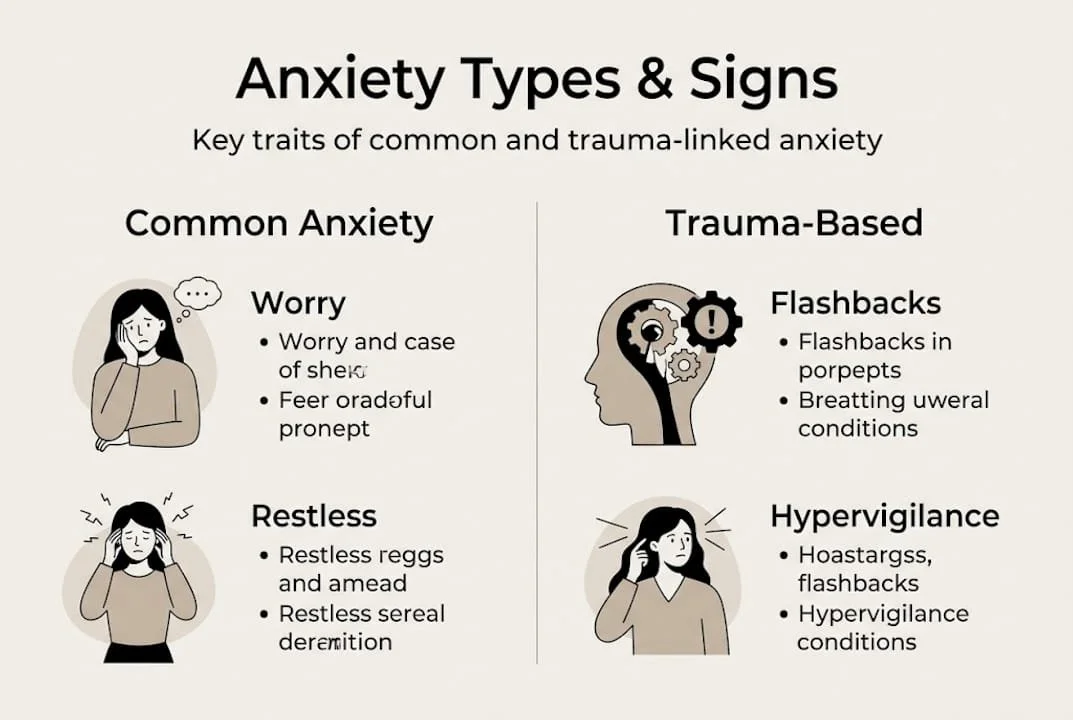
Compare anxiety types and management tactics
| Symptom | Likely trigger | Management tactic |
|---|---|---|
| Constant low-level worry | Stress overload, uncertainty | Scheduled worry time, journaling |
| Sudden panic or shutdown | Trauma reminder, sensory cue | Grounding, breathwork, EMDR |
| Irritability and reactivity | Sleep deprivation, chronic stress | Sleep hygiene, movement, therapy |
| Avoidance of situations | Fear of judgment, past harm | Gradual exposure, self-compassion |
Before choosing a strategy, ask yourself these questions:
Do my anxiety symptoms feel tied to specific memories or people?
Does my body react before my mind even processes what happened?
Do I avoid certain places, conversations, or feelings regularly?
Have coping tools helped short-term but never lasted?
Does my anxiety worsen around specific dates, seasons, or relationships?
If several of those resonate, your anxiety may have a trauma component. That is not a weakness. It is information. Exploring coping tips for anxiety with a trauma lens can make a significant difference in what actually sticks.
Why daily routines matter more than you think: Daily habits reduce anxiety with a long-term effect comparable to medication. Your nervous system learns safety through repetition. Small, consistent actions teach your brain that the world is manageable, one morning at a time.
With an understanding of what is driving your anxiety, you are ready to gather the essential tools and set up the habits that will lay your foundation for success.
Prepare your daily foundation: Essential habits and routines
Building a lower baseline of anxiety does not require a dramatic life overhaul. It requires a few well-placed habits done consistently. The science is clear: consistent sleep, limited caffeine, protein-rich breakfasts, and avoiding screens in the morning are all linked to measurably reduced anxiety. These are not wellness trends. They are nervous system basics.
Here is a simple morning sequence to start with:
Wake without your phone. Give yourself 15 to 20 minutes before checking any notifications. Your nervous system is most impressionable in the first hour after waking.
Eat a protein-rich breakfast. Blood sugar crashes amplify anxiety. Eggs, Greek yogurt, or nut butter on whole grain toast stabilize your mood before the day begins.
Move your body within 30 minutes. Even a 10-minute walk counts. Movement metabolizes stress hormones and signals safety to your brain.
Set a clear intention for the day. One sentence. Not a to-do list. Something like: "Today I will notice when I need a break and take it."
Effective vs. less effective daily habits
| Habit | More effective | Less effective |
|---|---|---|
| Morning fuel | Protein breakfast | Sugary cereal or skipping meals |
| Sleep | Consistent wake time daily | Variable bedtime and late scrolling |
| Stimulants | One coffee before noon | Multiple coffees throughout the day |
| Screen use | First 30 min screen-free | Checking phone immediately on waking |
| Movement | Short breaks every 90 minutes | One long workout, then sitting all day |
Sleep consistency is especially powerful. Going to bed and waking at the same time, even on weekends, regulates your cortisol rhythm. Erratic sleep is one of the fastest ways to undo any other anxiety management work you are doing. Reviewing a daily workflow for anxiety management can help you sequence these habits in a way that fits your actual schedule.
Pro Tip: Change only one habit at a time. Trying to overhaul your entire morning in a week is a setup for frustration. Pick the habit with the lowest barrier and build from there. Consistency beats intensity every time.
Now that your foundation is set, let's put these principles into daily practice with step-by-step strategies supported by both science and trauma-informed care.
Step-by-step guide: Practical tools for managing anxiety in real time
Knowing what to do when anxiety spikes is different from knowing it in theory. Here is how to actually execute these tools in the middle of a hard day.
Use movement snacks every 90 minutes. Stand up, stretch, walk to another room, or do 10 jumping jacks. Brief, regular activity resets your nervous system in a way that one long gym session cannot replicate.
Practice box breathing when tension rises. Inhale for 4 counts, hold for 4, exhale for 4, hold for 4. Repeat three times. This directly activates your parasympathetic nervous system.
Reframe the thought, not the feeling. When anxious thoughts spiral, ask: "Is this a fact or a fear?" You are not dismissing the feeling. You are examining the story attached to it.
Schedule a daily worry window. Pick a 15-minute block, write down your worries, then close the notebook. This creates a boundary so anxiety does not bleed into every hour. Scheduled worry time and movement breaks match or outperform medication for daily anxiety control.
When anxiety spikes sharply, these grounding practices help:
Name 5 things you can see, 4 you can touch, 3 you can hear
Hold something cold or textured to anchor to the present moment
Say your own name and location out loud
Place one hand on your chest and breathe slowly, noticing the rise and fall
Practice self-compassion: "This is hard. It makes sense that I feel this way."
For relationship anxiety strategies, these same tools apply but may need to be adapted for interpersonal triggers. Behavioral intervention outcomes show strong results when these tools are practiced regularly rather than only in crisis moments.
Pro Tip: Set a phone timer every 90 minutes labeled "reset." When it goes off, stand up and move for two minutes. Over time, this becomes automatic and keeps your nervous system from accumulating tension throughout the day.
While daily practice is crucial, some anxiety stems from trauma and may require more structured support like therapy. Let's examine when and how to engage evidence-based therapies.
When daily habits aren't enough: Therapy interventions and trauma-informed supports
Self-care tools are real and powerful. But they have limits. If you find yourself doing everything right and still struggling, that is not a failure of willpower. It may be a signal that your nervous system needs more targeted support.
Signs you may benefit from therapy:
Daily coping tools help temporarily but anxiety keeps returning at the same intensity
You notice repeated trauma triggers that disrupt your functioning
Anxiety is affecting your relationships, work, or ability to enjoy daily life
You feel emotionally numb, disconnected, or constantly on edge
Sleep problems, physical symptoms, or avoidance are getting worse over time
The evidence for trauma-focused therapy is strong. CBT and trauma-focused CBT have the strongest evidence base, with approximately 50% remission rates post-treatment. The APA recommends Cognitive Processing Therapy, Prolonged Exposure, and Trauma-Focused CBT as first-line approaches. Group and individual therapy tend to produce stronger ongoing gains than remote-only formats, though online therapy still outperforms no treatment significantly.
Starting small matters in therapy too. Consistency and gradual engagement with difficult material, at your own pace, produces more lasting change than trying to process everything at once. A good trauma-informed therapist will never push you faster than your nervous system can handle.
For anxiety rooted in trauma, EMDR for trauma-based anxiety is a particularly effective option. EMDR works by helping the brain reprocess stuck memories so they no longer trigger the same automatic fear response. If you are unsure where to start, learning how to create a therapy plan can help you walk into your first session with clarity.
Having covered therapy supports, you can now monitor your anxiety trends and celebrate the progress you are making with these verification strategies.
Track your progress: How to know what's working and adjust
Progress with anxiety is rarely a straight line. Some weeks feel like breakthroughs. Others feel like you are back at square one. The key is having a simple system to see your actual trend over time, not just how you feel on your worst day.
You do not need a complicated app. A basic mood log works. Each evening, rate your anxiety from 1 to 10, note what helped, and write one sentence about the day. Over two to four weeks, patterns emerge. You will start to see which habits are actually moving the needle.
Signs your plan is working:
Anxiety spikes feel shorter in duration
You recover faster after a stressful event
Sleep quality is improving
You are using grounding tools proactively, not just in crisis
You feel more able to tolerate uncertainty without spiraling
Signs you may need to adjust:
Anxiety intensity has not changed after four or more weeks
You are skipping your routines more than following them
New symptoms are appearing, such as physical tension or withdrawal
You feel worse after certain practices
Behavioral interventions are effective long-term when applied consistently, and adherence builds best when you start small. If progress stalls, revisit the workflow tracking steps and identify the one habit that has slipped. Rebuilding from one anchor habit is always faster than starting over entirely. And when setbacks happen, practice the same self-compassion you would offer a friend. Healing is not a performance.
As you reflect on your new daily management skills, let's consider what most guides miss in sustaining anxiety relief and what truly makes trauma-informed care work.
Why consistency and trauma-informed care beat quick fixes
Most anxiety guides are built around crisis management. They teach you what to do when panic hits. That is useful. But it misses the larger picture entirely.
The real work happens in the ordinary moments. The morning you choose protein over sugar. The afternoon you take a two-minute walk instead of scrolling. The night you go to bed at the same time even though you are not tired. These are not dramatic acts. They are the slow, steady recalibration of a nervous system that learned to stay on high alert.
General self-help often fails because it ignores the trauma lens. If your anxiety has roots in past harm, generic advice about "thinking positive" can feel dismissive or even destabilizing. Trauma-informed care works differently. It meets you where you are, respects your pace, and addresses causes rather than just symptoms.
Here in California, we also have access to culturally responsive, bilingual care that honors the full complexity of identity and lived experience. That specificity matters. Understanding therapy's impact on anxiety goes beyond technique. It is about finding an approach that actually fits your life, your history, and your nervous system.
Take the next step with trauma-informed support
You have the roadmap. Now the question is whether you want to walk it alone or with a guide who specializes in exactly this kind of work.
At Alvarado Therapy, our licensed clinicians bring trauma-informed, evidence-based care to adults across California, online and in person. Whether you are managing daily anxiety, healing from past trauma, or trying to understand why self-help has not been enough, we are here to help you build something lasting. Explore what to expect from trauma therapy, learn about our PTSD and complex trauma resources, or take the first step and request a consultation today. You deserve support that actually fits your story.
Frequently asked questions
What are the simplest habits I can use daily to reduce anxiety?
Start with a screen-free morning, eat a protein breakfast, and take short movement breaks every 90 minutes. Daily habits reduce anxiety with long-term effects comparable to medication when practiced consistently.
How does trauma-focused therapy help daily anxiety?
Trauma-focused therapies like CBT and EMDR address root causes and help retrain anxious reactions over time. CBT and trauma-focused CBT have the strongest evidence base and are recommended by the APA as first-line treatments.
When should I seek professional help for my anxiety?
Seek help if anxiety disrupts your daily life even with consistent self-care, or if past trauma continues to worsen your symptoms. CBT and trauma-focused CBT are highly effective when daily tools fall short.
Does daily anxiety mean I need medication?
Not necessarily. Behavioral interventions are comparable to medication and often produce better long-term outcomes, especially when combined with trauma-informed therapy.
