
Grief and Loss Explained: Navigating Healing in California
Most American adults facing loss in California struggle with feelings that go far deeper than sadness. When grief touches every part of life, the need for trauma-informed support becomes clear. Understanding what grief and loss really mean can help you approach your healing with compassion, especially if bilingual EMDR therapy might be right for you. This overview reveals the many faces of grief, offering insights that honor both your personal journey and your cultural background.
Table of Contents
Key Takeaways
| Point | Details |
|---|---|
| Grief is a multifaceted experience | Grief encompasses emotional, physical, and social dimensions that vary greatly among individuals. |
| Understanding diverse grief styles is essential | Recognizing different grieving styles can aid in providing appropriate support and understanding during the grieving process. |
| Emotional responses are often nonlinear | Grief is not a predictable progression, and individuals may experience a wide range of emotions simultaneously. |
| Trauma-informed approaches enhance healing | A trauma-informed perspective acknowledges the complex interplay between grief and psychological trauma, focusing on creating safe healing spaces. |
What Grief and Loss Really Mean
Grief and loss are deeply complex human experiences that go far beyond simple emotional reactions. Psychological responses to loss represent profound transformations in how individuals perceive themselves and their world after experiencing significant change or separation.
At its core, grief is a natural psychological process triggered by loss, encompassing emotional, physical, and social dimensions. These experiences can stem from concrete events like death or symbolic transitions such as career changes, relationship endings, or major life shifts that fundamentally alter one's identity and social role. The intensity and manifestation of grief vary widely, reflecting an individual's unique attachment patterns, cultural background, and personal resilience.
Understanding grief requires recognizing its multifaceted nature. Emotional reactions to bereavement can include shock, anger, confusion, profound sadness, and even temporary feelings of emotional numbness. These responses are not linear but often cyclical, with individuals moving between different emotional states as they process their loss.
Pro tip: Create a personal grief journal to track and understand your emotional journey, allowing yourself compassionate space to experience and document your healing process without judgment.
Types of Loss and Grieving Experiences
Grief is not a monolithic experience but a complex landscape with multiple dimensions and manifestations. Diverse grief experiences encompass a wide range of losses that extend far beyond traditional understandings of bereavement. These can include tangible losses like death, as well as profound symbolic losses that challenge one's sense of identity and social connection.
Researchers have identified several distinct grieving styles that reflect individual coping mechanisms. Some individuals are intuitive grievers who express emotions openly and directly, while others are instrumental grievers who process loss through action and problem-solving. Many people fall into a blended grieving category, combining emotional expression with practical responses. Unique grief patterns demonstrate that there is no single 'correct' way to experience loss.
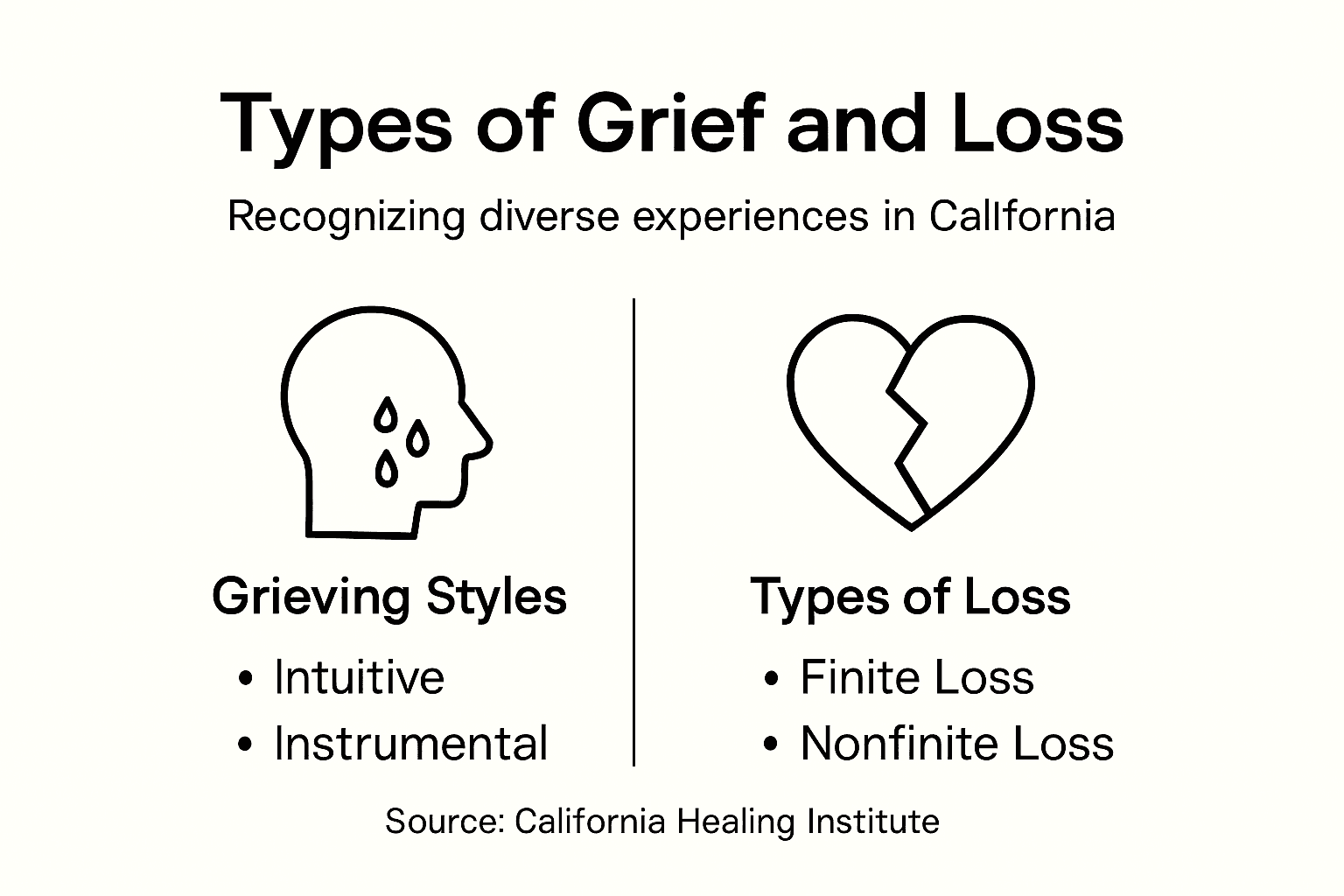
Here's a quick comparison of common grieving styles and their primary features:
| Grieving Style | Main Approach | Emotional Expression | Typical Coping Strategies |
|---|---|---|---|
| Intuitive | Emotion-based | Open and direct | Talking, journaling, seeking support |
| Instrumental | Problem-solving | Limited outward emotion | Taking action, planning, practical solutions |
| Blended | Combines both approaches | Mixed (varies by moment) | Alternates between emotional and practical responses |
Particularly significant are nonfinite losses and disenfranchised grief experiences that often go unrecognized by broader social structures. These can include miscarriage, job loss, end of significant relationships, chronic illness diagnoses, or the loss of future dreams and expectations. Such losses may not receive traditional sympathy or acknowledgment, making the grieving process even more challenging for individuals experiencing them.
Summary of unique grief types and key challenges
| Type of Loss | Examples | Main Challenges |
|---|---|---|
| Nonfinite Loss | Chronic illness, lost opportunities | Ongoing impact, unclear closure |
| Disenfranchised Grief | Miscarriage, job loss, stigma | Lack of recognition, limited support |
| Symbolic Loss | Retirement, identity shift | Redefining self, social adjustment |
Pro tip: Create a personalized grief support network that understands and validates your unique grieving style, ensuring you have compassionate spaces to express your emotional journey without judgment.
Stages of Grieving and Emotional Impact
Historical grief modelshave long attempted to capture the complex emotional landscape of loss, but contemporary research reveals grief as a deeply personal and nonlinear experience. Traditional theories like the Kübler-Ross five stages—denial, anger, bargaining, depression, and acceptance—have been widely critiqued for presenting an oversimplified understanding of human emotional processing.
Modern grief research emphasizes the dynamic and individualized nature of emotional responses. Instead of viewing grief as a predictable progression, experts now recognize it as a fluid, multidimensional experience that encompasses physical, psychological, social, and spiritual dimensions. The Dual Process Model suggests individuals oscillate between loss-oriented activities (directly processing grief) and restoration-oriented activities (rebuilding life and identity).

Emotional impacts of grief extend far beyond traditional expectations. Contemporary grief research highlights that bereaved individuals may experience a complex array of emotions simultaneously: profound sadness, anger, relief, guilt, numbness, and even moments of unexpected joy. These emotional responses can manifest through physical symptoms like fatigue, changes in appetite, sleep disruptions, and increased susceptibility to illness.
Pro tip: Create a flexible emotional wellness plan that allows space for unpredictable grief reactions, recognizing that healing is not linear and compassionate self-acceptance is key.
Trauma-Informed Approaches to Healing
Trauma-informed grief supportrepresents a compassionate, holistic approach to understanding how profound loss intersects with psychological trauma. This methodology recognizes that grief is not a uniform experience but a complex, deeply personal journey influenced by individual traumatic experiences, cultural background, and existing support systems.
Trauma-informed care moves beyond traditional therapeutic models by emphasizing safety, trust, collaboration, and empowerment. Practitioners understand that traumatic loss can fragment an individual's sense of self, disrupting emotional regulation, interpersonal relationships, and fundamental beliefs about safety and meaning. The approach prioritizes creating healing environments that validate individual experiences without judgment, allowing survivors to process grief at their own pace and in their own unique way.
Spiritually integrated healing approachesoffer additional depth to trauma recovery, recognizing that profound loss often triggers existential questioning and spiritual transformation. This perspective views grief not merely as a psychological challenge but as an opportunity for meaning-making, personal growth, and reconnecting with one's inner resilience. Therapeutic interventions focus on helping individuals reconstruct their narrative, integrate traumatic experiences, and rediscover hope and purpose.
Pro tip: Develop a personalized healing toolkit that includes multiple coping strategies, acknowledging that healing is nonlinear and requires compassionate, flexible self-support.
Common Myths About Grief and Recovery
Myths about griefoften create additional emotional barriers for individuals navigating loss. These widespread misconceptions can make the healing process more challenging by imposing unrealistic expectations and limiting understanding of the complex grieving experience. Many people mistakenly believe grief follows a predictable, linear path with clearly defined stages, when in reality, grief is deeply personal and unique to each individual.
One of the most damaging myths is the notion that time automatically heals all wounds. In truth, healing requires active engagement and emotional processing. Another pervasive misconception is that grief only occurs after death, when loss experiences are far more diverse and can include job loss, relationship endings, health changes, and significant life transitions. People often believe they must appear strong and suppress their emotions, which actually inhibits genuine healing and emotional recovery.
Traditional grief narratives often suggest there is a 'correct' way to grieve, implying that individuals should quickly move toward acceptance and closure. However, contemporary understanding recognizes grief as an ongoing, evolving process. Grief doesn't have an expiration date or a predetermined timeline. It's a deeply personal journey that can include moments of profound sadness, unexpected joy, confusion, and gradual acceptance, sometimes all within the same day.
Pro tip: Create a personal grief journal that allows you to track and validate your unique emotional experiences without judgment, understanding that healing is a nonlinear and deeply individual process.
Find Compassionate Healing for Grief and Loss in California
Grief and loss are deeply personal and nonlinear journeys that bring complex emotions like sadness, anger, and confusion. If you are struggling with nonfinite loss, disenfranchised grief, or need a trauma-informed approach to healing, you are not alone. At Alvarado Therapy, our licensed therapists understand the unique ways grief can affect your emotional and physical well-being. We specialize in trauma-informed mental health care including EMDR therapy and individual counseling designed to support your healing process in a safe and culturally responsive environment.
Take the next step toward reclaiming your life with support tailored to your unique grieving style. Explore our services tailored for those navigating profound loss across Pasadena, Ventura, and online anywhere in California by visiting Alvarado Therapy. Learn more about how our trauma-sensitive approach embraces emotional wellness through EMDR therapy and compassionate counseling. Do not wait to find safe, empowering care that honors your personal journey and fosters lasting resilience.
Frequently Asked Questions
What are the different types of grief and loss?
Grief and loss can encompass various experiences beyond death, including nonfinite losses like chronic illness and disenfranchised grief, where societal recognition may be limited, such as with job loss or miscarriages.
How can understanding grieving styles help in dealing with grief?
Recognizing different grieving styles—intuitive, instrumental, or blended—can help individuals understand their own emotional responses and coping strategies, allowing for a more personalized approach to healing.
What are the emotional impacts of grief that one should be aware of?
Grief can trigger complex emotions, including profound sadness, anger, relief, guilt, and even unexpected joy. It may also lead to physical symptoms like fatigue, changes in appetite, and sleep disruptions.
What is trauma-informed grief support, and why is it important?
Trauma-informed grief support focuses on understanding how loss intersects with psychological trauma, emphasizing safety, trust, and collaboration in healing. It provides a holistic environment for individuals to process grief in their own unique ways.
