
Process Trauma Safely: 30 Trauma Informed Journal Prompts for Adults

Use these trauma-informed, staged journaling prompts to process painful memories safely. Start with grounding prompts, then move to reflection, and only then try short, supported narrative work. These prompts fit most adults working through childhood, relational, or single-event trauma, but if you have severe or persistent PTSD symptoms, pair them with professional support rather than doing deep narrative work alone. Skip to the safety section below if you want the warning signs first.
TL;DR:
Trauma journaling should be approached gradually, starting with grounding prompts to establish safety before moving into reflection and narrative work.
Set a timer for 15 to 20 minutes during narrative prompts and stop immediately if distress signals like racing heart or dissociation appear.
Self-guided journaling with this staged approach is generally safe for everyday stress or single-event memories but is not recommended for severe PTSD symptoms without professional support.
Clinician-guided therapies like Written Exposure Therapy or EMDR are advised for those with diagnosed PTSD or persistent, severe symptoms.
Maintaining consistent, short daily journaling sessions and attaching prompts to existing routines enhances resilience versus long, exhausting sessions.
Alvaradotherapy
Find Support Beyond Journaling
Alvarado Therapy offers trauma-informed EMDR therapy and individual counseling for adults healing from trauma, anxiety, grief, and related challenges.
Table of Contents
Session formats worth trying: 3/2/1, timed writing, and daily rituals
Support beyond the page: EMDR, therapy, and journaling resources
Quick-start: 30 safe prompts organized by stage
Trauma-informed journaling works best when it follows your nervous system's pace instead of racing toward insight. These 30 prompts move through four stages: grounding, reflection, narrative, and integration. Start at stage one even if you feel ready for stage three. The grounding work is what makes the later stages safe.
Stage 1: Grounding prompts (calm the body, orient to safety)
Name five things you can see, hear, or touch right now, in detail.
Describe a place, real or imagined, where you feel completely safe.
Write about what your breath feels like in this exact moment.
List three things in your current life that are stable and predictable.
Describe a person, pet, or object that makes you feel steady.
Stage 2: Reflective prompts (notice patterns, beliefs, and triggers)
What situations tend to make you feel small or unsafe, and what do they have in common?
When do you notice your body tensing up during an ordinary day?
What belief about yourself do you suspect came from a painful experience rather than from truth?
Who taught you how to respond to conflict, and do you still want to respond that way?
What do you do when you feel overwhelmed, and does it actually help?
Write about a recent moment when a small event triggered a bigger reaction. What was underneath it?
What are you most afraid of people would think if they knew your full story?
Describe a pattern in your relationships that keeps repeating.
What would it mean to trust your own perception of what happened to you?
When do you feel most like yourself, and what is different about those moments?
Stage 3: Narrative prompts (cautious processing, with built-in safety cues) Approach these only after grounding and reflection feel manageable. Set a timer for 15 to 20 minutes and stop if your body signals distress.
Write about one specific memory, not the whole story, and describe only what you are ready to include today.
What do you wish someone had said to you during that experience?
Describe the moment you started to protect yourself, even if the protection looked unhealthy later.
What did you need in that moment that you did not get?
Write a letter to yourself at the age the event happened, from the perspective of who you are now.
What parts of the memory still feel unclear or foggy, and is that okay to leave unclear for now?
Describe one physical sensation connected to the memory, without describing the full event.
What did you do right, even in an impossible situation?
If you could change one belief you formed from that event, what would it be?
Write about what has changed in you since then, focusing on growth rather than the event itself.
Stage 4: Integration prompts (self-care and meaning after writing)
What do you need right now, after writing this?
Name one way you showed courage just by writing today.
What would you say to comfort a friend who wrote what you just wrote?
Describe one small, kind thing you can do for yourself in the next hour.
What does this entry tell you about how far you have already come?
Prompt sets by trauma type
Different kinds of trauma call for different entry points. These sets build on the stages above but narrow the focus to a specific experience, so pick the category that matches what you are actually working through.
Childhood and inner-child prompts target unmet needs and safety rather than retelling events in full.
What did the child version of you need to hear that nobody said?
Describe a safe adult you wish you had, real or imagined.
What rule did you learn as a child about expressing emotion, and do you still follow it?
Write a short note of reassurance to yourself at a specific childhood age.
What would re-parenting yourself look like in one small, concrete action this week?
Relationship and attachment prompts focus on boundaries and the voices that shaped your patterns.
Whose voice do you hear when you doubt your own worth in relationships?
Describe a boundary you wish you had learned earlier.
What pattern from a past relationship do you notice showing up now?
Write about a time you said yes when you meant no, and what stopped you from saying no.
What does a safe, mutual relationship look like to you, specifically?
PTSD-aware prompts stay short and are paired with grounding before and after, since symptom-heavy writing can intensify distress.
Name one thing your body does when you feel unsafe, without describing the trigger itself.
What helps you return to the present moment fastest?
Describe one coping skill that has worked for you, even once.
Grief prompts invite memory and ritual rather than only loss.
Describe a specific memory that makes you smile, even through grief.
What ritual, however small, helps you feel connected to what you lost?
Write a letter to the person or life you are grieving, saying what went unsaid.
How to use prompts safely
Journaling about trauma works best as a staged practice, not a race to "get it all out." Build grounding resources first, add reflection once that feels steady, and only then attempt brief narrative exposures. Each stage earns the next.
Prepare: Pick a quiet time when you are not rushed and have at least 20 minutes free afterward to recover.
Ground first: Try slow breathing, a 5-4-3-2-1 sensory check, or gentle movement before writing.
Timebox it: Set a timer for 15 to 20 minutes for narrative prompts, and stop when it goes off, even mid-sentence.
Watch your body: Racing heart, numbness, or dissociation are signals to pause and ground again.
Close with care: End every session with an integration prompt or a soothing activity, never mid-memory.
Pro Tip: If you notice your mind going blank or feeling far away while writing, stop, name five things you can see, and put the pen down until that passes.
Warning signs that journaling is doing more harm than good include flashbacks that do not settle after grounding, insomnia that worsens over several days, or a sense of reliving the event rather than reflecting on it. If any of these persist, stop solo narrative work and bring it to a therapist instead.
What the research says about expressive writing and WET
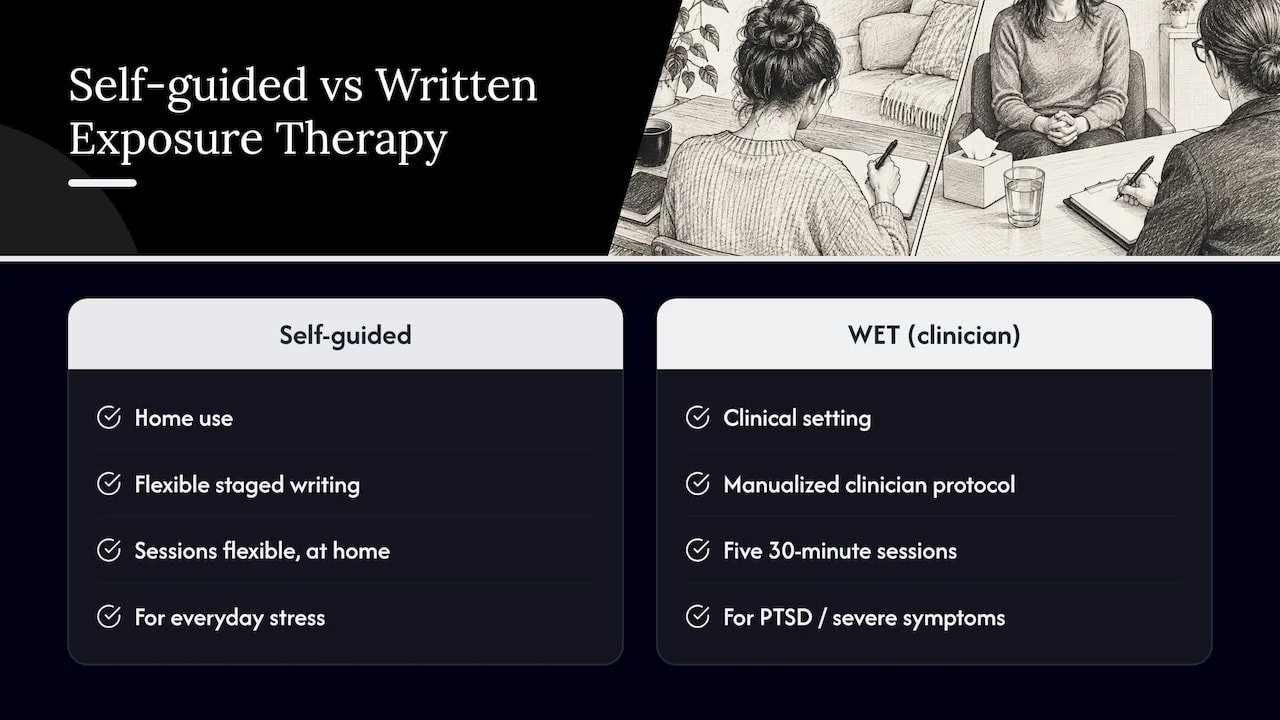
Self-guided trauma journaling has real but limited research behind it, and understanding those limits helps you use it appropriately. Written Exposure Therapy (WET) is a manualized, clinician-guided protocol built on five sessions, each involving 30 minutes of writing about a specific traumatic event in the presence of a clinician. It is a clinical intervention, not something designed for unsupervised home use.
A network meta-analysis found that expressive writing produces small-to-negligible effects overall, but larger effects for people diagnosed with PTSD, which suggests that writing about trauma helps more, and carries more risk, the more significant the symptoms are.
That split matters practically. If you are processing everyday stress or a single difficult memory, self-guided journaling with the staged approach above is reasonably safe. If you have diagnosed PTSD or symptoms that interfere with daily life, the evidence points toward clinician-guided methods like WET rather than solo deep narrative work. Journaling can support therapy, but it is not a substitute for it when symptoms are severe.
Session formats worth trying: 3/2/1, timed writing, and daily rituals
Different formats suit different moments, so it helps to have more than one option ready.
The 3/2/1 method: Write three things you notice around you, two things you feel in your body, and one small action to ground yourself, such as placing your feet flat on the floor.
Timed expressive writing: Set a 20-minute timer for reflective prompts or a 30-minute timer for narrative prompts, and stop completely when the timer ends, regardless of where you are in the entry.
Daily micro-journaling: Spend 5 to 10 minutes most days on grounding or reflective prompts, saving narrative prompts for longer weekend sessions when you have time to recover afterward.
Therapist-guided integration: If you are already in therapy, ask whether your clinician wants you to bring journal entries into EMDR or WET sessions, since combining the two without guidance can intensify distress rather than ease it.
Most people do better starting with the lighter, more frequent formats and saving deeper narrative work for sessions supported by a therapist.
Keeping up a journaling habit without losing motivation
Consistency matters more than intensity. A few minutes of grounding or reflective writing most days builds more resilience than one long, exhausting session followed by weeks of avoidance.
Attach journaling to an existing habit, like writing for five minutes after your morning coffee or before turning off the light at night, so it does not depend on willpower alone. Keep a running list of prompts you have not tried yet, since decision fatigue is one of the most common reasons people stop. Permission to skip days matters too: missing a week does not undo progress, and treating journaling as flexible rather than mandatory tends to keep people writing longer.
Track small wins instead of focusing only on breakthroughs. Noticing that you handled a trigger better this month than last month is worth writing down, even if the big narrative work feels far off. If motivation drops for more than a few weeks, that is worth mentioning to a therapist, since it can signal avoidance rather than simple busyness.
Adapting prompts to your background and beliefs
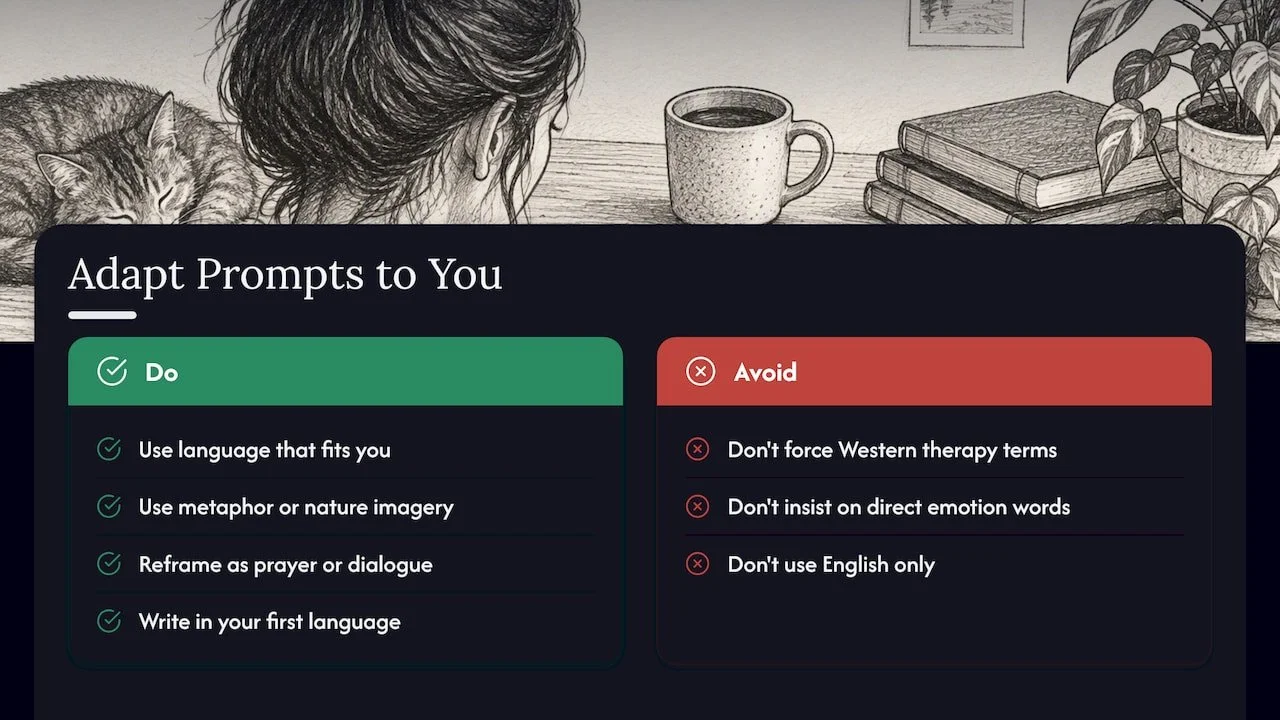
These prompts are written broadly on purpose, but they work better when you adjust the language to fit your own frame of reference. If direct emotional language feels unnatural, try translating prompts into metaphor, nature imagery, or whatever register feels familiar rather than forcing a Western therapy vocabulary onto your entries.
Faith or spiritual practice can sit comfortably alongside these prompts. Someone who prays regularly might reframe a reflective prompt as a conversation with a higher power rather than a solo reflection, and someone from a collectivist culture might adjust prompts about boundaries to focus on family roles rather than individual assertiveness.
Language matters too. If English is not your first language, writing in your first language, or switching between languages mid-entry, can access memories and feelings that get lost in translation. There is no correct way to phrase these prompts. The goal is accuracy to your own experience, not adherence to any particular script.
Why staged journaling is the approach we recommend
Most people reach for a journal when they are ready to feel better immediately, and that urgency is understandable but risky. The prompts that go viral online tend to skip straight to the deepest question, and that is exactly backward from how trauma recovery actually works.
Staging journaling, starting with grounding, then reflection, then short narrative work, is not caution for its own sake. It reflects how the nervous system processes threat: safety signals have to come first, or deeper memory work can retraumatize rather than heal. A culturally responsive approach matters just as much as pacing, since prompts written for one cultural frame can miss or misread someone else's experience of family, faith, or community. Journaling can be a genuine support alongside therapy, but it works best when it respects both the pace of healing and the person doing the healing.
— Juiced
Support beyond the page: EMDR, therapy, and journaling resources
Journaling helps many people organize their thoughts and notice patterns, but it has limits, especially for complex or persistent trauma.

Clinician-guided therapy options are available for readers whose symptoms go beyond what journaling alone can address.
EMDR Intensives in various formats provide concentrated, clinician-guided trauma processing when weekly sessions feel too slow.
Individual Counseling and EMDR Therapy offer ongoing, one-on-one work with trauma-informed therapists.
Immigration Evaluations and Victims of Crime support are offered for people navigating legal processes tied to trauma.
Journals and workbooks, including the PTSD Recovery Journal, for structured, evidence-informed writing support.
If your symptoms feel bigger than what a journal can hold, especially flashbacks, dissociation, or distress that lingers for weeks, consider booking an EMDR intensive or starting individual EMDR therapy with a bilingual, trauma-informed clinician.
Sources
These are the primary sources behind the safety and research guidance in this article.
Written Exposure Therapy (WET) for PTSD - PTSD: National Center for PTSD
Post-traumatic stress disorder (PTSD) - National Institute of Mental Health (NIMH)
Comparative efficacy and acceptability of expressive writing treatments... - Psychological Medicine
FAQ
What are some good prompts for journaling about trauma?
Good prompts start with grounding, like noticing five things you can see or naming a place where you feel safe, before moving into reflection and short narrative work. The 30 prompts organized by stage earlier in this article cover grounding, reflection, narrative, and integration.
What is the 3/2/1 method of journaling?
The 3/2/1 method asks you to write three things you notice around you, two things you feel in your body, and one small grounding action, such as feeling your feet on the floor. It works well as a quick check-in before or after deeper journaling.
What are the common responses to trauma in adults?
Common responses include heightened anxiety, avoidance of reminders, difficulty sleeping, and emotional numbness, though reactions vary widely between people. NIMH notes that many people recover naturally, but symptoms lasting more than a month and interfering with daily life may point to PTSD and warrant professional support.
What is the hardest trauma to heal from?
There is no single trauma that is universally hardest to heal from, since healing depends on factors like support systems, timing, and whether the trauma was ongoing or a single event. Complex or relational trauma, especially from childhood, often takes longer to process because it shapes core beliefs about safety and trust rather than a single memory.
When should trauma journaling stop and professional help start?
If journaling triggers flashbacks that do not settle, worsening insomnia, or a sense of reliving rather than reflecting on the event, it is time to pause solo narrative work and bring it to a therapist. A trauma-informed clinician can help you process deeper material safely, including through approaches like EMDR or Written Exposure Therapy.
