
Review of 15 Studies: EMDR for First Responders and Clinician Checklist

EMDR is a trauma-focused therapy recommended for PTSD in major clinical guidelines, and it is often an appropriate option for first responders, though research on first-responder samples specifically is still growing. If you carry work-related trauma from the job, the next step is finding a clinician trained in EMDR who also understands first-responder culture, and asking whether an intensive or telehealth format fits your schedule. Some therapy practices publish information on EMDR intensives for people in this position.
TL;DR:
EMDR can be adapted into short-term intensives or remote sessions, which may suit shift workers and those with unpredictable schedules.
The therapy often incorporates protocols like R-TEP and G-Search to target multiple recent or ongoing traumatic incidents common among first responders.
Stability and safety planning are essential before trauma processing, especially considering the reluctance and cultural norms around vulnerability in first responder populations.
Clinicians should have specialized EMDR training and experience with first responders; avoid practitioners who promise guaranteed cures or lack transparency about safety and scheduling.
Combining EMDR with medication, CBT, or peer support can enhance treatment, but sessions should be timed to optimize trauma processing and recovery.
Alvaradotherapy
Explore Trauma-Informed EMDR Support
Alvarado Therapy provides EMDR therapy and trauma-informed counseling for California adults healing from PTSD, complex trauma, anxiety, and grief.
Table of Contents
Evidence summary: effectiveness and limits for first responders
Specialized EMDR protocols and delivery formats used with first responders
How EMDR is adapted for first responder culture and schedules
How to choose an EMDR clinician: checklist and vetting questions
Long-term outcomes and relapse prevention after EMDR treatment
What EMDR is and how it works for trauma
EMDR, or Eye Movement Desensitization and Reprocessing, asks the brain to reprocess a stuck traumatic memory while the clinician guides bilateral stimulation, usually side-to-side eye movements, taps, or tones. The theory behind it, called adaptive information processing, holds that trauma gets stored in a way that keeps the nervous system reactive, and that this stimulation helps the memory settle into a less charged form. A typical course runs around three months of weekly sessions, though timelines vary by case complexity.
EMDR is grouped with two other trauma-focused therapies in most treatment guidelines:
Prolonged Exposure (PE) asks patients to repeatedly describe the traumatic memory aloud in detail.
Cognitive Processing Therapy (CPT) focuses on identifying and challenging trauma-related beliefs.
EMDR does not require a detailed verbal narrative of the event, which some first responders find easier to tolerate given operational habits around not discussing incidents in depth.
Evidence summary: effectiveness and limits for first responders
A systematic review and meta-analysis of psychological interventions for first responders found meaningful reductions in PTSD symptoms, with clinician-delivered, CBT-based approaches often producing the largest effects.
A pooled analysis across 15 studies of first responders found a standardized mean difference of -0.86 (95% CI, -1.34 to -0.39) for PTSD symptom reduction, a large effect by conventional benchmarks, though the same review flagged high heterogeneity and moderate-to-high risk of bias across the included studies.

The 2023 VA/DoD Clinical Practice Guideline lists EMDR alongside Prolonged Exposure and Cognitive Processing Therapy as a first-line, trauma-focused psychotherapy for PTSD, and it recommends shared decision-making rather than a single default choice, since no one therapy clearly outperforms the others for every patient. Read more in this overview of EMDR treatment effectiveness.
None of this means EMDR is a guaranteed fix. Evidence specific to first-responder populations is thinner than the general PTSD literature, study quality varies, and outcomes depend heavily on the clinician's training and the client's engagement. Clinician-delivered care, rather than self-guided or app-based versions, is the format the evidence actually supports.
Specialized EMDR protocols and delivery formats used with first responders
Standard weekly EMDR was designed for a single, resolved traumatic memory. First responders often carry multiple incidents, sometimes recent and sometimes ongoing, which has pushed the field toward adapted protocols.
G-Search, a technique within R-TEP, helps clinicians locate and target the most distressing fragments of a memory without requiring a full narrative walk-through, useful for cumulative or repeated exposure.
Group and remote intensive formats, such as GTEP, have shown promising results in a randomized controlled trial with frontline workers, which reported meaningful reductions in PTSD, anxiety, and depression symptoms using four 2-hour sessions delivered remotely over a week, though effects on moral injury were not demonstrated.
Intensive formats (multi-hour or multi-day sessions instead of weekly 50-minute visits) can compress treatment timelines, which matters for shift workers with unpredictable schedules; see how EMDR intensives work in practice.
These formats expand access quickly, but they require the treating clinician to be trained in the specific protocol and to have safety procedures in place before using them.
How EMDR is adapted for first responder culture and schedules
Occupational culture shapes how therapy needs to be delivered. First responders often operate under norms that discourage discussing distress openly, and stigma around seeking mental health care remains common in these fields. The EMDR International Association advises that clinicians working with public safety personnel use written early-intervention policies and demonstrate genuine familiarity with duty cycles, chain of command, and the reluctance many first responders feel about appearing vulnerable.
Timing matters as much as technique. Practitioners generally avoid scheduling intensive trauma processing in the 12 to 24 hours immediately following an active shift, since the post-shift emotional "crash" can blunt the nervous system's ability to integrate new processing, according to EMDRIA's guidance on first responders. Sessions are more often planned for off-shift windows when a person has had time to settle.
Before any memory processing begins, clinicians typically spend time on stabilization: safe-place imagery, grounding exercises, and a concrete safety plan for outside of sessions. This preparation phase is not optional scaffolding, it is part of what makes EMDR safe to use with someone whose job regularly exposes them to acute danger. For a walk-through of this phase, see how to prepare for EMDR therapy.
Pro Tip: Ask your clinician how they plan sessions around your shift schedule before you commit to a course of treatment.
How to choose an EMDR clinician: checklist and vetting questions
Not every licensed therapist who lists EMDR on a directory has deep experience with first responders. A short vetting process before booking can save months of mismatched care.
Confirm the clinician is a licensed mental health professional who has completed formal EMDR training through an approved program and receives ongoing consultation.
Ask directly whether they have experience treating first responders, and what they know about shift-work scheduling, chain-of-command culture, or repeated occupational exposure.
Ask about format options: standard weekly sessions, intensives, or telehealth, and whether they can accommodate irregular hours.
Ask how they handle stabilization and safety planning before any trauma processing begins.
Ask about session counts, fees, and how progress gets tracked over the course of treatment.
Treat certain answers as red flags: a clinician who promises a guaranteed cure, who skips any discussion of safety or containment, or who seems unwilling to talk openly about scheduling and confidentiality is worth reconsidering. A primer on EMDR evidence and therapist questions offers additional background if you want a second source before booking.
Long-term outcomes and relapse prevention after EMDR treatment
Symptom reduction after a course of EMDR does not mean the work is finished. First responders return to the same occupational exposures that contributed to their symptoms in the first place, which makes relapse prevention a distinct phase of care rather than an afterthought.
Clinicians typically build a maintenance plan before ending active treatment: identifying early warning signs of symptom return, such as sleep disruption, irritability, or avoidance behaviors creeping back in, and agreeing on a plan for brief check-in sessions if those signs appear. Some first responders schedule periodic EMDR "booster" sessions after a particularly difficult call or a cluster of incidents, using the same targeted, abbreviated approach found in recent-trauma protocols rather than restarting a full course of treatment.
Continued exposure to critical incidents means the underlying risk never fully disappears the way it might for someone who processed a single past event and returned to a low-stress environment. That reality shapes how relapse prevention gets framed: less about permanently closing a chapter, more about building a durable set of tools and a standing relationship with a clinician who can be reengaged quickly. Departments and unions increasingly support this model by making peer support and clinical referral pathways available on an ongoing basis rather than only after a crisis, though the extent of that support varies widely by agency and region.
Integrating EMDR with medication, CBT, and other treatments
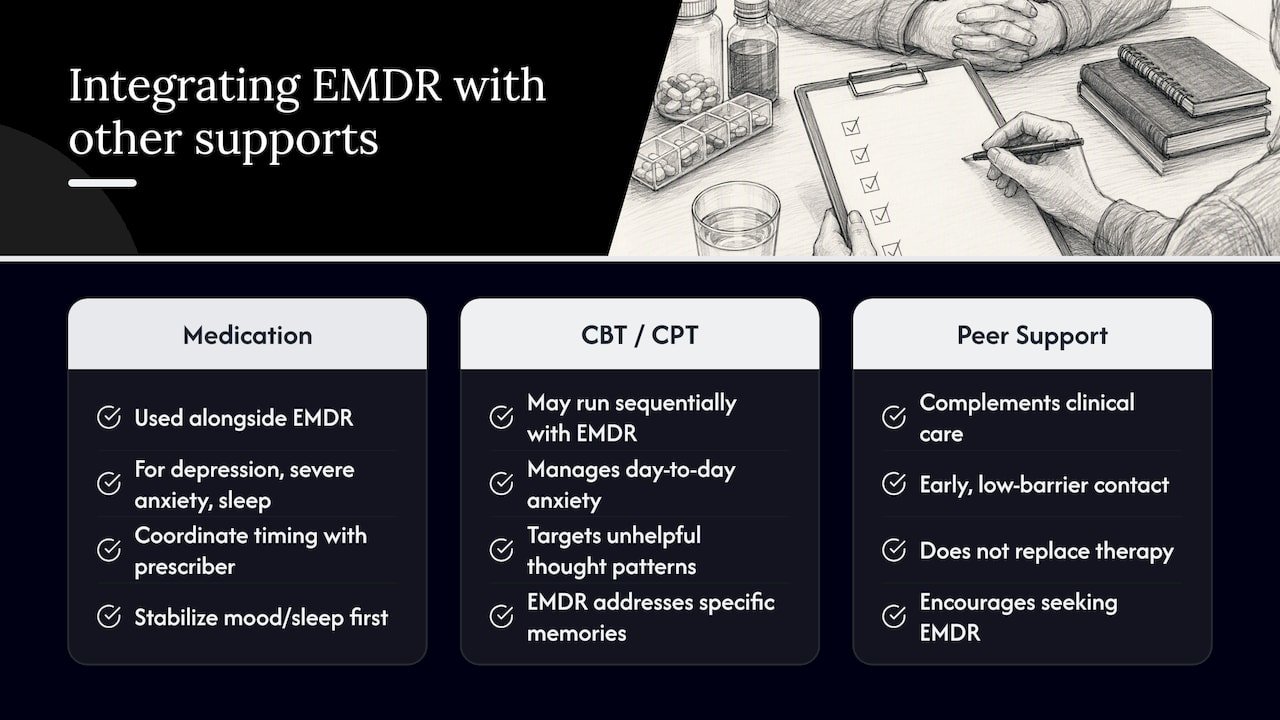
EMDR rarely stands alone as the only intervention a first responder receives, and it does not need to. The VA/DoD guideline places trauma-focused psychotherapy, including EMDR, above medication as a first-line choice when feasible, but it does not rule out combining approaches when clinically indicated.
Selective serotonin reuptake inhibitors or other medications are sometimes used alongside EMDR when depression, severe anxiety, or sleep disruption are significant enough to interfere with a person's ability to engage in trauma processing. A prescriber and the EMDR clinician ideally coordinate on timing, since stabilizing mood or sleep first can make trauma processing more productive.
CBT-based approaches, including Cognitive Processing Therapy, sometimes run in sequence with EMDR rather than in place of it. For example, a first responder might use CBT techniques to manage day-to-day anxiety or unhelpful thought patterns while EMDR addresses specific traumatic memories underneath those patterns. The choice between running therapies sequentially or relying on one approach depends on the individual's presentation, and it is a decision best made collaboratively with a treating clinician rather than self-directed.
Peer support programs, common in fire, police, and EMS departments, also complement clinical treatment. These programs do not replace licensed therapy, but they offer an early, low-barrier point of contact that can make someone more willing to eventually seek EMDR or another trauma-focused treatment.
Self-care and resilience habits that support EMDR treatment
EMDR sessions do the concentrated work, but what happens between sessions affects how well that work holds. Sleep is often the first casualty of shift work and repeated exposure, and poor sleep can blunt the nervous system's capacity to consolidate the gains made in processing sessions, so protecting sleep hygiene where shift schedules allow is a practical priority rather than a generic wellness tip.
Grounding techniques learned during the stabilization phase, such as paced breathing or sensory grounding, are meant to be used outside of sessions too, particularly after a difficult call. Physical activity, even in short bouts, is commonly recommended by clinicians as a way to discharge the physiological arousal that builds up during high-stress shifts. Maintaining social connection, whether through peer support groups, family, or friends outside the department, helps counter the isolation that can develop when someone feels their experiences are hard to explain to people outside the field.
Structured reflection tools, such as a trauma-focused journal, can also give people a private way to track patterns in mood, triggers, or sleep between sessions, information that is often useful to bring back to a clinician. None of these habits substitute for clinician-delivered EMDR when PTSD symptoms are significant, but they build the resilience base that makes trauma processing more sustainable over time.
A clinical perspective on treating first responders
First responders often wait years before seeking trauma treatment, not because EMDR does not work, but because the occupational culture around vulnerability makes the first phone call the hardest part. The clinicians we work with see this hesitation constantly, and it shapes how care gets structured from intake onward, with an emphasis on flexible scheduling, bilingual care in English and Spanish, and intensives for people whose availability does not fit a weekly appointment.
— Juiced
Getting started with EMDR at Alvarado Therapy
Some therapy practices offer individual EMDR therapy along with 1-day and 3-day EMDR intensives, formats built for people whose schedules do not allow for a year of weekly weeknight appointments. Sessions may be available online in multiple locations and sometimes in person, potentially in English and Spanish.

Getting started usually means an initial consultation to talk through your history, current symptoms, and schedule, followed by a stabilization phase before any trauma processing begins. If concentrated treatment fits your situation better than weekly visits, review the EMDR intensives page for details, or start with individual EMDR therapy if a standard weekly format works with your rotation. You can also review what to expect before booking your first session.
This article is general information, not a substitute for advice from a qualified doctor. Consult a qualified healthcare professional about your own circumstances before acting on anything here.
FAQ
What is the best therapy for first responders?
There is no single best therapy for every first responder. Major guidelines list EMDR, Cognitive Processing Therapy, and Prolonged Exposure as first-line, trauma-focused options according to the VA/DoD Clinical Practice Guideline, and the right choice depends on the individual's symptoms, history, and preferences.
Who is EMDR not recommended for?
EMDR generally requires caution or additional stabilization for people with significant dissociative symptoms, active substance dependence, or an unstable living or safety situation, since trauma processing can be destabilizing without adequate preparation. A qualified clinician assesses these factors during intake before beginning memory processing.
Which type of first responder has the highest rate of PTSD?
The reviewed evidence does not identify a single first-responder group with a definitively highest PTSD rate, since prevalence varies by study population, exposure level, and measurement method. What the research consistently shows is that cumulative and repeated exposure to critical incidents, common across police, fire, and EMS roles, is strongly linked to elevated PTSD risk.
What is first responder syndrome?
"First responder syndrome" is not a formal diagnostic term, but it is commonly used to describe the pattern of PTSD, depression, anxiety, and related symptoms that can develop from cumulative exposure to traumatic and high-stress incidents on the job. Clinicians typically diagnose and treat the underlying conditions, such as PTSD, rather than "first responder syndrome" as a standalone category.
