
1–24+ EMDR Sessions: Evidence Based Benchmarks by Trauma Type

Most people processing a single disturbing memory need just 1 to 3 sessions, while a full course for single-incident PTSD typically runs 3 to 6 sessions, and broader trauma work spans 6 to 12. Complex or childhood trauma often takes 12 to 24 or more sessions, run in 50 to 90 minute blocks, weekly, twice weekly, or in intensive formats. The real number always depends on individual assessment and how much preparation your history requires.
TL;DR:
Single-target memories typically require one to three sessions, while more complex traumas may need 12 or more, depending on severity and history.
The number of sessions is influenced by trauma target count, stabilization needs, comorbid conditions, and session pacing, not the trauma's severity.
Complex trauma involving childhood abuse or prolonged neglect often entails longer treatment, with many cases extending beyond 12 sessions.
Goals for progress include SUD scores near zero, positive cognition validation, and physical body scans showing no residual tension.
Intensive formats can condense traditional timelines for those unable to sustain weekly sessions, but they demand higher emotional bandwidth.
Table of Contents
How Many EMDR Sessions You'll Likely Need, by Situation
The question "how many EMDR sessions" doesn't have one answer because it isn't one kind of problem. A car accident and a childhood marked by neglect land in completely different session-count territory, even though both respond to EMDR.
1 to 3 sessions covers reprocessing a single targeted memory. This is the smallest clinical unit of EMDR work. Once your therapist identifies a specific image, belief, and body sensation tied to one event, reprocessing that single memory is generally accomplished within one to three sessions. That doesn't mean treatment ends there. It means one target got resolved.
3 to 6 sessions is the range clinics report for a single disturbing event with no complicating history. Think a dog bite, a bad car crash, a single assault. Cleveland Clinic notes single events often require 3 to 6 sessions, with sessions running 60 to 90 minutes.
6 to 12 sessions is the more commonly cited average for full PTSD treatment involving multiple targets or a slightly more layered history. APA's PTSD treatment guideline puts the typical delivery at one to two sessions per week for an average of 6 to 12 sessions, though some clients need fewer.
12 or more sessions applies to complex trauma. Childhood abuse, prolonged neglect, or multiple traumatic events layered over years require more stabilization work before reprocessing even starts, then multiple targets processed one by one. Cleveland Clinic reports these cases may take 8 to 12 or more sessions, and in practice many complex cases extend well past that.
A growing number of clients skip the weekly model entirely and opt for intensive formats: multiple hours or multiple days compressed into a shorter calendar window. These aren't a shortcut so much as a different delivery method for the same clinical work, and they suit people who can't sustain months of weekly appointments or who want faster containment around a specific event.
What Changes Your Session Count
Two people with what looks like "the same" trauma can need very different courses of treatment. A few variables drive most of that difference.
Number of trauma targets. One car accident is one target. A childhood spent walking on eggshells around an unpredictable parent might generate a dozen.
Stabilization needs. Clients who need real time in phases 1 and 2, building coping skills and emotional regulation before touching the memory itself, add sessions up front that pay off later.
Dissociation, active crisis, or substance use. Clinicians generally prioritize safety and pacing over rushing to reprocessing, which lengthens the timeline for anyone in an unstable period.
Comorbid diagnoses. Depression, anxiety disorders, or eating disorders layered on top of trauma often need their own attention alongside EMDR.
Session length and pacing model. A 50 minute weekly session and a 90 minute twice weekly session move through material at very different speeds, and intensives compress months of work into days.
None of these factors are a verdict on how "bad" your trauma is. A high target count usually reflects a long history, not a treatment failure. The EMDRIA blog points out that thorough prep work for complex histories exists specifically to prevent later sessions from becoming overwhelming.
Inside a Session: How the Eight EMDR Phases Use Your Time
EMDR runs on an eight-phase structure, and knowing where the time actually goes explains why some courses run long and others wrap up fast.
History taking. Your therapist maps your trauma history and picks initial targets.
Preparation. You learn grounding and self-regulation skills before touching anything painful.
Assessment. You and your therapist pin down the specific image, negative belief, emotion, and body sensation tied to one target.
Desensitization. This is the reprocessing phase, using eye movements or another form of bilateral stimulation while you hold the memory in mind.
Installation. A positive belief gets strengthened in place of the old negative one.
Body scan. You check for any remaining physical tension linked to the memory.
Closure. Every session ends with grounding, whether or not the target is fully processed.
Reevaluation. The next session opens by checking what held from the previous work.
Phases 1 and 2 are where complex-trauma courses gain most of their extra length, since building tolerance and coping skills before reprocessing takes real time. Phase 4 desensitization is the part most likely to span multiple sessions per target, especially when one memory triggers associative links to others. That's a known and expected pattern in EMDR, not a detour. Reprocessing frequently surfaces related memories once one target starts moving, which is exactly why a "simple" single-incident case can occasionally grow into more sessions than expected.
Pro Tip: Ask your therapist to name your specific targets by session three or four. If you can't get a rough list, it's a sign the assessment phase needs more time before reprocessing begins.
How Clinicians Know EMDR Is Working
Progress in EMDR isn't a feeling, it's tracked with two specific scales your therapist will reference by name.
The Subjective Units of Disturbance (SUD) scale runs 0 to 10, rating how upsetting a memory feels right now. The Validity of Cognition (VOC) scale runs 1 to 7, rating how true a positive belief feels when you think about that same memory. A target is generally considered processed when SUD drops near zero and VOC holds strongly positive, alongside a clean body scan showing no lingering physical tension tied to the memory.
Clinicians also watch for real-world shifts: less avoidance of triggers, better sleep, calmer reactions to reminders of the event. When those markers hold steady across sessions, some therapists schedule periodic booster sessions rather than closing treatment outright, particularly for clients with a history of relapse under stress.
SUD near 0 and VOC strongly positive on the target memory
Clear body scan with no residual tension
Reduced avoidance and improved daily functioning
Stability holding between sessions, not just within them
EMDRIA notes many clients show improvement after just a few sessions, even before the full target list is cleared, which is often the first real sign the approach is working for you.
Weekly, Twice Weekly, or Intensive: Choosing Your Pace
The standard EMDR model is one session a week, but it isn't the only one, and the right pace depends on your life and your history more than any fixed rule.
Weekly sessions give you time to integrate each session's work before the next one, which suits most people with moderate, ongoing support needs.
Twice weekly sessions speed up the calendar timeline for people with a specific event they want resolved quickly, without the intensity of a compressed format.
Multi-day intensives condense the same clinical work into a shorter window, often days instead of months, and work well for people who can't sustain a months-long weekly commitment.
Telehealth EMDR now runs at clinical parity with in-person work for most clients, using tools like tappers or on-screen visual cues instead of in-room bilateral stimulation.
VA guidance describes a typical course of about three months of weekly 50 to 90 minute sessions for many clients, which is a useful mental benchmark if you're mapping out a calendar. Massed, back-to-back sessions in an intensive format can move faster, but they demand more emotional bandwidth in a shorter window, so they aren't the right fit for everyone. Session length itself commonly runs 50 to 90 minutes, with some therapists offering extended 90 to 120 minute blocks specifically for intensive work.
The Research Behind These Session Ranges
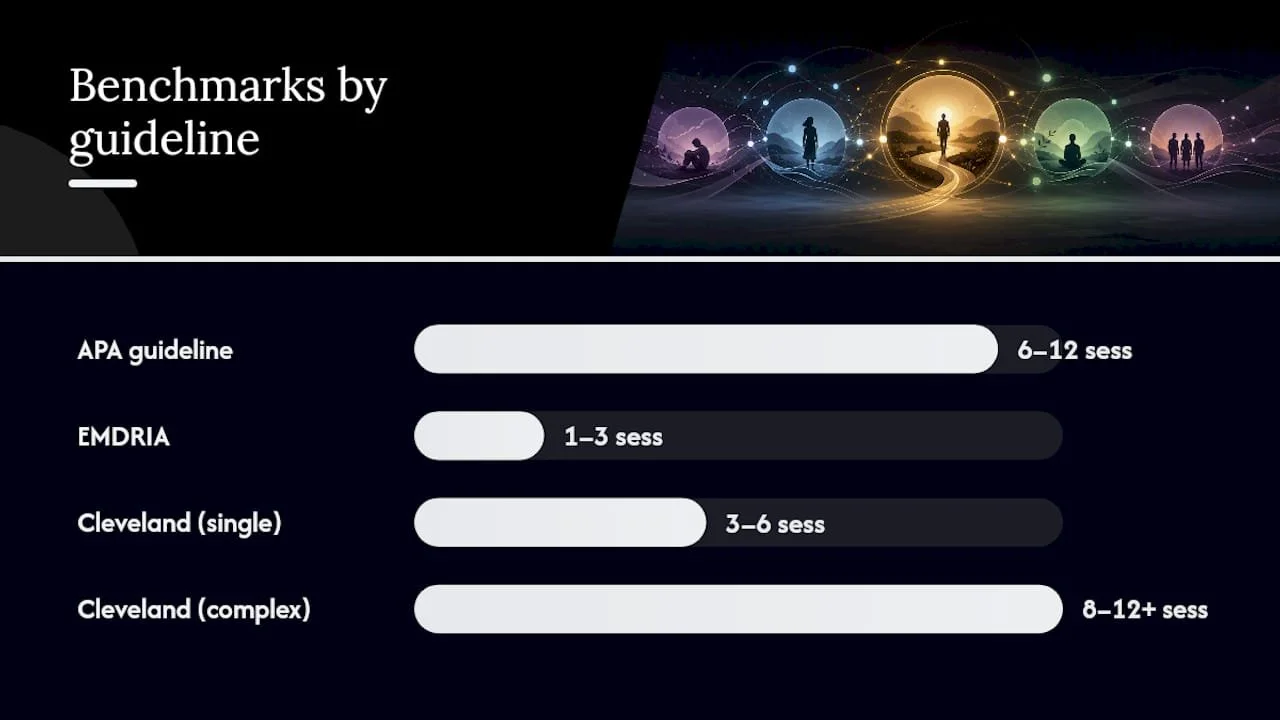
The numeric benchmarks used throughout this article aren't guesswork, they come from a small set of clinical guidelines and peer-reviewed sources that largely agree with each other.
APA's PTSD treatment guideline sets the benchmark at 6 to 12 sessions on average, delivered one to two times weekly, with single-target reprocessing often finishing faster. EMDRIA's own patient-facing guidance confirms the 1 to 3 session window for a single memory, while noting that full preparation and consolidation phases still need to happen around that core work. The VA's clinical page adds the practical detail that many people notice change within a handful of sessions, well before a full course wraps up.
APA guideline: 6 to 12 sessions typical, 1 to 3 for single-target reprocessing
EMDRIA: single memory generally resolved in 1 to 3 sessions
VA: noticeable improvement often within a few sessions; roughly three months typical course
Cleveland Clinic: 3 to 6 sessions for single events, 8 to 12 or more for complex trauma
Peer-reviewed literature backs the broad pattern but flags real variation. A PMC-published review of EMDR clinical trials documents substantial early improvement in some populations, though study designs and populations differ enough that pooled averages hide a wide spread. Single-incident studies skew toward shorter courses; studies involving complex or developmental trauma report longer ones, which tracks with what clinicians see in practice every week.
Getting the Most Out of Every Session You Book
A handful of small, deliberate choices between sessions can keep your course of treatment as efficient as your history allows.
Protect your sleep the night before and after a session, since sleep consolidation affects how well reprocessing holds.
Skip alcohol or recreational substances close to session times. They blunt the emotional access EMDR depends on.
Practice the regulation skills from phase 2 daily, not just when you're distressed, so they're automatic when you need them.
Name your priority targets with your therapist early rather than letting the list stay vague.
Track your own SUD score for the week between sessions in a short notebook or app.
Pro Tip: If a session leaves you shakier than usual for more than a day or two, tell your therapist before the next appointment. That's a pacing conversation, not a sign EMDR isn't working for you. For a fuller walkthrough of what to do before your first appointment, see how to prepare for EMDR therapy.
A Clinician's View on Session Counts
The numbers above are real benchmarks, but they're starting points, not promises. Cultural background, language, and how safe someone feels naming their history all shift pacing in ways a chart can't capture. Bilingual, trauma-informed care tends to move at a more honest pace because clients aren't also translating their pain into a second language mid-session. Intensive formats and telehealth have opened up options for people who couldn't sustain months of weekly appointments before, and that access matters more than any fixed session count.
— Juiced
Ready to Find Your Own EMDR Timeline?
Alvaradotherapy is the direct route to answering your own "how many sessions" question, rather than guessing from ranges in an article. As a bilingual, trauma-informed practice serving California and New York, Alvaradotherapy offers EMDR delivered weekly or in intensive formats for clients who want faster containment around a specific event, plus full online sessions for anyone who can't get into an office regularly.

If your history includes complex or childhood trauma rather than a single incident, the PTSD and complex trauma program is built around the longer, phased pacing that kind of work actually needs. Not sure which track fits? A consultation is the fastest way to get a real answer specific to your history. Ready to see what a first session looks like? Visit the what to expect page and book your first appointment.
Where These Session Benchmarks Come From
APA PTSD treatment guideline: the field's clinical benchmark for typical session ranges.
EMDRIA: the professional body defining the eight-phase model and single-target timelines.
VA EMDR guidance: practical timeline and session-length norms from a major clinical provider.
PMC peer-reviewed literature review: trial data on effectiveness and variation across populations.
Psymind's EMDR overview: additional clinical detail on phase-by-phase session mapping.
This article is general information, not a substitute for advice from a qualified doctor. Consult a qualified healthcare professional about your own circumstances before acting on anything here.
Sources
Eye Movement Desensitization and Reprocessing (EMDR) therapy — APA PTSD treatment guideline
Experiencing EMDR Therapy — EMDR International Association (EMDRIA)
