
Avoid Denials: California CalVCB Therapy Rules for ATPs, EOBs, Telehealth

Yes. The California Victim Compensation Board (CalVCB) pays for mental health treatment tied to a qualifying violent crime, but coverage comes with real limits. Expect session and dollar caps, a requirement that you bill your health insurance first, and specific rules around telehealth and provider licensing that can trip up claims if nobody plans for them.
TL;DR:
CalVCB therapy coverage is limited by session and dollar caps, requires insurance billing first, and has strict rules for telehealth and provider licensing.
Mental health benefits apply to direct victims, family members, witnesses, helpers, and caregivers, with benefits varying by classification and documentation.
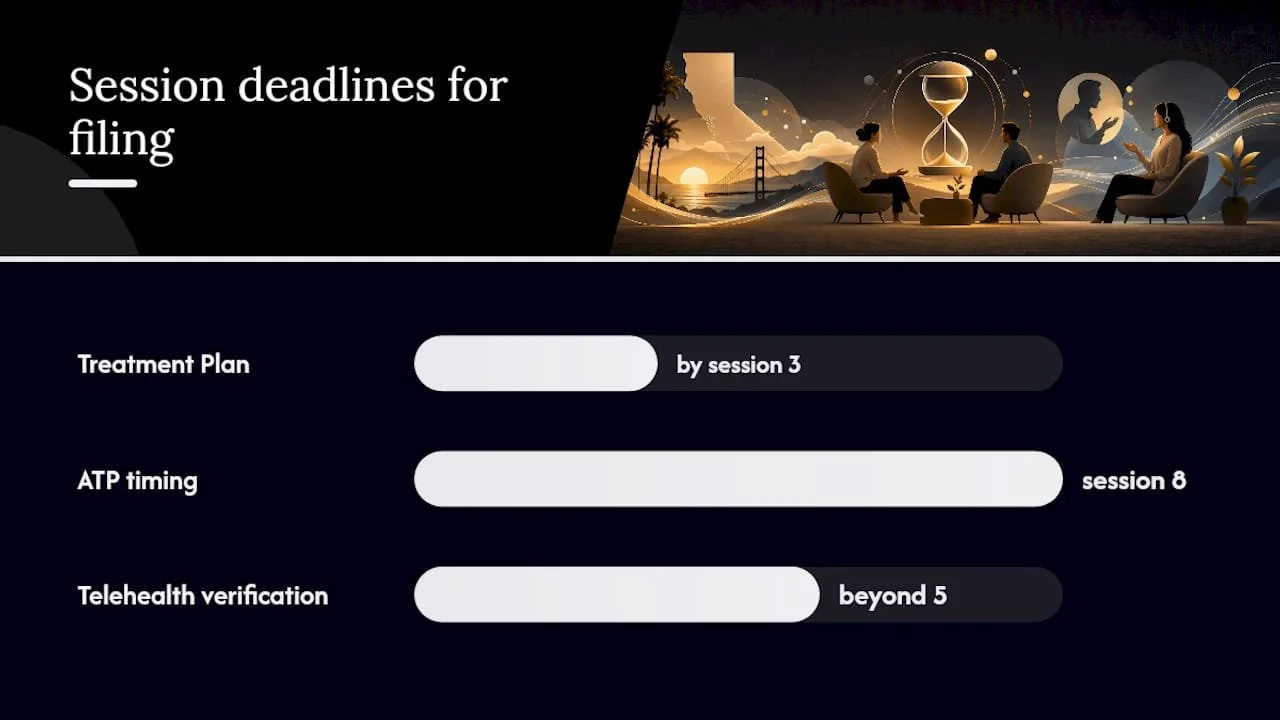
Providers must submit a Treatment Plan by session three and file an Additional Treatment Plan within 90 days after reaching the session limit to maintain coverage.
Insurance must be billed and EOB attached before CalVCB reimburses, and expenses unrelated to the crime or involving cancellations and travel are not covered.
Telehealth sessions count towards a five-hour per application limit, with additional authorization required beyond that, and licensed out-of-state providers can now bill CalVCB since January 2023.
Table of Contents
What Does CalVCB Therapy Coverage Actually Include?
CalVCB therapy coverage isn't a blank check for any mental health service. It covers treatment tied directly to a qualifying crime, and the list of covered services is fairly broad once eligibility is established.
Individual psychotherapy sessions with a licensed provider
Group therapy when clinically appropriate
Psychiatric evaluation and medication management
Case management, capped separately from therapy sessions
Psychological testing when it relates directly to the crime
The CalVCB Benefit Reference Guide lists specific session and dollar caps for mental health treatment for direct victims, along with a comprehensive cap per application covering all benefit types combined. Session limits aren't measured in raw hours. Billing uses CPT unit math, so a 60-minute session might register differently than a 45-minute one depending on the code a provider uses. That distinction matters when you're tracking how many sessions remain before you need additional authorization.
Case management runs on its own track too. CalVCB guidance caps it at up to five hours per application, and those hours don't eat into your mental health session count, according to CalVCB's mental health guidelines.
Who Qualifies for CalVCB Mental Health Benefits?
Your classification under CalVCB determines how many sessions and dollars you're eligible for, so it's worth understanding early.
Direct victims: people who were physically or emotionally injured by the crime itself
Derivative victims: family members or household members affected by what happened to a direct victim
Minor witnesses: children who witnessed violence, even without direct physical harm
Good Samaritans: bystanders injured while intervening or helping
Primary caretakers: those managing daily care for a victim who can't care for themselves
If you fit more than one category, CalVCB applies whichever classification gives you the most favorable benefit level. Documentation usually starts with a police report, though CalVCB can work with incident details even when charges were never filed or a suspect was never identified.
How Do You Apply for CalVCB Therapy Coverage?
Filing a claim follows a fairly predictable sequence, whether you're the victim or the provider handling the paperwork.
Call the CalVCB helpline or start your application online to establish your claim number.
Submit required documentation, including incident details and any police report on file.
Choose a provider and confirm they can bill CalVCB directly or that you'll seek reimbursement.
Providers submit a Mental Health Billing Intake Form alongside a CMS-1500 on the first bill, along with licensure verification and a completed W-9.
Providers itemize each date of service so CalVCB can match sessions against your authorized limit.
Attach an Explanation of Benefits (EOB) from your health insurer, since this speeds processing significantly.
Most providers bill CalVCB directly rather than asking you to pay out of pocket and wait for reimbursement, which keeps therapy accessible even if money is tight.
When Do You Need an Additional Treatment Plan (ATP)?
Your provider has to complete a Treatment Plan by your third session and keep it on file, per CalVCB's provider guidance. That initial plan covers you through your first authorized session block.
Once you're approaching that limit, an Additional Treatment Plan becomes necessary to keep receiving covered sessions.
ATPs request authorization for sessions beyond your initial limit.
The CalVCB guidelines call for the ATP to be submitted within 90 days after the bill that exhausts your authorized sessions.
Providers should start the ATP paperwork when a claimant is roughly eight sessions from their limit, not after hitting it.
Bills submitted for dates of service before a timely ATP was filed can be returned and denied permanently.
Pro Tip: Ask your provider directly which session number they're planning to submit your ATP at. If they can't answer, that's a sign to bring it up again before you're three sessions from your cap.
What Won't CalVCB Reimburse, and What Are the Billing Rules?
CalVCB is a payor of last resort. That means providers must bill your health insurance first and include the EOB with their claim, unless you qualify for a documented exemption, according to CalVCB's reimbursement page. CalVCB only steps in to cover what your insurance doesn't.
Providers bill using standard CPT codes, and CalVCB publishes example reimbursement rates tied to codes like 90834, 90837, 90846, and 90847 for individual, extended, and family sessions.
Some expenses fall outside coverage entirely:
Treatment unrelated to the qualifying crime
Missed or canceled appointment fees
Travel time to and from appointments
Interest charges or administrative billing fees
Costs tied to accompanying you to court proceedings
Knowing this list upfront saves both you and your provider from submitting bills that get bounced back.
Can You Get CalVCB-Covered Therapy Through Telehealth?
Telehealth counts toward your session limit just like in-person care, with an important cap: CalVCB allows up to five telehealth session hours per application before additional authorization is needed, per CalVCB's guidelines.
Beyond five telehealth sessions, providers must submit a Telehealth Therapy Verification form with clinical justification. Submitting it doesn't guarantee approval.
Since January 1, 2023, CalVCB reimbursement rules allow providers licensed in the state where you live to bill CalVCB, not just California-licensed clinicians, thanks to Senate Bill 877.
Telehealth sessions still need to meet HIPAA requirements and standard telehealth licensure rules.
If your treatment started before 2023, different licensure requirements may have applied to your case.
A Checklist for Victims and Providers Filing CalVCB Claims
Getting reimbursed smoothly usually comes down to timing and paperwork, not luck.
Call the CalVCB helpline and file your application as soon as possible after the incident.
Save every receipt, incident report, and piece of documentation connected to the crime.
Ask your provider to complete your Treatment Plan by session three, not later.
Confirm your provider submits the Mental Health Billing Intake Form and CMS-1500 on their first bill.
Make sure your provider bills your health insurance first and attaches the EOB to CalVCB claims.
Ask about ATP timing around session eight of your authorized block, not at the deadline.
If you're using telehealth beyond five sessions, confirm the Telehealth Therapy Verification form has been filed.
Pro Tip: Keep a simple session log yourself, even a note in your phone. If your provider's office changes staff mid-claim, you'll still know exactly where things stand.
Clinicians who work with crime victims regularly tend to build ATP prep into their intake process from day one, documenting how the treatment connects to the crime clearly enough that CalVCB reviewers don't have to guess.
How Alvarado Therapy Supports CalVCB Claimants
Alvaradotherapy works with crime victims across California through trauma-informed care for victims of crime, including EMDR therapy delivered in English and Spanish. The practice understands VOCA-adjacent funding and builds Treatment Plans and documentation with CalVCB requirements in mind from the first session, which helps prevent the returned-bill problems that come from late ATPs or missing licensure paperwork. If you're navigating a claim, Alvaradotherapy's what-to-expect page walks through the therapy process, and a direct consultation can address your specific documentation needs.
— Juiced
Where to Find CalVCB Forms and Crisis Support
Start with the Benefit Reference Guide for limits, the Mental Health Provider PDF for billing forms, and Mentalhealth if you need immediate crisis help. Download the Mental Health Billing Intake Form first.

Trauma Therapy That Fits Your CalVCB Coverage
Alvaradotherapy is built for exactly this situation: California crime victims who qualify for CalVCB therapy coverage but need a provider who already knows how the paperwork works. Rather than explaining Treatment Plans and ATP timing to a therapist for the first time, you work with a bilingual, trauma-informed practice that handles EMDR therapy and victims-of-crime support as a core specialty, not an afterthought.
If you're carrying PTSD, grief, or anxiety from a crime and want a therapist who understands both the clinical side and the CalVCB claims process, Alvaradotherapy serves clients across Pasadena, Ventura, and online throughout California. For general guidance on vetting any trauma counselor, The Pursuit Counseling's guide to finding trauma counseling is a useful starting point. When you're ready to talk through your specific situation and documentation needs, book a consultation with Alvaradotherapy to get started.
This article is general information, not a substitute for advice from a qualified doctor. Consult a qualified healthcare professional about your own circumstances before acting on anything here.
