
Relief in 6–12 Sessions: EMDR for Performers With Performance Anxiety

EMDR is a legitimate, evidence-backed option for performance anxiety, particularly when the fear traces back to a specific bad memory (a blown audition, a public failure, a moment of freezing on stage). Research on EMDR for anxiety and phobias shows it outperforms passive controls with a fair amount of consistency, though it looks more mixed against other active therapies. If you want the actual studies, keep reading the evidence section below; if you just want to know what a session looks like, skip to the timeline section.
TL;DR:
EMDR shows strong evidence of reducing anxiety and phobias overall, especially when compared to passive controls like waitlists.
The therapy effectively targets specific traumatic memories linked to performance anxiety and utilizes future rehearsal to build confidence.
Performance-specific research is limited by small sample sizes and varied study designs, so results should be approached with cautious optimism.
EMDR is best suited for individuals with a clear, identifiable triggering memory and pronounced physical reactions, not diffuse performance anxiety.
A typical EMDR session lasts 60 to 90 minutes and involves eight structured phases, with progress usually appearing within six to twelve sessions for clear cases.
Table of Contents
What the Research Says About EMDR for Anxiety and Performance
What EMDR Sessions for Performance Anxiety Actually Look Like
How EMDR for Performance Anxiety Works
EMDR stands for Eye Movement Desensitization and Reprocessing, and the mechanism behind it is less mysterious than it sounds. The therapy rests on the adaptive information processing (AIP) model, which holds that when something distressing happens, your brain sometimes fails to file the memory away properly. Instead, it stays "stuck," still wired to your nervous system as if the danger were current. That's why a singer can flub one high note in 2019 and still feel their stomach drop before every audition years later. The memory never got processed. It got frozen.
During a session, a therapist asks you to briefly recall the target memory while simultaneously engaging in bilateral stimulation, usually side-to-side eye movements, tapping, or alternating audio tones. Nobody fully agrees on why this works, but the leading theory is that dividing attention between the memory and the physical stimulation taxes working memory just enough to loosen the emotional grip of the recollection. Over repeated passes, the memory keeps its facts but loses its charge. You remember what happened. You stop reliving it.
For performance-specific work, many clinicians use EMDR-PEP, the Performance Enhancement Psychology Protocol, an adaptation built specifically for athletes, musicians, and performers. EMDR-PEP typically targets three things:
The originating memory (the specific moment performance anxiety took root)
Self-defeating beliefs that grew out of that memory ("I always choke," "I'm not cut out for this")
A future template, a mentally rehearsed, sensory-rich version of the upcoming performance, reprocessed the same way as the past memory
The future template deserves special attention because it's often what separates performance-focused EMDR from standard anxiety treatment. Instead of stopping once the old memory feels neutral, the therapist walks you through an imagined version of the recital, game, or presentation, complete with the small details that used to trigger panic, and pairs it with bilateral stimulation until it plays out calmly in your mind.
Pro Tip: Bring a specific memory to your first session, not just a general feeling of "I get nervous." EMDR works best when there's a concrete scene to target. Even something that seems minor, like a specific comment a coach made, gives the therapist somewhere to start.
That specificity is also why EMDR tends to produce durable change rather than a bag of coping tricks. CBT teaches you what to do when anxiety shows up. EMDR aims to change how much anxiety shows up in the first place, by neutralizing the memory that's generating it.
What the Research Says About EMDR for Anxiety and Performance
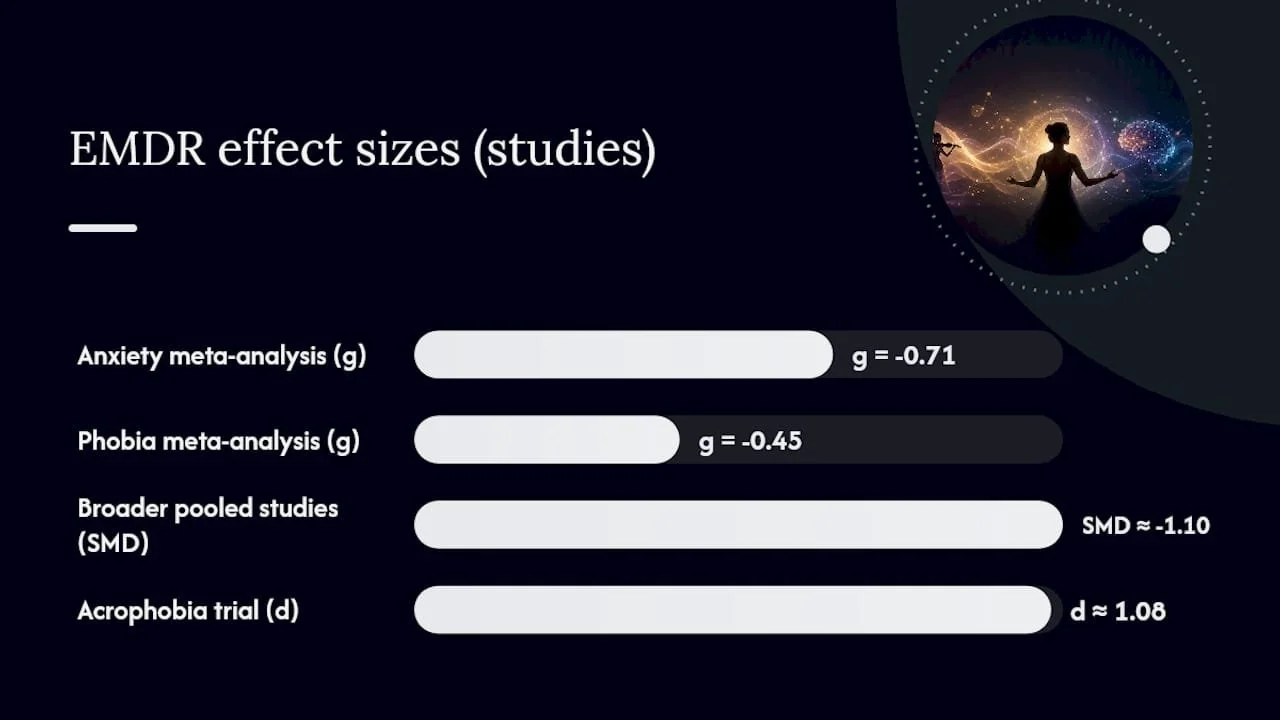
The strongest evidence for EMDR comes from anxiety and phobia treatment broadly, not performance anxiety in isolation, and it's worth being upfront about that gap.
A meta-analysis of 17 randomized trials involving 647 participants found EMDR produced significant reductions in anxiety (effect size g = -0.71) and phobia symptoms (g = -0.45). Those are meaningful effects by clinical standards. The catch: the improvement was much larger when EMDR was compared against passive controls (waitlists, no treatment) than when it went head-to-head against other active therapies like CBT. That doesn't mean EMDR is weaker than CBT. It means the two often land in similar territory, and picking one over the other usually comes down to fit, not superiority.
A broader analysis of 40 studies covering 2,064 participants reinforced that pattern, reporting a pooled standardized mean difference around -1.10 for anxiety and depression outcomes, alongside notably high heterogeneity across the included studies. Translation: EMDR works well on average, but individual results vary a lot depending on the population, the therapist, and how the condition was measured.
EMDR shows larger gains against passive controls than against other active anxiety therapies, and pooled studies report high heterogeneity, meaning results vary considerably between trials and populations.
Performance-specific research is thinner but growing. Early pilot work and clinical case reports describe reduced performance anxiety and improved output in athletes after EMDR, and a small mixed-methods study of student-athletes reported measurable drops on the Sports Anxiety Scale-2 across six sessions, with athletes also describing better self-talk and steadier pre-competition routines. A controlled trial on acrophobia found EMDR produced large effects (Cohen's d around 1.08) comparable to virtual reality exposure therapy, which matters here because acrophobia and stage fright share the same physiological signature: an out-of-proportion fear response tied to anticipated exposure.
The honest limitations:
Most performance-specific studies use small samples, sometimes single-digit or low double-digit participant counts
Sports and performing-arts research is newer and less standardized than PTSD or general phobia research
Study designs vary widely, making it hard to compare results across trials
The takeaway for anyone weighing this treatment: EMDR is well-established for anxiety and phobias generally and promising for performance anxiety specifically, but the performance-specific evidence base is still catching up to the theory. That's a reason for cautious optimism, not skepticism, and you can read more on how EMDR compares with other anxiety treatments if you want the fuller picture.
Who Actually Benefits From EMDR for Performance Anxiety
Not every case of stage fright or pre-game jitters needs trauma-focused work. EMDR tends to fit best when certain signals are present.
A specific originating memory exists. If you can point to a moment, a bombed solo, a public correction, a humiliating mistake in front of a crowd, EMDR has something concrete to target.
Strong physiological reactions accompany the fear. Racing heart, nausea, tunnel vision, or dissociation before performing suggests the nervous system is treating the event as a genuine threat, which is exactly what EMDR addresses.
Shame or humiliation keeps resurfacing. If the anxiety carries an emotional undertone of "everyone saw me fail," that's a hallmark of unprocessed memory, not just nerves.
General coping strategies haven't stuck. If breathing exercises and positive self-talk help briefly but the anxiety returns full force, the root memory may still be active.
CBT or skills-based coaching often works better, or works well alongside EMDR, when anxiety is more diffuse: general perfectionism, performance anxiety without a clear trigger event, or anxiety tangled up with ongoing life stress rather than a discrete past incident.
Comorbidities matter too. Depression, panic disorder, or a history of complex trauma don't rule out EMDR, but they change the pacing and often mean a longer stabilization phase before target-memory work begins. Mention any of these at intake, along with substance use, dissociation episodes, or current medications. A therapist trained in EMDR treatment planning needs that full picture to sequence the work safely.
What EMDR Sessions for Performance Anxiety Actually Look Like
EMDR follows an eight-phase structure, and for performance anxiety, each phase has a clear job.
Phases 1 to 2 (history and preparation): The therapist maps out your performance history, identifies the target memory, and teaches grounding techniques you'll use if things feel intense.
Phases 3 to 6 (reprocessing): This is the core work, revisiting the target memory with bilateral stimulation until its emotional charge drops, then addressing negative beliefs that grew from it.
Phase 7 (future template): The therapist guides you through a mentally rehearsed version of an upcoming performance, reprocessing it until it feels manageable rather than threatening.
Phase 8 (reevaluation): Follow-up sessions check whether gains held and whether new material surfaced.
Sessions typically run 60 to 90 minutes. For a single, well-defined incident, meaningful relief sometimes shows up within six to twelve sessions; more complex histories, especially where performance anxiety is layered on older trauma, can take considerably longer.
Bilateral stimulation might involve hand movements you follow with your eyes, alternating tactile buzzers held in each hand, or alternating tones through headphones, whichever your nervous system responds to best. Before sessions, it helps to jot down specific memories tied to your anxiety, note physical sensations you notice before performing, and get a full night's sleep when possible. Progress usually shows up gradually: less physical dread before a specific type of event, an easier time recovering from small mistakes mid-performance, memories that used to sting now feeling flat or distant. For a fuller walkthrough, see how to prepare for an EMDR session.

Is EMDR Safe? Risks and Aftercare to Know About
EMDR is generally well tolerated, but reprocessing distressing memories isn't always comfortable in the moment.
Emotional intensity or tearfulness during sessions is common and typically expected, not a sign something's wrong
Fatigue or feeling emotionally "raw" for the rest of the day after a session happens frequently
Vivid dreams or brief spikes in anxiety between sessions can occur as the brain continues processing
Clinicians manage these reactions with grounding techniques and by pacing the work so you never leave a session in a highly activated state. EMDR requires extra caution, and sometimes a different sequencing of care, for people with severe dissociative symptoms, active and unmanaged substance use, or unstable medical or psychiatric conditions. This isn't a reason to avoid EMDR outright, but it is a reason to be upfront about your full history during intake, per EMDRIA's clinical guidance on anxiety.
Pro Tip: After a session, skip major decisions or high-stakes performances if you can help it. Give yourself a buffer day, hydrate, and treat the rest of that day the way you would after a hard workout: rest, don't push.
Contact your clinician promptly if distress persists for days rather than hours, or if new, unrelated traumatic memories surface unexpectedly.
Alvaradotherapy's Approach to Performance-Focused EMDR
Alvaradotherapy works with clients across California and New York, in person in Pasadena and Ventura or fully online, using EMDR as a core part of individual therapy and through EMDR intensives for those who want concentrated, accelerated progress. Bilingual care is available in English and Spanish, which matters for performers and professionals who think and feel most precisely in their first language.
Intake for performance-focused EMDR starts with mapping your specific triggers: which situations spike anxiety, whether there's an identifiable originating memory, and how anxiety shows up physically before and during performance. From there, care follows the standard eight-phase EMDR protocol, adapted with performance-specific future templates when appropriate, and grounded in the same evidence discussed above rather than treated as a guaranteed fix. Every client is screened for contraindications and comorbidities before reprocessing work begins, and the pacing adjusts to what each person's history actually calls for.
Where the Field Gets Performance Anxiety Wrong
Most performance-anxiety advice treats the problem as a skills gap: breathe better, visualize success, practice more. That framing misses a real subset of cases where the anxiety isn't about skill at all. It's about an unresolved memory still running in the background. Conventional coaching keeps polishing the technique while ignoring the actual source of the fear.
The evidence supports a more specific claim than "EMDR helps anxiety." It supports EMDR as a strong option when a person can point to a discrete moment their performance fear began, and a weaker fit when the anxiety is diffuse or purely situational. Readers should prioritize that distinction before anything else: identify whether there's a real memory to target. If there is, EMDR's future template work offers something coping strategies alone rarely deliver, a rehearsed, embodied sense that the next performance will go differently. If there isn't a clear originating event, CBT or structured exposure work may be the more efficient first step, with EMDR held in reserve.
— Juiced
Ready to Talk to Someone About Performance Anxiety?
If you've read this far, you're probably past general curiosity and into "what would this actually look like for me." A first appointment with Alvaradotherapy usually starts with a conversation about what triggers your anxiety, whether there's a specific memory behind it, and what past attempts at managing it have looked like. It helps to bring a rough timeline of when the anxiety started, notes on physical symptoms, and one or two concrete examples of performances that went badly.

You can see exactly what an initial session involves on the what to expect page, or book a lower-commitment consultation first if you want to ask questions before committing to a full course of care. During that call, ask directly about a clinician's experience with performance-focused EMDR and EMDR-PEP specifically, not every therapist trained in EMDR has worked with athletes, musicians, or public speakers, and that specialization matters for how quickly the future template work clicks into place. If you're weighing whether to search locally first, guidance on finding an anxiety therapist can help you know what questions to ask any provider you're considering.
Sources
This article is general information, not a substitute for advice from a qualified doctor. Consult a qualified healthcare professional about your own circumstances before acting on anything here.
