
Benefits of EMDR for Anxiety: What the Evidence Shows

TL;DR:
EMDR can significantly reduce anxiety symptoms by reprocessing distressing memories and decreasing automatic threat responses. It is especially effective for PTSD-related anxiety, panic disorder, and specific phobias, often within 6 to 12 sessions. The therapy involves phases of stabilization, targeted reprocessing, and grounding to ensure safe and lasting relief.
EMDR can meaningfully reduce anxiety symptoms for many adults by reprocessing distressing memories and decoupling the automatic threat responses that keep anxiety alive. A meta-analysis of 40 RCTs (N = 2,064) found EMDR associated with a standardized mean difference of approximately −1.10 for combined depression and anxiety outcomes versus control conditions, with anxiety subgroup effects slightly larger. The APA and the VA/DoD Clinical Practice Guideline both recognize EMDR as a first-line trauma treatment, and standard protocols typically run 6–12 sessions, though some people report meaningful relief in as few as 1–3 sessions for focused targets.
The strongest evidence sits with PTSD-linked anxiety, panic disorder, and specific phobias. Evidence for generalized anxiety disorder is thinner, and head-to-head comparisons with active therapies like CBT show smaller, less certain differences. Still, for adults whose anxiety connects to specific memories or conditioning events, EMDR offers a structured, evidence-backed path that many find more tolerable than prolonged exposure approaches.
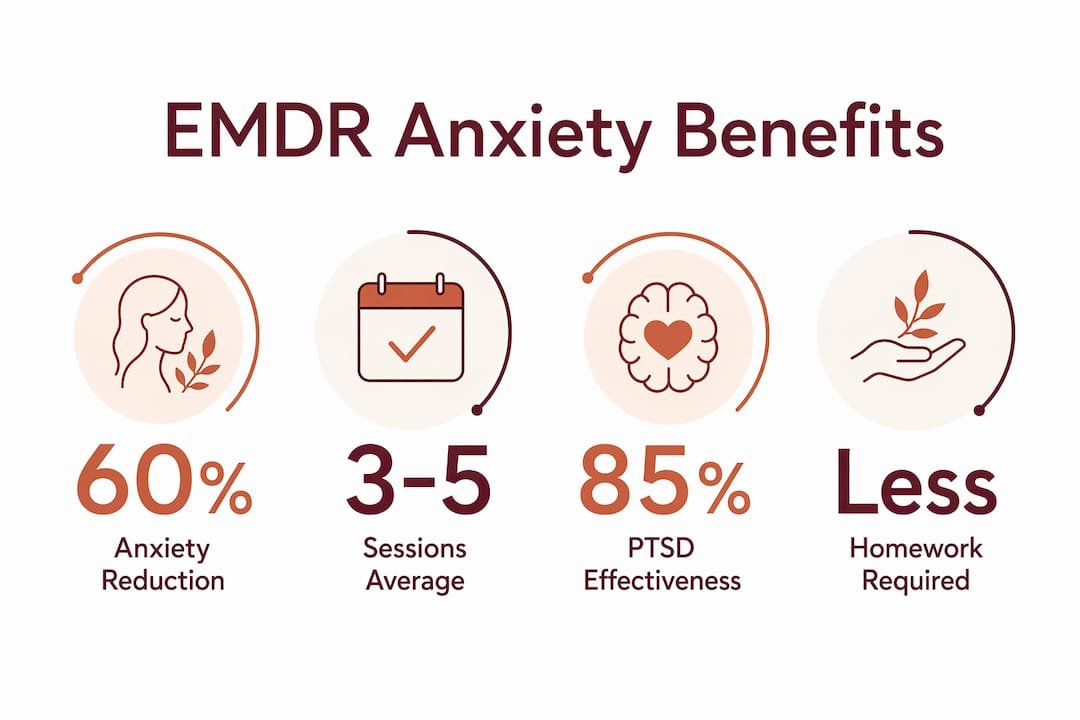
Table of Contents
How EMDR can reduce anxiety: the mechanisms behind the relief
What does the research actually show about EMDR and anxiety?
What happens in an EMDR session? A phase-by-phase walkthrough
How long does EMDR take for anxiety, and what does it cost in the U.S.?
How to find and choose a qualified EMDR therapist in the U.S.
A clinical perspective on EMDR for anxiety at Alvaradotherapy
Alvaradotherapy offers EMDR for anxiety in California and New York
What is EMDR and how does the clinical framework work?
Eye Movement Desensitization and Reprocessing (EMDR) is a structured psychotherapy developed by Francine Shapiro in the late 1980s. Its goal is to reduce the distress attached to traumatic or disturbing memories by changing how those memories are stored and retrieved in the brain.
The theoretical backbone is the Adaptive Information Processing (AIP) model, which holds that psychological symptoms arise when distressing experiences get "stuck" in memory without being fully processed. The nervous system stores them in a raw, emotionally charged form, and they continue to fire as if the threat were still present. EMDR uses bilateral stimulation — typically guided eye movements, auditory tones, or tactile taps — during controlled memory recall to restart that processing and allow the memory to integrate into the broader memory network in a less distressing form.
The treatment unfolds across eight structured phases:
Phase 1 (History-taking): Clinician and client map relevant history, identify memory targets, and assess readiness.
Phase 2 (Preparation): Client learns grounding and stabilization techniques before any reprocessing begins.
Phase 3 (Assessment): Client identifies a target image, a negative belief about the self, and rates current distress.
Phase 4 (Desensitization): Sets of bilateral stimulation are applied while the client holds the target in mind; distress is tracked after each set.
Phase 5 (Installation): A positive cognition is strengthened to replace the negative belief.
Phase 6 (Body scan): Client scans for residual physical tension or distress linked to the memory.
Phase 7 (Closure): Session ends with grounding; the client is stabilized before leaving.
Phase 8 (Reassessment): Next session opens by checking what has shifted since the last reprocessing block.
The preparation phase is not a formality. EMDRIA is explicit that therapists should assess readiness and build coping skills before moving into reprocessing, particularly for clients with complex trauma or limited emotional regulation. Skipping that step is one of the most common reasons outcomes fall short.
How EMDR can reduce anxiety: the mechanisms behind the relief
EMDR works on anxiety through three overlapping processes: targeting the memory that anchors the threat response, using bilateral stimulation to lower the emotional charge of that memory during recall, and allowing the nervous system to integrate a more adaptive understanding of the event.
Think of it this way. Anxiety is often not a free-floating feeling. It is tied to something specific: a memory of a panic attack in a grocery store, a childhood event that taught you the world was unsafe, a car accident that now makes every highway feel dangerous. Those memories keep the threat system on high alert because they were never fully processed. EMDR goes directly to the source.
The bilateral stimulation component is where the mechanism gets interesting. Proposed explanations include lowering physiological arousal, decreasing the vividness and emotionality of memories, and enhancing access to more adaptive associations by improving retrieval of episodic memories. The working memory hypothesis suggests that holding a distressing image in mind while simultaneously tracking a moving stimulus taxes working memory capacity, which reduces the image's emotional intensity. None of these mechanisms are definitively proven, but the clinical effects are well-documented regardless of which explanation turns out to be correct.
Common anxiety targets EMDR addresses:
Panic-conditioning memories (the first panic attack, a medical emergency)
Phobia-related events (a dog bite, a near-drowning, a traumatic flight)
Early childhood experiences that established a baseline of threat or shame
PTSD triggers that generalize into daily anxiety
Future-oriented worry anchored to past failures or humiliations
Pro Tip: EMDR is not limited to events that qualify as "big-T" trauma. Harvard Health notes that clinicians use it for "pivotal" negative events that fuel persistent anxiety even when they fall below a formal trauma threshold. If your anxiety connects to a specific memory or moment, EMDR may be worth discussing with a clinician.
One reason many clients prefer EMDR over traditional exposure therapy is tolerability. EMDR reduces distress by having clients hold the memory while using bilateral stimulation, rather than requiring prolonged, detailed verbal recounting of the event. For people who have tried talk therapy and found it re-traumatizing, that distinction matters.
Specific benefits EMDR can deliver for anxiety symptoms
The symptom-level benefits adults most commonly report from EMDR therapy for anxiety fall into several categories, and the research backs most of them.

Reduced panic frequency and intensity. For panic disorder, RCTs have shown EMDR to be at least non-inferior to CBT on multiple panic measures. When panic attacks are conditioned to specific memories or triggers, EMDR can reduce both the frequency of attacks and the anticipatory anxiety that builds around them.
Decreased avoidance behavior. Avoidance is what keeps anxiety disorders alive. Once the memory driving the avoidance loses its emotional charge through reprocessing, the behavioral pattern often softens without requiring separate behavioral interventions.
Fewer intrusive memories and flashbacks. This is where EMDR has its deepest evidence base. Intrusive re-experiencing is a direct target of the protocol, and reductions in intrusive imagery are among the most consistently reported outcomes across trials.
Lower physiological arousal. Clients often describe a reduction in the physical symptoms of anxiety, including muscle tension, hypervigilance, and sleep disruption, as reprocessing progresses. This tracks with the proposed mechanism of bilateral stimulation lowering baseline autonomic arousal.
Improvement in comorbid depression. Anxiety and depression frequently co-occur, and the meta-analysis data shows EMDR producing meaningful reductions in depression symptoms alongside anxiety outcomes, which is clinically significant for adults dealing with both.
One practical advantage worth naming: EMDR typically requires less between-session homework than most CBT protocols. Instead of structured thought records or exposure hierarchies to complete at home, clients are generally asked to notice and note any emergent thoughts or images that arise between sessions, then bring them to the next appointment. For adults with demanding schedules or limited bandwidth, that lower homework burden can make consistent attendance more realistic.
For a broader look at EMDR therapy for anxiety and how these benefits translate to real clinical practice, Alvaradotherapy's blog covers the practical picture in detail.
What does the research actually show about EMDR and anxiety?
The evidence base for EMDR is substantial but nuanced. Here is what the data actually says, without the oversimplification.
Effect sizes versus passive controls
The clearest signal comes from comparisons with waitlist or minimal-treatment controls. The large meta-analysis of 40 RCTs (N = 2,064) found an SMD of approximately −1.30 relative to passive controls, which is a large effect by conventional standards. A separate PLOS One meta-analysis of RCTs in PTSD patients found EMDR produced a Hedges's g of −0.640 (95% CI: −0.890 to −0.390) for anxiety specifically, a moderate effect size.
Comparisons with active therapies
Against active psychological comparators like CBT, the picture is more modest. The same meta-analysis found an SMD of approximately −0.59 relative to active comparators, smaller and statistically less certain. For panic disorder specifically, RCT data shows EMDR is at least non-inferior to CBT on several measures, which is clinically meaningful even if it is not superiority. A 2025 review found EMDR comparably effective to trauma-focused CBT in reducing PTSD symptoms.
Where evidence is strongest and where gaps remain
| Condition | Evidence Quality | Key Finding |
|---|---|---|
| PTSD-linked anxiety | Strong (multiple RCTs, meta-analyses) | Consistent moderate-to-large reductions vs controls |
| Panic disorder | Moderate (several RCTs) | Non-inferior to CBT on multiple measures |
| Specific phobias | Moderate (RCT data) | Improvements vs waitlist; fewer head-to-head trials |
| Generalized anxiety disorder | Limited (few RCTs) | Promising but insufficient data for strong conclusions |
| Complex trauma with anxiety | Emerging | Positive signals; more research needed |
Heterogeneity and what it means for you
Meta-analytic subgroup analyses show high heterogeneity across studies, with I² values often exceeding 85%. That means effect sizes vary considerably depending on sample characteristics, therapist experience, session length, and intervention format. Shorter intensive courses have shown larger short-term effects in some analyses, but follow-up data is inconsistent. The practical takeaway: EMDR works for many people with anxiety, but individual response varies, and working with an experienced clinician matters more than the average effect size suggests.
Guideline positions: The VA/DoD, ISTSS, and NICE all give EMDR their highest recommendation for PTSD. The APA issued a conditional recommendation. For anxiety conditions beyond PTSD, EMDR is widely used clinically, though formal guideline recommendations are less universal.
What happens in an EMDR session? A phase-by-phase walkthrough
A standard EMDR session runs 60–90 minutes. The first one or two sessions are almost entirely history-taking and preparation; reprocessing typically does not begin until the clinician is confident the client has adequate stabilization skills.
The eight phases in practice:
History and treatment planning: You and your therapist identify the memories or experiences most likely driving your anxiety, map relevant history, and set treatment targets. This is collaborative, not interrogative.
Preparation: Your therapist teaches you grounding techniques (safe-place visualization, container exercises, breathing regulation) that you can use during and between sessions. This phase can take multiple sessions for clients with complex histories.
Asessment: You identify a specific target image, the negative belief it activates ("I am in danger," "I am powerless"), and rate your current distress on a 0–10 scale (Subjective Units of Distress, or SUD).
Desensitization: You hold the target image and negative belief in mind while your therapist guides you through sets of bilateral stimulation, typically 20–40 back-and-forth movements. After each set, you briefly report what came up. This continues until distress drops to 0 or 1.
Installation: You focus on a positive cognition ("I am safe now," "I have choices") while doing bilateral stimulation sets until it feels fully true.
Body scan: You scan your body for any residual tension or discomfort linked to the memory. If found, additional sets are run.
Closure: Every session ends with grounding, regardless of whether reprocessing is complete. You leave stabilized, not activated.
Reassessment: The next session begins by checking what has shifted, what new material has surfaced, and whether the previous target needs more work.
A single reprocessing set is brief, typically 20–40 bilateral movements followed by a short check-in. The rhythm is deliberate: stimulation, pause, report, stimulation again. Most clients find it less overwhelming than they expected.
Pro Tip: If you are considering telehealth EMDR or an intensive format, ask your therapist specifically about their approach to pacing and stabilization. EMDR intensives compress multiple sessions into consecutive days, which can accelerate progress but requires careful readiness assessment. A good clinician will not rush into reprocessing regardless of format.

How long does EMDR take for anxiety, and what does it cost in the U.S.?
For many anxiety presentations, a standard course of EMDR runs 6–12 sessions. Some clients with focused, single-incident targets report meaningful change in 1–3 sessions. Complex trauma, long-standing generalized anxiety, or significant comorbidities typically require more time, sometimes 20 or more sessions.
Variables that affect timeline:
Severity and chronicity of anxiety symptoms
Number and complexity of memory targets
Presence of comorbid conditions (depression, dissociation, personality disorders)
Client's capacity for emotional regulation and distress tolerance
Frequency of sessions (weekly vs. intensive format)
Therapist experience with the specific anxiety presentation
EMDR intensives, which compress treatment into multi-hour sessions over consecutive days, can significantly shorten the overall calendar timeline. They are not appropriate for everyone, but for clients with limited scheduling flexibility or who want to move through a focused target quickly, they are worth asking about.
Cost and insurance in the U.S.
EMDR therapy is delivered by licensed mental health clinicians, so pricing follows standard outpatient therapy rates. In the U.S., individual therapy sessions typically range from $100 to $300 per session depending on the clinician's credentials, location, and practice setting. Rates in major metropolitan areas like Los Angeles tend to sit at the higher end of that range.
Practical insurance guidance:
Ask your insurance plan whether outpatient mental health therapy is covered under your behavioral health benefits.
Confirm whether the therapist is in-network before booking; out-of-network benefits vary widely.
Ask the therapist directly whether they accept your insurance, offer sliding-scale fees, or work with out-of-network reimbursement.
Telehealth EMDR is covered by many plans, particularly since coverage expansions following 2020.
Pro Tip: If cost is a barrier, ask specifically about sliding-scale availability and whether the practice accepts Medi-Cal (in California) or other state Medicaid plans. Some EMDR-trained therapists also offer reduced-fee slots for clients who qualify. Telehealth options often expand access to lower-cost providers outside your immediate area.
What are the risks and limits of EMDR for anxiety?
EMDR is generally safe when delivered by a trained, licensed clinician. That said, it is not without short-term side effects, and there are clinical situations where it requires careful management or is not the right first step.
Common short-term reactions:
Increased vividness of imagery or dreams in the days following a reprocessing session
Temporary emotional activation or tearfulness between sessions
Fatigue after intensive reprocessing work
Transient sleep disturbance as the nervous system continues processing
Most of these reactions are normal signs that processing is occurring. They typically resolve within a day or two. The key is knowing when to contact your clinician rather than waiting for the next scheduled appointment.
Contact your therapist if:
Emotional activation persists beyond 48–72 hours without subsiding
You experience significant dissociation or feel unable to function
New, distressing memories surface that feel unmanageable
You feel unsafe
A note on contraindications and clinical caution: EMDR requires stabilization before reprocessing for clients with active psychosis, significant dissociative disorders, or severe emotional dysregulation. Rushing into reprocessing without adequate preparation is where adverse outcomes most often occur. The eight-phase protocol exists precisely to prevent this — but only if a clinician follows it. Clients with complex trauma histories should expect a longer preparation phase, not a shorter one.
Where the evidence is weaker:
Generalized anxiety disorder has limited RCT data specific to EMDR; the evidence is promising but not yet robust.
Head-to-head comparisons with CBT show smaller, less certain differences, meaning EMDR is not clearly superior to other active treatments for most anxiety presentations.
High heterogeneity across studies means individual response is genuinely variable, and effect sizes from meta-analyses should not be read as guarantees.
For a fuller picture of anxiety treatment options and how EMDR fits within the broader care landscape, iMind Mental Health Solutions offers a useful overview of symptoms and care pathways.
How to find and choose a qualified EMDR therapist in the U.S.
Not everyone who offers EMDR is equally trained to deliver it safely. Here is what to look for.
Must-have credentials
Active state licensure as a psychologist, licensed clinical social worker (LCSW), licensed professional counselor (LPC), licensed marriage and family therapist (LMFT), or equivalent.
Completed EMDR training from an EMDRIA-approved training program (minimum 20 hours of didactic training plus supervised practice hours).
Experience with your specific presentation — anxiety, panic, phobia, or complex trauma, depending on your situation.
Useful extras
EMDRIA Certified Therapist or Approved Consultant status, which requires additional supervised hours beyond basic training.
Experience with telehealth EMDR delivery if you plan to work remotely.
Bilingual capacity or cultural competency relevant to your background.
Familiarity with trauma-informed stabilization approaches for clients with complex histories.
Questions to ask in an intake call
How many clients with panic disorder / specific phobias / GAD have you treated with EMDR?
How do you approach the preparation phase, and how do you decide when a client is ready to begin reprocessing?
What is your plan if I become destabilized between sessions?
Do you offer telehealth, intensives, or flexible scheduling?
What does your fee structure look like, and do you offer sliding scale?
Red flags to watch for
Promises of a cure or guaranteed results within a fixed number of sessions.
Moving directly into reprocessing in the first session without a preparation phase.
Unlicensed providers offering EMDR without clinical supervision.
Pressure to continue reprocessing when you feel unsafe or overwhelmed.
No clear plan for between-session support if activation occurs.
For California adults specifically, Alvaradotherapy's guide to EMDR for anxiety covers what to look for in a local or telehealth provider and what the intake process typically involves.
What to do after EMDR sessions to consolidate your gains
The work does not stop when the session ends. What you do in the hours and days after reprocessing affects how well the gains hold.
Practical aftercare steps:
Rest after intensive reprocessing sessions; your nervous system has done real work and benefits from recovery time.
Use grounding techniques (5-4-3-2-1 sensory grounding, slow diaphragmatic breathing, or a safe-place visualization) if activation arises between sessions.
Keep a brief journal of any emergent images, thoughts, or memories that surface after a session, and bring them to your next appointment rather than trying to process them alone.
Avoid alcohol or substances in the 24 hours following a reprocessing session; they can interfere with the consolidation process.
Maintain your regular sleep schedule as much as possible; sleep is when memory consolidation occurs.
When to reach out to your therapist before the next session:
Emotional activation that does not settle within 48–72 hours.
Intrusive imagery or memories that feel unmanageable.
Any sense of dissociation or feeling disconnected from yourself or your surroundings.
Pro Tip: A short grounding routine immediately after a reprocessing set, and again before bed on session days, can reduce post-session activation significantly. Try the "container exercise" (mentally placing unfinished material in an imagined container until your next session) or a brief body-scan meditation. Your therapist can teach you a version tailored to your nervous system. Alvaradotherapy's trauma-informed guide includes practical coping strategies you can use between sessions.
Research snapshot and a clinical perspective on outcomes
The meta-analytic picture for EMDR and anxiety is consistent: meaningful reductions versus passive controls, with effect sizes in the moderate-to-large range. The 40-RCT meta-analysis found an SMD of approximately −1.30 versus passive controls for anxiety and depression outcomes. Gains appear to be maintained at follow-up in most studies, though heterogeneity is high and long-term data is less consistent. Against active comparators, the SMD drops to approximately −0.59, which is smaller and less certain. That is not a reason to dismiss EMDR; it is a reason to match it to the right client and presentation rather than treating it as universally superior.
What the evidence supports most clearly:
EMDR produces clinically meaningful anxiety reductions for adults with PTSD-linked anxiety, panic disorder, and specific phobias.
Effects are maintained at follow-up in most trials, though the quality of long-term data varies.
EMDR is at least comparable to CBT for several anxiety presentations, with some clients responding faster to EMDR than to traditional talk-based approaches.
Shorter, intensive formats may produce larger short-term effects for some clients, though follow-up data is less robust.
From a clinical perspective: Effective EMDR for anxiety is not just about the bilateral stimulation. It is about the quality of the preparation phase, the accuracy of target selection, and the therapist's ability to titrate the pace of reprocessing to the client's window of tolerance. The research supports EMDR as a protocol, not as a technique applied in isolation. Clients who do not respond as expected often have unaddressed stabilization needs or targets that require more careful sequencing.
At Alvaradotherapy, the clinical approach to EMDR for anxiety begins with a thorough readiness assessment. Therapists evaluate emotional regulation capacity, identify the memory network most likely driving current symptoms, and build stabilization skills before any reprocessing begins. For clients who need to move faster, EMDR intensives are available. For those who cannot access in-person care, telehealth delivery is offered across California and New York. Bilingual services in English and Spanish are available throughout.
For a deeper look at EMDR treatment effectiveness and how the research translates to clinical practice, Alvaradotherapy's evidence review covers the key trials and what they mean for adults considering treatment.
Key Takeaways
EMDR produces clinically meaningful anxiety reductions for many adults, with the strongest evidence for PTSD-linked anxiety, panic disorder, and specific phobias, typically across 6–12 sessions.
| Point | Details |
|---|---|
| Effect size vs. controls | A meta-analysis of 40 RCTs found an SMD of approximately −1.30 for EMDR versus passive controls for anxiety outcomes. |
| Realistic session count | Standard protocols run 6–12 sessions; some clients with focused targets report meaningful relief in 1–3 sessions. |
| Evidence gaps | GAD has limited RCT data; comparisons with CBT show smaller, less certain differences (SMD ≈ −0.59). |
| Safe practice requires preparation | The 8-phase protocol includes stabilization before reprocessing; skipping this step is the most common source of poor outcomes. |
| Alvarado Therapy | Offers individual EMDR sessions, intensives, and telehealth in California and New York, with bilingual English-Spanish care and a readiness-first clinical approach. |
A clinical perspective on EMDR for anxiety at Alvaradotherapy
At Alvaradotherapy, EMDR for anxiety starts with one principle: no one goes into reprocessing before they are ready. That means the first sessions are spent understanding your history, identifying the memory targets most likely driving your anxiety, and building the stabilization skills that make reprocessing safe and effective. For clients who have tried therapy before and felt destabilized or unheard, that pacing is often what makes the difference.
The practice serves adults in California and New York, in English and Spanish, through both standard weekly sessions and EMDR intensives for those who want to move through focused targets more quickly. Telehealth delivery makes care accessible regardless of where you are in the state. If you are ready to ask whether EMDR is the right fit for your anxiety, the first step is a consultation.
Alvaradotherapy offers EMDR for anxiety in California and New York
If you have been living with anxiety that connects to specific memories, past experiences, or conditioned threat responses, EMDR may be the most direct path to lasting relief. Alvaradotherapy provides individual EMDR sessions, EMDR intensives, and telehealth therapy for adults across California and New York, with bilingual care available in English and Spanish.

The practice works with clients dealing with PTSD-linked anxiety, panic disorder, phobias, complex trauma, and generalized anxiety, and the clinical team conducts a thorough readiness assessment before any reprocessing begins. Sliding-scale fees are available for qualifying clients, and the team can answer questions about insurance coverage during your intake call. To find out whether EMDR is right for your situation and what to expect from the process, schedule a consultation or visit the what to expect page to learn how Alvaradotherapy delivers care.
Selected further reading and top-cited sources
Eye Movement Desensitization and Reprocessing for PTSD — VA National Center for PTSD
EMDR Therapy: What It Is, Procedure & Effectiveness — Cleveland Clinic
Eye Movement Desensitization and Reprocessing (EMDR) Therapy — APA PTSD Guideline
EMDR and Anxiety — EMDRIA
EMDR Outcomes in Depression and Anxiety: Evidence from a Meta-Analysis — Journal of EMDR Practice and Research
Efficacy of EMDR for Patients with PTSD: A Meta-Analysis of RCTs — PLOS One
Eye Movement Desensitisation and Reprocessing: Wider Use in Stress and Trauma Conditions — BJPsych Advances
The Effectiveness of EMDR Toward Anxiety Disorder: A Meta-Analysis of RCTs — ScienceDirect
What Is EMDR Therapy and Who Can It Help? — Harvard Health
This article is for general informational purposes only and does not constitute professional medical or mental health advice. Please consult a licensed clinician to determine whether EMDR is appropriate for your specific situation.
