
Causes of Relationship Anxiety: What to Know and Do

TL;DR:
Relationship anxiety often stems from insecure childhood attachments and unresolved past trauma.
Effective treatment includes cognitive behavioral therapy, EMDR, and couples counseling for lasting change.
Relationship anxiety most often grows from insecure attachment patterns formed in childhood and unresolved trauma from past romantic relationships. Low self-esteem, generalized anxiety disorders, and cultural pressures about what love "should" look like all feed into it too. Understanding this isn't just reassuring. It's the first step toward doing something about it.
Immediate next steps:
Track your triggers for one week. Note what sets off worry (a delayed text, a change in tone) and what you tell yourself in that moment.
Delay one reassurance-seeking behavior today. Instead of texting your partner for the third time, wait 20 minutes and notice whether the anxiety peaks and then passes.
Consider a therapy consultation if the worry is interfering with your daily life, your work, or your ability to be present in the relationship.
TL;DR: Relationship anxiety is usually rooted in insecure attachment and past relational hurt. It's treatable with CBT, EMDR, ERP (for ROCD), and couples therapy. You don't have to white-knuckle through it.
Table of Contents
What is relationship anxiety, and how is it different from normal worry?
How relationship anxiety affects your partner and the relationship
Evidence-based treatments that actually reduce relationship anxiety
A practical 4–6 week plan to start reducing relationship anxiety now
What is relationship anxiety, and how is it different from normal worry?
Relationship anxiety is a persistent pattern of worry, doubt, or fear about a romantic relationship that interferes with your ability to be present, trust your partner, or feel secure even when things are going well. It's not the occasional "did I say something weird?" thought after a first date. It's the chronic, low-grade hum of dread that follows you into a stable, loving relationship and whispers that something is about to go wrong.
The clinical distinction matters. Normal relationship worry is temporary and proportionate to a real event (a fight, a period of distance, a major life change). Relationship anxiety is disproportionate, persistent, and often disconnected from what's actually happening between you and your partner. It tends to recur regardless of reassurance.
How relationship anxiety compares to related conditions:
Relationship OCD (ROCD): Characterized by intrusive, ego-dystonic doubts ("Do I really love them?") paired with compulsive rituals like mental reviewing or reassurance-seeking. ROCD responds specifically to Exposure and Response Prevention (ERP), not just general anxiety treatment.
Separation anxiety: Focused on fear of physical separation from a partner, often with panic when apart. Relationship anxiety is more present-focused, centering on doubt and perceived threat within the relationship itself.
Generalized anxiety disorder (GAD): Anxious attention that moves across multiple life domains. When GAD is the root, the relationship becomes one of several worry targets rather than the primary one.
Knowing which pattern fits your experience changes which treatment will actually help.
The main causes of relationship anxiety, explained
The causes of relationship anxiety rarely come from a single source. Most people are dealing with a combination of history, biology, and circumstance. Here's how the major drivers break down.
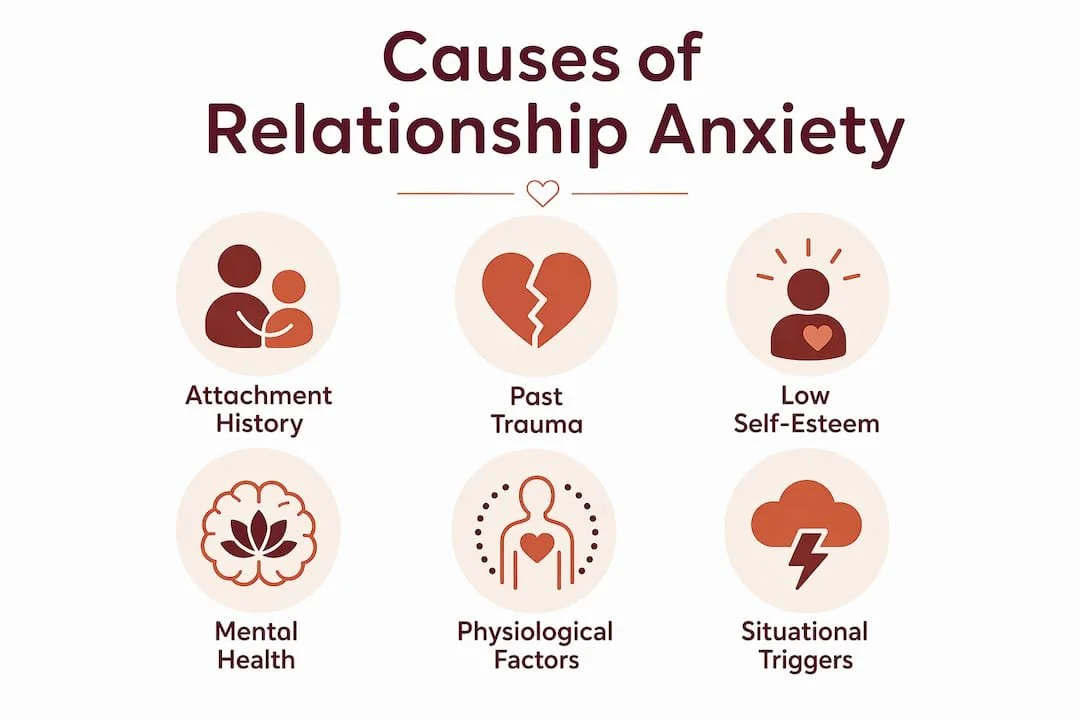
Attachment history
Anxious and avoidant attachment styles developed in childhood are among the strongest predisposing factors. When caregivers were inconsistently responsive, children learned that closeness is unpredictable. That lesson doesn't disappear in adulthood. It becomes an internal working model: a set of beliefs about whether you're lovable and whether others can be trusted to stay. Adults with anxious attachment tend to monitor their partners constantly for signs of withdrawal. Adults with avoidant attachment may feel smothered by intimacy and pull away, which can trigger anxiety in their partners.

Research on adult attachment consistently shows that these early patterns shape how people interpret ambiguous relationship cues, often reading neutral behavior as rejection.
Past relational trauma
Betrayal, infidelity, emotional abuse, and unexpected abandonment leave a mark. Past relationship betrayal significantly increases the risk of chronic hypervigilance in later relationships. Someone who was cheated on may find themselves scanning their current partner's phone, reading into every late reply, or bracing for abandonment even when there's no real evidence of threat. The nervous system learned a lesson from that earlier relationship and is now applying it everywhere, whether it fits or not.

as meant to relieve.
When should you seek professional help?
Self-help strategies are a real starting point, but some situations call for professional support sooner rather than later.
Red flags that suggest it's time to see a therapist:
The anxiety is interfering with your work, sleep, or ability to function day to day.
You're experiencing intrusive, repetitive doubts that feel impossible to dismiss (possible ROCD).
You have a history of trauma, abuse, or neglect that you haven't processed in therapy.
You're having thoughts of self-harm or suicide. (Call or text 988 to reach the Suicide and Crisis Lifeline immediately.)
Your anxiety is driving behaviors that are damaging the relationship (frequent accusations, checking a partner's devices, emotional withdrawal).
You've tried self-help strategies consistently for several weeks with no improvement.
A practical pathway:
Self-help first: Trigger tracking, journaling, reassurance-reduction experiments, and communication scripts (see the next section).
Individual therapy: For attachment-based anxiety, trauma history, low self-esteem, or co-occurring anxiety disorders. CBT, EMDR, and ERP are the most evidence-supported options.
Couples therapy: When the anxiety has created entrenched patterns in the relationship, or when both partners need support shifting the dynamic.
Psychiatric consultation: When anxiety is severe, persistent, and not responding to therapy alone. A psychiatrist can evaluate whether medication is appropriate as an adjunct.
Pro Tip: Bring three things to your first therapy session: a short list of recent trigger examples, a rough timeline of your relationship history (including past relationships that felt significant), and one sentence about what you most want to feel differently. That context helps a therapist move faster.
Individual therapy is usually the right first step when the anxiety is rooted in personal history. Couples therapy makes more sense when both partners are caught in the cycle and need to shift the dynamic together. Often, the most effective approach combines both.
Evidence-based treatments that actually reduce relationship anxiety
There's no shortage of advice about relationship anxiety online. The treatments below have actual clinical backing.
| Therapy | What it targets | How it helps | Typical course |
|---|---|---|---|
| CBT | Unhelpful thought patterns, avoidance behaviors | Restructures distorted beliefs; builds behavioral experiments | 20 sessions |
| ERP (for ROCD) | Compulsive rituals, intrusive doubts | Reduces compulsions; builds tolerance for uncertainty | 20 sessions |
| EMDR | Past relational trauma, traumatic memories | Reprocesses trauma that drives hypervigilance | 20+ sessions |
| Trauma-informed CBT | Trauma-linked core beliefs, avoidance | Combines trauma processing with cognitive restructuring | 24 sessions |
| Couples therapy | Relationship patterns, communication, accommodation | Shifts dynamic from “anxious partner vs. partner” to “couple vs. pattern” | 24 sessions |
| Attachment-based therapy | Internal working models, self-worth | Updates core beliefs about safety and lovability | Ongoing, varies |
What the evidence supports:
CBT is well-validated for anxiety disorders broadly and for relationship-focused worry specifically.
ERP is the treatment of choice for ROCD. General anxiety therapy without the ERP component often fails to address the compulsive rituals that maintain the cycle.
EMDR is particularly effective when past relational trauma is driving the anxiety. It processes the traumatic memory rather than just managing the symptoms.
Combining individual trauma-focused work with couples therapy shifts the problem from "the anxious partner vs. the partner" to "the couple vs. the pattern," which reduces blame and supports co-regulation.
On medication: Medication is not a first-line treatment for relationship anxiety specifically, but it can be a useful adjunct when there's a co-occurring anxiety disorder or depression. A psychiatrist is the right person to evaluate that, not a therapist alone.
For readers whose anxiety is rooted in trauma and relationship challenges, the sequenced approach above tends to produce the most durable results.
A practical 4–6 week plan to start reducing relationship anxiety now
You don't need to wait for a therapy appointment to start making progress. These steps are designed to build on each other.
Week 1–2: Map your triggers
Keep a daily trigger log. For each anxiety spike, write: what happened, what you told yourself, what you did, and how long the anxiety lasted.
Look for patterns after 7 days. Are most triggers tied to communication (texts, tone, availability)? To specific memories? To your own thoughts rather than your partner's behavior?
Identify your top two reassurance-seeking behaviors and pick one to experiment with reducing.
Week 3–4: Slow the cycle
Practice a 5-minute grounding routine when anxiety spikes: 5 things you can see, 4 you can touch, 3 you can hear, 2 you can smell, 1 you can taste. This interrupts the stress response before it escalates.
Use this communication script with your partner: "I'm feeling anxious right now and I notice I want to ask for reassurance. I'm going to try to sit with it for a bit instead. I just wanted you to know." That one sentence reduces the pressure on both of you.
For partners responding to this: "I hear you. I'm here. I trust you to work through this." Short, warm, non-accommodating.
Week 5–6: Run a behavioral experiment
Identify a feared outcome you keep anticipating (e.g., "If I don't check in, they'll think I don't care and pull away").
Write down your prediction specifically: what you expect to happen, how likely you think it is (0–100%), and how bad it would be.
Run the experiment: don't check in for one full day. Record what actually happened.
Compare prediction to outcome. Most people find the feared outcome either didn't happen or was far less catastrophic than expected.
Reassurance-seeking reduction: If you're using tools to check on a partner's behavior online, that behavior tends to feed the anxiety cycle rather than resolve it. Some people find that understanding the reassurance loop helps them decide whether the checking is driven by real evidence or anxiety-driven compulsion.
Pro Tip: A behavioral experiment only works if you write down the prediction before you run it. Memory is unreliable under anxiety. If you don't write it down, your brain will revise the prediction after the fact to match whatever happened, and you won't learn anything.
Key Takeaways
Relationship anxiety is rooted in insecure attachment and past relational trauma, and it responds well to structured, evidence-based treatment when the underlying cause is correctly identified.
| Point | Details |
|---|---|
| Primary causes | Insecure attachment and past relational trauma are the most common drivers of relationship anxiety. |
| ROCD is distinct | ROCD involves compulsive rituals and requires ERP specifically, not general anxiety treatment. |
| Reassurance backfires | Repeated reassurance-seeking reduces internal coping capacity and maintains the anxiety cycle long term. |
| Treatment works | CBT, EMDR, ERP, and couples therapy all have clinical backing; sequencing matters for trauma cases. |
| Alvarado Therapy | Alvarado Therapy offers trauma-informed EMDR, individual counseling, and couples therapy online in CA and NY. |
A clinician's perspective on relationship anxiety
Relationship anxiety is one of the most misunderstood presentations we see in clinical practice. People come in convinced that their anxiety means something is wrong with their relationship, when in most cases it means something happened to them, usually long before this relationship began.
The nervous system doesn't lie. When someone scans their partner's face for signs of withdrawal, or replays a conversation at 2 AM looking for the moment things went wrong, that's not irrationality. That's a nervous system doing exactly what it learned to do to stay safe. The problem is that the lesson was learned in a context that no longer applies.
What we find at Alvaradotherapy is that the most durable change comes from working at the level of the nervous system, not just the thought. EMDR, for example, doesn't ask you to think your way out of old trauma. It helps the brain reprocess the memory so it stops generating the same alarm signal in the present. Paired with couples therapy, that work shifts the entire relational dynamic, not just one partner's symptoms. If you're in California or New York, or want to work online, we'd be glad to talk about what that could look like for you.
Alvaradotherapy can help you work through this
If the patterns in this article feel familiar, individual therapy, EMDR, and couples counseling are the most direct routes to lasting change. Alvaradotherapy's trauma-informed therapists work with adults whose relationship anxiety is rooted in attachment wounds, past betrayal, or unresolved trauma. The practice offers EMDR therapy and trauma-focused care online throughout California and New York, with sessions available in both English and Spanish.
For couples caught in the reassurance and accommodation cycle, online couples therapy helps both partners shift the dynamic together rather than placing the full weight of change on one person. A first consultation is a low-pressure way to ask questions, describe what you're experiencing, and find out whether the practice is a good fit. Book a consultation to get started.
Useful sources and further reading
The following sources informed this article. Each is either peer-reviewed, clinician-authored, or published by a recognized clinical authority.
Clinical and research sources:
Attachment theory and adult relationships — R. Chris Fraley, University of Illinois. Foundational overview of how early attachment patterns shape adult relationship behavior.
PMC: Attachment and relationship outcomes — Peer-reviewed research on attachment styles and their effects on romantic relationship functioning.
PMC: Anxiety and relationship quality — Research on how anxiety disorders intersect with relationship satisfaction and partner dynamics.
PMC: Trauma and interpersonal functioning — Peer-reviewed findings on how trauma history affects close relationships.
PMC: ROCD and OCD-spectrum presentations — Clinical research on Relationship OCD, its features, and evidence-based treatment.
DSM-5-TR — American Psychiatric Association — Diagnostic framework for anxiety disorders, OCD-spectrum conditions, and related presentations.
988 Suicide and Crisis Lifeline — Free, confidential crisis support available 24/7 by call or text.
Alvaradotherapy blog resources for deeper reading:
Role of trauma in relationships: impacts and healing — How past trauma shapes relationship functioning and what recovery looks like.
Couples therapy in trauma recovery: rebuilding trust — A practical look at trauma-informed couples approaches.
PTSD relationship struggles: causes, signs, and healing — PTSD's specific effects on romantic relationships and how EMDR fits in.
What is relationship anxiety? Understanding and healing — A deeper primer on relationship anxiety from the Alvaradotherapy clinical team.
About this article: This content was developed by the editorial team at Alvaradotherapy, a trauma-informed mental health practice with licensed therapists serving clients in Pasadena, Ventura, and online throughout California and New York. It is intended as general educational information, not a substitute for professional mental health advice. For guidance specific to your situation, consult a licensed clinician.
