
Why Couple Counseling Matters: Benefits and Next Steps

TL;DR:
Couples counseling benefits most couples when they engage early and work with trained, evidence-based approaches.
Meta-analyses show 60 to 80 percent of distressed couples improve with behavioral and emotion-focused therapy.
Couples counseling helps partners repair communication, rebuild trust, and improve both individual and shared well-being. Meta-analyses show that 60–80% of distressed couples benefit from behavioral and emotion-focused approaches, and the average person who completes treatment is better off than 70–80% of those who receive no help. Johns Hopkins Medicine and Harvard Health both recommend counseling not only for couples in crisis but also as a proactive relationship checkup. If you're on the fence, the most useful first step is scheduling a single consultation to see whether the fit feels right.
Table of Contents
How effective is couples counseling? What the research shows
How long does couples counseling take, and what does it cost?
When trauma shapes your relationship: choosing a trauma-informed therapist
Alvaradotherapy offers couples therapy online across California and New York
What are the real benefits of couples counseling?
The clearest benefit most couples notice first is communication. Not just "talking more," but learning to say hard things without triggering a defensive shutdown. Therapists teach specific skills: how to express a need without blame, how to listen without preparing a rebuttal, how to slow a conversation that's escalating before it becomes a fight. Those skills transfer to every disagreement, not just the ones you bring to the session.
Beyond communication, couples therapy advantages include:
Trust repair after betrayal. Infidelity or broken agreements erode the foundation of a relationship. Structured therapy gives both partners a process for rebuilding, rather than cycling through the same argument indefinitely.
Conflict resolution. Couples learn to distinguish between solvable problems and perpetual differences, and how to manage each without contempt.
Emotional and physical intimacy. Disconnection often builds gradually. Therapy creates space to name what's missing and work toward it deliberately.
Support for coexisting health issues. Research supports couple-based interventions for depression, anxiety, PTSD, alcohol problems, and chronic health conditions. When one partner struggles, the relationship suffers too. Addressing both together accelerates recovery.
Parenting alignment. Disagreements about discipline, routines, or values are among the most common sources of ongoing conflict. A therapist can help partners find shared ground.
Preventive maintenance. Harvard Health notes that improvements in relationship functioning create healthier home environments and measurable benefits for children.
Statistic: Meta-analyses report that 60–80% of distressed couples benefit from behavioral and emotion-focused approaches.
Pro Tip: Frame the idea of therapy to a hesitant partner as a "relationship checkup" rather than a sign something is broken. Johns Hopkins Medicine specifically recommends this framing because it reduces resistance and increases uptake among couples who would otherwise never call.
Who should go to couples counseling, and when?
The short answer: most couples, and sooner than they think. Research summarized by Simply Psychology found that the average couple waits roughly six years after problems become serious before seeking professional help. By that point, negative patterns like criticism, contempt, and stonewalling are often deeply entrenched and require significantly more work to shift.
Couples who tend to benefit most include:
Partners in acute distress (frequent conflict, emotional withdrawal, a recent betrayal)
Couples navigating major transitions: pregnancy, a new baby, relocation, job loss, retirement
Partners where one or both are managing a mental or physical health condition
Couples who feel "fine" but want to strengthen their connection before problems develop
Earlier engagement consistently produces better outcomes. Conflict patterns are still flexible early on. Once contempt becomes the default response, or one partner has emotionally checked out, treatment takes longer and results are less predictable. Signs that it's time to seek therapy don't always look dramatic. Sometimes it's just a persistent sense of distance that neither partner knows how to close.
When trauma is part of the picture, a specialist referral matters. A therapist trained in trauma-informed couples work can pace the process safely, rather than inadvertently reopening wounds without the right support structure in place.

What problems does couples therapy actually address?
Couples arrive in therapy with a wide range of presenting issues. The most common ones, and how therapy typically approaches them:
Communication breakdowns. The therapist identifies the specific pattern (pursuer-withdrawer, mutual escalation) and teaches both partners to interrupt it.
Infidelity. Trust repair is a structured process: disclosure, accountability, grief, and gradual rebuilding. It takes time and both partners' commitment.
Sexual and intimacy difficulties. Therapists address both the relational dynamics and, when needed, refer to a sex therapist for specialized work.
Parenting conflict. Disagreements about children often mask deeper differences in values or unresolved childhood experiences. Therapy helps separate the two.
Substance use. Couples therapy can support recovery when both partners are engaged, but it is not a substitute for individual addiction treatment during active withdrawal.
Life transitions. Empty nest, retirement, illness, and grief all reshape a relationship's structure. Therapy helps couples renegotiate roles and expectations.
Coercive control or intimate partner violence. Standard couples therapy is not appropriate when one partner is being controlled or harmed. Individual safety planning and specialized services come first.
"Couples therapy is useful not only in times of crisis, but also when couples want to navigate big life changes or simply deepen their connection." — Harvard Health
Consider a couple who sought therapy after a job loss disrupted their routines and left one partner feeling unsupported and the other overwhelmed. They weren't in crisis, but resentment was building. Over 12 sessions, they identified the specific moments where each felt abandoned, practiced new ways of asking for support, and left with a shared framework for handling the next stressor. No dramatic rupture, no dramatic repair. Just a gradual shift in how they talked to each other.
Specialized couple treatments have evidence for issues like sexual difficulties, infidelity repair, and intimate partner violence, though the last requires careful safeguards and is not appropriate in all circumstances.
Which types of couples therapy have the strongest evidence?
Not all approaches work the same way, and the right fit depends on what you're dealing with.
Emotionally Focused Therapy (EFT). Developed by Dr. Sue Johnson, EFT focuses on attachment patterns. The goal is to help partners identify the emotional needs driving their conflict and respond to each other from a place of security rather than fear. Meta-analyses show approximately 70–75% improvement rates with EFT, with durable gains at follow-up. It's particularly well-suited for couples dealing with attachment injuries, emotional disconnection, or trauma.
Integrative Behavioral Couples Therapy (IBCT). IBCT combines behavior change strategies with acceptance-based work. Rather than pushing both partners to change everything, it helps them accept differences that don't require change and modify the patterns that do. It's a strong fit for couples where one or both partners feel chronically misunderstood.
The Gottman Method. Built on decades of observational research, the Gottman Method targets the "Four Horsemen" (criticism, contempt, defensiveness, stonewalling) that predict relationship breakdown. It's highly structured, uses assessments and exercises, and is particularly effective for couples who want concrete communication tools.
CBT-based couples therapy. Cognitive-behavioral approaches help partners identify and challenge the distorted thinking patterns that fuel conflict. Useful when one or both partners have individual anxiety or depression alongside relationship difficulties.
Trauma-informed couples therapy. When past trauma shapes how partners respond to each other, a trauma-informed approach prioritizes safety and stabilization before processing. This is distinct from standard couples work and requires a clinician with specific training.
When interviewing a potential therapist, ask directly: "What model do you primarily use with couples, and what training have you completed in it?" A well-trained clinician will answer that question without hesitation.
What actually happens in couples counseling sessions?
The first session is an assessment, not a confrontation. The therapist gathers history: how you met, what's brought you in, what each of you hopes to get from the process. Most therapists also ask about individual histories, since each partner's background shapes how they show up in the relationship.
Typical early-session questions include:
What brings you in right now, and why now?
What does a good week look like for you as a couple?
What have you already tried to address this?
What would need to change for you to feel the relationship is working?
Sessions usually run 50–60 minutes. The therapist structures the conversation, redirects when it escalates, and introduces exercises both in-session and as between-session practice. That homework matters. Skills practiced only in the therapist's office rarely transfer to real life without repetition.
Confidentiality in couples therapy works differently than in individual therapy. What's said in the room is generally shared between both partners and the therapist. Many therapists will not hold secrets from one partner that the other doesn't know, though policies vary. Ask about this explicitly before your first session.

Progress is usually tracked through brief check-ins at the start of each session and periodic reviews of goals. If you're not seeing movement after 8–10 sessions, that's worth raising directly with your therapist. What to expect in couples counseling varies by approach, but transparency about progress should be a constant.
How effective is couples counseling? What the research shows
The evidence base for couples therapy is solid, though not without caveats.
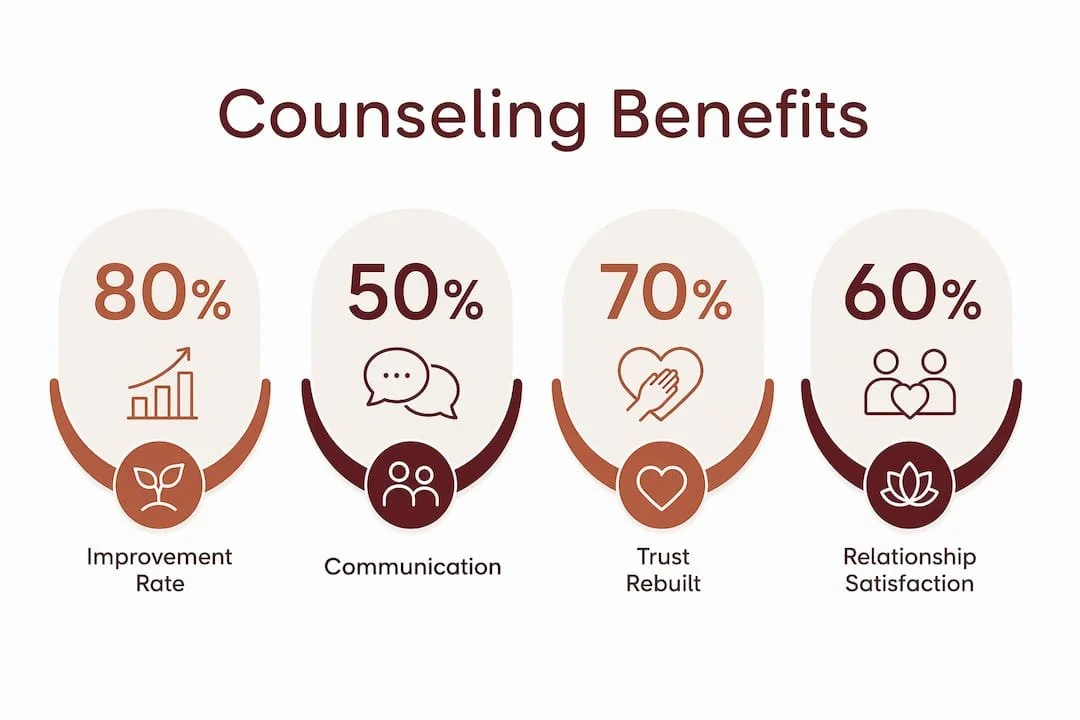
| Outcome Metric | Finding | Source |
|---|---|---|
| Overall improvement rate | 60–80% of distressed couples benefit | PMC meta-analysis |
| Comparative effectiveness | Average treated person better off than 70–80% of untreated | PMC meta-analysis |
| EFT improvement rate | ~70–75% show significant improvement | Simply Psychology |
| Long-term durability | About half of couples show some attenuation of gains over years | UCLA review |
| Individual mental health | Evidence supports couples-based interventions for depression, PTSD, anxiety | PMC review |
The honest caveat is that treatment effects in routine clinical practice are often smaller than what controlled trials report. Real-world therapy involves missed sessions, ambivalent partners, and competing life stressors. About half of couples show some dissipation of gains over several years, which is why many therapists recommend periodic booster sessions after completing a primary course of treatment.
Success depends heavily on both partners' active engagement. One committed partner and one reluctant one produces weaker results than two people who show up ready to work. That's not a reason to avoid therapy if your partner is hesitant. It's a reason to address the hesitancy directly, ideally before the first session.
For a deeper look at what the research shows, Alvarado Therapy's evidence review covers the key meta-analytic findings in plain language.
How do you find a qualified couples therapist?
Credentials matter, but they don't tell the whole story. A licensed therapist with specific couples training will outperform a general therapist with more years of experience but no specialized couples work.
Credentials to look for:
LMFT (Licensed Marriage and Family Therapist): trained specifically in relational and systemic approaches
LCSW (Licensed Clinical Social Worker): broad clinical training; look for additional couples specialization
PhD or PsyD: doctoral-level training; again, check for couples-specific experience
Specialized training: EFT certification, Gottman Level 1–3 training, IBCT training, or trauma-informed couples work
Screening questions to ask before booking:
What model do you primarily use with couples?
What formal training have you completed in that approach?
Have you worked with couples dealing with [your specific issue]?
Do you offer telehealth sessions?
What are your fees, and do you offer a sliding scale?
What is your policy on individual secrets within couples therapy?
Where to search:
Psychology Today's therapist directory (filter by "couples" and your zip code)
Your insurance company's provider panel
The ICEEFT directory for EFT-certified therapists
The Gottman Institute's referral network
Clinic websites like Alvaradotherapy.org for practices with specific modality expertise
Red flags: A therapist who takes sides consistently, who shares one partner's individual session content with the other without consent, or who has no clear model or training to name.
How long does couples counseling take, and what does it cost?
Timeline depends on what you're working on and how entrenched the patterns are.
| Treatment Phase | Typical Duration | What It Addresses |
|---|---|---|
| Brief / focused work | 8–12 sessions | Specific skill deficits, mild distress, life transitions |
| Moderate course | 3–6 months (biweekly) | Communication patterns, trust repair, moderate conflict |
| Longer-term work | 12+ months | Severe distress, trauma overlap, infidelity recovery |
U.S. session costs typically run $150–$300 per session for in-person therapy in most metro areas, with some specialists charging more. Telehealth sessions often run slightly lower. Many therapists offer sliding-scale fees based on income.
Insurance coverage for couples therapy is inconsistent. Most plans cover individual therapy but not couples therapy as a standalone service, unless one partner has a diagnosed condition being treated through the couples format. Check your plan's mental health benefits carefully, and ask your therapist whether they can bill under an individual diagnosis when clinically appropriate.
Online interventions and structured programs can approach the effectiveness of in-person therapy for certain couples and certain outcomes, making telehealth a genuinely viable option rather than a compromise. FSA and HSA funds can typically be used for therapy sessions, which reduces out-of-pocket cost for many couples.
How to prepare for your first couples counseling session
Walking in with some preparation makes the first session more productive and less disorienting.
Before you go:
Agree on one or two goals you both want from therapy (even if they differ)
Think through your relationship history: when things were good, when they shifted, what you've already tried
Confirm logistics: who books, who pays, whether sessions are in-person or virtual, and where you'll have privacy for telehealth
Set one joint agenda item to bring to the first session
If your partner is hesitant, try one of these approaches:
"I'd like us to try one session together. If it doesn't feel useful, we don't have to go back."
"I'm not saying we're in trouble. I just want us to have a space to talk about some things."
"I've been feeling disconnected, and I think talking to someone together could help us both."
Pro Tip: Don't wait for a crisis to book. Couples who enter therapy with some goodwill still intact have more to work with. A single consultation session, framed as a checkup, is a low-stakes way to start.
When trauma shapes your relationship: choosing a trauma-informed therapist
Trauma doesn't stay in the past. Childhood experiences, previous abusive relationships, or a traumatic event during the partnership can shape how each person responds to conflict, closeness, and perceived threat. A partner who shuts down during arguments may not be stonewalling on purpose. They may be in a nervous system response that standard communication coaching won't touch.
Trauma-informed couples therapy operates on different principles:
Safety first. The therapist establishes physical and emotional safety before any emotional processing begins.
Stabilization. Both partners learn grounding and regulation skills before the therapy moves into more activating territory.
Pacing. Trauma processing is not rushed. The therapist monitors activation levels and slows down when needed.
Attunement. The therapist tracks both partners' nervous system states, not just the content of what's being said.
Signs that a trauma-informed specialist may be the right fit:
One or both partners have a history of childhood abuse, neglect, or attachment disruption
A traumatic event (accident, assault, loss) has occurred within the relationship
One partner has a PTSD diagnosis that affects intimacy or conflict response
Standard couples therapy has stalled or felt retraumatizing
Evidence supports integrating trauma-focused methods with couples treatment when trauma is prominent. At Alvaradotherapy, EMDR-informed individual work can run alongside couples sessions when clinically indicated, addressing the individual trauma layer while the couples work addresses the relational one. When screening a therapist, ask specifically: "How do you approach trauma that shows up in the relationship? Do you integrate individual trauma work with couples sessions?"
Key Takeaways
Couples counseling is most effective when both partners engage early, with a trained clinician using an evidence-based modality matched to their specific presenting issues.
| Point | Details |
|---|---|
| Early engagement matters | Couples who wait years to seek help face more entrenched patterns and longer treatment timelines. |
| Evidence is strong | Meta-analyses report that 60–80% of distressed couples benefit from behavioral and emotion-focused approaches. |
| Modality fit counts | EFT, IBCT, and the Gottman Method each target different problems; ask your therapist about their specific training. |
| Trauma needs a specialist | When past trauma shapes relationship dynamics, a trauma-informed clinician with EMDR training produces better outcomes. |
| Alvarado Therapy | Offers online couples therapy in California and New York, with trauma-informed, bilingual clinicians and EMDR-informed support. |
A clinical perspective on why couples counseling works
Most people come to couples therapy expecting the therapist to referee. They want someone to confirm who's right. What actually happens in good couples work is almost the opposite: the therapist helps each partner see the pattern they're both caught in, rather than the villain they're both fighting. That shift, from "you're the problem" to "we have a problem," is where real change begins.
What gets underestimated is how much individual history shows up in a relationship. The partner who goes silent during conflict isn't being passive-aggressive. They may have learned early that expressing emotion was dangerous. The partner who escalates isn't just being dramatic. They may be terrified of being abandoned and don't know another way to signal that. Couples therapy, especially trauma-informed couples therapy, makes those histories visible without weaponizing them.
The research on EFT and IBCT points to something worth sitting with: the most durable changes come not from learning new scripts but from genuinely shifting how partners experience each other. That takes longer than 8 sessions. It also lasts longer than a communication workshop. If you're considering couples counseling, the question isn't whether your relationship is "bad enough." It's whether you want it to be better.
Alvaradotherapy offers couples therapy online across California and New York
If you've been reading this and thinking "we could use this," Alvaradotherapy's online couples therapy gives you access to trauma-informed clinicians without the logistical friction of in-person appointments. Sessions are available throughout California and New York, in both English and Spanish, with therapists who hold specific training in evidence-based couples approaches.
When trauma overlaps with relationship difficulties, Alvaradotherapy's EMDR-informed clinicians can integrate individual trauma work alongside couples sessions, rather than treating the two as separate problems. That integrated approach is what makes the difference for couples where one or both partners carry significant trauma histories.
Ready to take the first step? Schedule a consultation to talk through your situation and find out whether couples therapy is the right fit for where you are right now.
Sources and further reading
Short and long-term effectiveness of couple counselling (PMC) — Peer-reviewed meta-analytic review of couples therapy outcomes, including improvement rates and durability.
Couple therapy in the 2020s: Current status and emerging developments (PMC) — Comprehensive clinical review covering modalities, individual mental health applications, and trauma-informed approaches.
Will couples therapy improve your relationship? (Harvard Health) — Accessible summary of when couples therapy helps and what to expect.
Could Your Marriage Benefit From Counseling? (Johns Hopkins Medicine) — Clinical guidance on proactive counseling and the "marriage checkup" framing.
Interventions for Couples (Bradbury & Bodenmann, UCLA) — Academic review of effectiveness data, including real-world effect size caveats and online intervention research.
Couples Therapy Guide (Simply Psychology) — Practical overview of modalities, EFT outcome data, and the six-year delay finding.
Couples therapy advantages (Alvaradotherapy) — Research-backed benefits summary with clinical examples.
Couples therapy effectiveness: what the research shows (Alvaradotherapy) — Meta-analytic findings explained in plain language alongside Alvaradotherapy's clinical approach.
When to seek couples therapy (Alvaradotherapy) — Practical checklist of signs and steps for couples considering therapy.
