
Couples Therapy Advantages That Strengthen Any Relationship
TL;DR:
Couples therapy offers benefits beyond crisis management, including improved communication and emotional connection.
Starting therapy early helps build resilience and prevents issues from worsening, leading to lasting relationship growth.
Most people assume couples therapy is reserved for relationships on the brink. That assumption keeps a lot of couples from getting help until the damage runs deep. The truth is that the couples therapy advantages extend well beyond crisis management. Therapy builds communication skills, restores emotional connection, and gives partners tools for handling stress and conflict before things spiral. Whether you're navigating a rough patch or simply want a stronger foundation, understanding what therapy actually delivers can change how you think about your relationship.
Table of Contents
Key Takeaways
| Point | Details |
|---|---|
| Therapy isn’t only for crises | Couples counseling benefits partners during life transitions, communication struggles, and proactive relationship growth. |
| Communication improves with structure | Therapist-guided sessions teach listening and non-blaming speech that reduces conflict and defensiveness. |
| Emotional safety drives connection | Creating space for vulnerability in therapy leads to sustained intimacy and trust. |
| Acceptance beats pressure | When partners feel accepted rather than pressured to change, they become more open to genuine growth. |
| Early engagement pays off | Couples who seek help before problems become entrenched see better couples therapy positive outcomes. |
Couples therapy advantages for communication
Every couple argues. That's not the problem. The problem is what happens during the argument. Most couples fall into the same traps repeatedly: interrupting, assuming intent, defending before listening, and saying things that wound rather than explain. These patterns don't mean the relationship is broken. They mean no one ever taught you a better way.
Couples therapy gives you that better way. A therapist creates a structured, regulated space where both partners can practice communicating without immediately triggering each other's defenses. That structure matters more than most people realize. At home, your nervous system is already activated before the conversation starts. In a session, you learn to slow down, name what you're feeling, and say what you actually need.
Some of the communication skills therapists work on with couples include:
Active listening: Reflecting back what your partner said before responding, so they feel genuinely heard.
"I" statements: Replacing "you always do this" with "I feel dismissed when..." to remove the accusatory tone.
Pausing before reacting: Recognizing when your body is escalating and choosing to slow down before words cause damage.
Validating without agreeing: Acknowledging your partner's experience even when you see things differently.
A self-regulation-based couple therapy program showed significant improvements in marital adjustment after just nine 90-minute sessions. That's not a small shift. It means real couples learning real skills in a relatively short period.
Pro Tip: Before your first therapy session, write down one communication pattern you know frustrates your partner. Bringing that specific example helps your therapist zero in on what matters most to you both.
Building emotional connection and trust
Communication skills are the mechanics. Emotional connection is the fuel. You can learn every technique in the book and still feel distant from your partner if neither of you feels safe being vulnerable. This is where couples therapy does work that most self-help books can't replicate.
Emotional disconnection rarely happens overnight. It builds slowly through unspoken disappointments, moments where one partner reached out and the other didn't respond, conversations that felt too risky to start. Over time, both partners learn to protect themselves by pulling back. The relationship starts running on autopilot.
Therapy interrupts that cycle. It creates a space where both people can express what they actually need, not the version they think their partner can handle. Research on Emotionally Focused Therapy shows that EFT produced sustained intimacy improvements that held at a three-month follow-up. The emotional gains weren't temporary. They stuck because therapy targeted the attachment dynamics underneath the surface conflict.
Some of what this process looks like in practice:
Identifying your emotional needs without labeling them as demands
Sharing fears about the relationship without it turning into an argument
Responding to your partner's vulnerability with empathy instead of defensiveness
Rebuilding small moments of connection that erode trust when they disappear
Trust isn't rebuilt through grand gestures. It's rebuilt through repeated small moments of feeling seen. Therapy gives couples a way to practice that, guided by someone trained to spot when one partner is shutting down or when the conversation is about to go sideways.
Healthier conflict resolution skills

There's a difference between fighting and having a disagreement. Fighting is reactive, escalating, and often leaves both people feeling worse than when they started. Having a disagreement means two people with different perspectives working toward mutual understanding. Most couples have the first. Therapy teaches the second.
Constructive conflict links to emotional investment, not relationship failure. The goal is never to eliminate conflict. It's to stop letting conflict do lasting damage. A skilled therapist helps couples recognize the moment an argument is about to escalate and build in a pause before it crosses into territory that's hard to come back from.
Here's a practical framework therapists often use to shift conflict dynamics:
Identify your triggers. Know what topics or behaviors activate your defensive response automatically.
Name the pattern, not the person. "We keep getting stuck on this topic" is less inflammatory than "you always shut me out."
Call for a structured timeout. Agree in advance on a signal that means "I need 20 minutes before we continue," and honor it.
Return to the conversation. A timeout is not a way to avoid the issue. It's a way to approach it with less cortisol.
Repair after conflict. The conversations couples have after an argument often matter more than the argument itself.
Pro Tip: If your arguments tend to happen late at night or when one of you is hungry or tired, that's data. Agree to a "no serious topics after 9 PM" rule and watch how many fights simply don't happen.
Couples therapy helps slow escalation cycles so partners can actually hear each other before the conversation becomes a battle. That shift alone changes the emotional math of a relationship.
Understanding patterns and building empathy
Every couple has recurring conflicts. The dishes. The finances. Who initiates closeness and who pulls away. These arguments rarely get resolved because the argument isn't actually about the dishes. It's about something deeper: feeling unvalued, unheard, or not a priority. Therapy helps both partners see what's really happening beneath the surface.
When you replace blame with insight, the dynamic shifts. Instead of seeing your partner as the problem, you start to understand what unmet needs are driving their behavior, and your own. That understanding doesn't excuse hurtful actions. But it creates empathy where there used to be resentment.
Here's how a common conflict looks before and after therapy:
| Before therapy | After therapy |
|---|---|
| “You’re always so distant. You don’t care.” | “When you don’t respond, I feel like I’m not a priority. Can we talk about that?” |
| “You’re nagging me again.” | “I feel overwhelmed when I get a lot of requests at once. Can we figure out a better system?” |
| “Why do you always bring up money?” | “I feel anxious about finances because of how I grew up. That’s what’s underneath this.” |
| “You’re too sensitive.” | “I see this affects you strongly. Help me understand what’s happening for you.” |
When partners feel pressured to change, they become defensive. Acceptance creates safety. When someone feels accepted, they become far more willing to grow. Therapy builds that acceptance systematically, which is why the shifts it produces tend to last.
Long-term relationship resilience
Most couples don't think about their relationship the way they think about their physical health. You don't wait until you're in the emergency room to start exercising. But many couples wait years before seeking therapy. Research shows couples typically wait about two years after persistent problems before getting help. That delay matters.
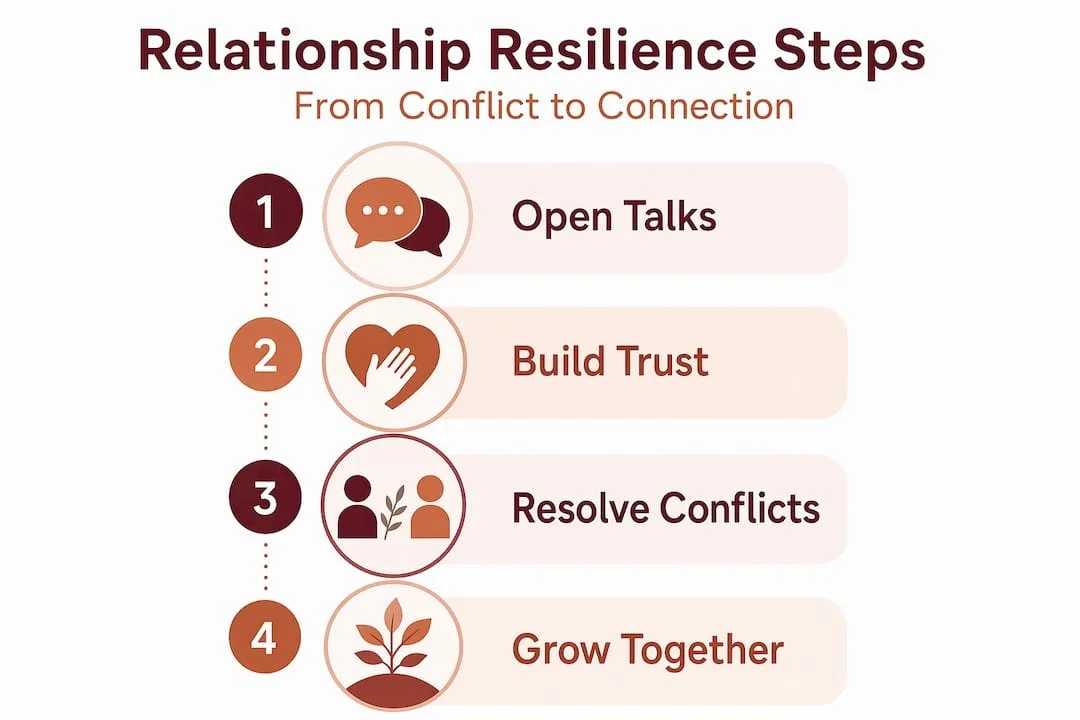
Early therapy helps couples build tools before stress exposes vulnerabilities. Think about what couples face: job changes, having children, financial pressure, grief, health challenges, aging parents. Every major life transition puts strain on a relationship. Partners who already have communication tools and emotional safety built in are far better equipped to navigate that pressure without it becoming a crisis.
The couples therapy positive outcomes that matter most aren't just about solving the current problem. They're about building capacity:
The ability to repair after conflict without it dragging on for days
Shared language for talking about emotional needs without it escalating
Clarity about each partner's values, limits, and goals
A default toward "we can figure this out" rather than "this is hopeless"
The habit of checking in regularly rather than waiting for resentment to build
Exploring therapy during major transitions is one of the smartest things a couple can do. Not because the relationship is failing, but because the investment pays dividends long after the transition is over. Therapy isn't a rescue. It's a resource.
My take on what couples often miss
I've watched couples come into therapy after years of the same fight, finally ready to do something different. What strikes me most is how quickly the dynamic shifts once both people feel genuinely heard in the room. Not fixed. Heard. That's where the real work starts.
The biggest misconception I see is that therapy is about convincing your partner to change. It isn't. The most effective therapy I've seen focuses on helping each partner understand their own role in the dynamic first. That's uncomfortable. It's also where everything opens up.
People underestimate how much conflict escalation is physiological. Your body starts preparing for a threat before your brain catches up. Therapy teaches you to recognize those physical signals early, and that skill alone changes how fights go. Less damage per disagreement adds up to a fundamentally different relationship over time.
The couples who do best in therapy aren't the ones with the smallest problems. They're the ones who show up willing to be curious instead of certain. Certainty closes doors. Curiosity opens them.
— Alvaradotherapy
Ready to experience these advantages for yourself?
If any of this resonates, you don't need to be in crisis to start. Alvarado Therapy offers online couples therapy for California residents, with licensed therapists who specialize in communication, emotional connection, and trauma-informed relational work. Sessions are available in both English and Spanish, with flexible online access for couples in Pasadena, Ventura, and throughout California.
Whether you're navigating a specific challenge or simply want a stronger foundation, taking a first step is easier than most people expect. You can book a consultation to talk through what you're looking for and find the right fit. Alvarado Therapy is built around the belief that every couple deserves access to care that actually works, delivered by people who understand the complexity of real relationships.
FAQ
What are the main couples therapy advantages?
Couples therapy improves communication, builds emotional connection, and teaches conflict resolution skills that reduce long-term resentment. Research shows 70 to 80 percent of couples report improvements by the end of therapy.
Does couples therapy only work during a crisis?
No. Harvard Health notes that therapy is equally effective during life transitions or as a proactive tool to deepen connection, not only when a relationship is in acute distress.
How long does couples therapy take to show results?
Research on self-regulation-based therapy shows meaningful improvements after nine sessions. Emotionally Focused Therapy produced sustained intimacy gains after eight weekly sessions, with results holding at a three-month follow-up.
Can therapy help if only one partner wants to go?
One partner engaging in therapy can still shift relationship dynamics. However, both partners participating leads to better couples counseling benefits, since communication and conflict patterns involve two people and require both to practice new skills.
When is the right time to start couples therapy?
The right time is before problems become entrenched. Couples who seek help early build communication tools and emotional resilience before major stressors test the relationship, which leads to stronger long-term couples therapy positive outcomes.
Recommended
Couples Therapy Success: What Actually Works — Alvarado Therapy
7 Key Benefits of Couples Counseling for Healing Together — Alvarado Therapy
Effective Couples Counseling: Methods, Results, and What Works — Alvarado Therapy
Why Seek Couples Therapy—Transforming Connection After Trauma — Alvarado Therapy
