
Role of Therapy in Major Life Transitions: Healing and Clarity

More than sixty percent of American adults report that major life changes, like divorce or job loss, trigger long-lasting anxiety. These shifts can shake foundations, especially for Californians balancing cultural expectations and personal well-being. Whether the transition is sudden or expected, understanding its deep emotional effects lays the groundwork for real healing. Discover how trauma-informed therapy supports emotional resilience, so you can manage distress and reclaim stability during life’s toughest moments.
Table of Contents
Key Takeaways
| Point | Details |
|---|---|
| Understanding Life Transitions | Major life transitions are profound psychological shifts that necessitate intentional navigation and support to foster emotional resilience. |
| Therapeutic Approaches | Trauma-informed therapy and EMDR can effectively address the emotional distress associated with transitions, promoting personal growth and coping skills. |
| The Importance of Proactive Support | Regular therapeutic check-ins during significant life changes can help prevent escalation of mental health challenges and support emotional stabilization. |
| Navigating Complex Emotions | Recognizing the non-linear nature of adaptation is essential for managing the complex emotional responses triggered by life’s transitions. |
Defining Major Life Transitions and Their Impact
Life transitions represent significant psychological and emotional shifts that fundamentally reshape an individual's personal landscape. These transformative experiences go beyond simple change, representing profound moments of adaptation, challenge, and potential growth. Comprehensive research from longitudinal studies reveals that such transitions are not merely events, but complex psychological journeys that profoundly influence personal development and emotional resilience.
Major life transitions typically encompass several critical domains: career shifts, relationship changes, geographic relocations, health challenges, and significant personal milestones. Each transition carries unique psychological weight, triggering a cascade of emotional responses ranging from excitement and anticipation to anxiety and uncertainty. For individuals in California navigating these transitions, understanding the inherent complexity becomes crucial. Some transitions are planned and anticipated, like career advancements or planned relocations, while others arrive unexpectedly, such as sudden job loss, relationship dissolution, or unexpected health complications.
The psychological impact of these transitions cannot be understated. Neurologically, significant life changes activate stress response systems, engaging brain regions associated with emotional processing and adaptive behavior. This neurological activation explains why transitions often feel overwhelming, triggering complex emotional landscapes that require intentional navigation and support. Individuals experiencing these shifts may encounter heightened levels of anxiety, temporary disruptions in personal identity, and the challenging task of reconstructing emotional equilibrium.
Pro Tip - Transition Navigation: Approach major life transitions with intentional self-compassion, recognizing that adaptation is a process, not an immediate outcome. Seek professional therapeutic support to develop personalized coping strategies that honor your unique emotional experience and facilitate healthy psychological adjustment.
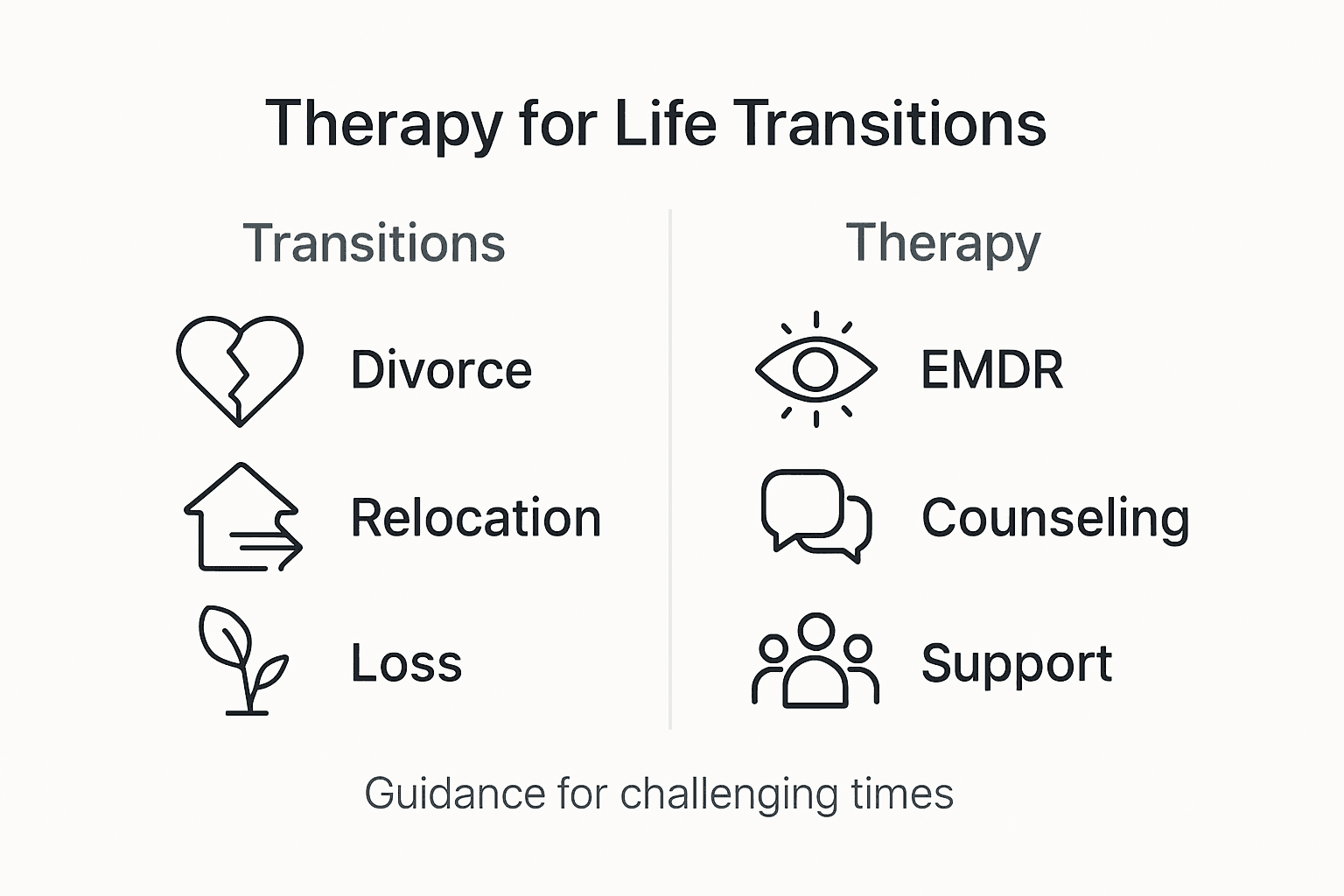
Types of Transitions: Divorce, Loss, Relocation, Job Changes
Life transitions are complex psychological experiences that manifest uniquely across different domains, each presenting distinct challenges and emotional landscapes. Cross-national research on transition types reveals that divorce, loss, relocation, and job changes represent profound shifts that fundamentally alter an individual's psychological and social infrastructure.
Divorce stands out as a particularly intense transition, involving complex emotional recalibration and potential socioeconomic disruption. Beyond the immediate emotional impact, divorce triggers comprehensive life restructuring, affecting personal identity, financial stability, social networks, and familial dynamics. Multi-country demographic studies demonstrate that these transitions carry gendered and socioeconomic dimensions, with varying long-term implications for housing stability and personal well-being.
Job changes and relocations represent additional significant life transitions that demand substantial psychological adaptation. Losing a job or changing career paths can trigger profound identity challenges, financial stress, and emotional uncertainty. Geographic relocations similarly demand comprehensive personal adjustment, requiring individuals to rebuild social support systems, navigate new professional environments, and reconstruct personal routines. These transitions often activate complex emotional responses, including anxiety, excitement, grief, and hope, simultaneously challenging and expanding an individual's resilience and coping mechanisms.

Pro Tip - Transition Resilience: Develop a proactive support network and engage in structured self-reflection during major life changes, recognizing that adaptation is a non-linear process that requires patience, compassion, and intentional emotional processing.
Here's a summary of how different major life transitions impact psychological and practical well-being:
| Type of Transition | Key Psychological Effects | Main Practical Challenges |
|---|---|---|
| Divorce | Identity disruption, grief | Socioeconomic adjustments, family changes |
| Job Change/Loss | Anxiety, uncertainty | Financial concerns, career development |
| Relocation | Excitement, loneliness | Social network rebuilding, routine change |
| Health Challenges | Fear, emotional stress | Medical care demands, new habits |
How Trauma-Informed Therapy Supports Transition
Trauma-informed therapy represents a compassionate, holistic approach to supporting individuals navigating significant life transitions, recognizing that past experiences profoundly shape current emotional responses. Comprehensive research on trauma-informed therapeutic techniques highlights the critical importance of creating safe, empowering environments that honor an individual's unique psychological landscape and healing journey.
At its core, trauma-informed therapy acknowledges that life transitions are not isolated events, but complex intersections of past experiences, current challenges, and future potential. Therapists employing this approach prioritize understanding an individual's entire emotional context, recognizing how previous traumatic experiences might amplify the stress and uncertainty inherent in major life changes. This method goes beyond traditional counseling by integrating nuanced strategies that address both immediate transition-related challenges and deeper underlying emotional patterns, helping clients develop robust psychological resilience.
The therapeutic process involves several key strategies designed to support individuals through transitions. These include creating psychological safety, validating emotional experiences, teaching adaptive coping mechanisms, and helping clients reframe their narratives from victimhood to empowerment. By systematically addressing underlying trauma responses, trauma-informed therapy enables individuals to approach life transitions not as overwhelming obstacles, but as opportunities for profound personal growth and transformation. This approach recognizes that healing is not about eliminating pain, but about developing the emotional skills to navigate complexity with grace and self-compassion.
Pro Tip - Transition Healing: Approach therapy as a collaborative journey of self-discovery, where your lived experiences are honored and your healing potential is recognized as inherently powerful and unique.
EMDR and Individual Counseling for Emotional Distress
EMDR therapy and individual counseling represent powerful, complementary approaches for addressing emotional distress during major life transitions. Comprehensive research from psychological authorities demonstrates how these therapeutic methods work synergistically to help individuals process complex emotional experiences, reduce psychological symptoms, and develop robust coping mechanisms.
EMDR, or Eye Movement Desensitization and Reprocessing, offers a unique neurobiological approach to processing traumatic memories and emotional disruptions. By utilizing bilateral stimulation techniques, EMDR helps individuals reframe and desensitize deeply embedded emotional experiences that might otherwise impede transition adaptation. Integrative psychological research reveals that this approach is particularly effective in reducing anxiety, depression, and emotional reactivity associated with significant life changes, enabling clients to approach transitions with greater emotional flexibility and resilience.
Individual counseling complements EMDR by providing a consistent, supportive therapeutic relationship that helps clients develop practical coping strategies, explore underlying emotional patterns, and construct meaningful narratives around their experiences. Unlike traditional talk therapy, this approach focuses on empowering individuals to understand their emotional responses, recognize their inherent strengths, and develop personalized strategies for navigating complex life transitions. The combination of EMDR's neurological reprocessing and individualized counseling creates a holistic therapeutic environment that supports comprehensive emotional healing and personal growth.
Pro Tip - Therapeutic Integration: Approach therapy as an active, collaborative process where your unique experiences are honored, and your potential for healing and transformation is recognized as a dynamic, ongoing journey.
Below is a comparison of EMDR therapy and individual counseling in supporting emotional health during transitions:
| Approach | Primary Focus | Unique Benefit |
|---|---|---|
| EMDR Therapy | Trauma memory reprocessing | Reduces emotional reactivity |
| Individual Counseling | Relationship-based support | Builds coping skills and strengths |
| Combined Approach | Holistic healing | Enhances flexibility and resilience |
Common Challenges and What Therapy Can Prevent
Major life transitions present complex psychological challenges that can significantly impact an individual's mental health and overall functioning. Comprehensive research on mental health during transitions reveals a constellation of interconnected challenges, including chronic stress, profound anxiety, social isolation, identity disruption, and potential relapse of previous mental health conditions.
These transitions frequently trigger a cascade of psychological responses that can compromise an individual's emotional stability and adaptive functioning. Common challenges include persistent anxiety, deep-seated loneliness, cognitive confusion about personal identity, and increased vulnerability to depression. Systematic interventional studies demonstrate that timely therapeutic intervention can effectively prevent these challenges from escalating into more severe, long-term mental health disorders by providing structured support, coping mechanism development, and personalized emotional processing strategies.
Therapy serves as a critical preventative mechanism, offering individuals strategic tools to navigate complex emotional landscapes. By addressing underlying psychological patterns, therapists help clients develop resilience, reconstruct healthy narratives, and transform potentially destabilizing life transitions into opportunities for personal growth. The therapeutic process provides a safe, structured environment where individuals can explore their emotional responses, develop adaptive coping strategies, and proactively manage potential mental health risks associated with significant life changes.
Pro Tip - Preventative Mental Health: Recognize therapy as a proactive investment in your emotional well-being, not a reactive solution, by scheduling regular check-ins during significant life transitions to maintain psychological equilibrium and build emotional resilience.
Find Healing and Clarity Through Compassionate Therapy in California
Major life transitions are often overwhelming and bring intense emotional challenges such as identity disruption, anxiety, and grief. If you are navigating divorce, job changes, relocation, or health challenges, understanding how trauma-informed therapy and EMDR can reduce emotional reactivity and build resilience is vital to regaining control and peace of mind. At Alvarado Therapy, we specialize in guiding Californians through these complex psychological journeys with personalized, trauma-sensitive care.
Take the first step toward transformation by connecting with licensed therapists who understand your unique experience. Explore our California — Meet Our Team — Alvarado Therapy page to learn about the dedicated professionals ready to support your healing journey. Discover comprehensive service options including individual counseling and EMDR therapies at Alvarado Therapy. Empower yourself now with therapeutic tools designed to turn life challenges into opportunities for growth.
Frequently Asked Questions
What is the impact of major life transitions on mental health?
Major life transitions can trigger psychological challenges such as anxiety, identity disruption, and emotional distress. These experiences may also lead to chronic stress or social isolation if not managed effectively.
How can therapy support individuals during major life transitions?
Therapy, particularly trauma-informed therapy, provides a safe space for individuals to explore their emotions, develop coping strategies, and reconstruct their narratives, allowing them to navigate transitions with greater resilience and clarity.
What role does EMDR therapy play in managing emotional distress during life changes?
EMDR therapy helps individuals process traumatic memories and emotional experiences associated with life transitions. It reduces emotional reactivity and promotes adaptive coping mechanisms, enhancing overall emotional flexibility and resilience.
Why is it important to seek therapy proactively during significant life changes?
Proactively seeking therapy during life changes can prevent psychological challenges from escalating into more severe issues. It provides individuals with tools and support to maintain emotional well-being and navigate transitions more effectively.
