
12 Coping Ideas for Anxiety in Young Adults That Work
TL;DR:
Practicing slow breathing, grounding techniques, and social connection can provide immediate relief from anxiety. Combining these with cognitive skills and healthy lifestyle habits builds resilience and reduces baseline anxiety over time. Professional therapy, especially CBT and EMDR, offers deeper support for persistent or traumatic anxiety.
Three things you can do right now: take one slow breath with a longer exhale than inhale (try 4 seconds in, 6 seconds out), name five things you can see around you, then send a single text to someone you trust. That's it. Those three moves, drawn from top-down and bottom-up anxiety management techniques, give you immediate physiological relief, a sensory anchor to the present, and a social connection, all in under two minutes.
The rest of this article gives you the full toolkit: fast-acting breathing and grounding scripts, CBT-style thinking tools, daily habits that lower your baseline, a two-week practice plan, a panic attack script, and clear guidance on when professional therapy, including EMDR at Alvarado Therapy, is the right next step.
If you're in crisis right now: call or text 988 (Suicide and Crisis Lifeline) or go to your nearest emergency room. Don't wait.
Breathe: Inhale for 4 counts, exhale for 6. Repeat three times.
Ground: Look around and name five things you can see, four you can touch, three you can hear.
Connect: Text one person: "Hey, can we talk soon?"
Pro Tip: You don't need to feel calm before using these skills. Use them while you feel anxious. That's the whole point.
Table of Contents
What are the best coping ideas for anxiety in young adults right now?
How do CBT-based thinking skills help you manage anxious thoughts?
How do you build a personal coping toolkit that actually holds up under stress?
When does therapy help, and what can CBT and EMDR actually do?
How do you manage anxiety triggers specific to college and work life?
How do you build resilience so anxiety doesn't keep escalating?
Alvarado Therapy offers professional anxiety support online across California and New York
What are the best coping ideas for anxiety in young adults right now?
Bottom-up skills work fastest because they target the body first. When anxiety spikes, your nervous system is already in overdrive, and trying to think your way out before you've calmed the body is like reasoning with a car alarm. Physiological tools quiet the alarm first.
Breathing techniques you can use anywhere
Diaphragmatic breathing: Place one hand on your belly. Breathe in slowly through your nose so your belly rises, not your chest. Exhale through your mouth. Do this for 60 seconds.
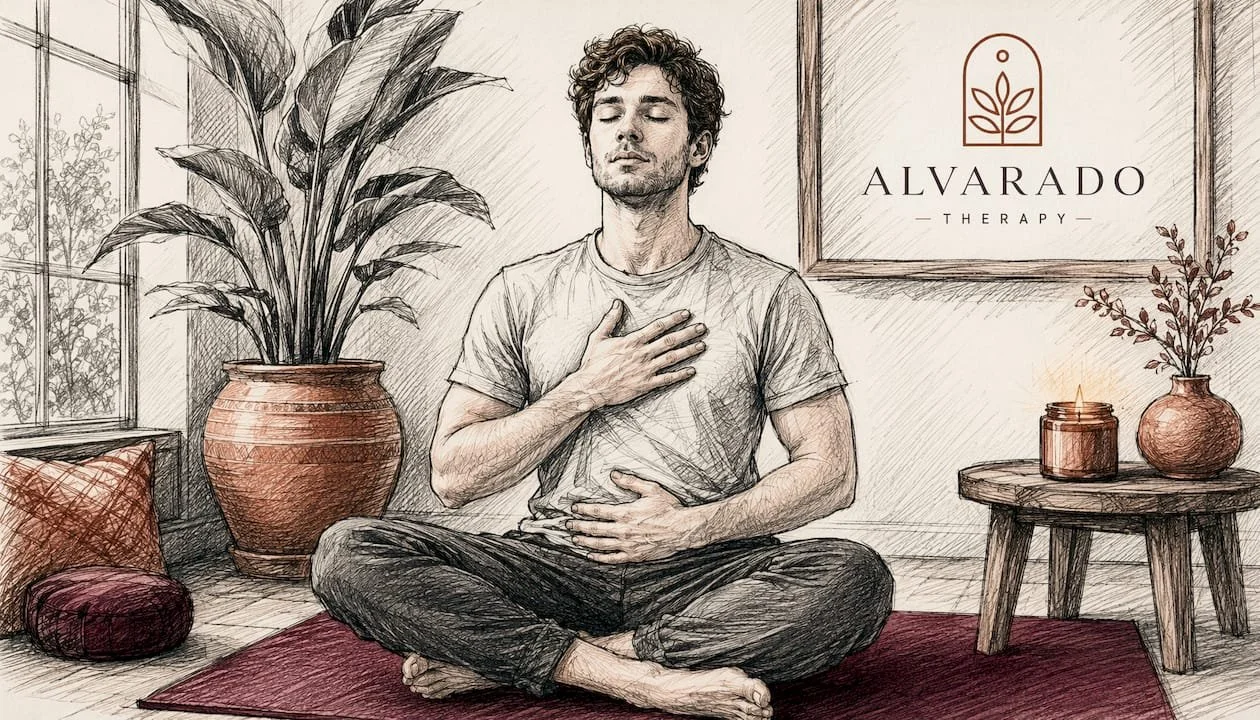
Box breathing: Inhale for 4 counts, hold for 4, exhale for 4, hold for 4. Repeat four cycles.
Physiological sigh: Take a normal inhale, then sneak in a second short inhale on top of it, then release a long, slow exhale. This double-inhale fully inflates the lungs and speeds CO₂ clearance, which drops heart rate quickly.
The key across all three: longer exhale than inhale reliably activates the vagus nerve and slows your heart rate. A 4-second inhale and 6-second exhale is a solid default.
Pro Tip: The exhale is doing the work, not the inhale. If you can only remember one thing, just make your exhale longer.
The 5-4-3-2-1 grounding exercise
The 5-4-3-2-1 method pulls your attention out of anxious thought loops and into your senses. It works in a dorm room, a lecture hall, or a crowded subway car.
Name 5 things you can see (your coffee cup, a window, a poster, your hands, the ceiling light).
Name 4 things you can touch (your chair, your shirt fabric, the desk surface, your phone).
Name 3 things you can hear (traffic outside, your own breathing, a fan).
Name 2 things you can smell (coffee, fresh air, soap).
Name 1 thing you can taste (gum, water, toothpaste from earlier).
Progressive muscle relaxation is another fast option: starting at your feet, tense each muscle group for 5 seconds, then release. Work up to your shoulders. The contrast between tension and release teaches your body what relaxed actually feels like. For a quick movement option, a brisk 2-minute walk or a few shoulder rolls can break the physical tension cycle just as effectively.
A word of caution: Grounding and breathing are tools for functioning through anxiety, not for eliminating every uncomfortable feeling. Using them compulsively to avoid any anxious sensation can actually maintain anxiety over time. The goal is tolerance and action, not zero discomfort.
How do CBT-based thinking skills help you manage anxious thoughts?
CBT is the gold-standard psychological treatment for most anxiety disorders, and its core insight is simple: anxious thinking patterns keep anxiety alive. Changing those patterns changes the anxiety, not just the symptoms.
The order of operations matters. Downregulate your body first (breathing, grounding), then do the cognitive work. Trying to challenge thoughts while your nervous system is still flooded rarely sticks.
A one-page thought record you can use today
Work through these five prompts in a notebook or your phone's notes app:
What happened? (Situation: "I got a bad grade on my midterm.")
What thought did I have? ("I'm going to fail out of school.")
What's the evidence for and against that thought?
What's a more realistic alternative thought? ("One bad grade doesn't determine my GPA. I can talk to my professor.")
What's one small behavioral experiment to test the realistic thought? ("Email my professor today and see what they say.")
This is the core of cognitive reframing. It doesn't require a therapist to start, though a therapist helps you go deeper and faster.
Scheduled worry time
Pick a 15-minute window each day, say 5:00 PM, and contain all your worrying to that slot. When a worry intrudes outside that window, write it down and tell yourself, "I'll think about that at 5." Scheduled worry time reduces rumination by giving worry a container instead of letting it run all day.
The CBT principle worth remembering: Avoidance is what keeps anxiety strong. Every time you avoid something anxiety-provoking, you teach your brain it was actually dangerous. Behavioral experiments and exposure work do the opposite — they build evidence that you can handle it.
Pro Tip: Give each CBT skill a one-week honest trial before deciding it doesn't work. One use rarely shows results; consistent practice does.
| CBT Skill | How to Use It | Frequency |
|---|---|---|
| Thought record | Write out situation → thought → evidence → alternative | Daily or when anxiety spikes |
| Scheduled worry | Contain worry to a 15-minute daily window | Daily |
| Behavioral experiment | Test one anxious prediction with a small real-world action | Weekly |
| Exposure practice | Gradually face avoided situations, starting with the easiest | Weekly, with a therapist when possible |
For a deeper primer on these techniques, CBT for anxiety explains the clinical framework in plain language.
Which daily habits actually lower your baseline anxiety?
Lifestyle habits aren't optional wellness extras. They function as nervous-system hygiene, and when they're inconsistent, your baseline sensitization rises, meaning smaller triggers produce bigger anxiety spikes.
The evidence-backed targets:
Sleep: Aim for 7–9 hours. Keep a consistent wake time even on weekends. A variable sleep schedule disrupts cortisol rhythms and amplifies anxiety the next day.
Exercise: Regular weekly moderate aerobic activity is the public health benchmark for mental health benefits. That's 30 minutes, five days a week, or three 50-minute sessions. Any regular movement helps, but consistency matters more than intensity.
Meals: Skipping meals causes blood sugar dips that mimic anxiety symptoms. Three regular meals with protein and complex carbs stabilize your energy and your mood.
Caffeine and alcohol: Both worsen anxiety. Caffeine is a stimulant that raises heart rate and can trigger panic-like sensations. Alcohol disrupts sleep architecture and increases next-day anxiety. Cutting back is one of the fastest lifestyle changes you can make.
Pro Tip: Don't overhaul everything at once. Pick one habit, practice it for two weeks, then add another. Gradual changes stick; dramatic ones don't.
Statistic callout: regular weekly moderate exercise is the recommended dose for broad mental health benefits, including anxiety reduction.
| Habit | Target | Why It Matters |
|---|---|---|
| Sleep | 7–9 hours, consistent wake time | Regulates cortisol and nervous system baseline |
| Aerobic exercise | 30 minutes, five days a week | Reduces baseline anxiety and improves mood |
| Meals | 3 regular meals with protein | Prevents blood sugar dips that mimic anxiety |
| Caffeine | Reduce or eliminate | Stimulant effect raises heart rate and anxiety |
| Alcohol | Limit or avoid | Disrupts sleep and increases next-day anxiety |
| Breathing ratio | 4-second inhale, 6-second exhale | Activates vagus nerve, lowers acute arousal |
For a deeper look at how sleep, meals, and substance use interact with the nervous system, Alvarado Therapy's stress management guide covers the mechanisms in detail.
How do you build a personal coping toolkit that actually holds up under stress?
A compact toolkit plus consistent practice turns these skills from things you've read about into automatic responses you reach for without thinking. That's the whole goal.
Your 2-week practice plan
Daily (5–10 minutes):
Morning: One breathing exercise (pick diaphragmatic, box, or physiological sigh).
Midday: One grounding check-in (5-4-3-2-1 or a 2-minute walk).
Evening: One thought record entry or worry journal prompt.
Bedtime: Progressive muscle relaxation or a brief body scan.
Weekly (one longer session, 20–30 minutes):
Review your mood/anxiety ratings from the week.
Run one behavioral experiment from your CBT thought record.
Check in with one person in your support network.
Do one activity purely for enjoyment.
Categories to include in your toolkit
One breathing technique
One grounding exercise
One movement option (walk, stretch, yoga)
One cognitive tool (thought record or worry scheduling)
One sleep habit (consistent wake time or a wind-down routine)
One social check-in (text, call, or in-person)
One self-care activity you genuinely enjoy
Pro Tip: Track your anxiety on a 1–10 scale before and after each skill. After two weeks, you'll have real data on what works for you specifically, not just what works in general.
| Week | Daily Focus | Weekly Goal |
|---|---|---|
| Week 1 | Breathing + grounding morning and evening | Complete one thought record; rate anxiety before/after |
| Week 2 | Add CBT tool + sleep habit | Run one behavioral experiment; review weekly ratings |
The daily anxiety management workflow from Alvarado Therapy walks through how to combine these skills into a sustainable routine.
What should you do during a panic attack?
Follow these steps in order. Panic attacks feel dangerous but are not medically dangerous for most people. They peak within 10 minutes and pass.
Name it. Say to yourself: "This is a panic attack. It will pass. I am not in danger."
Stabilize your breathing. Slow your exhale. Don't try to breathe fast. Breathe out longer than you breathe in.
Ground yourself. Name five things you can see. Touch something solid, like a chair or a wall.
Change your position. Sit down or lean against something stable. Lying flat can sometimes increase the sensation of breathlessness.
Contact support if helpful. Text or call someone. You don't have to explain everything, just say "I'm having a hard moment."
Wait it out. The peak passes. Your job is to stay with it, not fight it.
Script to read aloud to yourself: "I feel anxious right now. This feeling is uncomfortable but not dangerous. My body is doing what it's designed to do. I will breathe slowly and let this pass."
When to call 911 or go to the ER: Chest pain with arm or jaw pain, difficulty breathing that doesn't improve, loss of consciousness, or any symptom you genuinely cannot distinguish from a cardiac event. When in doubt, get checked. Panic attacks and cardiac events can feel similar, and no one should feel embarrassed for seeking medical evaluation.
Pro Tip: If you're prescribed medication for acute anxiety, use it as directed by your clinician. Never start benzodiazepines on your own, and never use someone else's prescription. These medications carry real dependency risks and require medical supervision.
When does therapy help, and what can CBT and EMDR actually do?
Evidence is clear: therapy, especially CBT, produces lasting change for anxiety disorders, not just temporary relief. CBT restructures the thought patterns and avoidance behaviors that keep anxiety active, and its effects hold at 12-month follow-up. Medications like SSRIs and SNRIs are a valid option for moderate to severe anxiety, but they typically take 4–6 weeks to reach full effect. Combined care, therapy plus medication, often works best for persistent or severe cases.
What to expect from a therapy timeline
Initial consultation: You describe your history and goals. The therapist explains the approach.
First 4–6 sessions: Skill-building, psychoeducation, and identifying your specific anxiety patterns.
Sessions 6–16: Active CBT work, including exposure exercises and thought records.
Noticeable improvement: Most people notice meaningful change within 8–12 weeks of consistent work.
Ongoing or intensive care: Some people benefit from EMDR intensives or longer-term therapy, especially when past trauma is driving anxiety.
When EMDR is the right fit
EMDR (Eye Movement Desensitization and Reprocessing) is particularly effective when anxiety is rooted in past traumatic experiences, not just current stressors. If you notice that your anxiety spikes are tied to specific memories, relationships, or childhood experiences, trauma-focused therapy may address the root more directly than CBT alone.
The realistic timeline: Most people feel noticeably better within 8–12 weeks of consistent therapy. That's not a guarantee, but it's a reasonable expectation to hold when starting. Progress isn't linear, but it is real.
Alvarado Therapy offers trauma-informed CBT and EMDR for anxiety, with licensed therapists available online across California and New York, and in person in Pasadena and Ventura. Sessions are available in English and Spanish.
Pro Tip: Read the step-by-step therapy guide before your first session so you know what to expect and can make the most of the time.
How does social support reduce anxiety for young adults?
Social connection is one of the most underused anxiety management techniques, partly because anxiety itself makes you want to withdraw. That withdrawal makes anxiety worse. Breaking the cycle matters.
Peer support: A friend who knows what you're going through doesn't need to fix anything. Telling someone "I've been anxious lately" reduces the isolation that amplifies anxiety. The Anxiety and Depression Association of America recommends joining support groups specifically because shared experience reduces shame and provides perspective.
Family: Not every family is a safe space for mental health conversations, and that's real. If yours is, use it. If it isn't, peer and professional support fill that role.
Online communities: Moderated mental health communities on platforms like Reddit (r/Anxiety) or through NAMI can provide connection and practical tips, especially for young adults who don't yet have a local support network. The key word is moderated: unmoderated spaces can amplify anxiety rather than reduce it.
Relationship anxiety: When anxiety is closely tied to a specific relationship, couples therapy can address the dynamic directly rather than managing symptoms in isolation. For anxiety in relationships, Alvarado Therapy's guide covers five concrete strategies.
Which apps and digital tools actually help with anxiety?
A few categories of tools have real evidence behind them; most wellness apps do not. Be selective.
Mindfulness and meditation apps: Headspace and Calm both offer structured mindfulness practices for young adults, including sleep meditations and breathing exercises. Consistent use, even 10 minutes daily, builds the mindfulness practices that reduce anxiety reactivity over time.
CBT-based apps: Woebot uses conversational CBT techniques and has been studied in college student populations. It's not a replacement for therapy, but it's a low-barrier way to practice thought records and mood tracking between sessions.
Crisis tools: The 988 Lifeline has a chat option at 988lifeline.org for those who prefer text over phone.
Relaxation resources: For guided breathing and relaxation techniques, structured audio practices can make it easier to build a daily habit than trying to practice from memory.
The honest caveat: apps work best as supplements to real skills and real relationships, not substitutes. Screen time itself can increase anxiety, so set intentional limits on passive scrolling.
How do you manage anxiety triggers specific to college and work life?
Academic, social, and work-related stress are the most common anxiety triggers for young adults, and they share a common structure: high stakes, uncertain outcomes, and social evaluation. That combination is a reliable anxiety activator.
Academic stress: Break large tasks into the smallest possible next action. "Write my paper" is paralyzing. "Open a blank document and write one sentence" is not. Perfectionism drives academic anxiety more than workload does for many students. A thought record targeting "I have to get this perfect" is often more useful than another hour of studying.
Social anxiety: Avoidance is the main driver. Every time you skip a social event because of anxiety, the anxiety grows. Gradual exposure, starting with lower-stakes situations, is the evidence-based approach. Campus counseling centers often offer group therapy specifically for social anxiety, which is itself a form of exposure.
Work-related stress: Boundary-setting and time management reduce the chronic overload that keeps the nervous system sensitized. The ADAA's stress management tips specifically include learning time management as an anxiety reduction strategy, not just a productivity one.
One skill that cuts across all three: identifying your specific triggers. Keep a simple log for one week: situation, anxiety level (1–10), and what you did. Patterns become visible fast, and visible patterns are manageable ones.
How do you build resilience so anxiety doesn't keep escalating?
Resilience isn't a personality trait you either have or don't. It's a set of skills that get stronger with practice, and most of them overlap with the anxiety management techniques already covered in this article.
Emotional regulation means noticing a feeling without immediately reacting to it. The pause between stimulus and response is where choice lives. Mindfulness practices build that pause. Even two minutes of focused breathing daily, over weeks, measurably increases your ability to tolerate distress without acting on it.
Distress tolerance is the skill of getting through a hard moment without making it worse. Grounding, breathing, and self-compassionate self-talk ("This is hard, and I can handle hard things") are the core tools. The goal isn't to feel nothing; it's to stay functional.
Meaning and identity: Young adults who have a clear sense of their values and what matters to them tend to recover from setbacks faster. This isn't abstract. It means knowing what you care about enough to keep going when things are difficult. Journaling, therapy, and honest conversations with people you respect all build this.
Trauma-informed care recognizes that for some young adults, anxiety escalation is connected to past experiences that haven't been fully processed. If your anxiety feels disproportionate to current stressors, or if certain situations trigger intense reactions that don't make sense to you, that's worth exploring with a therapist trained in trauma-focused approaches.
Key Takeaways
Anxiety in young adults responds to a combination of immediate physiological skills, consistent cognitive practice, and lifestyle foundations, with professional therapy accelerating progress when self-help alone isn't enough.
| Point | Details |
|---|---|
| Start with the body | Use a longer exhale than inhale (4 in, 6 out) and 5–4–3–2–1 grounding for fast relief. |
| Add CBT tools | Thought records and scheduled worry time change the thinking patterns that keep anxiety active. |
| Fix the foundations | Adequate sleep duration, regular weekly moderate exercise, and reduced caffeine lower your baseline anxiety. |
| Build a toolkit | A 2-week practice plan with daily 5–10 minute skill sessions turns coping into an automatic response. |
| Alvarado Therapy | Offers trauma-informed CBT and EMDR online across California and New York for anxiety that persists or limits daily life. |
A realistic note on progress and what actually helps
The most common mistake young adults make with anxiety is expecting skills to work immediately and abandoning them when they don't. Anxiety built over months or years doesn't dissolve in a week. What actually happens is more gradual: you use a breathing technique and it takes the edge off. You do a thought record and notice the catastrophic thought was exaggerated. You sleep consistently for two weeks and realize your baseline has quietly shifted. The change is real, but it's cumulative.
The other thing worth saying plainly: self-help tools are genuinely useful, and they have a ceiling. If anxiety is limiting your ability to work, study, maintain relationships, or enjoy your life, that's the signal that professional support isn't optional. Therapy doesn't mean something is wrong with you. It means you're using the most effective tool available.
Anxiety is treatable. Skills help. Therapy speeds the process. Both are worth your time.
Alvarado Therapy offers professional anxiety support online across California and New York
If anxiety is getting in the way of your daily life, self-help tools are a strong start, but working with a licensed therapist moves the process faster and deeper. Alvarado Therapy provides trauma-informed CBT and EMDR for anxiety, with licensed therapists available online throughout California and New York, and in person in Pasadena and Ventura.
Services include individual therapy for anxiety and trauma, EMDR Intensives for faster processing, and bilingual care in English and Spanish. Whether your anxiety is tied to academic pressure, relationship stress, past trauma, or a combination, the approach is tailored to what's actually driving it, not a generic protocol.
Your next step: Book a consultation to talk with a therapist about what you're experiencing. Before your first session, the what to expect guide walks you through exactly how the process works so you can come prepared.
This article is general information, not professional medical or psychological advice. For your specific situation, consult a licensed mental health professional or your primary care provider.
Useful sources and further reading
Crisis support:
988 Suicide and Crisis Lifeline: Call or text 988, or chat at 988lifeline.org. Available 24/7.
Crisis Text Line: Text HOME to 741741.
Authoritative sources used in this article:
ADAA: Tips and Strategies to Manage Anxiety and Stress
URMC Health Matters: How to Manage Anxiety
Simply Psychology: Anxiety Management Techniques
Mayo Clinic: Anxiety Disorders Diagnosis and Treatment
Alvarado Therapy resources:
Anxiety and stress management services (CA and NY)
Alvarado Therapy blog for downloadable worksheets and mental health guides
Additional tools:
Meditation and CBT apps (Headspace, Calm, Woebot) for daily skill practice between sessions.
NAMI (National Alliance on Mental Illness) at nami.org for peer support groups and local resources.
