
Coping Tips for Anxiety in Relationships: 5 Proven Strategies
TL;DR:
Recognizing and understanding triggers is essential for managing relationship anxiety effectively.
Communication using 'I' statements and scheduled check-ins improves emotional safety.
Mindfulness, boundaries, and professional therapy help reduce anxiety's impact and promote growth.
Relationship anxiety can quietly erode the closeness you've worked hard to build. One moment you feel secure, and the next you're spiraling over an unanswered text or replaying a conversation for the third time. The frustrating part? Generic advice like "just communicate better" rarely helps when your nervous system is already in overdrive. Using 'I' statements and non-blaming language is one piece of the puzzle, but lasting change requires a layered set of skills. This article walks you through five evidence-backed coping strategies, from building self-awareness to knowing when professional support makes sense, so you can choose what fits your relationship right now.
Table of Contents
Key Takeaways
| Point | Details |
|---|---|
| Self-awareness first | Understanding your anxiety triggers helps prevent reactive conflict with your partner. |
| Effective communication pays off | Using 'I' statements and scheduled check-ins builds emotional safety for both partners. |
| Practice mindfulness daily | Grounding exercises like box breathing can regulate feelings before they escalate. |
| Healthy boundaries matter | Setting boundaries reduces unhealthy reassurance cycles and resentment. |
| Professional support available | Couples therapy and psychoeducation are effective solutions for persistent anxiety. |
Prioritize self-awareness and triggers
Before you can change a pattern, you have to see it clearly. Self-awareness is the foundation of every other coping strategy because anxiety tends to operate on autopilot. You react before you even realize you're triggered. Understanding what sets off your anxiety gives you a split second of choice that simply wasn't there before.
Identifying anxiety triggers in relationships starts with noticing patterns rather than isolated incidents. Ask yourself: When does my anxiety spike? Is it when your partner is quiet? When plans change last minute? When you feel left out of a decision? Naming the pattern is far more useful than replaying the argument.
Here are three practical steps to build this skill:
Start a trigger journal. After a tense moment, write down what happened, what you felt in your body, and what thought followed. Over two weeks, themes will emerge.
Use the "pause and name" routine. When anxiety rises, pause and say internally, I feel anxious because I interpreted this as rejection. Naming the emotion reduces its intensity almost immediately.
Apply the 24-hour rule. For intense conflicts or fears, wait 24 hours before initiating a big conversation. This gives your nervous system time to regulate so you're responding thoughtfully rather than reactively.
Pro Tip: Before responding in a heated moment, try naming your emotion out loud to yourself. Something as simple as "I'm feeling scared, not angry" can completely shift how you show up in the conversation.
"When we slow down enough to identify what's triggering us, we stop blaming our partners for feelings that are often rooted in older wounds. Self-awareness breaks the cycle before it starts." — Alvarado Therapy clinical perspective
Prioritizing self-awareness before communicating and using tools like the 24-hour rule significantly reduces reactive blame and protects emotional safety for both partners.
Communicate with 'I' statements and scheduled check-ins
Once you understand your triggers, the next core skill is sharing them without putting your partner on the defensive. This is where most couples struggle. You feel something real and valid, but the way it comes out sounds like an accusation, and suddenly you're arguing about who said what instead of solving the actual problem.
'I' statements restructure the conversation around your experience rather than your partner's behavior. Compare these two:
"You never make time for me."
"I feel disconnected when we don't have time together, and I'd love to figure out a way to change that."
The second version shares the same need but removes the attack. Your partner can respond to a feeling. They can only defend against a criticism.
Scheduled check-ins take this further by creating a predictable, low-stakes space for emotional conversations. Instead of anxiety-fueled ambushes, you have a weekly 20-minute window where both of you agree to discuss how things are going. This structure removes the fear of "bringing up something bad" because the conversation is already expected.
Gottman Method principles highlight a striking reality: happy couples turn toward each other's emotional bids 86% of the time, while couples in unstable relationships do so only 33% of the time. Scheduled check-ins are one practical way to increase that percentage.
Here's how to structure effective check-ins:
Pick a consistent day and time when neither of you is rushed or tired.
Start with something positive: one thing you appreciated about your partner that week.
Use 'I' statements to share one concern or need.
Close with a plan or a simple acknowledgment.
Pro Tip: Write down two or three topics you want to bring up before each check-in. Walking in prepared keeps anxiety low and prevents the conversation from going blank or spinning out.
Open, non-blaming communication through 'I' statements and scheduled check-ins measurably improves emotional safety and reduces misunderstandings over time.
Practice mindfulness and grounding techniques
With communication skills in place, managing emotional surges in the moment becomes the next frontier. Anxiety doesn't always wait for a convenient time. It can spike mid-conversation, in a crowded restaurant, or right before you walk through the door after work. Mindfulness and grounding techniques are your real-time reset button.
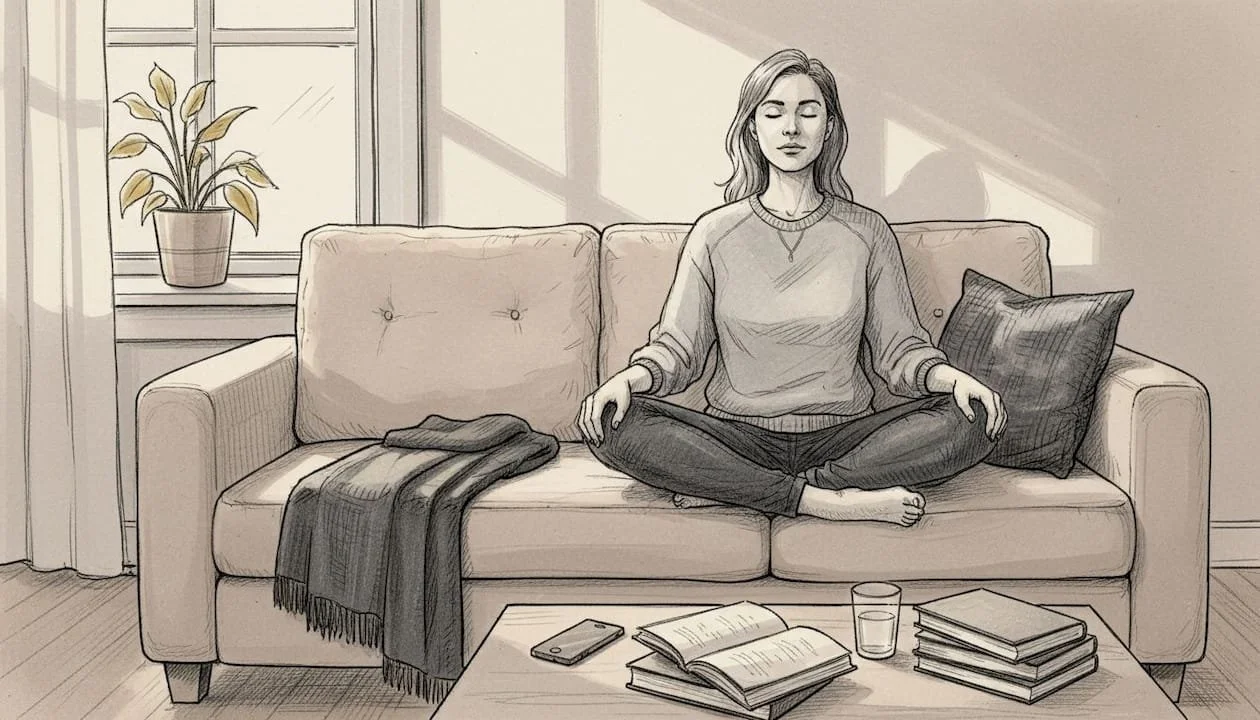
These tools work by redirecting your attention away from the anxious thought loop and back into your body and immediate environment. They interrupt the spiral before it takes over.
The three most effective techniques include:
Box breathing: Inhale for 4 counts, hold for 4, exhale for 4, hold for 4. Repeat 4 times. This directly activates the parasympathetic nervous system.
5-4-3-2-1 grounding method: Name 5 things you see, 4 you can touch, 3 you hear, 2 you smell, and 1 you taste. It anchors you in the present.
STOP technique: Stop what you're doing, Take a breath, Observe your thoughts and feelings without judgment, Proceed with intention.
Here's a quick reference to help you choose the right tool:
| Technique | How to do it | Best used when |
|---|---|---|
| Box breathing | 4-count inhale, hold, exhale, hold | Chest tightness, racing heart |
| 5-4-3-2-1 | Engage all five senses in sequence | Dissociation, panic, overwhelm |
| STOP technique | Stop, breathe, observe, proceed | Mid-argument, impulsive reactions |
Mindfulness and grounding techniques like these regulate emotions in the moment and can prevent small triggers from becoming full-blown conflicts. You can also explore more anxiety coping techniques tailored for California adults.
Pro Tip: Pair your go-to grounding technique with a physical sensory cue, like holding an ice cube or pressing your feet firmly into the floor. The physical sensation speeds up the grounding effect significantly.
Set healthy boundaries and limit reassurance-seeking
After learning how to self-regulate anxiety, keeping relationships strong requires one more layer: healthy boundaries. Boundaries aren't walls. They're the agreements that allow both partners to feel safe, respected, and not responsible for managing each other's emotional state.
One of the sneakiest patterns in relationship anxiety is reassurance-seeking. It feels helpful in the short term: you ask if your partner still loves you, they say yes, you feel better for an hour. But the relief never lasts. The anxiety returns, requiring more reassurance, and over time your partner starts to feel exhausted and your anxiety grows stronger, not weaker.
Setting healthy boundaries and limiting reassurance-seeking prevents this cycle of dependency and resentment from taking root. Validation can absolutely calm anxiety, but it needs to come from within more than from outside.
Healthy boundaries to consider implementing:
Dedicated alone time for each partner, without guilt or interpretation as rejection
Agreed response windows for texts and calls so silence doesn't automatically mean something is wrong
A shared phrase like "I'm okay, I just need 20 minutes" to signal a need for space without triggering the other person
Limiting repetitive check-ins to once per topic per day
Replacing the question "Do you still love me?" with the statement "I'm feeling insecure right now and I want to sit with that"
Pro Tip: Instead of asking for reassurance, try sharing the vulnerability directly: "I'm feeling anxious and I just want you to know, I don't need you to fix it." This validates your own experience and invites your partner's presence without creating pressure.
For a deeper look at healing relationship anxiety from the root, exploring trauma-informed perspectives can be especially powerful.
Seek professional support: Therapy and psychoeducation
If boundaries and self-help strategies aren't enough, professional support can offer effective, lasting solutions. There's no shame in reaching that ceiling. Relationship anxiety often has roots that self-help can't fully reach, including attachment wounds, past trauma, or deeply ingrained beliefs about love and safety.
Knowing which type of therapy fits your situation helps you make a confident decision:
| Therapy type | Core approach | Best for |
|---|---|---|
| EFT (Emotionally Focused Therapy) | Attachment bonds and emotional cycles | Disconnection, fear of abandonment |
| Gottman Method | Communication skills and conflict tools | Repeated arguments, criticism patterns |
| CBT (Cognitive Behavioral Therapy) | Thought patterns and behavioral responses | Overthinking, catastrophizing |
The data behind couples therapy is encouraging. Couples in distress see 70 to 75% recovery rates through therapy, with 90% reporting major improvement. These are significant outcomes for people who might otherwise feel stuck indefinitely.
You can explore couples therapy options to find the right modality, and if you're unsure whether therapy will help, a step-by-step guide to therapy for anxiety can clarify the process.
Notably, even a single psychoeducation session can meaningfully reduce reassurance-seeking and self-silencing behaviors. You don't have to commit to months of work before seeing a shift.
Signs it's time to reach out for professional support:
Anxiety is causing repeated, unresolved arguments
One or both partners feel emotionally withdrawn or shut down
Self-help strategies provide only temporary relief
There's a history of trauma affecting how you show up in the relationship
A fresh perspective: Coping with anxiety as a growth opportunity
Most people treat relationship anxiety as a problem to eliminate. We understand that impulse. It feels awful. But here's what years of working with anxious couples has taught us: anxiety in relationships is often the most honest signal in the room.
It shows up loudest where you care the most. Partners who face their anxiety transparently, naming it instead of acting it out, almost always build stronger communication systems than couples who never had to work at it. The discomfort forced them to develop skills that comfortable couples never needed.
Reframing anxiety as a signal rather than a flaw changes your entire orientation. Instead of asking "What's wrong with me?" you start asking "What does this feeling need?" That shift is where real growth begins. Tracking daily anxiety workflows can help you build that orientation into your everyday life, not just crisis moments.
We've seen couples come in distressed and leave with a shared language for their emotional lives that made them genuinely closer. The anxiety didn't disappear entirely. It became a tool.
Get help with relationship anxiety today
If these strategies resonate but you're ready for more personalized support, Alvarado Therapy is here to help. Our licensed therapists work with Californians across Pasadena, Ventura, and online throughout the state, offering trauma-informed care specifically designed for anxiety and relationship difficulties.
Whether you're looking for online couples therapy or want to start with a therapy consultation to explore your options, we can help you find the right path forward. Our bilingual team offers culturally responsive care in both English and Spanish, so you can heal in the language that feels most like home.
Frequently asked questions
What are the signs of anxiety in a relationship?
Common signs include excessive reassurance-seeking, fear of abandonment, and difficulty trusting your partner even when there's no clear reason not to.
How can I stop overthinking in my relationship?
Using mindfulness tools like the 5-4-3-2-1 grounding method or box breathing can interrupt overthinking in real time and bring you back to the present moment.
When should I consider couples therapy for relationship anxiety?
Couples therapy is recommended when anxiety causes repeated arguments, withdrawal, or distress that neither partner can resolve alone. Recovery rates through structured therapy are strong, reaching 70 to 75% for couples in distress.
Is reassurance-seeking always unhealthy?
Occasional reassurance is normal, but frequent reassurance-seeking can strain relationships and increase dependency. Limiting it helps both partners build genuine emotional security.
Does anxiety in a relationship ever go away on its own?
Relationship anxiety can lessen significantly with self-awareness and consistent skills practice, but it rarely resolves by simply ignoring it. Professional support through therapy or psychoeducation often makes the difference.
