
Immigration Evaluations: Key Steps and Expert Insights

TL;DR:
Immigration evaluations are detailed clinical documents crucial for case success, not just routine paperwork.
A credible evaluation requires clinical rigor, cultural competence, and explicit connection to legal standards.
Preparing thoroughly and working with trauma-informed, experienced professionals enhances evaluation quality and case outcomes.
If you believe an immigration psychological evaluation is just a routine paperwork step, you're not alone, but that assumption can cost you your case. These assessments are high-stakes clinical documents that USCIS officers read closely, and in 2026, scrutiny has only intensified. A well-crafted evaluation can serve as some of the most powerful evidence in your file, while a weak or generic one can trigger a Request for Evidence or outright denial. The APA notes trauma affects testimony in ways that are not obvious from court transcripts alone, which is exactly why a credible mental health professional's analysis matters so much.
Table of Contents
Key Takeaways
| Point | Details |
|---|---|
| Purpose of evaluation | A psychological immigration evaluation gives essential evidence to support your legal case and personal story. |
| Types and who it's for | Different legal pathways such as asylum, hardship waiver, or VAWA each require tailored assessments for eligibility. |
| Quality matters | Thorough, trauma-informed reports that meet 2026 guidelines improve approval odds and reduce costly delays. |
| Preparation tips | Arriving organized with documents and honest history makes your evaluation smoother and more effective. |
| Expert support available | California-based professionals specializing in immigration evaluations can guide you through every step. |
What is an immigration evaluation?
An immigration evaluation is a formal psychological assessment written by a licensed mental health professional for use in immigration legal proceedings. It is not therapy, and it is not a simple letter of support. It is a clinical document that follows structured protocols, cites diagnostic standards, and translates a person's psychological experience into legally relevant language.
These evaluations appear in many different legal contexts. According to immigration evaluation research, the most common types include:
Asylum cases: Focus on trauma, persecution history, and PTSD credibility
VAWA petitions: Document patterns of domestic violence and their psychological effects
U-visas and T-visas: Assess trauma from crime victimization or human trafficking
Hardship waivers (I-601/I-601A): Demonstrate extreme hardship to qualifying U.S. relatives
Cancellation of removal: Show exceptional hardship when deportation is on the table
Every solid evaluation shares a core set of elements. The evaluator conducts in-depth clinical interviews, often across multiple sessions. They apply current DSM-5 diagnostic criteria to identify any mental health conditions. They write a detailed trauma and personal history narrative. And critically, they include an impact statement that connects the person's psychological state to the specific legal standard in the case.
Here is a quick comparison of what makes an evaluation credible versus one that falls short:
| Feature | Strong evaluation | Weak evaluation |
|---|---|---|
| Length | 8+ pages | 2–4 pages |
| DSM diagnosis | Clearly stated | Vague or absent |
| Nexus to legal claim | Explicit and detailed | Missing or implied |
| Cultural context | Addressed | Ignored |
| Trauma narrative | Deep and specific | Generic summary |
If you want to understand the types of immigration evaluations that California practitioners use, that overview can help you identify exactly what kind of report your case needs.
Cultural responsiveness also matters more than most people realize. An evaluator who understands your background, language, and cultural context will capture nuances that a generic assessment simply cannot.
Types of immigration evaluations and who needs them
Not all immigration cases need the same kind of evaluation. Choosing the right type, and making sure your evaluator knows how to write it, can be the difference between a strong file and a confusing one.
Here is a structured comparison so you can see which evaluation type may apply to your situation:
| Evaluation type | Who it's for | Key documentation focus |
|---|---|---|
| Asylum | Persecution and torture survivors | PTSD, trauma credibility, country conditions |
| VAWA | Domestic violence survivors | Abuse patterns, psychological harm, safety risks |
| U-visa | Crime victims cooperating with law enforcement | Mental health impact of victimization |
| T-visa | Human trafficking survivors | Trauma from exploitation, coercion, fear |
| Hardship waiver | U.S. relatives of those facing removal | Hardship impact on citizen or LPR family member |
| Cancellation of removal | Long-term residents facing deportation | Exceptional hardship to U.S. citizen children or spouse |
Here is how to identify which evaluation fits your case:
Asylum applicants need an evaluation that establishes trauma from persecution. PTSD is the most common diagnosis, but anxiety disorders and depression are also relevant.
VAWA petitioners benefit from an evaluation that documents the cycle of abuse and its psychological impact, supporting the claim that the abuse was real and sustained.
U and T-visa applicants need documentation that shows how crime or trafficking affected their mental health, even if they do not have a formal PTSD diagnosis.
Hardship waiver applicants often overlook that the evaluation focuses on a U.S. citizen or legal permanent resident family member, not the applicant themselves.
Cancellation of removal cases demand that the evaluator clearly articulate what deportation would mean for children or spouses left behind.
Understanding the therapists' role in evaluations can help you ask better questions when you contact a provider. The more informed you are, the more productive your first session will be.
One important note: the legal standard is set by your attorney, not your therapist. The evaluator's job is to assess your mental health and connect it to that standard. These are two distinct professional roles, and they work best in close coordination.
What makes an immigration evaluation effective?
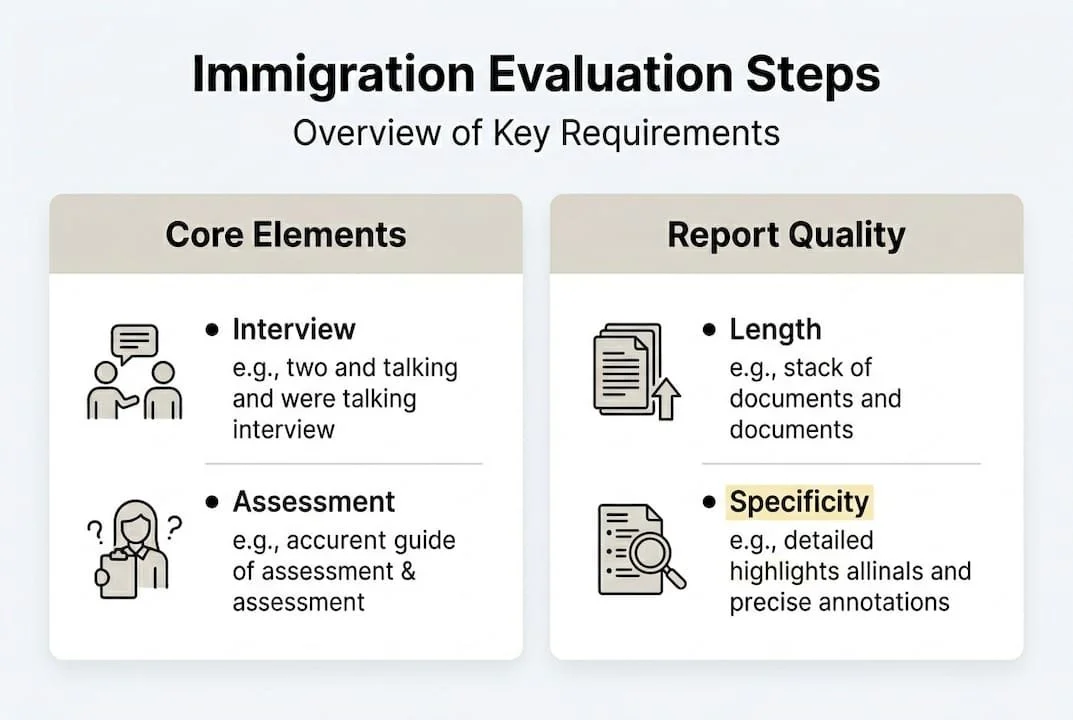
Length is the first signal. Reports under eight pages rarely meet the bar USCIS now expects. That does not mean longer is always better, but a two-page letter is not a clinical evaluation. It signals that the evaluator did not spend sufficient time with you or your records.

The 2026 USCIS trend toward stricter scrutiny means that cookie-cutter reports are now a liability. Officers are trained to spot template language, and a report that could apply to anyone signals that the evaluator did not actually assess you.
Here are the benchmarks a strong evaluation should hit:
| Quality benchmark | Why it matters |
|---|---|
| DSM-5 diagnosis with justification | Establishes clinical legitimacy |
| Clear nexus to legal claim | Connects your psychology to the legal standard |
| Trauma narrative in your words | Demonstrates individualized assessment |
| 8+ pages with clinical reasoning | Shows thoroughness and professional rigor |
| Cultural and linguistic context | Adds credibility and reduces misinterpretation |
The APA's research on trauma and immigration highlights something important: trauma fundamentally changes how people remember and report events. A skilled evaluator explains this to the reader, which helps officers understand why a trauma survivor's account may seem inconsistent or incomplete.
"A trauma-informed evaluation does not just describe symptoms. It explains why those symptoms make sense given the person's history, and why that history should be believed."
Pro Tip: Ask any potential evaluator how many immigration evaluations they have written and whether they have experience with your specific case type. A therapist who has only written one or two evaluations is not the same as one who has written dozens and understands current USCIS expectations.
When you look at essential practices for immigration evaluations, one consistent theme emerges: specificity wins. The more your report anchors your experience to concrete events, symptoms, and impacts, the harder it is to dismiss. Vague language about "significant distress" without clinical grounding does not hold up. Detailed narrative tied to DSM criteria does.
The connection between healing and evaluation quality is also worth noting. Clients who have already begun therapy often have richer self-awareness, which translates into more detailed and credible evaluation sessions.
How to prepare for your immigration evaluation
Preparation reduces anxiety and improves the quality of the information your evaluator captures. Think of it like preparing for any important medical appointment: the more organized and honest you are, the better your provider can help you.
Here are the steps to take before your session:
Gather your documents. Bring identification, any legal notices, police reports, medical records, and court documents related to your case.
Talk to your attorney first. Understand the specific legal standard your evaluation needs to address so you can communicate this clearly to your evaluator.
Write notes about key events. You do not need to memorize everything, but jotting down dates, places, and people involved can help you stay grounded during the interview.
Bring a support person. Many evaluators in California allow a trusted friend or family member to sit in the waiting area, which can ease anxiety before and after the session.
Plan for multiple sessions. Do not expect a single one-hour interview to be enough. Thorough evaluations often require two or more meetings.
The APA's findings on trauma testimony confirm that trauma affects memory recall in ways that can look like inconsistency. Meeting with your evaluator more than once gives you both the space to build trust and capture a fuller picture.
What you can expect during the session:
A detailed interview about your personal history and current mental health
Questions about your symptoms, daily functioning, and relationships
A review of relevant documents you bring
Possible standardized psychological measures
A follow-up call or session if the evaluator needs clarification
Pro Tip: You have the right to take breaks, ask questions, and speak through an interpreter. A trauma-informed evaluator will not rush you or pressure you to share more than you are ready to.
Connecting your experience to trauma assessment best practices is something your evaluator should already know how to do. But understanding what trauma-informed care actually looks like in practice helps you recognize when you are working with someone who truly gets it.
Our perspective: Why trauma-informed professionals make all the difference
Here is what years of working on immigration evaluations in California have taught us: the single biggest variable in evaluation quality is not the format or even the diagnosis. It is whether the evaluator genuinely understands trauma.
Many people assume that any licensed therapist can write a sufficient evaluation. That assumption is costly. USCIS officers in 2026 are reading for depth. They notice when a report uses clinical language without showing that the evaluator actually sat with a person's story and understood it. Generic evaluations not only fail, they can make cases harder to recover.
Cultural competence is equally essential. Culturally responsive evaluations produce 73% better outcomes, and that gap shows up in immigration cases too. An evaluator who understands your background, language, and the cultural meaning of your experiences will write something far more credible than one who does not.
We have seen cases where a rushed, template-based report caused unnecessary delays and additional rounds of documentation. We have also seen thoughtful, individualized evaluations shift the entire tone of a case. The human dimension of this work is not a soft extra. It is the core of what makes it work.
Get expert support for your immigration journey
If you are facing an immigration case and need a psychological evaluation, the quality of that report matters more than most people realize going in. At Alvarado Therapy, our licensed clinicians specialize in trauma-informed, culturally responsive immigration evaluations in California. We understand the legal standards, the clinical benchmarks, and the human experience that sits at the center of every case.
We work with asylum seekers, VAWA petitioners, U-visa and T-visa applicants, and individuals facing hardship waivers or removal proceedings. Our bilingual team serves clients in Pasadena, Ventura, and throughout California via secure online sessions. If you are ready to take the next step, book a consultation and let us walk you through what to expect.
Frequently asked questions
Who can perform immigration evaluations in California?
Licensed mental health professionals, including psychologists, licensed clinical social workers, and licensed marriage and family therapists, can perform these evaluations when they have training in trauma and familiarity with immigration legal standards. The APA's guidance on trauma emphasizes that expertise in trauma assessment is not optional for credible reports.
How long does an immigration evaluation take?
Most evaluations involve one to three hours of clinical interviews plus document review, with the final written report typically ready within one to three weeks after sessions are complete.
What documents should I bring to my immigration evaluation?
Bring government-issued identification, court documents, medical records, police reports, and any written notes or declarations already filed in your case.
Does having an immigration evaluation guarantee my case will be approved?
No evaluation guarantees approval, but detailed evaluations correlate with approvals because they provide the evidentiary depth that strengthens your overall case file significantly.
