
Understanding immigration evaluations for Californians: 2026

TL;DR:
Immigration psychological evaluations document trauma to support legal claims and credibility.
These assessments help translate invisible suffering into legally recognized language.
Skilled, culturally responsive clinicians are essential for credible, trauma-informed legal evaluations.
Invisible trauma can decide the outcome of an immigration case just as powerfully as any document or witness. Many people assume that courts and immigration authorities only respond to hard, physical evidence, but immigration psychological evaluations document the psychological impact of trauma to support legal claims. California is home to one of the largest and most diverse immigrant populations in the country, which means the stakes here are especially high. If you are navigating a legal immigration process and carrying the weight of trauma, this guide will take you from confusion to clarity about what these evaluations are, why they matter, and what you should know before you begin.
Table of Contents
Key Takeaways
| Point | Details |
|---|---|
| Legal importance | Immigration evaluations provide essential evidence for trauma and hardship claims in legal cases. |
| Trauma sensitivity | Skilled, trauma-informed approaches protect vulnerable individuals undergoing evaluation. |
| Professional standards | Ethical and culturally aware evaluations increase credibility and legal effectiveness. |
| Impact on outcomes | Well-conducted evaluations measurably improve the chances of a favorable legal outcome. |
What are immigration evaluations and why do they matter?
An immigration evaluation is a professional assessment performed by a licensed mental health clinician. It is not a simple questionnaire or a quick screening. It is a structured, in-depth process designed to document how trauma, abuse, persecution, or extreme hardship has affected a person's psychological health. The goal is to translate lived, invisible suffering into language that courts and immigration authorities can recognize and act on.
These evaluations are used in a wide range of legal situations. Some of the most common include:
Asylum claims, where applicants must demonstrate a credible fear of persecution
VAWA (Violence Against Women Act) petitions, for survivors of domestic abuse
U-visa and T-visa applications, for victims of crime or human trafficking
Hardship waivers, where separation from family creates exceptional psychological suffering
Naturalization disability waivers (N-648), for those unable to meet standard requirements due to a medical or mental condition
Research confirms that evaluations document trauma, persecution, abuse, and hardship to support legal claims in a way that personal testimony alone often cannot. When someone has experienced prolonged fear or violence, their ability to tell a clear, chronological story can be compromised by the very trauma they endured. A well-written psychological report bridges that gap.
"A psychological evaluation does not just describe symptoms. It contextualizes a person's entire history of suffering within a clinical framework that immigration decision-makers can understand and trust."
The impact of immigration trauma on daily functioning, memory, and behavior is often misunderstood by those outside the mental health field. This is precisely why having a qualified clinician prepare your evaluation matters so much.
Pro Tip: When searching for a clinician to conduct your evaluation, look specifically for someone who has experience in forensic mental health and immigration cases. General therapy experience alone is not sufficient for producing a legally credible report.
California's sheer diversity means that evaluators here must also be equipped to work across languages and cultures. A culturally responsive evaluation does not just check a box; it captures context that can be entirely missed by a clinician unfamiliar with a client's background. If you want a sense of what this looks like in practice, learning about evaluations in California can help you set expectations before you begin.
How forensic evaluations support legal immigration cases
Forensic mental health evaluations occupy a unique space. They are clinical in their methodology but legal in their purpose. This combination is what makes them so powerful in immigration proceedings.
Consider what happens when an asylum seeker cannot remember specific dates or gives inconsistent accounts of their experience. Without context, a judge may view this as dishonesty. But with a forensic report explaining that fragmented memory is a documented symptom of PTSD, that same inconsistency becomes evidence of genuine trauma. Forensic reports improve odds of securing benefits by substantiating trauma and explaining credibility issues like memory gaps due to PTSD.
Here is a comparison of cases with and without forensic evaluations:
| Factor | Without evaluation | With evaluation |
|---|---|---|
| Credibility of testimony | Often questioned | Contextualized by clinical evidence |
| Documentation of trauma | Absent or anecdotal | Clinically validated and detailed |
| Outcome likelihood | Lower, especially in contested cases | Significantly improved |
| Judge/officer understanding | Relies on testimony alone | Supported by expert opinion |
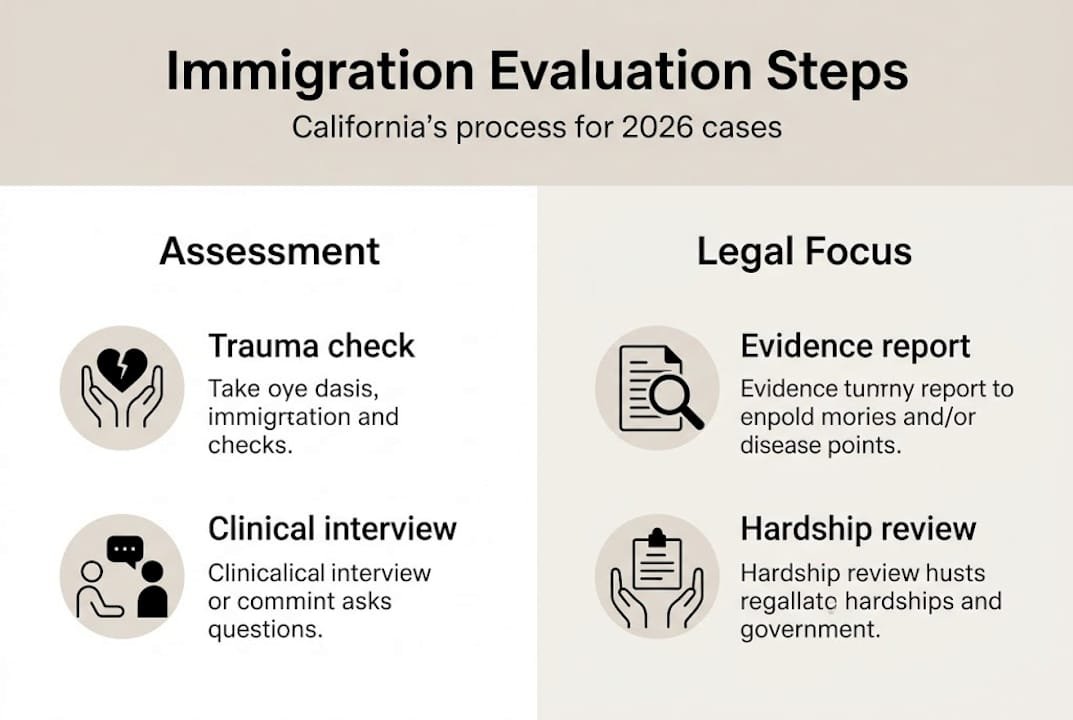
The steps in a strong forensic evaluation generally follow this order:
Initial clinical interview to gather background history and trauma exposure
Standardized psychological testing using validated instruments appropriate for the population
Review of collateral documents, such as medical records, legal filings, or police reports
Diagnostic formulation that links symptoms to documented events
Written report preparation tailored to the specific legal standard required
Understanding the therapists' role in evaluations helps clarify why the clinician's training and objectivity are so critical. The report must withstand scrutiny from attorneys, adjudicators, and potentially appeals courts. It is a legal document as much as a clinical one.
For California residents, the California evaluation process has specific nuances worth understanding, including state licensing expectations and the volume of cases handled by USCIS offices in Los Angeles, San Francisco, and Sacramento.

Special considerations: trauma, children, and hardship waivers
Different legal cases and different people need a thoughtful approach to evaluation. Not all immigration evaluations are the same, and assuming a one-size-fits-all process can lead to incomplete or even harmful assessments.
Research highlights that edge cases include N-648 for citizenship disability waivers, family separation trauma, and child evaluations requiring child-sensitive methods. Each of these situations demands specific adaptations in how the clinician approaches the process.
Here is a quick overview of what different populations may need:
| Population | Key evaluation need | Primary concern |
|---|---|---|
| Trauma survivors | Trauma-informed, paced sessions | Risk of retraumatization |
| Children | Age-appropriate tools and language | Developmental appropriateness |
| Hardship waiver applicants | Documented family impact | Quantifying emotional and functional harm |
| N-648 applicants | Medical and psychiatric documentation | Clear disability nexus |
For trauma survivors, the evaluation process itself can feel threatening. Revisiting painful memories in a clinical setting, even with a compassionate evaluator, carries real risk. This is why the approach to culturally sensitive assessments is so important. A skilled clinician knows how to pace sessions, build rapport, and use trauma-informed techniques that gather necessary information without causing unnecessary distress.
Children present their own set of challenges. Standard adult psychological measures are not appropriate for minors, and children may not have the language or developmental capacity to describe their experiences directly. Play-based assessments, structured observations, and age-appropriate interviews are essential tools in these cases.
Pro Tip: If your case involves a child, ask the evaluating clinician specifically about their training in child trauma and whether they use validated, age-appropriate instruments. This is not a standard for every clinician, and it matters enormously for the quality of the report.
Hardship waiver cases require documenting not just what happened to the applicant, but how their removal or continued separation would psychologically affect qualifying U.S. citizen or resident family members. This is a distinct clinical skill. Understanding mental health in trauma healing is part of what makes these evaluations so nuanced and so consequential.
Challenges and ethical standards in immigration evaluations
With those special situations in mind, it is also important to understand the difficulties and standards involved in producing credible, compassionate evaluations.
Producing a high-quality immigration evaluation is genuinely hard work. Clinicians face a layered set of challenges that go well beyond typical therapeutic practice. Here are some of the most significant ones:
Retraumatization risk: Gathering detailed trauma history can activate trauma responses in clients, requiring careful management throughout the process.
Cultural and linguistic bias: Many assessment tools were developed for and validated on Western, English-speaking populations. Using them with immigrants from diverse backgrounds requires careful adaptation.
Forensic objectivity vs. therapeutic care: Evaluators must remain objective in their findings while also treating clients with sensitivity and compassion.
Scrutiny from legal authorities: Reports submitted to USCIS or EOIR (the immigration courts) may be challenged by government attorneys, requiring thorough, defensible methodology.
The APA guidelines on immigration assessments emphasize ethical standards and multicultural competence. The APA emphasizes ethical standards and multicultural guidelines in psychological evaluations, noting that challenges include risk of retraumatization, need for cultural adaptation, and limited empirical forensic assessment instruments.
For California clinicians specifically, these standards carry extra weight. California's immigrant population speaks dozens of languages and comes from vastly different cultural traditions around mental health, authority, and disclosure. An evaluator who relies on a single cultural lens will produce a report that misses critical context.
Some key ethical obligations for evaluators include:
Informed consent that clearly explains the forensic (not therapeutic) nature of the evaluation
Transparency about who will receive the report and how it will be used
Use of validated, appropriate assessment tools whenever possible
Honest reporting, even when findings are not entirely favorable to the applicant
Understanding ethical guidelines for therapists in this context gives applicants a clearer picture of what they should expect and what they are entitled to ask for.
"Ethical evaluations are not just about protecting the clinician or the legal process. They are fundamentally about protecting the person sitting across the table."
The real impact: why mental health expertise makes a difference
Here is what we see over and over again in this work: a technically adequate evaluation and a genuinely expert evaluation can produce very different outcomes for the same person. The difference is not in the format or the length of the report. It is in the depth of clinical understanding brought to the process.
When an evaluator truly understands trauma, they can articulate why a survivor behaved in ways that might otherwise seem inexplicable, such as returning to an abusive partner or taking years to disclose abuse. That clinical context is not obvious to a judge or adjudicator. It has to be explained clearly, credibly, and with authority.
Evaluations bridge clinical psychology and immigration law, providing objective evidence of invisible trauma impacts that are crucial for individuals in California. Culturally aware evaluations can reveal context that a general assessment would completely miss, and that context can tip the scales. Mental health's role in recovery does not stop at the therapy room. It extends into the legal process itself, and that is a reality we believe more Californians deserve to know.
Support for your immigration journey
If you are preparing for an immigration evaluation or simply trying to understand your options, having the right support around you makes all the difference. These evaluations are not just paperwork. They are an opportunity to have your experience seen, documented, and advocated for by someone who understands both trauma and the legal process.
At Alvarado Therapy, we offer immigration evaluations in California that are trauma-informed, culturally responsive, and prepared to meet the specific requirements of your legal case. Our licensed clinicians work with asylum seekers, VAWA applicants, U-visa and T-visa clients, and many others across Pasadena, Ventura, and online throughout California. We also offer trauma therapy in California for those who need ongoing support alongside or after the evaluation process. Reach out today for a confidential consultation.
Frequently asked questions
What is included in an immigration evaluation in California?
An immigration evaluation typically includes a psychological assessment, review of trauma history, clinical interviews, and a written report tailored to legal requirements. The goal is to document trauma and hardship in a clinically valid and legally useful format.
How do immigration evaluations affect the outcome of legal cases?
They provide objective documentation that can substantiate trauma and resolve credibility issues, increasing the likelihood of a favorable decision. Forensic reports substantiate trauma and explain issues like memory gaps that might otherwise undermine a case.
Are immigration evaluations safe for trauma survivors?
When conducted by trauma-informed mental health professionals, evaluations can minimize harm and support healing while meeting strict ethical standards. APA ethical standards and multicultural guidelines are designed specifically to protect vulnerable populations during this process.
Can children undergo immigration evaluations?
Yes, but children require specialized, age-appropriate approaches to ensure accurate and compassionate documentation of their experiences. Child-sensitive evaluation methods are essential for producing reports that are both reliable and protective of the child's wellbeing.
