
Immigration Evaluations in California: Trauma-Informed Guide

TL;DR:
Immigration evaluations include medical exams and forensic mental health assessments for legal cases.
Trauma-informed approaches protect clients' emotional wellbeing and improve the accuracy of reports.
Proper evaluations help establish credibility by explaining trauma-related inconsistencies during immigration proceedings.
Immigration Evaluations in California: Trauma-Informed Guide
Most people assume immigration evaluations are simple paperwork, routine checkups that a doctor signs off on before you move to the next step. That assumption is costly. Immigration evaluations, especially psychological ones, carry real legal weight and can shape the outcome of an asylum claim, a hardship waiver, or a VAWA petition. For California immigrants navigating complex legal processes while carrying the weight of trauma, understanding what these evaluations really do, and how a trauma-informed approach protects you, is one of the most important steps you can take.
Table of Contents
Key Takeaways
| Point | Details |
|---|---|
| Dual evaluation roles | Immigration evaluations can cover both medical and trauma-related mental health needs, each with distinct legal purposes. |
| Trauma-informed practices | Using trauma-informed methods protects immigrants from harm and better supports their legal cases. |
| Credibility support | Expert evaluators can clarify how trauma and culture impact memory, bolstering your credibility with immigration officials. |
| Cultural nuances | Cultural and research gaps make it vital to have evaluators skilled in diverse backgrounds. |
What is an immigration evaluation and why is it needed?
Immigration evaluations are not a single, uniform process. The term actually refers to two distinct types of assessments, each serving a different purpose within the U.S. immigration system.
The first type is the medical immigration examination, conducted by a USCIS-designated civil surgeon. These exams check for physical conditions and certain mental health disorders that could make someone inadmissible to the United States. Health-related inadmissibility is assessed through uniform criteria recorded on Form I-693, and every applicant for certain visa categories or permanent residence must complete one. This is the part most people are familiar with.
The second type is the forensic mental health evaluation, and this is where trauma-informed care becomes essential. These psychological assessments are conducted by licensed mental health professionals, not civil surgeons. They serve a completely different function. Immigration evaluations serve two roles: medical screening and trauma forensic psychological assessment. The forensic evaluation documents trauma symptoms, assesses psychological impact, and provides evidence that supports legal claims.

| Feature | Medical Exam | Forensic Mental Health Evaluation |
|---|---|---|
| Conducted by | USCIS civil surgeon | Licensed therapist or psychologist |
| Form used | Form I-693 | Written clinical report |
| Focus | Physical and mental health inadmissibility | Trauma, credibility, psychological impact |
| Required for | Green card, some visa applications | Asylum, VAWA, U visa, T visa, hardship waivers |
| Setting | Medical office | Therapeutic or clinical environment |
So why do people seek forensic psychological evaluations? The reasons are varied but tend to cluster around specific immigration pathways:
Asylum claims: Demonstrating fear of persecution and trauma exposure
VAWA petitions: Documenting the psychological effects of abuse for survivors applying under the Violence Against Women Act
U visa and T visa applications: Supporting evidence of trauma for crime victims and trafficking survivors
Extreme hardship waivers: Showing the emotional and psychological toll that deportation or separation would cause to qualifying relatives
Cancellation of removal: Providing evidence of psychological hardship
You can explore evaluation types in California to understand the range of cases these evaluations support and why they matter at each stage of the process.
"An immigration psychological evaluation is not a box to check. It is a clinical document that communicates a person's trauma history and psychological experience in a way that judges and officers can understand and weigh."
The process begins with gathering documentation, followed by one or more clinical interviews. The evaluator then writes a detailed report that synthesizes your history, current symptoms, and the connection between your experiences and your immigration case. Done well, this report becomes one of the most powerful pieces of evidence in your file.
How trauma-informed assessments protect you
Understanding the evaluation types is the first step. Equally important is understanding how those evaluations are conducted, because the approach makes a significant difference in your safety and the quality of the final report.
A trauma-informed evaluation is built on the understanding that many immigrants seeking these assessments have experienced significant harm. The goal is not to extract every painful detail as quickly as possible. Instead, the process is structured to protect your emotional wellbeing while still gathering the clinical information needed to write a credible, persuasive report.
Trauma-informed methodology is specifically important in immigration forensic evaluations to avoid retraumatization and to ensure quality information is collected. When someone is pushed to recount trauma too quickly, or without appropriate support, they may shut down, dissociate, or provide fragmented accounts that appear inconsistent. A skilled trauma-informed evaluator prevents that.
Here is what the trauma-informed process looks like in practice:
Informed consent: Before the first question, you are told exactly what the evaluation involves, how the information will be used, and what your rights are. Nothing happens without your understanding and agreement.
Pacing: The evaluator moves at a pace that you can tolerate. You are not required to detail every traumatic event in a single session.
Safeguarding: The clinician watches for signs of distress and adjusts the conversation accordingly. Grounding techniques may be used if you become overwhelmed.
Culturally sensitive questioning: Questions are framed in ways that account for your cultural background, native language, and the specific context of your experiences.
Validation: Your experiences are treated as real and important, not interrogated with skepticism.
Pro Tip: Ask any evaluator you are considering working with to explain their approach before you commit. A genuinely trauma-informed clinician will welcome that question and give you a clear, respectful answer.
The trauma-informed care impact extends beyond the evaluation itself. Clients who go through a well-structured assessment often report feeling heard for the first time, which itself supports healing. The process of putting words to experience, within a safe container, can begin to reduce the grip trauma has on daily life.
This method also produces better evidence. When someone is not retraumatized during the evaluation, they can provide more coherent, detailed accounts. The trauma assessment best practices that reputable California practices follow are designed to maximize both client safety and clinical quality at the same time. These are not competing goals. They reinforce each other.
Why credibility and consistency matter in immigration cases
Beyond minimizing harm, trauma-informed evaluations are vital for another reason: proving your story's credibility during the immigration process.
In immigration court and administrative adjudication, credibility is everything. Judges and officers need to believe your account. If your story contains gaps, contradictions, or emotional responses that seem inconsistent with what you are describing, it can hurt your case, even if your experiences were real. This is where a mental health evaluation becomes critically important.
Trauma does not preserve memory the way we might wish it did. Research consistently shows that traumatic experiences fragment memory. Survivors often remember certain sensory details with striking clarity while being unable to recall the sequence of events or basic factual information. They may describe a violent incident in a flat, emotionless tone, which can read as dishonest to someone without clinical training. Alternatively, someone may become visibly distressed when discussing even minor details, which can seem disproportionate to an uninformed observer.
Forensic mental health assessments are sought to substantiate trauma and support credibility in immigration adjudication, though they document consistency rather than physically verify trauma. This is a critical distinction. The evaluator is not saying "this happened." They are saying "this person's symptoms and presentation are consistent with someone who experienced what they described."
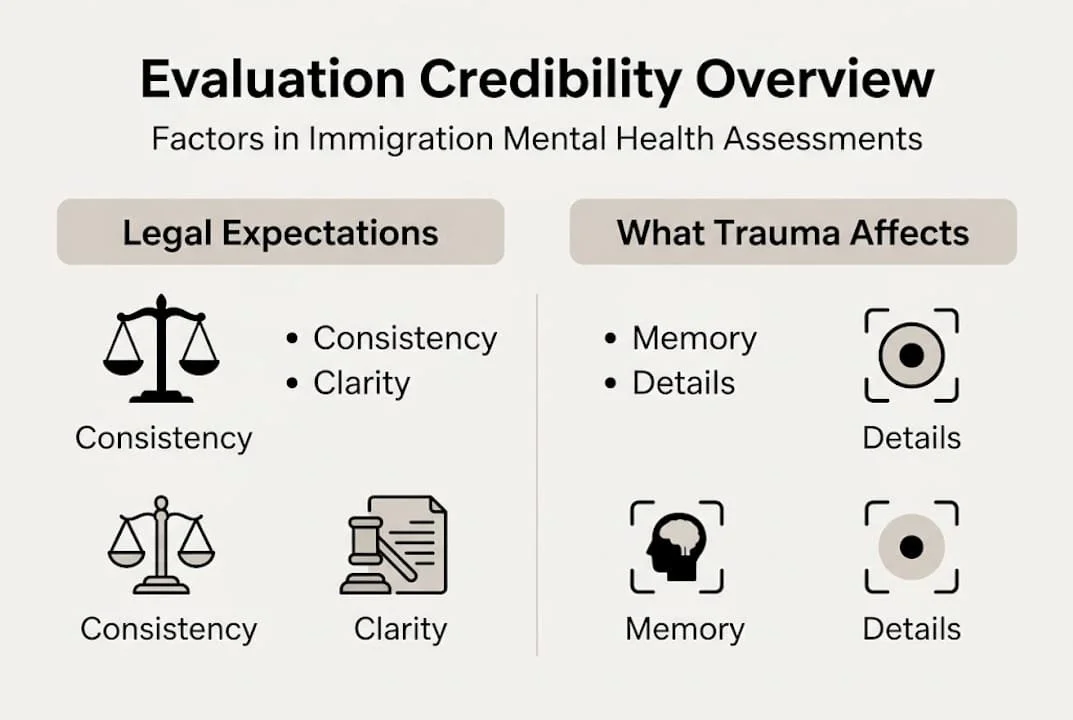
| Perspective | What it expects | What trauma does |
|---|---|---|
| Legal system | Consistent, chronological, detailed accounts | Fragments and disrupts memory formation |
| Legal system | Calm, rational emotional presentation | May produce flat affect or intense distress |
| Legal system | Clear cause and effect narrative | Trauma creates non-linear memory retrieval |
| Mental health science | Inconsistency as a symptom | Inconsistency is clinically expected |
The role of mental health evaluations includes bridging this gap between legal expectation and psychological reality. A well-written forensic report explains to the judge or officer why apparent inconsistencies are not signs of deception but rather signs of genuine traumatic experience.
Cultural differences add another dimension. In some cultures, discussing personal suffering to authority figures is deeply uncomfortable or even taboo. Some survivors minimize their experiences as a coping mechanism. Others may express distress through physical symptoms rather than emotional language. A clinician who understands cultural identity in trauma evaluations can contextualize these differences in the report, giving decision-makers a fuller and more accurate picture.
Nuances, cultural considerations, and real-life scenarios
Understanding credibility leads us to the unique nuances and cultural realities involved in trauma-informed immigration evaluations.
One important thing to acknowledge is that this field is still evolving. Research gaps exist on when and how forensic immigration reports are sought, how often they influence outcomes, and what standardized benchmarks should look like. Not every jurisdiction uses these evaluations consistently, and not every evaluator follows the same methodology. This means the quality of your evaluation depends heavily on who conducts it.
Trauma symptoms and memory differences can create discrepancies between legal expectations of credibility and scientific understanding of trauma. For California immigrants, this gap is particularly important to close with skilled professional help.
Here are some real-life scenarios where these nuances play out:
A woman from Central America seeking VAWA protection struggles to make eye contact and gives short answers. Without a clinical report explaining that avoidance and emotional numbing are PTSD symptoms, a judge might misread this as evasiveness.
A man from Southeast Asia applying for asylum describes fleeing violence but cannot recall the exact dates. A trauma-informed report explains that under extreme stress, the brain prioritizes survival over factual encoding.
A teenager who survived trafficking responds to questions with humor and detachment. A skilled evaluator recognizes this as a dissociative coping strategy, not indifference.
For practical preparation, consider the following:
Bring a trusted person: Many practices allow a support person to accompany you to an evaluation if that helps you feel safe.
Write notes beforehand: You do not need to have everything memorized. Writing down key experiences before your appointment can help you communicate more clearly.
Ask about interpretation: If English is not your first language, request a bilingual evaluator or a certified interpreter in advance.
Understand the timeline: Reports typically take one to three weeks to finalize after the clinical interview.
Pro Tip: Do not worry about telling your story "correctly." A qualified trauma-informed evaluator is trained to work with how trauma affects communication. Your job is simply to share what you can, when you can.
For deeper support throughout this process, healing the emotional impact of immigration stress is something you can pursue alongside the evaluation itself, not after it.
Our perspective: Why thoughtful immigration evaluations change lives
Seeing these complexities firsthand, here is our perspective as trauma-focused experts.
Most people walk into an immigration evaluation believing it is a bureaucratic hurdle. We have seen time and again that when it is conducted thoughtfully, it becomes something far more significant. It becomes a moment where someone's suffering is finally witnessed, documented, and taken seriously by a professional whose words carry legal weight.
There is something quietly powerful about that. Many of the individuals we work with have spent years minimizing what happened to them, either because they had to survive or because no one around them validated their pain. A careful, trauma-informed evaluation interrupts that pattern. It says: what you experienced was real, it has affected you in specific and documented ways, and that matters.
We also believe that the therapists' role in evaluations extends beyond writing a report. The clinician sets the tone for how a person feels about their own story. When done right, clients leave not just with documentation but with a clearer sense of their own resilience. That is not a side effect. That is part of what good clinical work does, and it can become a meaningful step in a longer healing journey.
Immigration evaluations, at their best, are not just legal tools. They are acts of recognition.
Next steps: Expert support for your immigration journey
If you are navigating an immigration case in California and believe a psychological evaluation might strengthen your claim, starting can feel overwhelming. It does not have to be.
At Alvarado Therapy, our licensed, trauma-informed clinicians conduct immigration evaluations for asylum, VAWA, U visa, T visa, extreme hardship cases, and more. Before your evaluation, you can review what to expect so nothing feels like a surprise. And if you are carrying PTSD or complex trauma alongside your immigration process, our PTSD and trauma therapy services provide ongoing support in English and Spanish. You deserve care that sees all of you, not just your case file.
Frequently asked questions
What is the difference between a medical exam and a psychological immigration evaluation?
A medical exam assesses physical and certain mental health conditions for legal admissibility, while a psychological evaluation documents trauma symptoms and supports specific legal claims like asylum or VAWA petitions.
Why are trauma-informed practices important during immigration assessments?
They protect you from being retraumatized during the process and help the evaluator collect accurate, quality information that produces stronger, more credible clinical documentation for your case.
Can a psychological evaluation prove trauma occurred?
No evaluation can prove a past event happened, but it can document consistency between your symptoms and the traumatic experiences you described, which is what decision-makers need.
What should I look for in a trauma-informed immigration evaluator?
Choose a licensed clinician who explains the full process before starting, respects your cultural background and boundaries, and has documented experience with trauma and immigration cases.
Recommended
Immigration Evaluations in California: Types, Process & Experts — Alvarado Therapy
Immigration Therapy: Healing the Emotional Impact — Alvarado Therapy
California relationship transition support: Heal in 3-4 years — Alvarado Therapy
How therapists shape immigration evaluations in 2026 — Alvarado Therapy
