

TL;DR:
A thorough, individualized psychological evaluation is critical for supporting immigration cases involving trauma, hardship, or abuse.
USCIS rejects generic reports; high-quality evaluations link clinical findings directly to legal standards with detailed, culturally sensitive analysis.
Active participation and proper selection of experienced evaluators significantly enhance the chance of a successful immigration outcome.
Many applicants assume that a psychological evaluation is a box to check, a quick appointment with a brief report attached to the back of a stack of forms. That assumption has cost people their cases. In California, where immigration proceedings are among the most contested in the country, a thorough, individualized psychological evaluation can be the deciding factor between approval and denial. This article will walk you through what immigration evaluations actually are, why they carry so much legal weight, how a quality report differs from a generic one, and what you can do right now to make sure yours is as strong as possible.
Table of Contents
Key Takeaways
| Point | Details |
|---|---|
| Detailed reports matter | USCIS prefers thorough, individualized evaluations over generic ones. |
| Skilled evaluators bridge gaps | Expert assessments convey trauma and cultural factors missed by standard forms. |
| Preparation improves outcomes | Bringing full information and choosing the right evaluator can strengthen applications. |
| Trauma and culture shape narratives | A trauma- or culturally-informed approach supports credibility and clarity in your case. |
What are immigration evaluations?
An immigration evaluation is a formal psychological assessment conducted by a licensed mental health professional and submitted to the U.S. Citizenship and Immigration Services (USCIS) or an immigration court as supporting evidence in a legal case. It is not a therapy session. It is not a letter from your doctor. It is a structured, evidence-based document that connects your psychological state, your history, and your lived experiences to the specific legal standards your case must meet.
You will most often need one of these evaluations in cases involving:
Hardship waivers, where you must show that a qualifying relative would suffer extreme and unusual hardship if you were removed
Asylum applications, where the evaluator documents trauma, fear of persecution, and psychological harm
VAWA (Violence Against Women Act) petitions, which require evidence of abuse, its psychological effects, and credibility
U visa and T visa applications, where victims of crime must demonstrate psychological impact
Cancellation of removal, where demonstrating deep family ties and hardship is essential
The evaluation must be detailed, individualized, and evidence-based. It needs to go far beyond a template. USCIS reviewers read thousands of reports, and they know when a report is a fill-in-the-blank document rather than a genuine clinical assessment of a real person. As one immigration resource puts it, USCIS rejects generic reports and specifically emphasizes the need for detailed, individualized methodology.
You can learn more about the types and process of evaluations that are most commonly requested in California cases, as well as a broader overview of understanding evaluations in California for applicants at different stages of their immigration journey.
The core value of a well-written evaluation is that it translates your private pain into language that legal decision-makers are trained to respond to. It bridges two worlds: the deeply personal and the formally legal.
Why are immigration evaluations essential for your case?
With an understanding of what an immigration evaluation is, you may wonder why it carries so much weight for your California case. The short answer: it gives decision-makers evidence they could not get any other way.
Immigration judges and USCIS officers are not mental health professionals. They are trained in law. When they need to assess whether someone has suffered genuine trauma, whether a family member's hardship is severe enough to meet legal standards, or whether an applicant's story is credible despite inconsistencies, they rely on expert documentation. A psychological evaluation fills that gap with clinical authority.
Research confirms this function. Forensic assessments bridge the gap between legal expectations of linear, consistent narratives and the scientific reality of trauma-disrupted memory, which meaningfully improves adjudicator understanding. That is significant because trauma survivors often cannot tell their stories in neat, chronological order. They forget details. They contradict themselves. Without expert explanation, those inconsistencies can destroy credibility. With it, they become clinically expected and understandable.
Here is why a quality evaluation matters at each stage of your case:
It validates your experience. A licensed evaluator can formally document symptoms of PTSD, depression, anxiety, or trauma responses in ways that a personal statement cannot.
It explains behavioral patterns. Memory gaps, emotional numbness, and avoidance can look like dishonesty to an untrained reviewer. An evaluation explains why these are consistent with trauma.
It connects your psychological state to legal standards. "Extreme hardship" is a legal phrase. An evaluator shows how your specific condition meets that definition.
It adds clinical credibility. Adjudicators weigh expert testimony heavily, especially when it is specific and well-documented.
It supports your attorney's legal arguments. The evaluation and your legal filing reinforce each other.
Pro Tip: When choosing an evaluator, ask directly whether they will link findings to the specific legal standard in your case. A skilled evaluator who understands how therapists shape evaluations will know exactly how to frame clinical findings in legal terms. Also explore what a thorough immigration evaluation process in CA looks like so you know what to expect.
Individualized assessments vs. generic reports: What's the difference?
Understanding the weight of evaluations, let's compare what makes a high-quality assessment stand out from a generic one.
The table below breaks down the key differences:
| Feature | Individualized assessment | Generic/template report |
|---|---|---|
| Length and detail | 10 to 25+ pages, client-specific | 2 to 5 pages, fill-in-the-blank |
| Clinical interviews | Multiple sessions, in-depth | Single brief intake |
| Psychological testing | Standardized instruments used | Absent or minimal |
| Cultural context | Explicitly addressed | Ignored or generic |
| Legal standard addressed | Named and linked to findings | Vague or absent |
| USCIS outcome | Generally accepted | Frequently rejected |
| Memory and trauma narrative | Explained clinically | Not addressed |
"USCIS rejects generic or template-based reports and places strong emphasis on detailed, individualized methodology that directly addresses the facts of the applicant's case."
The difference is not just technical. It is the difference between an officer reading a report and thinking "this could apply to anyone" versus "this is clearly about this specific person and their specific circumstances." A generic report signals to a reviewer that neither the evaluator nor the applicant took the process seriously.
An individualized report, on the other hand, demonstrates that a licensed professional spent real time with you, used validated psychological instruments, considered your cultural background, reviewed relevant records, and drew a clear line between your suffering and the legal relief you are seeking. That is the kind of document that earns credibility.

The evaluator's ability to address cultural factors is especially important in California, where the immigration population includes communities from Latin America, Southeast Asia, the Middle East, and Central Africa, among others. Cultural norms around emotional expression, shame, gender roles, and help-seeking behavior all shape how a person tells their story. The therapists' role in individualized reports is not just clinical. It is interpretive, contextual, and deeply human.
Trauma, cultural factors, and memory: Navigating complex cases
Complex cases, especially those involving trauma or cultural identity, require special care in evaluation.
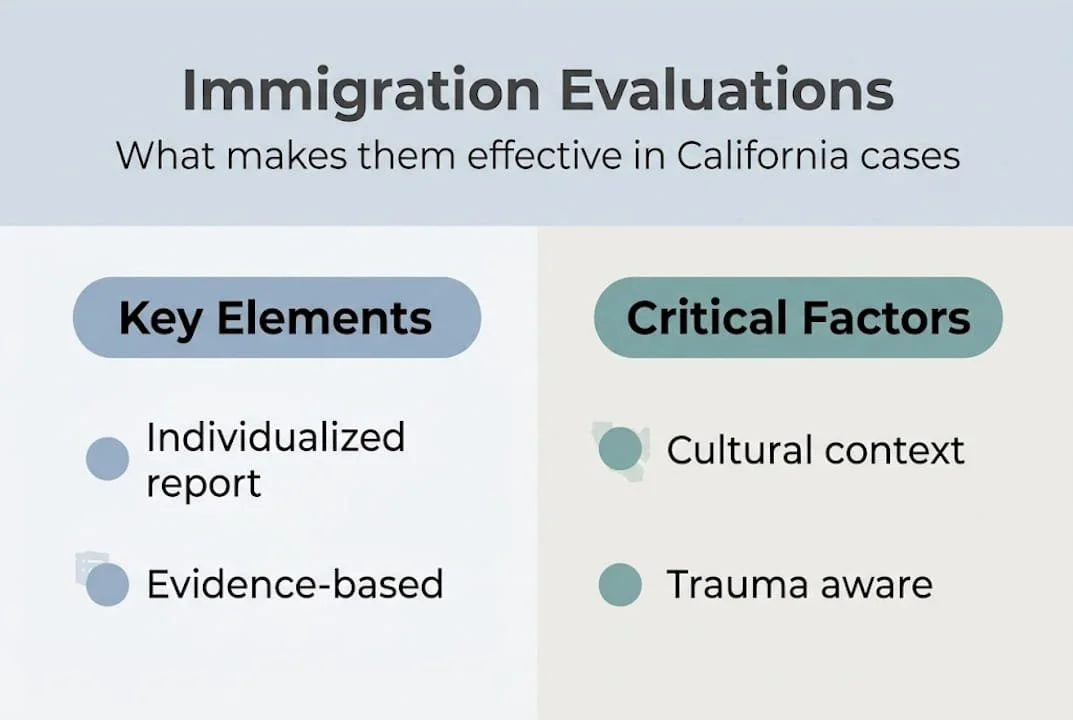
Trauma does not follow a neat timeline. When someone has experienced domestic violence, persecution, or severe loss, their memory can be fragmented, non-linear, and sometimes contradictory. This is not a character flaw. It is a neurological reality. When adjudicators expect a clean, consistent narrative and instead receive one full of gaps, they can incorrectly flag it as dishonest. Mental health forensic assessments are specifically designed to reconcile trauma-disrupted memory with legal expectations, giving adjudicators the scientific framework they need to evaluate credibility fairly.
The table below shows how skilled evaluators document common trauma and cultural factors:
| Challenge | How it appears in testimony | How a skilled evaluator documents it |
|---|---|---|
| Memory gaps | Inconsistent dates or details | Explains dissociation and trauma memory research |
| Emotional flatness | Seems “unbothered” by trauma | Documents emotional numbing as a PTSD symptom |
| Cultural stigma | Reluctant to discuss abuse | Contextualizes shame norms within specific culture |
| Gender-based silence | Avoids discussing sexual violence | Notes culturally conditioned avoidance |
| Hypervigilance | Appears nervous or evasive | Documents trauma-related hyper-arousal |
California's diverse population makes culturally responsive evaluation especially critical. A Salvadoran woman disclosing domestic abuse carries a different cultural weight than the same disclosure from someone in a different community. A Vietnamese applicant discussing family shame may express distress very differently from a Colombian applicant. An evaluator who does not understand these nuances may misread restraint as dishonesty or detachment as lack of credibility.
Tips for finding evaluators who genuinely understand trauma and culture:
Ask whether they conduct evaluations in your language, or with a qualified interpreter experienced in mental health contexts
Ask about their specific experience with your community or country of origin
Confirm they use validated instruments such as the Harvard Trauma Questionnaire or the PTSD Checklist (PCL-5)
Check whether they have experience with your specific case type, whether asylum, VAWA, or hardship waiver
Review their report format by asking to see a sample or outline before committing
Pro Tip: Share everything, even experiences you feel embarrassed about, confused by, or unsure are relevant. Cultural nuances, traditional practices, family dynamics, and community expectations might actually be the detail that strengthens your case most. An evaluator experienced in cultural identity and trauma therapy will know how to place those details in context. You can also explore how trauma-informed care approaches the intersection of trauma symptoms and cultural expression.
How to maximize the value of your immigration evaluation
Armed with knowledge of what works, here's how to make sure your immigration evaluation is truly effective.
Taking an active role in the evaluation process dramatically improves the quality of the final report. Here is a step-by-step guide:
Find a licensed mental health professional with immigration evaluation experience. Not every therapist or psychologist is qualified to write immigration evaluations. You want someone who understands both clinical assessment and the legal standards your case involves. Ask for credentials, experience, and references.
Gather all relevant documents before your first appointment. This includes any records of medical care, prior therapy, police reports, court orders, immigration filings, and letters from attorneys. The more context your evaluator has, the more precise the report can be.
Be completely open during the evaluation sessions. Withholding information, even out of shame or fear, limits what the evaluator can document. What feels minor to you might be clinically significant.
Request a culturally-informed evaluation explicitly. If your cultural background is central to your case, tell your evaluator. Ask them to address cultural context in the report. This is not optional in complex cases. It is essential.
Review the draft before submission if possible. Ask your evaluator whether you can review the report for factual accuracy. This is not about editing conclusions. It is about ensuring that dates, names, and key events are correctly represented.
Coordinate with your immigration attorney. Your attorney should be in communication with your evaluator so that the clinical findings align with the legal arguments being made.
Mistakes to avoid include settling for a quick, template-driven report just because it is cheaper or faster, ignoring trauma symptoms because you think they make you seem unstable, and withholding information about your cultural background because you are unsure it matters. Remember, USCIS consistently rejects brief or generic evaluations, so cutting corners here can cost you your case entirely.
You can also find support for healing the emotional impact of the immigration process itself, because the evaluation is one part of a larger experience that deserves care.
What most candidates get wrong about immigration evaluations
Here is the hard truth we see repeatedly: most applicants treat the psychological evaluation as the least important item on their to-do list. They spend months preparing financial evidence, gathering affidavits, and working with attorneys, then schedule a single-session appointment with whoever is available and accept whatever report comes back.
That approach fails because it misunderstands what an immigration evaluation actually is. It is not paperwork. It is expert advocacy. The evaluator is your expert witness. Their report is their sworn testimony about your psychological reality, and if that testimony is thin, vague, or disconnected from your legal standard, it does not just fail to help. It can actively undermine your case by signaling that the evidence of hardship or trauma is weak.
The cases that succeed are the ones where the evaluator's ability to translate lived suffering into persuasive, legally-aligned language becomes the center of the application, not a footnote. Trauma-aware, culturally-sensitive evaluations do not just describe your pain. They interpret it in the exact framework a reviewer needs to act on it. That translation is worth far more than any form or fee receipt in your file.
Get compassionate, expert help with your immigration evaluation
If you want to give your immigration application the best possible support, here's how to start.
At Alvarado Therapy, our immigration evaluations in California are individualized, trauma-informed, and culturally responsive. We work with clients across Pasadena, Ventura, and throughout California via telehealth, providing bilingual services in English and Spanish. Our licensed clinicians have extensive experience with hardship waivers, asylum cases, VAWA petitions, and more. Every report we write is built around your specific story, your cultural background, and the legal standard your case must meet.

You do not have to navigate this alone. Whether you are just beginning the process or need a second opinion on a prior evaluation, we are here to help. Book a consultation today and take the first step toward a report that truly represents you.
Frequently asked questions
What makes an immigration evaluation credible to USCIS?
A credible evaluation is detailed, individualized, and clearly links psychological findings to the specific facts of your case. USCIS rejects generic reports and requires assessments built on individualized methodology.
Does trauma or cultural background affect the evaluation process?
Yes, significantly. Trauma can fragment memory and alter how experiences are expressed, while cultural factors shape how distress is communicated. Forensic assessments address these realities directly, helping adjudicators understand credibility through a clinical lens.
Can I use a brief or generic psychological report for my case?
No. Brief or generic reports are regularly rejected by USCIS and immigration courts. Only thorough, fact-based, individualized evaluations carry the weight needed to support your application effectively.
What information should I bring to my immigration evaluation?
Bring all relevant case documents, any medical or psychological history records, police or court records if applicable, and be prepared to discuss your personal experiences openly, including events that feel painful, embarrassing, or uncertain in your memory.
