
Immigration evaluations: Your complete guide for California

TL;DR:
An immigration evaluation is a formal psychological report that supports legal immigration cases.
High-quality evaluations include multiple sessions, standardized testing, and clear methodology.
The report's credibility and methodology are more important than having a specific diagnosis.
An immigration evaluation is not a quick letter or a checkbox on a form. It is a formal psychological report that can directly shape the outcome of your legal case, whether you are applying for a hardship waiver, seeking asylum, or filing under VAWA. Many people walk into the process without knowing what to expect, and that gap in understanding can cost them. This guide will walk you through what an immigration evaluation actually is, how the process works in California, what separates a strong report from a weak one, and why the quality of your evaluation matters far more than most people realize.
Table of Contents
Key Takeaways
| Point | Details |
|---|---|
| Define the evaluation | An immigration evaluation is a formal, detailed mental health assessment supporting legal cases like asylum or hardship waivers. |
| Quality matters | Comprehensive, evidence-based reports are more credible and reduce the risk of requests for evidence or denials. |
| Focus on impact | Evaluations should highlight how hardship or trauma affects daily life, not just provide a diagnosis. |
| Choose the right expert | Work with experienced, immigration-savvy professionals for the best outcomes in California. |
What is an immigration evaluation?
An immigration evaluation is a formal psychological assessment conducted by a licensed mental health professional. Its purpose is to document how mental health concerns, trauma, and hardship are relevant to your immigration case. Think of it as a bridge between your lived experience and the legal system. It translates your story into clinical language that judges, immigration officers, and attorneys can use when reviewing your case.
These evaluations are used in a wide range of immigration matters, including:
Extreme hardship waivers, where you must show that a family member would suffer significant harm if you were removed from the country
Asylum applications, where trauma history and fear of persecution need to be documented
VAWA petitions, which protect survivors of domestic violence or abuse by a U.S. citizen or lawful permanent resident
U-Visa applications, for crime victims who have cooperated with law enforcement
Cancellation of removal, where strong equities must be demonstrated before an immigration judge
| Case type | Main goal of evaluation |
|---|---|
| Extreme hardship waiver | Document psychological and emotional impact on qualifying relatives |
| Asylum | Establish credibility of fear, trauma history, and psychological impact |
| VAWA petition | Demonstrate abuse, trauma response, and psychological harm |
| U-Visa | Document crime-related trauma and its ongoing effects |
| Cancellation of removal | Show hardship to family members if removed |
The evaluator is always a licensed professional, which in California can include a psychologist, licensed clinical social worker, or marriage and family therapist with the right training. These professionals understand both the immigration evaluations for Californians and the clinical standards required to produce credible, court-ready reports.
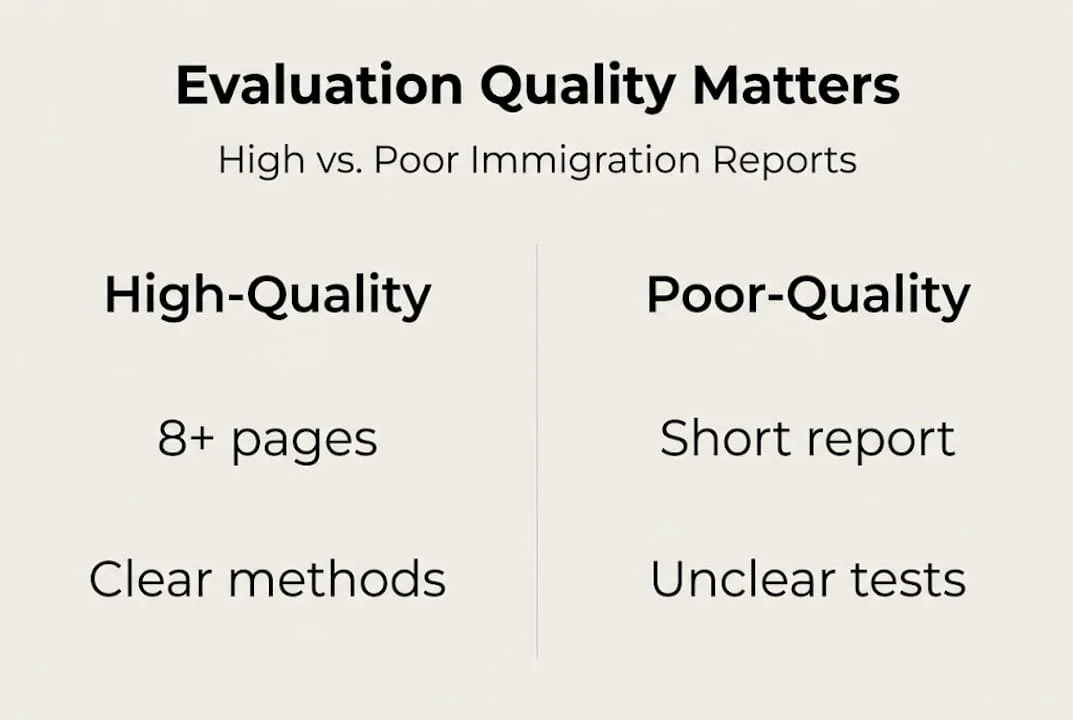
One of the most important things to understand early is that quality is not optional. According to immigration legal experts, high-quality reports that include detailed methodology, psychological testing, and a clear DSM-5 framework significantly reduce the risk of Requests for Evidence (RFEs) and outright denials. In contrast, reports that are shorter than eight pages, rely on a single interview, or lack standardized testing are frequently flagged by USCIS and EOIR reviewers.
A well-written evaluation is not just a document. It is an expert's careful account of how a person's mental health intersects with their legal situation, written in a way that a decision-maker can trust.
Understanding the different evaluation types and experts available in California helps you make a more informed choice from the start.
How the immigration evaluation process works
Now that you know what an evaluation is, let's walk through the practical steps of getting one in California. The process is more involved than most people expect, and knowing what comes next helps reduce anxiety along the way.
1. Referral or self-referral Most people come to an evaluator through their immigration attorney, who recognizes that a psychological evaluation will strengthen the legal case. Others self-refer after researching their case type. Either way, the first step is reaching out to a licensed evaluator who has experience in immigration forensic assessments.
2. Intake and initial consultation The evaluator will gather background information and explain what the process involves. This is also your chance to ask questions. You should feel safe and respected from the very beginning.
3. Clinical interviews (multiple sessions) This is the core of the process. The evaluator will conduct in-depth interviews across at least two sessions, sometimes more. They will ask about your personal history, trauma experiences, family relationships, mental health symptoms, and how your immigration situation affects your daily life. Single-interview evaluations are a red flag, since they rarely capture the complexity of a person's experience.
4. Psychological testing For many case types, standardized psychological tests are administered to measure symptoms such as PTSD, depression, or anxiety. These tests add an objective layer of evidence that reviewers at USCIS and EOIR take seriously. Reports that skip testing are weaker and more likely to face scrutiny.
5. Review of supporting documents You should bring relevant materials to your sessions. These include:
Government-issued identification
Legal documents related to your immigration case
Medical or mental health records
Evidence of hardship, abuse, or persecution
6. Report writing The evaluator synthesizes everything they have learned into a formal written report. A thorough report is typically more than eight pages, includes a detailed methodology section, integrates test results, and clearly explains the connection between your mental health and the legal issue at hand.
7. Review and submission Your attorney will review the completed report before submitting it as part of your case. Some evaluators will be available to answer follow-up questions from attorneys.
The role of therapists in shaping these reports is significant. Experienced evaluators understand that their clinical voice can directly influence how a case officer reads and weighs your circumstances.

According to immigration assessment experts, common pitfalls that lead to weak reports include relying on a single interview, skipping standardized testing, writing reports under eight pages, and failing to draw a clear line between the mental health findings and the legal hardship being claimed.
The full process in California typically takes one to three weeks, depending on scheduling and the complexity of the case.
Pro Tip: Before you commit to an evaluator, ask them directly how many immigration evaluations they have completed, what testing instruments they use, and how long their reports typically run. An experienced evaluator will answer these questions confidently and specifically.
What makes a high-quality immigration evaluation?
Knowing each step, it is important to recognize why quality can make or break an evaluation's effectiveness. Not all reports are equal, and a poorly written one can do real damage to your case.
A high-quality immigration evaluation shares several defining characteristics:
Clear methodology. The report explains exactly how the evaluation was conducted, what interviews took place, what tests were used, and how the evaluator interpreted the findings. This transparency is what gives the report credibility.
Multiple sessions. One interview is not enough to understand a person's full history and current functioning. Credible evaluators always conduct multiple meetings before writing their report.
Standardized psychological testing. Tests such as the PCL-5 for PTSD symptoms or the Beck Depression Inventory add measurable, objective evidence to the evaluator's clinical observations. These instruments are recognized by USCIS and EOIR as meaningful data points.
DSM-5 framework. If a diagnosis is relevant, it must be grounded in the current clinical standard, which is the Diagnostic and Statistical Manual of Mental Disorders, Fifth Edition. Using outdated frameworks or vague clinical language weakens the report's authority.
Cultural competence. A strong evaluator understands how culture shapes the expression of trauma and distress. An evaluator who lacks this awareness may miss important context or misinterpret symptoms.
Hardship narrative. Beyond listing symptoms, the report must clearly explain how those symptoms connect to the legal situation. A diagnosis alone is not enough. The evaluator must show the impact.
| Feature | High-quality evaluation | Poor-quality evaluation |
|---|---|---|
| Length | More than 8 pages | Under 8 pages |
| Interviews | Multiple sessions | Single interview |
| Testing | Standardized instruments used | No testing conducted |
| Clinical framework | DSM-5, clear methodology | Vague or template-based |
| Hardship nexus | Explicitly documented | Missing or unclear |
| Cultural awareness | Demonstrated throughout | Absent or superficial |
Research published by Cambridge University Press reinforces an important point: the absence of a formal diagnosis does not mean a person's trauma is not real or legally relevant. USCIS and EOIR reviewers focus heavily on whether the report is credible and well-supported, not simply whether it includes a label. The impact of trauma on a person's life can be fully documented and compelling without a specific diagnosis being present.
Pro Tip: Choose an evaluator who understands immigration law standards, not just mental health standards. A clinician who has worked alongside immigration attorneys will produce a report that speaks directly to what reviewers are looking for.
How therapist expertise matters in the evaluation process goes beyond technical skills. It includes knowing how to frame a narrative in a legally meaningful way without compromising clinical integrity.
The real impact: How evaluations affect immigration cases
It is not just about paperwork. Here is where the evaluation really meets the real world and why it matters for your future.
An immigration evaluation can influence your case in several important ways:
Supporting a hardship finding. In extreme hardship waiver cases, the evaluation provides direct evidence that your qualifying relative will experience significant psychological harm if you are deported or denied entry.
Strengthening asylum credibility. A well-documented trauma history, supported by test results and clinical observations, can make your account of persecution more believable to a judge.
Demonstrating the effects of abuse. In VAWA cases, the evaluation shows the psychological impact of domestic violence or abuse, which is central to proving that the relationship and the harm were real.
Documenting ongoing impact. Even after the immediate threat has passed, trauma leaves lasting marks. A strong evaluation shows how those marks affect daily functioning, parenting, employment, and relationships.
A statistic worth noting: according to immigration case experts, high-quality psychological evaluations that include detailed methodology and standardized testing are significantly more likely to survive USCIS scrutiny and reduce RFEs. Weak reports, in contrast, are frequently met with skepticism or requests for additional evidence that delay and complicate cases.
What many applicants do not realize is that reviewers at USCIS and EOIR are trained to look at the methodology of a report, not just its conclusions. A report that makes strong claims but cannot show how it reached them will raise red flags, no matter how compelling the individual's story may be.
Credibility and consistency matter more than any single diagnosis. USCIS and EOIR look at whether the story holds together across every document in the file, including the psychological evaluation.
Research on forensic mental health assessments confirms that adjudicators scrutinize methodology carefully and are more swayed by a coherent, evidence-supported narrative than by a clinical label.
Beyond the legal case, evaluations also serve a healing purpose. The process of being genuinely heard and having your experiences documented can itself be meaningful, as we explore in our writing on the emotional impact of immigration therapy. The evaluation, when done right, can also point toward the kind of ongoing care that supports long-term recovery, which is discussed further in our content on the role in trauma healing.
A fresh perspective: What most guides miss about immigration evaluations
Even with all the facts, there is a widespread misunderstanding that deserves to be challenged directly.
Most guides, and even some attorneys, focus heavily on getting a diagnosis. The thinking goes: if a clinician can label your experience as PTSD or major depression, your case becomes stronger. That logic is understandable, but it misses the point entirely.
USCIS and EOIR are not looking for labels. They are looking for truth, supported by evidence. A diagnosis means nothing if the report around it is thin, vague, or inconsistent with the rest of the case file. On the other hand, a thorough, well-written report that describes how a person functions, how their experiences have shaped their mental health, and how those effects connect to the legal question at hand can be far more persuasive, even without a formal diagnosis.
Research on forensic mental health credibility makes this clear: adjudicators are trained to weigh methodology and coherence over clinical categories. The evaluator's job is not to advocate blindly but to document honestly and thoroughly.
What matters most is finding an evaluator who listens deeply, asks hard questions, and can translate your story into a credible, legally meaningful document. The therapists' role in evaluations is to be a skilled witness to your experience, not a rubber stamp.
How Alvarado Therapy supports your immigration journey
If you are navigating the immigration evaluation process in California and want support from a team that genuinely understands what is at stake, Alvarado Therapy is here to help.

Our licensed clinicians provide immigration evaluation services that meet California and federal standards, with a trauma-informed approach that puts your experience at the center. We conduct multiple clinical interviews, use standardized testing, and write thorough reports grounded in the DSM-5 framework. We serve clients in Pasadena, Ventura, and online throughout California, in both English and Spanish. If you are ready to take the next step, you can consult a specialist to discuss your situation or visit our page on what to expect from therapy to learn more before you begin.
Frequently asked questions
Who can conduct an immigration evaluation in California?
Licensed mental health professionals such as psychologists, clinical social workers, or marriage and family therapists with relevant immigration assessment experience can conduct these evaluations in California.
What documents should I bring to my immigration evaluation?
You should bring identification, relevant legal documents, medical or mental health records, and any evidence of trauma or hardship that relates to your immigration case.
How long does the immigration evaluation process usually take?
The process typically involves several sessions over one to three weeks, since high-quality evaluations require multiple interviews, standardized testing, and a detailed written report to meet the standards that reduce RFEs and denials.
Does an immigration evaluation require a mental health diagnosis?
No. As forensic assessment research confirms, the absence of a formal diagnosis does not negate your experience. The focus is on documenting hardship, impact, and credibility in a well-supported, thorough report.
