
California relationship transition support: Heal in 3-4 years

TL;DR:
Life satisfaction drops sharply after relationship endings but can recover with support.
Trauma-informed care prioritizes safety, trust, and collaboration in the healing process.
Practical strategies and legal protections are essential for lasting emotional recovery.
Ending a relationship feels like the ground shifts beneath you overnight. Life satisfaction drops sharply right after a breakup or divorce, yet long-term healing is possible when the right support is in place. Many people assume the pain is permanent, or that simply "getting over it" is the only path forward. It is not. Trauma-informed care offers a structured, compassionate framework that addresses grief, safety, and communication skills together. This guide walks you through what that looks like in California, from understanding your emotional response to finding the right therapist and legal protections.
Table of Contents
Key Takeaways
| Point | Details |
|---|---|
| Sudden changes are typical | Relationship transitions often cause dramatic drops in emotional health but recovery is expected with proper support. |
| Safety is the foundation | Trauma-informed care starts with physical, emotional, and legal safety before deeper healing can occur. |
| California-specific protections | Special laws and resources in California are available for those facing high-conflict or trauma-related relationship changes. |
| Structured communication matters | Setting clear communication boundaries and using legal tools help in high-conflict transitions, especially with children involved. |
| Therapy improves recovery | Evidence-based therapies like narrative therapy accelerate adjustment and reduce grief during transitions. |
Understanding emotional impact: Why transitions hit hard
Breakups and divorces are not just emotional events. They are full-system disruptions that touch your finances, your identity, your daily routines, and sometimes your safety. Understanding this helps you stop blaming yourself for struggling and start building a real recovery plan.
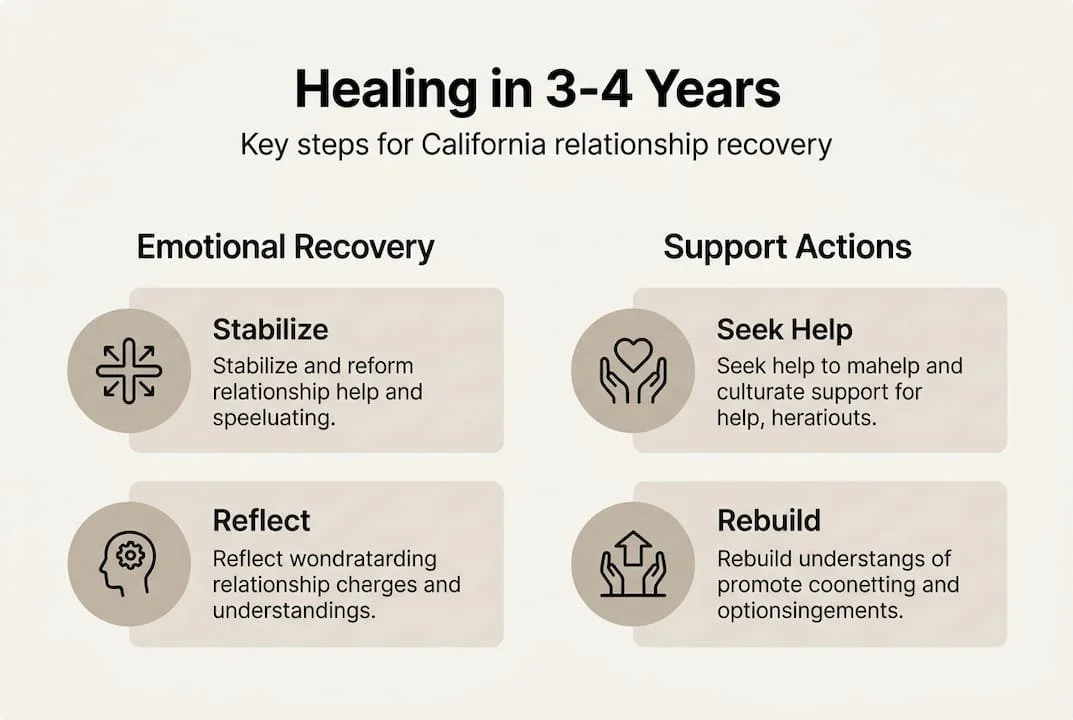
Research confirms what many people feel but cannot name. There is a sudden drop in life satisfaction immediately after a relationship dissolution, followed by a gradual, stable recovery that typically takes three to four years with adequate social support and professional help. That timeline is not a sign of weakness. It is biology and psychology working together.
Here is what makes relationship transitions especially difficult:
Grief and trauma overlap. Losing a partner activates the same brain pathways as other forms of loss, and if there was any abuse or chronic conflict, trauma symptoms like hypervigilance and intrusive thoughts often surface.
Practical stressors amplify emotional pain. Co-parenting disputes, financial separation, and housing changes all compete for your mental bandwidth at the exact moment your emotional reserves are lowest.
Social networks shrink. Shared friends often pull away. Isolation then becomes its own risk factor for slower recovery.
How these stressors interact matters. Trauma impacts on relationships rarely stay contained to one area. A financial argument with an ex can trigger a trauma response rooted in earlier experiences. A custody disagreement can feel existentially threatening even when the legal outcome is manageable.
| Stressor type | Emotional effect | Recovery support needed |
|---|---|---|
| Financial separation | Anxiety, helplessness | Financial counseling, legal guidance |
| Co-parenting conflict | Chronic stress, hypervigilance | Parallel parenting strategies, therapy |
| Social isolation | Depression, shame | Community support, peer groups |
| Trauma history | PTSD symptoms, flashbacks | Trauma-informed therapy, EMDR |
"Recovery is not linear. Most people experience waves of grief, moments of clarity, and setbacks. The goal is not to feel nothing. It is to build a life that can hold all of it."
Understanding why trauma affects relationships is the first step toward making sense of your reactions. And if you are navigating loss specifically, grief counseling after divorce can offer a structured path through the hardest stages. With the context for how transitions truly affect emotional health, let’s explore why trauma-informed support is so critical.
Trauma-informed care: Principles and safety first
Trauma-informed care is not a single therapy technique. It is a framework that shapes how every interaction, every session, and every recommendation is delivered. At its core, it means that safety comes before processing. You cannot heal what you cannot first stabilize.

For people navigating relationship transitions, this principle is especially important. Asking someone to process grief or rebuild communication skills while they are still in an unsafe situation is not just ineffective. It can cause harm. The role of therapy in divorce recovery makes clear that trauma-informed care must ensure safety before any deep emotional processing begins, and that practical support for finances and co-parenting must be integrated alongside emotional healing.
California offers specific legal tools that align with this safety-first approach. California DV protections include Domestic Violence Restraining Orders (DVROs) and a child best interest standard that courts apply in custody decisions. These protections exist to create the physical and legal safety that trauma-informed healing requires.
Key principles of trauma-informed care during relationship transitions:
Safety first. Physical, emotional, and legal safety are established before any deep therapeutic work begins.
Trustworthiness. Your therapist explains what they are doing and why, so nothing feels like a surprise.
Choice and control. You set the pace. You decide what to explore and when.
Collaboration. Healing is a partnership between you and your support team, not something done to you.
Cultural sensitivity. Your background, language, and identity are respected and integrated into care.
Pro Tip: When searching for a therapist in California, ask directly whether they use a trauma-informed framework and whether they have experience with high-conflict separations. A good therapist will welcome that question.
| Traditional therapy approach | Trauma-informed approach |
|---|---|
| Focuses on emotional processing first | Establishes safety and stability first |
| One-size-fits-all structure | Adapts pace and methods to the individual |
| Minimal coordination with legal support | Integrates practical and legal considerations |
| May overlook cultural context | Prioritizes culturally responsive care |
A trauma-sensitive therapy guide can help you understand what to look for in a provider. If you are ready to take that step, learning about empowering healing safely gives you a strong foundation. Now that safety is centered, let's see how practical strategies create real progress during relationship transitions.
Strategies for healthy communication and emotional recovery
Recovery does not happen by waiting. It happens through deliberate, structured action. The good news is that evidence-backed strategies exist for every stage of the process, from the first weeks of shock to the longer work of rebuilding your sense of self.
A stepwise recovery framework:
Establish physical and emotional safety. Secure housing, legal protections if needed, and a support network before anything else.
Name what you are feeling. Grief, anger, relief, shame, and fear can all coexist. Labeling emotions reduces their intensity.
Build coping skills. Breathing techniques, grounding exercises, and structured routines help regulate your nervous system.
Engage in narrative therapy. This approach helps you reframe your story without being trapped by it.
Rebuild communication skills. Especially if co-parenting is involved, structured communication protects both you and your children.
Process deeper trauma. Once stability is established, approaches like EMDR can address the root causes of your responses.
Narrative therapy deserves special attention here. Research shows it significantly improves adjustment and reduces grief, with results showing F=57.90, p<0.0001. That is a statistically powerful finding. It means narrative therapy is not just a feel-good exercise. It produces measurable change.
Statistic spotlight: Narrative therapy produces one of the strongest measurable outcomes in divorce adjustment research, with an F-statistic of 57.90 and p<0.0001, meaning the results are highly unlikely to be due to chance.
For communication specifically, tips for trauma recovery offer practical tools you can use right now. If you are co-parenting with a difficult ex, written communication and parallel parenting structures reduce conflict and protect your mental health. Legal tools like DVROs can also minimize manipulation in high-conflict cases.
Pro Tip: Use a co-parenting app like OurFamilyWizard or TalkingParents to keep all communication documented and emotionally neutral. This protects you legally and reduces the emotional charge of every interaction.
For those dealing with PTSD symptoms, the PTSD relationship healing guide offers a clear map of what healing looks like at each stage. Rebuilding trust after trauma is also possible, whether that means trusting yourself again or eventually trusting a new partner. With core recovery strategies in place, let's outline how to find and evaluate trauma-informed support in California.
How to find and evaluate trauma-informed support in California
Knowing you need help and knowing where to find the right help are two different things. California has a large mental health landscape, but not every therapist is equipped to handle the intersection of trauma, divorce, and high-conflict dynamics.
Where to start your search:
Psychology Today's therapist finder (filter by trauma, divorce, EMDR)
California Association of Marriage and Family Therapists (CAMFT) directory
Referrals from domestic violence organizations and legal aid clinics
Trusted community members, especially those who have navigated similar transitions
Trauma-informed practices like Alvarado Therapy that serve clients statewide online
When you find a potential therapist, evaluate them carefully. High-conflict cases, especially those involving narcissistic dynamics or domestic violence history, need a specific kind of support. Parallel parenting and written communication are recommended over cooperative co-parenting in these situations, along with legal tools like DVROs rather than informal agreements.
"The right therapist does not just listen. They understand California's legal landscape, know when to refer you to a family law attorney, and help you build safety at every level."
| Evaluation criteria | What to look for |
|---|---|
| Training and credentials | Licensed MFT, LCSW, or psychologist with trauma specialization |
| Experience with relationship transitions | Ask directly about divorce and high-conflict cases |
| Knowledge of California law | Familiar with DVROs, custody standards, and legal resources |
| Cultural responsiveness | Bilingual options, identity-affirming approach |
| Telehealth availability | Online sessions for statewide access |
Questions to ask a prospective therapist:
What trauma modalities do you use, and how do you decide which to apply?
Have you worked with clients in high-conflict divorces or with PTSD from relationship abuse?
Do you coordinate with legal advocates or attorneys when needed?
What does your intake process look like for safety screening?
For those also working through intimacy concerns, improving intimacy after trauma is a practical resource that addresses one of the most common long-term effects of difficult relationship transitions. Having walked through key support resources, it's time for a fresh perspective on overcoming obstacles in relationship transitions.
Why trauma-informed support redefines recovery: An expert's take
Most people entering therapy after a breakup or divorce expect to talk about their feelings. And talking matters. But conventional emotional processing alone misses something critical: the real-world conditions that either support or undermine healing.
Here is what we have seen at Alvarado Therapy. People who make the fastest, most durable progress are not always the ones who go deepest into their pain first. They are the ones who first build safety, structure, and legal clarity. Once those foundations are in place, emotional work becomes possible in a way it simply cannot be when someone is still in crisis mode.
Traditional therapy often underestimates this. It can treat trauma symptoms without addressing the ongoing stressors that keep those symptoms active. California's legal protections, from DVROs to child best interest standards, are not just bureaucratic tools. They are part of the healing architecture.
The trauma-sensitive therapy guide we offer reflects this belief: that safety and practical support are not separate from emotional healing. They are the foundation it stands on. Skipping that foundation and jumping straight to processing is like trying to build a house on sand.
Start your healing journey: Trauma-informed solutions
If you are navigating a breakup, divorce, or high-conflict separation in California, you do not have to figure this out alone. The emotional weight is real, and so is the path forward.
At Alvarado Therapy, we offer trauma-informed individual counseling, EMDR therapy, and specialized support for those healing from relationship trauma and PTSD. Our licensed therapists serve clients across Pasadena, Ventura, and online throughout California, in both English and Spanish. Whether you are just beginning to process what happened or you are ready to rebuild, we meet you where you are. Learn what to expect with EMDR therapy, explore our PTSD and complex trauma support services, or schedule a consultation today to take your first step.
Frequently asked questions
How long does relationship transition recovery take?
Empirical research shows most people recover emotionally within three to four years when supported by strong social networks and professional therapy. Recovery is gradual and nonlinear, but it is achievable.
What are trauma-informed therapy principles?
Trauma-informed therapy prioritizes safety before processing and integrates emotional, legal, and practical support to create lasting recovery rather than short-term relief.
What legal protections do California residents have during relationship transitions?
California DV protections include DVROs and a child best interest standard that courts apply in custody decisions, giving individuals and families a legal safety net during transitions.
How do I find a trauma-informed therapist in California?
Look for therapists with specialized training in trauma protocols such as EMDR or somatic therapy, state-specific knowledge about California legal protections, and ideally a referral from a trusted domestic violence organization or legal aid clinic.
Why is narrative therapy helpful during relationship transitions?
Narrative therapy helps you reframe your experience without being defined by it, and research confirms it significantly reduces grief and improves adjustment with statistically strong results.
Recommended
Practical Guide to Starting Therapy for Healing in California — Alvarado Therapy
Step-by-step trauma healing: EMDR guide for Californians — Alvarado Therapy
Step by Step Trauma Healing Guide for Lasting Recovery — Alvarado Therapy
Grief and Loss Explained: Navigating Healing in California — Alvarado Therapy
