
Marriage Counseling Advice: Practical Tips for Couples

The most effective marriage counseling advice comes down to three things before you ever sit in a therapist's office: prepare together, agree on what you each want to change, and commit to owning your part of the problem. Research-backed approaches like Emotionally Focused Therapy (EFT), the Gottman Method, and Integrative Behavioral Couple Therapy (IBCT) all share one assumption — both partners have to show up willing to look at themselves, not just their spouse. Couples who seek help earlier tend to have more options and better outcomes; entrenched patterns are genuinely harder to shift.
Start here — six behaviors that make sessions work:
Be honest, even when it's uncomfortable
Speak in "I" statements ("I feel dismissed" rather than "You never listen")
Listen to reflect, not to rebut
Avoid blame and historical lists of grievances
Accept and try the tasks your therapist assigns between sessions
Take responsibility for your own contribution to negative cycles
Most couples can expect an initial joint assessment, sometimes a brief individual session with each partner, and then a collaborative treatment plan. For mild to moderate concerns, evidence suggests about 8 sessions is typically needed.
Table of Contents
What is the best marriage counseling advice therapists actually give?
How to prepare before your first couples therapy appointment
Alvarado Therapy offers couples counseling online in California and New York
What is the best marriage counseling advice therapists actually give?
The single most consistent piece of advice across EFT, Gottman, and IBCT practitioners: stop trying to win. The goal of couples therapy is not to prove your version of events is correct. It's to understand the cycle you're both stuck in and interrupt it.
Here are 10 therapist-informed tips, ordered by impact:
Arrive with one shared goal. Agree before the session on one thing you both want to improve. Vague intentions ("communicate better") stall progress; specific ones ("stop the argument before it escalates to silence") give the therapist something to work with.
Use "I" statements consistently. "I feel scared when we fight" lands differently than "You always start fights." The first opens a conversation; the second closes it.
Practice reflective listening. Before responding, summarize what your partner said. "What I'm hearing is..." slows reactivity and signals you're actually listening.
Limit historical grievances. One issue per session. Bringing a list of everything that's gone wrong since 2019 derails the work and overwhelms the therapist's ability to help.
Take ownership of your part. Clinicians often frame this as "cleaning your own side of the street." You cannot control your partner's behavior, only your contribution to the dynamic.
Do the homework. Practicing between sessions reduces the total number of sessions needed. Rehearse takeaways within 24 hours of each appointment while they're still fresh.
Lower the expectation of perfection. Couples who use counseling proactively — to strengthen communication or navigate a life transition — often get more out of it than those waiting for a crisis. Counseling works as prevention, not just repair.
Stop trying to be right. Being right and being connected are often in direct competition. Choosing the relationship over the argument is a skill, and it takes practice.
Monitor your blind spots. Ask yourself honestly: what do I do that makes this worse? Most people can name their partner's blind spots instantly and their own only vaguely.
Practice assertive communication outside sessions. Use the scripts and techniques your therapist introduces in low-stakes moments at home, not just during conflict.
Two safety caveats: If there is intimate partner violence or coercive control in the relationship, joint couples therapy is not the right starting point. Individual support and safety planning come first. Talk to a therapist individually, or contact the National Domestic Violence Hotline at 1-800-799-7233.
A script to open a hard topic in session: "I want to bring something up that's been bothering me. I'm not trying to blame anyone — I just want us to understand it better together."
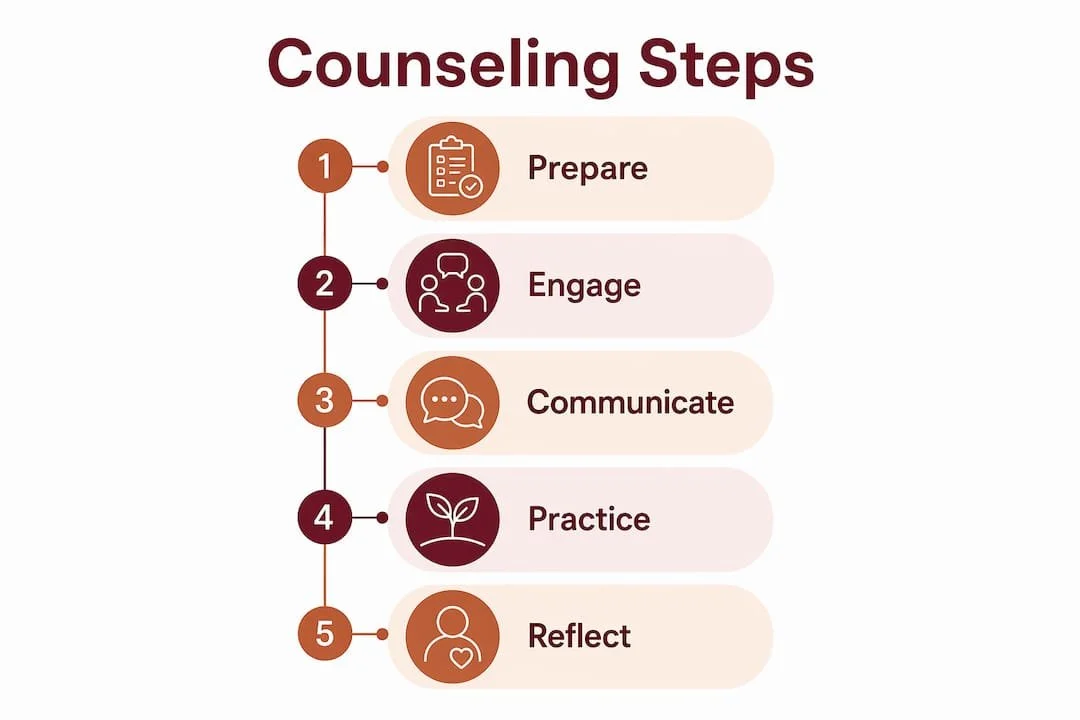
How to prepare before your first couples therapy appointment
Logistics matter more than most couples expect. Arriving unprepared wastes the first session on administrative catch-up. Alvarado Therapy's preparation guidance emphasizes self-reflection, shared goal-setting, and practical readiness as the foundation for effective counseling.
Pre-appointment checklist:
Insurance and billing: Call your insurer to confirm mental health benefits and whether couples therapy is covered. Many plans cover individual sessions but not conjoint therapy — know this before you book.
Telehealth setup: If attending online, test your video link, audio, and a quiet private space at least 24 hours before the session.
Childcare and logistics: Arrange coverage so neither partner is distracted or rushed.
Paperwork: Complete intake forms honestly and in full before the appointment, not in the waiting room.
Shared goals: Sit down together and identify 2–3 specific, measurable things you want therapy to address. Write them down.
Brief relationship timeline: Jot a short history — when you met, major transitions, when problems started, recent conflict examples.
Individual stressors: Note any personal factors (work stress, health issues, mental health history, medications) that may be affecting the relationship.
Pro Tip: The night before your first session, spend five minutes on slow breathing or a brief body scan. Defensiveness spikes when you're already stressed walking in. A small self-regulation practice beforehand lowers your baseline reactivity and helps you stay open.
What happens in the first few sessions?

Most couples will move through a predictable sequence. The first session is typically a joint intake: the therapist gathers relationship history, hears both perspectives, and begins identifying patterns. Some therapists then schedule brief individual sessions with each partner to get information that might not surface in a joint setting. After that, you return to joint work and build a treatment plan together.
Session tempo usually starts weekly, then tapers to biweekly or monthly as progress consolidates. Intensive formats, which compress several sessions into a weekend or a few consecutive days, are an option for couples with scheduling constraints or who want faster traction.
The three most widely used, research-supported approaches in the U.S. are EFT, the Gottman Method, and IBCT. Here's how they differ:
| Approach | Core Focus | Key Techniques | Best Fit |
|---|---|---|---|
| Emotionally Focused Therapy (EFT) | Attachment needs and negative emotional cycles | Identifying cycle patterns, expressing vulnerable emotions, restructuring bonds | Couples with emotional distance, anxious/avoidant dynamics |
| Gottman Method | Observable interaction patterns and friendship | Sound Relationship House, Four Horsemen identification, rituals of connection | Couples wanting structured, skill-based work |
| Integrative Behavioral Couple Therapy (IBCT) | Acceptance and targeted behavior change | Unified detachment, empathic joining, behavior change strategies | Couples where one or both partners resist change |
All three are evidence-based approaches with strong research support. Your therapist may draw from more than one, depending on what your relationship needs.
Communication do's and don'ts for therapy and at home
The Gottman Method identifies four communication patterns that reliably predict relationship breakdown: criticism, contempt, defensiveness, and stonewalling. Gottman researchers call these the Four Horsemen, and their presence in a couple's conflict style is one of the strongest behavioral predictors of long-term relationship distress. Avoiding them is not just good manners — it's structurally important.
Do:
Speak for yourself using "I feel..." statements
Reflect before responding ("What I heard you say is...")
Make small repair attempts during conflict ("Can we slow down?")
Express appreciation specifically ("I noticed you handled that call so I didn't have to — thank you")
Ask open-ended questions that invite sharing
Don't:
Lead with criticism ("You always..." / "You never...")
Use contemptuous language, eye-rolling, or sarcasm
Stonewall by going silent or leaving without a plan to return
Defend yourself before your partner finishes speaking
Bring up unrelated past grievances mid-argument
Example phrases to practice:
"When you come home and go straight to your phone, I feel invisible."
"I'm hearing that you feel overwhelmed. Is that right?"
"I need a 20-minute break. I'll come back and we'll finish this."
"I know I got defensive just now. Let me try again."
"I appreciate that you stayed calm when I was upset."
"I want to understand your perspective before I share mine."
Structured mirroring techniques, where one partner speaks and the other reflects back before responding, slow down reactivity and increase understanding for couples who tend to talk past each other. Practice these scripts at home in low-stakes conversations first, not during a heated moment.
How long does couples therapy take, and what does it cost?

Duration depends on severity. Research-based guidelines suggest a moderate number of sessions for mild to moderate concerns, and a larger number for more severe issues. Intensive formats compress that timeline but require sustained focus over consecutive days.
| Concern Level | Typical Session Range | Format Options |
|---|---|---|
| Mild to moderate | 8 sessions | Weekly, then biweekly |
| Moderate to severe | 16–30+ sessions | Weekly, possibly with individual add-ons |
| Intensive/accelerated | Equivalent of months, compressed | Multi-day intensive retreat or block |
Cost and access options:
- Per-session rates vary widely across the U.S. Rates differ by region, therapist licensure, and setting; ask directly at intake.
- Insurance: Many plans cover individual therapy but exclude conjoint couples sessions. Verify your specific benefits before booking.
- Sliding scale: Many private practices and community mental health centers offer income-based fees. Ask directly — most therapists won't advertise it.
- Telehealth: Online sessions often cost less than in-person and remove geographic barriers. Alvarado Therapy offers online couples therapy throughout California and New York.
- Shorter focused models: An 8–12 session structured format may be appropriate when goals are specific and both partners are motivated.
Ask your therapist at intake: “How many sessions do you typically recommend for concerns like ours?” Track your progress against your stated goals every four sessions and reassess whether the current approach is working.
What questions should you ask a couples therapist?
Therapist fit matters as much as the method. A skilled clinician using the wrong approach for your relationship, or one you don't trust, will produce limited results. Use these questions at intake:
What is your training in couples therapy specifically (not just general therapy)?
Which approach do you use — EFT, Gottman, IBCT, or something else?
Have you worked with couples dealing with [your specific concern: infidelity, trauma, cultural differences]?
How do you handle confidentiality when you also see partners individually?
What does a typical session look like for you?
How do you measure progress, and how will we know if it's working?
What is your cancellation policy and session fee?
How do you handle it if one partner is being coercive or controlling?
Do you ever refer clients to individual therapy alongside couples work?
Safety note: If you feel unsafe being honest in joint sessions, tell the therapist privately. A well-trained clinician will have a protocol for this. If safety is an immediate concern, individual support takes priority over couples work.
Why evidence-based couples therapies actually work
The mechanism behind effective couples therapy is not insight alone. It's changing the cycle.
EFT works by helping partners identify the negative emotional loop they're caught in — usually one person pursuing and the other withdrawing — and then access the underlying attachment needs driving that loop. When a partner can say "I get angry because I'm terrified you're going to leave" instead of just getting angry, the interaction changes. The couples therapy research on EFT is among the strongest in the field.
The Gottman Method targets observable patterns: how couples fight, how they repair, whether they maintain friendship and positive regard outside conflict. It's more behavioral and structured, which suits couples who want concrete skills and clear homework.
IBCT adds something the other two don't emphasize as strongly: acceptance. Some differences between partners won't resolve. IBCT helps couples stop fighting those differences and start understanding them, which paradoxically creates more room for actual change.
Meta-analyses show approximately 70–75% of couples show significant improvement with EFT, and those gains hold at follow-up. Therapist training in couples-specific methods matters significantly — general therapy training does not automatically transfer to couples work.
When individual therapy should run alongside couples work: if one partner has unresolved trauma, severe depression, or an active substance use issue, those need parallel individual attention. Couples therapy alone won't resolve what's rooted in one person's individual history.
Key Takeaways
Effective couples therapy requires preparation, honest participation, and consistent practice between sessions — not just showing up.
| Point | Details |
|---|---|
| Prepare before session one | Agree on 2–3 shared goals, complete intake paperwork, and test your telehealth setup in advance. |
| Own your contribution | Focus on what you can change in yourself; clinicians call this “cleaning your own side of the street.” |
| Know the timeline | Mild to moderate concerns typically take 8 sessions; moderate to severe concerns often need 16–30 or more. |
| Use evidence-based approaches | EFT, the Gottman Method, and IBCT each have strong research support — ask your therapist which they use. |
| Alvarado therapy for couples | Alvarado Therapy offers online couples therapy in California and New York, with trauma-informed and bilingual care available. |
What couples therapy taught me about realistic expectations
Most people walk into couples counseling hoping the therapist will fix their partner. That expectation, more than any communication deficit, is what gets in the way. The couples who make real progress are the ones who arrive curious about themselves, not just frustrated with the person across from them.
Therapy sometimes leads to healthier separation. That's not a failure. A couple that ends a relationship with more clarity, less bitterness, and better co-parenting capacity has done meaningful work. Progress over perfection is the frame that actually holds — and both partners' engagement, not just one person pulling the weight, is what makes the difference between a process that transforms and one that stalls.
Counseling is also not only for crisis. Many couples use it proactively, to navigate a career change, a new baby, or a slow drift in connection. The earlier you go, the more options you have.
Alvarado Therapy offers couples counseling online in California and New York
If you're ready to move from reading about couples therapy to actually starting it, Alvarado Therapy provides online couples therapy throughout California and New York, with licensed therapists trained in trauma-informed approaches. Sessions are available in both English and Spanish, and the practice works with couples navigating relationship difficulties, communication breakdowns, grief, and the effects of trauma on partnership.
What couples therapy taught me about realistic expectations
Most people walk into couples counseling hoping the therapist will fix their partner. That expectation, more than any communication deficit, is what gets in the way. The couples who make real progress are the ones who arrive curious about themselves, not just frustrated with the person across from them.
Therapy sometimes leads to healthier separation. That's not a failure. A couple that ends a relationship with more clarity, less bitterness, and better co-parenting capacity has done meaningful work. Progress over perfection is the frame that actually holds — and both partners' engagement, not just one person pulling the weight, is what makes the difference between a process that transforms and one that stalls.
Counseling is also not only for crisis. Many couples use it proactively, to navigate a career change, a new baby, or a slow drift in connection. The earlier you go, the more options you have.
Alvarado Therapy offers couples counseling online in California and New York
If you're ready to move from reading about couples therapy to actually starting it, Alvarado Therapy provides online couples therapy throughout California and New York, with licensed therapists trained in trauma-informed approaches. Sessions are available in both English and Spanish, and the practice works with couples navigating relationship difficulties, communication breakdowns, grief, and the effects of trauma on partnership.
Alvarado Therapy's intake process is straightforward: review what to expect, then schedule a consultation to ask about availability, approach, and sliding-scale options. You don't need to be in crisis to book. If you've been reading this and thinking "we should probably do this," that's reason enough to take the next step.
Concrete next steps:
Visit the consultation page to request an intake appointment
Review the couples therapy page to confirm services match your needs
Ask about sliding-scale fees and telehealth availability when you reach out
Useful sources and further reading
How to Prepare for Marriage Counseling — Alvarado Therapy: Practice-authored step-by-step preparation guide covering logistics, goal-setting, and mental readiness.
Couples Therapy: How It Works, What to Expect — Simply Psychology: Overview of EFT, Gottman, and IBCT with meta-analytic outcome data.
What Is Marriage Counseling? — TherapyExplained: Practical overview of session structure, duration guidelines, and communication techniques.
Making the Most of Couple Therapy — Couples Therapy NZ: Clinician tips on between-session practice, ownership, and reducing total session count.
The Love Map: 6 Essentials for a Thriving Relationship — Psychology Today: Six behavioral directives for relationship longevity, including assertive communication and blind-spot awareness.
How to Prepare for a Healthy Relationship — Gottman Institute: Gottman-authored guidance on communication habits, repair attempts, and the Four Horsemen.
Couples Therapy Effectiveness: What the Research Shows — Alvarado Therapy: Research summary supporting EFT outcomes and evidence-based couples work.
The Best Couples Counseling Tips — Wellman Psychology: Practical tips normalizing proactive counseling for growth, not just crisis.
