
Trust-Based Therapy for Couples: Rebuild What Matters

What is trust-based therapy for couples?
Trust-based therapy for couples is a specialized form of couples counseling built around one specific goal: restoring trust after it has been broken. Unlike general couples therapy, which addresses a broad range of relationship concerns, this approach zeroes in on the mechanics of betrayal and repair. It treats trust not as a feeling but as a behavioral pattern, something that must be demonstrated consistently over time before it can be felt again.
The distinction matters. A couple dealing with infidelity, chronic dishonesty, or emotional withdrawal needs more than improved communication skills. They need a structured process that makes accountability visible, creates emotional safety for the injured partner, and gives both people a realistic framework for what healing actually looks like.
Evidence-based methods drive this work. The Gottman Method, Emotionally Focused Therapy (EFT), Cognitive Behavioral Therapy (CBT), and EMDR Therapy each contribute specific tools for trust repair, and skilled therapists draw from all of them depending on the nature of the rupture.
Core benefits of trust-based couples therapy:
Creates a structured, observable repair process rather than leaving couples to guess
Addresses the specific injury, whether infidelity, secrecy, or emotional unavailability
Builds communication skills that reduce reactivity and increase safety
Helps both partners understand their role in the relationship pattern
Integrates trauma-informed care when betrayal has caused psychological injury
Establishes new behavioral agreements that replace broken ones
Table of Contents
Which therapeutic approaches actually repair trust in couples?
The stages couples move through when rebuilding trust in therapy
Communication skills that actually move trust repair forward
Alvaradotherapy offers trauma-informed couples therapy in California and New York
Where trust issues in relationships actually come from
Trust does not break all at once in most relationships. It erodes through repeated experiences that signal unreliability, or it shatters suddenly through a single act of betrayal. Both paths lead to the same place: a relationship where one or both partners no longer feel safe.
The most common origins of trust rupture include infidelity, financial deception, chronic lying, emotional withdrawal, and unresolved conflicts that were never properly addressed. Secrecy, even when it does not involve infidelity, creates a particular kind of damage because it signals that one partner has been living a separate interior life.
Attachment patterns shape how each person responds to these injuries. Someone with an anxious attachment style may become hypervigilant after a betrayal, scanning constantly for new signs of threat. An avoidant partner may shut down under the pressure of the injured partner's distress, which reads as indifference and deepens the wound. Therapy needs to account for both.
Common trust wounds that couples bring to therapy:
Infidelity, including emotional affairs and online relationships
Financial dishonesty or hidden debt
Addiction and the deception that often accompanies it
Chronic criticism or contempt that erodes emotional safety over time
Emotional or physical unavailability during critical life events
Broken promises repeated enough to become a pattern
The physiological impact of betrayal is real and often underestimated. Research on trauma-informed couples therapy shows betrayal activates the same stress-response systems as other traumatic events, which is why some injured partners experience symptoms that resemble PTSD: intrusive thoughts, hyperarousal, difficulty concentrating, and emotional numbness.
Which therapeutic approaches actually repair trust in couples?
Not every therapy modality is equally suited to trust repair. The approaches that work best share a common thread: they address both the behavioral and emotional dimensions of the rupture, and they give the therapist tools to work with trauma when it is present.
The Gottman Method draws from decades of research on what distinguishes stable couples from those headed for dissolution. The Sound Relationship House theory at its core emphasizes replacing negative conflict patterns with "turn towards" responses, small moments of connection that rebuild the emotional bank account between partners. For trust repair specifically, Gottman-trained therapists use structured protocols for affair recovery that address the betrayed partner's trauma, the betraying partner's accountability, and the couple's shared future.
Emotionally Focused Therapy (EFT), developed by Dr. Sue Johnson and grounded in attachment theory, works by identifying the negative interaction cycles that keep couples stuck. In trust repair, EFT helps partners access the deeper emotions beneath their defensive behaviors, fear, grief, shame, and longing, and express them in ways the other person can actually receive. EFT research consistently shows strong outcomes for couples in distress.
Cognitive Behavioral Therapy (CBT) applied to couples focuses on the thought patterns that sustain mistrust long after the original injury. A partner who was deceived may develop cognitive distortions: assuming the worst, catastrophizing ambiguous situations, or interpreting neutral behavior as threatening. CBT gives couples concrete tools to examine and challenge those patterns. The NCBI review of couples therapy interventions notes that cognitive-behavioral conjoint therapy specifically targets how trauma has influenced thoughts related to trust, control, and emotional closeness.
EMDR Therapy (Eye Movement Desensitization and Reprocessing) addresses the trauma stored in the nervous system after a significant betrayal. When a partner cannot stop reliving the moment of discovery, or when certain triggers send them into a full stress response, EMDR works at the neurological level to reduce the charge on those memories. It is particularly effective when the trust rupture has left one or both partners with trauma symptoms that make the relational work harder to access.
Integrative approaches that combine these modalities are increasingly common among experienced couples therapists. A clinician might use EFT to open emotional access, CBT to address distorted thinking, and EMDR to process traumatic memories, all within a Gottman-informed framework for conflict and communication.
Why therapist qualifications matter here: Trust repair is not entry-level couples work. It requires clinical training in trauma, specific certification or advanced training in at least one evidence-based modality, and the judgment to know when individual therapy needs to run alongside the couples work.
Pro Tip: Before booking a couples therapist for trust issues, ask directly: "What is your training in affair recovery or betrayal trauma?" A qualified therapist will name specific modalities and training, not just say they have "experience with trust issues."
The stages couples move through when rebuilding trust in therapy
Trust repair does not follow a straight line. Most couples move through recognizable phases, but the pace is uneven, and setbacks are part of the process rather than signs of failure.
Stage 1: Stabilization and boundary setting. The first priority is stopping the bleeding. This means establishing clear agreements about transparency, contact with third parties if relevant, and basic behavioral commitments that create enough safety for therapy to proceed. Without this foundation, sessions become crisis management rather than repair work.
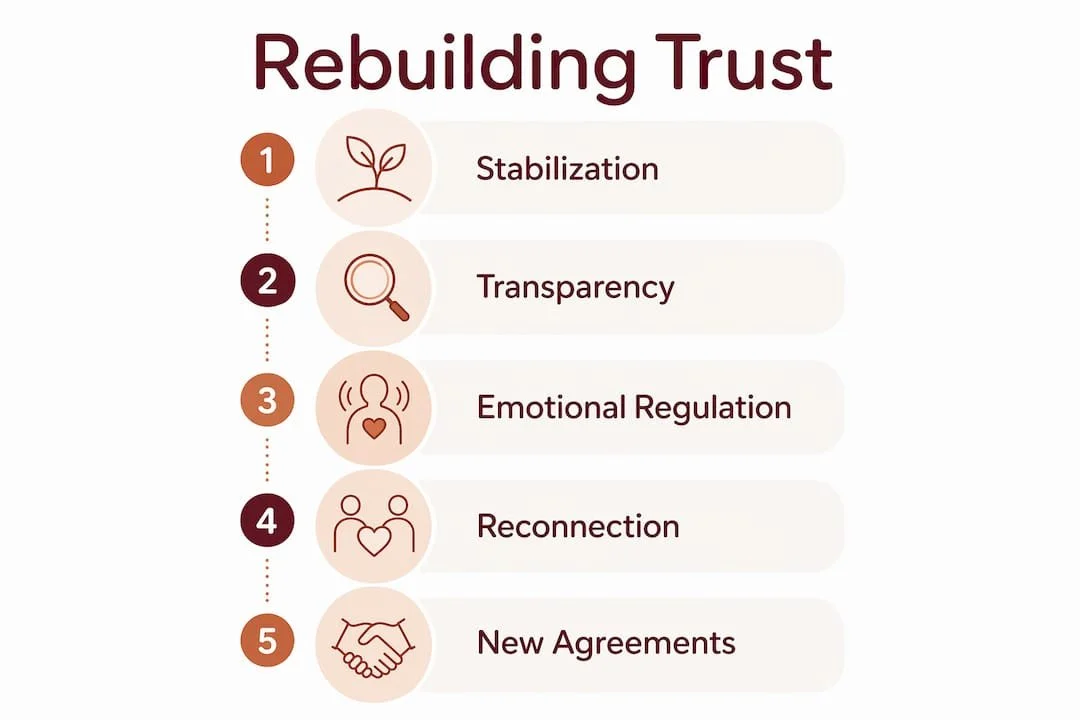
Stage 2: Transparency and accountability. The partner who caused the injury must demonstrate accountability through clear, observable actions over time, not just apologies. This is where many couples stall. Saying "I'm sorry" is not the same as showing changed behavior consistently. The therapist structures this phase so accountability is visible and the injured partner can receive it without the defensive responses that shut the process down.
Stage 3: Emotional regulation and managing triggers. As the couple begins to stabilize, old wounds surface unpredictably. A song, a location, a phrase can send the injured partner back to the moment of betrayal. Therapy at this stage focuses on helping both partners understand the difference between a trigger and a present-day threat, and on building the regulation skills to stay in the conversation rather than escalating or shutting down.
Stage 4: Reconnection and rebuilding intimacy. Once some emotional safety has been established, couples begin the work of reconnecting. This is gradual and often awkward. Physical intimacy, playfulness, and shared meaning all need to be rebuilt deliberately. Therapists guide this with specific exercises and check-ins that make the reconnection process intentional rather than accidental.
Stage 5: New relationship agreements. The relationship that existed before the rupture cannot simply be restored. Couples who succeed in rebuilding trust typically construct a new version of their partnership, with explicit agreements about transparency, communication, and what each person needs to feel secure. This is not about surveillance; it is about clarity.
On timelines: Deep trust repair takes two to five years, with setbacks being entirely normal throughout. Couples who expect a linear recovery often interpret a difficult week as evidence that nothing is working. It rarely is.
Communication skills that actually move trust repair forward
Communication training is not a soft add-on in trust-based couples therapy. It is structural. Without the ability to express pain without attacking, and to hear pain without defending, the repair process cannot advance.
Therapists typically introduce these tools early, often in the first few sessions, because couples need them immediately. The shift in communication patterns can become visible within weeks to months when both partners commit to practicing them outside of sessions.
Core communication tools taught in trust-focused therapy:
"I feel" statements: Expressing emotion without accusation ("I feel scared when you come home late without texting" rather than "You never think about how I feel"). This keeps the injured partner's pain audible without triggering the other partner's defensiveness.
Active listening: Reflecting back what the partner said before responding, which slows the conversation enough for both people to feel heard.
Repair attempts: Small bids to de-escalate a conflict before it spirals, a touch, a phrase, a pause. The Gottman Institute's research identifies repair attempts as one of the strongest predictors of relationship stability.
Scheduled check-ins: A weekly structured conversation about how each partner is feeling in the relationship, separate from daily logistics. This creates a container for difficult feelings rather than letting them accumulate.
Timeouts with return commitments: Agreeing to pause a heated conversation and return to it within a specific timeframe, rather than stonewalling indefinitely.
Emotional intimacy exercises used in therapy extend this work beyond words. Couples might practice sustained eye contact, take turns sharing appreciations, or complete structured vulnerability exercises designed to rebuild the sense of being known by the other person.
Pro Tip: The repair attempt only works if the other partner receives it. Practice recognizing your partner's bids for de-escalation, even when they feel clumsy or poorly timed. Receiving a repair attempt is a skill, not just a reflex.
One thing therapists consistently observe: couples who practice these tools between sessions progress faster than those who treat therapy as the only space for difficult conversations. The real work of trust rebuilding happens on ordinary days, not just in the therapy room.
What to expect when you start trust-based couples therapy
Most couples begin with weekly sessions of sufficient duration depending on the therapist's format. Weekly frequency matters because consistent repetition is how new patterns get established. Spacing sessions too far apart allows old dynamics to reassert themselves between appointments.
What the early sessions typically look like:
Individual history-taking, sometimes in separate sessions, so the therapist understands each partner's background and attachment patterns
Assessment of the specific trust rupture and its impact on both partners
Introduction of communication tools for immediate use
Goal-setting that is specific to the couple's situation, not generic relationship improvement
Progress in trust-based therapy does not always feel like progress. Some couples report that the first month of therapy is harder than the weeks before they started, because the process of naming what happened and how it felt brings suppressed pain to the surface. This is normal and expected.
Markers that trust is rebuilding:
The injured partner begins to feel safe enough to be vulnerable again
The partner who caused harm demonstrates accountability without being prompted
Conflict de-escalates faster and less frequently becomes destructive
Both partners report feeling more understood and less alone in the relationship
Physical and emotional intimacy begins to return, even tentatively
The role of individual therapy: Couples therapy and individual therapy are not mutually exclusive, and for many people dealing with trust rupture, both are necessary. When one partner has significant trauma history, or when the betrayal has triggered symptoms that interfere with the couples work, individual sessions running parallel to couples therapy produce better outcomes. A research-driven approach to couples therapy recommends that when an individual partner's issues significantly impact the relationship, individual therapy should run alongside couples work rather than replace it.
On choosing a therapist: Look for a licensed clinician (LMFT, LCSW, or licensed psychologist) with specific training in at least one evidence-based modality and documented experience with betrayal trauma or affair recovery. Ask about their approach to individual sessions within couples work, and whether they have training in trauma-informed care.
Clinical insights on what trust repair actually requires
The clinical picture of trust rebuilding is more demanding than most couples anticipate, and more achievable than many fear after a devastating rupture.
The most consistent finding across experienced couples therapists is that trust rebuilds on ordinary days, not through grand gestures. Deep trust repair takes two to five years of steady, sometimes boring consistency: showing up when you said you would, being transparent without being asked, choosing the relationship in small ways repeatedly. The couples who make it are not the ones who had the most dramatic reconciliation moments. They are the ones who kept showing up on random Tuesday nights.
What clinical practice consistently shows:
Apologies without behavioral change do not rebuild trust. The injured partner needs observable accountability over time, not words.
The betrayed partner must eventually create opportunities for the other person to demonstrate reliability. Withholding those opportunities indefinitely prevents the very evidence that would allow trust to return.
Distinguishing triggers from real threats is one of the most clinically significant skills couples develop in therapy. A trigger is a reminder of past pain; a threat is a present-day risk. Treating every trigger as a threat keeps the nervous system in a state of alarm that makes genuine repair impossible.
Therapy intensives can jumpstart progress when couples are stuck in dysfunctional cycles, but they do not replace the ongoing weekly work.
Individual therapy running alongside couples sessions produces better outcomes when one partner carries significant trauma.
Clinical note: The TRUST Framework used by some couples therapists for affair recovery breaks the repair process into structured phases: Truth-telling, Responsibility, Understanding, Safety, and Transformation. It is one of several structured approaches that give couples a map when the terrain feels completely disorienting.
Setbacks are not failures. A difficult week, a triggered reaction, a moment of withdrawal does not erase the progress that came before it. Therapists who work in this area consistently reframe setbacks as data rather than disasters, information about what still needs attention rather than evidence that the relationship cannot be saved.
Alvaradotherapy offers trauma-informed couples therapy in California and New York
If you are in California or New York and looking for couples therapy that takes trust repair seriously, Alvaradotherapy is built for exactly this work. The practice specializes in trauma-informed care, which means the therapists understand that betrayal is not just a relationship problem. It is often a psychological injury that requires clinical attention alongside the relational work.
Alvaradotherapy integrates EMDR therapy with couples counseling, which makes it particularly well-suited for couples where one or both partners are carrying trauma symptoms from the rupture. Sessions are available online throughout California and New York, and the practice offers bilingual English-Spanish therapy for couples who need it.
The team works with couples navigating infidelity, chronic dishonesty, emotional disconnection, and the kind of accumulated damage that does not have a single identifiable cause. If you are ready to move from surviving the rupture to actually rebuilding, schedule a consultation to talk through what couples therapy at Alvaradotherapy looks like for your specific situation.
Key Takeaways
Trust-based therapy for couples works because it makes repair observable, teaches both partners the skills to stay in the process, and integrates trauma-informed care when betrayal has caused psychological injury.
| Point | Details |
|---|---|
| Trust rebuilds through behavior, not words | Observable accountability over time matters more than apologies; consistent action is what the injured partner can actually measure. |
| Deep repair takes two to five years | Setbacks are normal throughout; couples who expect linear progress often misread a hard week as evidence of failure. |
| Triggers differ from real threats | Learning to distinguish a trauma reminder from a present-day risk is one of the most important skills couples develop in therapy. |
| Individual therapy strengthens couples work | When one partner carries significant trauma, running individual sessions alongside couples therapy produces better outcomes. |
| Alvarado therapy | Offers trauma-informed couples therapy with EMDR integration, available online in California and New York, in English and Spanish. |
