
How to Rebuild Trust in a Relationship: Real Steps

TL;DR:
Rebuilding trust after betrayal requires honesty, consistency, and both partners' genuine motivation to restore the relationship. Establishing clear safety agreements and practicing transparency help repair emotional safety and confidence over time. Professional therapy supports couples through setbacks, trauma responses, and deepening their authentic connection beyond previous trust levels.
Broken trust is one of the most disorienting experiences a person can face in a relationship. Whether it came from infidelity, repeated dishonesty, or a slow erosion of emotional safety, the pain is real and it reshapes how you see your partner and yourself. Knowing how to rebuild trust in a relationship feels impossible at first, especially when your nervous system is still in shock. But trust repair is not a myth. It is a real, researched process that requires honesty, consistency, and effort from both partners. This guide will walk you through exactly what that looks like.
Key takeaways
| Point | Details |
|---|---|
| Both partners must be willing | Pro-relationship motivation from both sides is the foundation of any real trust repair. |
| Transparency beats perfection | Replacing secrecy with consistent honesty matters more than having a flawless track record. |
| Hypervigilance is not a problem | The betrayed partner’s heightened alertness is a normal trauma response and should shape the pace of rebuilding. |
| Setbacks are part of the process | Trust recovery is nonlinear. Expect difficult moments and treat them as repair opportunities, not failures. |
| Professional support accelerates healing | Couples therapy and trauma-informed care give both partners tools they cannot easily access alone. |
How to rebuild trust in a relationship: the foundation
Trust in a relationship is not simply believing your partner won't lie. It is a felt sense of safety, the confidence that your partner cares about your wellbeing and will act accordingly. Researchers describe it as having both emotional and behavioral components. Emotionally, you feel secure and seen. Behaviorally, your partner's actions confirm that security repeatedly over time.
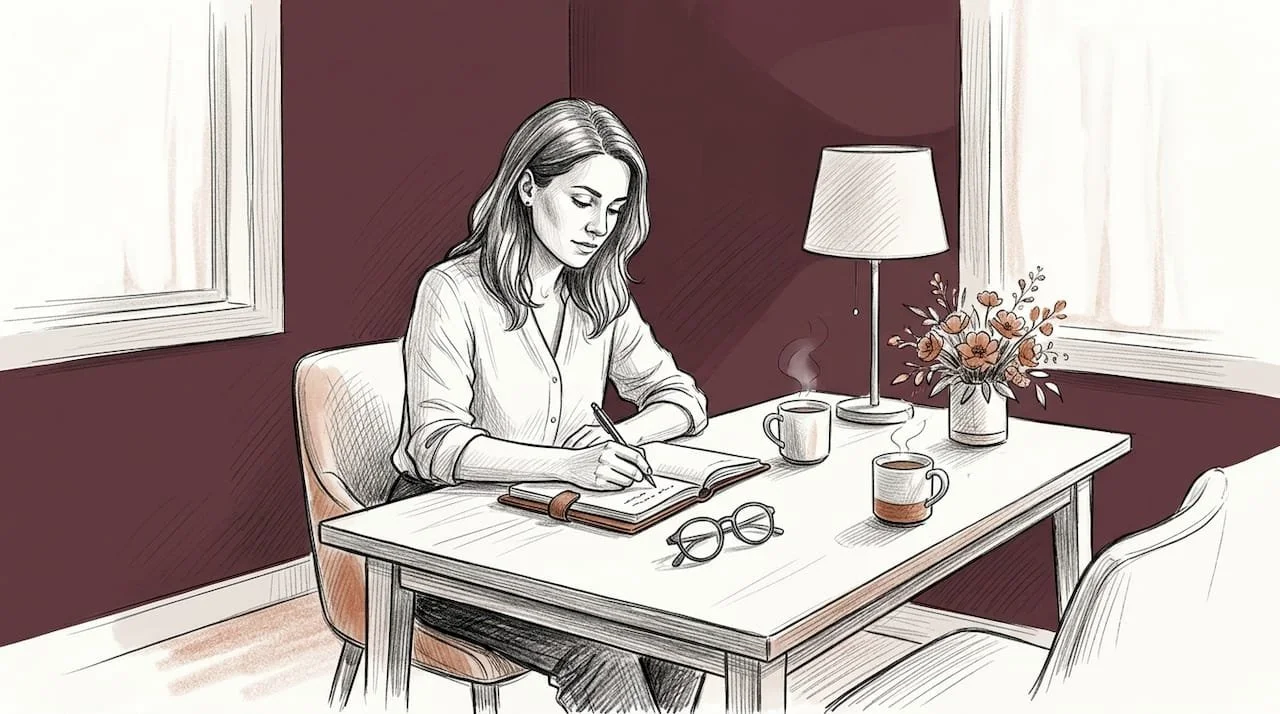
Trust breaks in many ways. Infidelity is the most obvious, but betrayal also includes financial deception, broken promises, emotional unavailability, and hidden struggles like addiction. What these have in common is secrecy. When one partner conceals something significant, the other's internal model of the relationship gets shattered.
The neurological impact is real. Betrayal activates the brain's threat response, and many people develop trauma symptoms after a trust violation. You may find yourself scanning your partner's face for signs of deception, replaying memories, or swinging between anger and numbness. This is not weakness. It is your brain doing exactly what brains do after danger.
Common reasons trust breaks down include:
Infidelity or emotional affairs
Repeated dishonesty or broken commitments
Financial secrecy or deception
Hidden substance use or compulsive behavior
Emotional withdrawal or consistent unavailability
Understanding why trust broke does not excuse the behavior. It gives you a starting point for repair. You cannot fix what you cannot name.
Getting ready to rebuild: mindset and safety terms
Before any steps toward restoration can work, both partners need to answer an honest question: do I actually want this relationship to survive? Rebuilding violated trust requires both partners' internal pro-relationship motivation. Without that, the effort becomes one-sided and collapses.
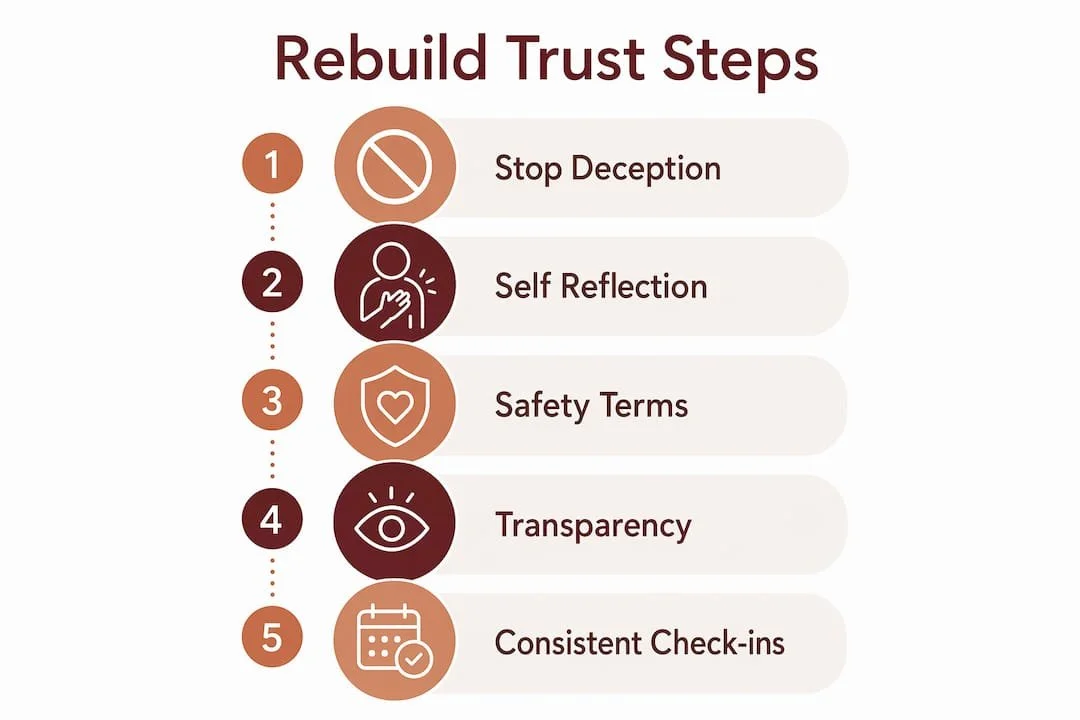
Self-reflection is equally important. The partner who broke trust needs to look honestly at what conditions allowed the breach. Not to perform guilt, but to understand the patterns that led there. The betrayed partner also benefits from reflection, not to assign themselves blame, but to identify what kind of reassurance they genuinely need going forward.
One of the most underused tools in trust repair is what therapists call "new safety terms." These are explicit agreements about how the relationship will function during the rebuilding phase. Therapists treat boundaries as protective agreements rather than punishments, and that framing matters. A boundary is not a threat. It is a structure that lets both of you breathe.
| Safety term | Purpose |
|---|---|
| Communication check-ins | Daily or regular conversations to share whereabouts and emotional state, reducing anxiety |
| Device transparency | Agreed-upon openness with phones or accounts for a set period to restore predictability |
| Pace agreements | Explicit understanding that rebuilding moves at the betrayed partner’s pace, not a timeline |
| Conflict protocols | Agreed signals for pausing difficult conversations before they escalate |
| Emotional update language | Regular, low-stakes sharing of feelings to maintain connection and reduce guessing |
Pro Tip: Write your new safety terms down together. Verbal agreements fade under stress. A written reference you both created gives you something concrete to return to when things get difficult.
Transparency and accountability: the practical steps
Knowing what to do is one thing. Doing it consistently when emotions are running high is another. The partner who broke trust often wants to move forward quickly. The partner who was hurt needs evidence, not promises. These two timelines rarely match, and that gap is where most rebuilding attempts fail.
Trust repair in couples therapy focuses on transparency and reliability, with daily sharing of plans and consistent reachability. Small, predictable actions matter more than grand gestures. Showing up on time, following through on minor commitments, and being reachable when you say you will are how trust comes back. Not through speeches.
Here is a practical sequence for the partner working to restore trust:
Stop all deceptive behavior completely. This sounds obvious, but partial honesty is still dishonesty. Replacing secrecy with consistent honesty, including sharing moments of struggle, is what actually changes the system.
Communicate remorse genuinely, not strategically. Research shows that spontaneous guilt communication is more effective in repairing trust than planned apologies. When you feel regret, say it in the moment. Rehearsed remorse reads as performance.
Share your plans and whereabouts proactively. Do not wait to be asked. Offer information before your partner has to wonder about it. This builds the evidence of safety that betrayed partners need.
Stay present during hard conversations. When your partner expresses pain, resist the urge to defend yourself or redirect. Listen. Let them finish. Defensiveness signals that your comfort matters more than their healing.
Acknowledge your partner's triggers with patience. Hypervigilance is not accusation. When your partner asks again about something already discussed, that is their nervous system checking for safety, not an attack on your integrity.
Keep track of your own emotional honesty. If you are struggling, say so. Hiding internal conflict is what created the problem. Transparency about imperfection is not weakness. It is proof that the system has changed.
Pro Tip: Set a weekly 20-minute check-in where the focus is only on how the rebuilding process is going, not daily logistics. This gives both partners a dedicated space to express needs without every conversation becoming a crisis.
Healing for the betrayed partner
If you were the one hurt, your healing is not secondary to the relationship's healing. In fact, the relationship cannot recover if you are not given space to process what happened to you.
Honoring your feelings is not the same as acting on all of them. You are allowed to feel rage, grief, profound sadness, and moments of unexpected numbness. Minimizing those feelings to protect your partner's comfort stalls your own recovery. Find a way to express them, whether through therapy, journaling, or honest conversation at the right moments.
Your hypervigilance deserves respect. Betrayed partners often experience heightened alertness after trust violations, and trauma-informed approaches treat this as the body's wisdom rather than a dysfunction. You are not being paranoid. You are responding to real data your nervous system received.
Some tools that help betrayed partners move through pain without getting stuck:
Mindfulness practices to stay grounded in the present rather than looping through past events or catastrophizing future ones
Selective vulnerability, meaning choosing safe moments and topics to gradually reopen emotional sharing with your partner
Self-protective boundaries framed around your needs rather than as punishments, such as asking for specific kinds of reassurance rather than issuing ultimatums
Gradual reconnection activities, low-stakes, positive experiences with your partner that slowly reintroduce warmth without pressure to fast-forward the process
You might also benefit from exploring EMDR for relationship trauma. EMDR therapy helps process the intrusive memories and emotional flooding that betrayal often creates, and it can be transformative for people whose bodies are still living in the moment of discovery.
Common pitfalls and how to handle setbacks
Trust recovery is nonlinear. A week of real closeness can be followed by a flashback, a triggering moment, or a conversation that reopens everything. This is not evidence that rebuilding has failed. It is evidence that healing is actually happening at depth.
The biggest mistake most couples make is treating setbacks as proof that the process is not working. They stop using the tools they agreed on, revert to old patterns, and lose months of progress. Understanding that ruptures during rebuilding are normal lets you respond to them as repair opportunities instead of catastrophes.
| Common pitfall | What to do instead |
|---|---|
| Rushing the betrayed partner’s timeline | Follow their pace; ask regularly how they are feeling about progress |
| Defensiveness during hard conversations | Pause, breathe, and reflect the partner’s pain back before responding |
| Withholding transparency to avoid conflict | Share proactively; information withheld now creates doubt tomorrow |
| Expecting full trust after one good period | Recognize trust builds in small increments across consistent time |
| Avoiding professional support | Seek trauma-informed couples therapy when communication stalls |
Pro Tip: When a conflict threatens to derail progress, use a “soft landing” protocol: each partner takes 20 minutes apart, then returns to share one feeling using “I” language. It keeps things from escalating while still moving forward.
My perspective on what actually rebuilds trust
I've worked alongside trauma-informed therapists long enough to know that the majority of trust repair advice misses the most important variable. People focus on behavior change, and behavior change matters. But trust returns not just when behavior changes but when the injured partner perceives that the change is motivated by genuine care. Intent is the invisible engine.
What that means practically is this: if you are rebuilding to avoid consequences, your partner will feel it. If you are rebuilding because you actually value them and regret the harm you caused, they will feel that too. Nervous systems are extraordinarily good at reading motivation. You cannot fake your way to restored trust.
I've also seen couples who thought the betrayal ended their relationship discover that the process of rebuilding, done honestly, created a depth of connection they never had before. The conversations forced by repair work are often the first truly honest ones a couple has ever had. That does not make the betrayal worthwhile. But it does mean that healing is not just a return to what was. It can be the beginning of something more real.
The pace needs to be slower than the person who broke trust wants, and faster than the betrayed partner fears is safe. Holding that tension, with patience and professional support when needed, is where the real work lives.
— Alvaradotherapy
Ready to rebuild with professional support
Rebuilding trust after betrayal is work that most couples cannot do alone, and there is no shame in that. At Alvaradotherapy, our trauma-informed therapists specialize in exactly this kind of healing. We offer online couples therapy for clients across California, with sessions designed to help both partners communicate honestly, process pain, and create the new safety structures that actual repair requires. For individuals carrying the weight of betrayal trauma, our PTSD and complex trauma services address the nervous system impact that often goes unspoken. If you are ready to take the first step, explore what to expect and start your healing process with a licensed therapist who understands the full complexity of what you are going through.
FAQ
What is the first step to rebuilding trust after betrayal?
The first step is a full stop on deceptive behavior combined with honest acknowledgment of what happened. Without those two things, no further repair effort will hold.
How long does it take to rebuild trust in a relationship?
There is no fixed timeline. Research shows trust recovery is nonlinear, meaning progress is gradual and setbacks are normal. Most couples working with professional support see meaningful change over months, not weeks.
Can trust be fully restored after infidelity?
Yes, though it looks different than the trust that existed before. Many couples describe the rebuilt trust as deeper because it was consciously constructed. The process requires transparency, consistent accountability, and often professional guidance.
Why do I still feel anxious even when my partner is trying to change?
Hypervigilance after betrayal is a trauma response, not irrationality. Your nervous system learned to detect threat and it takes time and repeated evidence of safety before it recalibrates. This is normal and expected.
When should couples seek therapy for trust issues?
When communication repeatedly breaks down, when one or both partners feel stuck, or when the betrayed partner's trauma symptoms are interfering with daily life, professional support is worth seeking. Couples counseling provides structure and tools that most people cannot create on their own.
