
Why Couples Therapy Works: Skills That Save Relationships
TL;DR:
Couples therapy replaces guesswork with structured, therapist-guided interventions that interrupt harmful recurring patterns. It builds essential skills like emotional intimacy, daily engagement, teamwork, and healthy autonomy to sustain long-term connection. Early, proactive therapy enhances relationship resilience and reduces individual stress by transforming conflict into intentional communication.
Couples therapy works because it replaces guesswork with structure, giving partners a therapist-guided process to interrupt harmful patterns and build the specific skills that sustain long-term connection. Harvard Health describes therapy as providing partners a "structured space" to work through conflicts with professional support, rather than leaving them to cycle through the same arguments alone. The recognized clinical term for this process is couples counseling or relationship therapy, and it draws on evidence-based models including Emotionally Focused Therapy (EFT), the Gottman Method, and Cognitive Behavioral Therapy (CBT). Understanding why couples therapy works means understanding that love initiates a relationship but skills are what sustain it.
Why couples therapy works: the core mechanism
The reason couples therapy produces lasting change is not that a therapist mediates arguments. It is that a trained clinician identifies the pattern underneath the argument and interrupts it before it loops again.
Most couples in distress are not fighting about dishes or finances. They are caught in negative interaction cycles built from criticism, defensiveness, contempt, and withdrawal. These cycles repeat because each partner's reaction triggers the other's defense. Without outside intervention, the loop tightens over time.
Here is how a therapist breaks that cycle in practice:
Identify the trigger. The therapist names the specific moment one partner shifts from calm to reactive, making the invisible pattern visible to both people.
Slow the sequence. By slowing the interaction in session, both partners observe their own behavior rather than just reacting to each other's.
Introduce a new response. The therapist coaches a different reply at the exact point where the old cycle would normally escalate.
Assign practice between sessions. Partners rehearse the new response outside the therapy room, which is where lasting behavioral change actually takes root.
This four-step process is why couples therapy effectiveness is measurable. The work does not stay in the office. It becomes a repeatable habit.
Pro Tip: Keep a brief journal between sessions noting one moment where you used the new response pattern. Bringing that example to the next session accelerates progress significantly.
What skills do couples actually build in therapy?
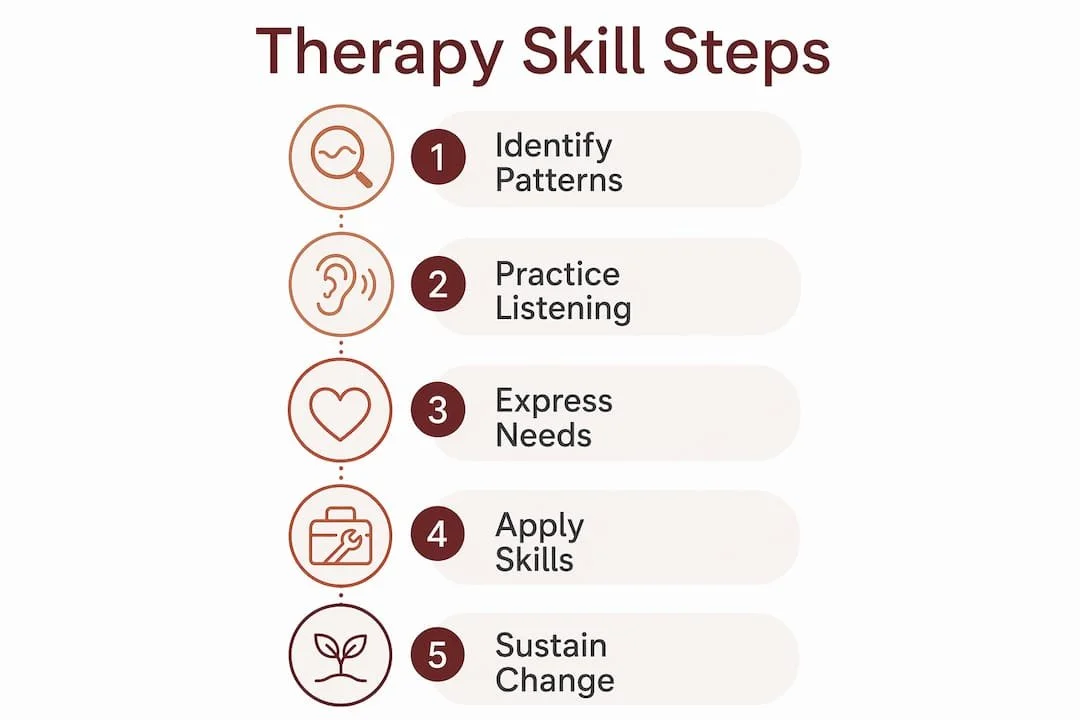
Therapy is not just conflict resolution. The skills that sustain relationships fall into four distinct categories, each addressing a different way relationships erode over time.
Emotional intimacy conversations. Many couples avoid talking about closeness because it feels vulnerable or leads to conflict. Therapy teaches partners to discuss changing emotional needs, physical affection, and connection directly, without it becoming an accusation. This is especially relevant during major life transitions like parenthood, career shifts, or loss.
Daily partner engagement. Relationship longevity depends on daily habits of learning and actively choosing your partner rather than assuming the relationship runs on autopilot. Therapy makes this concrete by helping couples design small, consistent rituals of connection.
Teamwork through challenges. Life delivers stress that couples face together or against each other. Therapy builds the coordination skills that let partners function as a unit during illness, financial pressure, or family conflict rather than turning on each other under strain.
Healthy autonomy. Secure attachment does not mean merging identities. Therapy helps partners maintain individual needs and boundaries within the relationship, which reduces resentment and increases genuine desire to connect.
One of the most overlooked advantages of relationship counseling is that it addresses the slow drift apart before couples even recognize it is happening. Research from Psychology Today notes that neglecting emotional connection amid daily logistics is the primary driver of couples becoming functional roommates rather than intimate partners. Therapy interrupts that drift by making intimacy a practiced skill, not an assumed state.
Pro Tip: Between sessions, try one five-minute check-in daily where each partner shares one feeling and one appreciation. This single habit, recommended in effective couples communication guides, builds the daily engagement muscle therapy reinforces.
What are the benefits of couples therapy beyond crisis management?
The most persistent myth about couples counseling is that it is a last resort. In reality, therapy is most effective when couples use it proactively, before patterns calcify into contempt or disconnection.
A study found that over 44% of divorced and separated individuals now view couples therapy as proactive relationship care rather than crisis intervention. That shift in perspective matters because it means more couples are entering therapy with enough goodwill and motivation to do the skill-building work effectively.
The benefits of couples therapy extend across several dimensions of relationship health:
| Benefit | What it looks like in practice |
|---|---|
| Improved communication | Partners learn to express needs without triggering defensiveness |
| Rebuilt trust and empathy | Therapeutic interventions rebuild emotional bonds by deepening mutual understanding |
| Conflict resolution skills | Couples replace reactive arguments with structured, productive disagreement |
| Emotional and physical intimacy | Ongoing conversations about closeness replace assumptions about connection |
| Relationship resilience | Skills developed in therapy hold during future stressors, not just current ones |
The impact of couples therapy on emotional health is not limited to the relationship itself. When partners communicate better and feel more secure, individual anxiety and stress levels drop measurably. The relationship becomes a source of regulation rather than dysregulation.
"Therapy taught us that we were not fighting about the same thing twice. We were fighting about the same feeling twice, and we had never named it." — Composite reflection from couples in relational therapy
Evidence-based approaches like EFT, the Gottman Method, and CBT each target different mechanisms, but all share the same goal: replacing reactive patterns with intentional communication skills that couples can use independently long after sessions end.
Common myths about couples therapy that hold people back
Several misconceptions prevent couples from seeking therapy until the damage is severe. Addressing them directly matters because timing affects outcomes.
Myth: Therapy is only for relationships in crisis. Couples therapy effectiveness is highest when partners still have positive regard for each other. Entering therapy early, when conflict is moderate, produces faster and more durable results than waiting until trust has collapsed.
Myth: Love is enough to sustain a relationship. Psychology Today states clearly that love initiates relationships but does not sustain them. Skills do. Attraction and affection are not substitutes for the learned behaviors that keep a relationship functional through decades of change.
Myth: Therapy means one partner is the problem. Effective couples counseling targets the system between two people, not the individual. Harvard Health confirms that therapy addresses patterns of communication and emotional reactivity, not isolated incidents or individual fault.
Myth: Talking about problems makes them worse. Unaddressed conflict does not resolve on its own. It compresses. Therapy provides the structure that makes difficult conversations productive rather than destructive, which is precisely why therapy improves relationships where avoidance has failed.
Understanding these distinctions is the first step toward using couples counseling as the skill-building investment it actually is, rather than the admission of failure it is often mistaken for. Alvarado Therapy's resource on couples therapy success breaks down what actually drives positive outcomes for couples at every stage.
Key takeaways
Couples therapy works because it targets recurring interaction patterns and replaces them with practiced communication and emotional skills that sustain relationships long after sessions end.
| Point | Details |
|---|---|
| Pattern interruption is the core mechanism | Therapists identify and break negative cycles, not just mediate individual arguments. |
| Skills sustain what love starts | Emotional intimacy, teamwork, and daily engagement are learned behaviors, not natural states. |
| Proactive use produces better outcomes | Entering therapy before crisis preserves the goodwill needed for skill-building to take hold. |
| Therapy targets the system, not the individual | Effective counseling addresses how two people interact, not who is at fault. |
| Benefits extend beyond the relationship | Improved communication reduces individual anxiety and builds long-term relationship resilience. |
What I've seen that most articles won't tell you
After working with couples across a range of relationship stages, the pattern that stands out most is not the severity of the conflict. It is the gap between what couples say they want and what they are willing to practice between sessions.
Therapy sessions are the map. The territory is every conversation, every moment of tension, every choice to respond differently at 9 p.m. on a Tuesday when no therapist is in the room. Couples who see the most meaningful change are the ones who treat the skills they learn in session as daily practice, not as insights to admire and forget.
The other thing most articles skip: couples therapy is not always comfortable. There will be sessions where both partners leave feeling worse before they feel better. That discomfort is not a sign the therapy is failing. It is a sign that something real is being addressed. The couples who push through that discomfort consistently are the ones who report the deepest shifts in connection and trust.
If you are considering therapy, the question is not whether your relationship is broken enough to deserve help. The question is whether you are willing to practice something new. That willingness is the actual variable that determines couples counseling success.
— Juiced
Start building real relationship skills with Alvarado Therapy
Alvarado Therapy offers online couples therapy for partners across California, delivered by licensed, trauma-informed therapists who specialize in communication, emotional connection, and conflict resolution. The practice uses evidence-based approaches including EFT and trauma-sensitive methods tailored to each couple's specific patterns and goals. Sessions are available in both English and Spanish, with flexible online scheduling designed for busy lives. Whether you are navigating a specific conflict or simply want to invest in a stronger relationship before problems deepen, Alvarado Therapy provides the structured, professional support that makes real change possible. Schedule a consultation to take the first step.
FAQ
Why does couples therapy work when talking alone doesn't?
Couples therapy works because a trained therapist identifies the recurring pattern beneath the argument, not just the surface content. Without that outside perspective, partners typically repeat the same cycle with more intensity rather than breaking it.
How long does it take for couples therapy to show results?
Most couples notice meaningful shifts in communication patterns within six to twelve sessions, though this depends on the severity of existing conflict and how consistently partners practice skills between appointments.
Is couples therapy only for relationships that are failing?
Couples therapy is effective at every relationship stage, including healthy relationships seeking stronger communication. Research shows that proactive use of therapy, before crisis hits, produces faster and more lasting results.
What methods do couples therapists use?
Licensed couples therapists commonly use Emotionally Focused Therapy (EFT), the Gottman Method, and Cognitive Behavioral Therapy (CBT), each targeting communication patterns, emotional responsiveness, and conflict resolution skills.
Can couples therapy help if only one partner is willing?
Therapy is most effective when both partners participate actively. However, even one partner developing new communication skills can shift the interaction dynamic enough to reduce conflict and open space for the other partner to engage differently over time.
