
Couples Counseling for Conflict Resolution That Works
TL;DR:
Conflict itself is not the enemy of healthy relationships; poor handling makes it destructive. Couples counseling focuses on changing behaviors and skills, not personalities, through measurable goals and evidence-based techniques.
Conflict is not the enemy of a healthy relationship. Handled poorly, it absolutely is. But couples counseling for conflict resolution is built on a different premise: that the way you fight matters far more than the fact that you fight. Couples who seek help are not broken. They are often just missing a specific set of skills, and those skills are learnable. This article walks you through the behavioral science behind relationship conflict, what measurable therapy goals actually look like, and the evidence-based techniques that help couples turn recurring arguments into genuine understanding.
Table of Contents
Key takeaways
| Point | Details |
|---|---|
| Conflict patterns, not personality, predict outcomes | Specific behaviors like criticism and contempt predict breakdown far more reliably than who you are as a person. |
| Measurable goals make therapy work | Setting behavioral targets, like reducing escalation episodes, makes progress visible and keeps couples motivated. |
| Physiological regulation comes first | When your heart rate spikes during conflict, rational conversation shuts down. Structured breaks restore it. |
| Technique fit matters for safety | Communication exercises work differently depending on the nature of conflict, and safety must always guide approach. |
| Skills are learned, not innate | Every couple can acquire repair and communication skills. Counseling is the structured space to practice them. |
Couples counseling for conflict resolution: understanding what drives the cycle
Most couples enter therapy believing the problem is that they fight too much. What research consistently shows is that the content of the conflict is rarely the real issue. The pattern is.
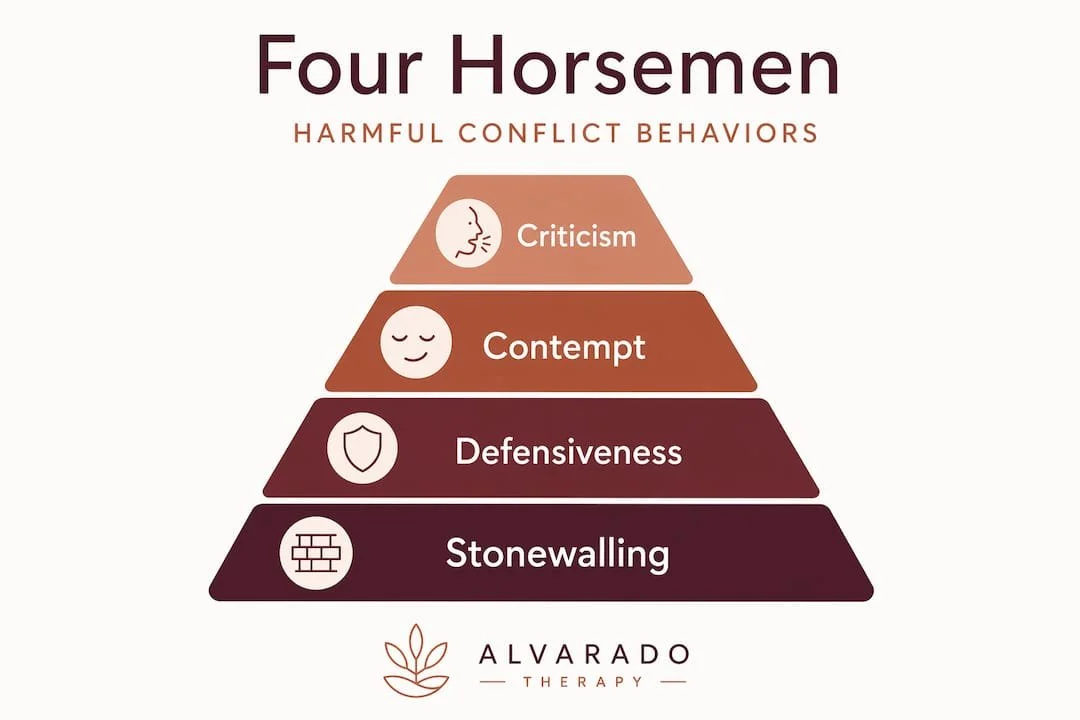
John Gottman's decades of research identified four communication behaviors that predict relationship breakdown with striking accuracy. Known as the Four Horsemen, these patterns are criticism, contempt, defensiveness, and stonewalling. Contempt, which involves treating your partner as inferior, is the single strongest predictor of relationship failure. It is not a personality flaw. It is a behavior that develops over time when negative sentiment is allowed to accumulate unchecked.
What makes this framework so useful in relationship conflict therapy is that it shifts the focus from who you are to what you are doing. That is a meaningful distinction. You cannot change your personality in a session, but you can learn to catch yourself mid-criticism and redirect.
Equally significant is the concept of flooding. When a conflict escalates, your heart rate can exceed 100 beats per minute, and at that point your brain is no longer processing information the way it does during calm conversation. You are in survival mode. Logic, empathy, and listening all become physiologically inaccessible.
A few additional patterns worth knowing:
Repair attempts are small gestures, verbal or physical, that try to de-escalate tension mid-conflict. Couples who use them regularly fare significantly better even when they have bad communication habits in other areas.
Stonewalling, often misread as indifference, frequently reflects emotional overwhelm. In Gottman's studies, 85% of stonewallers were male partners, largely due to differences in cardiovascular recovery from stress. This is physiology, not avoidance as a character trait.
Cooperation versus defection in conflict mirrors game theory. Couples who interpret each other's neutral or ambiguous moves as hostile tend to escalate, while those who default to charitable interpretation tend to de-escalate.
"Conflict is not a sign of incompatibility. It is an opportunity to understand your partner more deeply, if you have the tools to work with it rather than against it."
Understanding these dynamics gives you a foundation. The next step is knowing what good therapy actually targets.
Setting goals that measure real progress
One of the most overlooked aspects of effective couples therapy is how goals are set. Vague intentions like "we want to fight less" or "we want to communicate better" sound reasonable, but they give both the couple and the therapist nothing concrete to measure.
Measurable therapy goals are behavioral, observable, and time-bound. The difference matters more than most people expect.
Here is how that contrast looks in practice:
| Vague Goal | Measurable Goal |
|---|---|
| "Stop fighting so much" | Reduce verbal escalation episodes to fewer than two per week within 8 weeks |
| "Communicate better" | Demonstrate reflective listening in at least three of five observed exchanges per session |
| "Trust each other more" | Increase follow-through on agreed commitments, tracked weekly for 6 weeks |
| "Feel closer" | Use one connection ritual (a brief check-in, a shared activity) at least four times per week |
Why does specificity help? Because behavioral targets make progress visible. Couples often drop out of therapy prematurely because they feel it is not working. When you have a concrete benchmark, you can see movement even when the relationship still feels difficult. That visibility sustains motivation during hard stretches.
Goals also guide reassessment. If a couple reaches their 8-week check-in and escalation episodes have not decreased, that is clinical information. It tells the therapist to adjust the approach, not simply repeat the same intervention.
Pro Tip: Before your first session, each partner should write down two or three specific behaviors they want to see more of, not just less of. "I want us to take a break before things get loud" is more useful than "I want us to stop yelling."
Techniques that actually change the dynamic
Evidence-based couples therapy does not rely on one script. The best approaches draw from multiple methods depending on what a couple actually needs.
Here is a structured look at the techniques most commonly used in conflict mediation for couples:
Structured time-outs. Forced, structured breaks work better than vague requests for space. A structured time-out includes a specific phrase to signal the break ("I need 20 minutes"), a defined duration, and an agreed return point to continue the conversation. Vague breaks get interpreted as avoidance and often escalate conflict.
Reflective listening. Instead of preparing your rebuttal while your partner talks, you reflect back what you heard before responding. This is harder than it sounds, and it directly interrupts the defensiveness cycle.
Expressing needs over accusations. Replacing "You always ignore me" with "I feel unseen when our plans get canceled" shifts the conversation from attack to disclosure. It changes the emotional register of the exchange.
Validation without agreement. You can acknowledge that your partner's feelings are real without conceding that their interpretation of events is correct. This distinction alone defuses many standoffs.
Emotion-Focused Therapy (EFT). An 8-week EFT intervention showed significant improvements in marital intimacy and adjustment, with gains maintained at a 3-month follow-up. EFT works by helping partners identify the vulnerable emotions beneath their anger and communicate those instead.
Gottman Method. Specifically targets the Four Horsemen patterns with structured exercises, including "softened startup" for initiating difficult conversations and "dreams within conflict" for exploring the deeper meaning behind recurring disagreements.
One critical point that marriage counseling for disputes often underemphasizes: not all conflict is the same. Communication skill exercises show meaningfully different effectiveness depending on the nature and severity of the conflict. When coercive control or intimate partner violence is part of the picture, safety-informed treatment must come before communication training. Standard conflict resolution models were not designed for those contexts, and applying them without adjustment can inadvertently increase risk.
Pro Tip: If you are unsure which technique fits your situation, bring that uncertainty into the room with your therapist. A skilled counselor will assess your conflict profile before prescribing a method. You can also explore communication exercises that are clinically backed and low-risk to try at home.
Applying what you learn between sessions
Therapy happens for one hour a week. The other 167 hours are up to you.
The couples who make the most progress are not the ones with the cleanest arguments in session. They are the ones who take what they practice in the room and commit to using it in real moments at home. That takes structure.
Here are practical ways to carry conflict resolution strategies for partners into daily life:
Track conflict episodes together. Keep a simple shared log noting when escalation occurred, what triggered it, and whether a repair attempt was made. You do not need detail, just a brief note. Over weeks, patterns become visible in a way that memory alone cannot reveal.
Practice repair attempts proactively. Do not wait for a conflict to use repair language. Practice during low-stakes moments so that "I'm feeling overwhelmed, can we slow down?" becomes automatic rather than something you have to remember mid-argument.
Recognize when deeper support is needed. Some conflicts circle back to childhood trauma, attachment wounds, or experiences that standard communication tools cannot reach. When that happens, a trauma-informed approach addresses the root rather than just the symptom. Couples therapy effectiveness research confirms this distinction matters for lasting outcomes.
Celebrate genuine progress. Conflict work is exhausting, and couples often focus entirely on what is still broken. Acknowledging a successful de-escalation, a repair attempt that worked, or a week with fewer eruptions is not self-congratulation. It is reinforcement of the behaviors you are trying to build.
Connection rituals also deserve a mention here. A daily check-in, a consistent goodbye routine, or a weekly conversation that has nothing to do with logistics all serve as deposits in the emotional bank account that conflict draws from. You can learn more about how counseling supports these habits through resources on healing together through therapy.
My take: behavior is where the work lives
I have seen couples come in convinced that their problem is incompatibility. Different personalities, different communication styles, fundamental mismatches. And sometimes, after careful assessment, that turns out to be true. But far more often, what looks like incompatibility is actually a set of learned patterns that both partners have been reinforcing for years without realizing it.
What shifts everything is when a couple accepts that behavior, not personality, is the lever. You cannot rewire who your partner is. But you can both choose, with support, to interrupt the Four Horsemen the next time one appears. You can both practice the repair attempt. You can both agree to take a structured break before the conversation reaches the point where neither of you can think clearly.
The measurable goals piece matters more than people expect. When I see a couple track their escalation frequency and watch it drop from six episodes a week to two over eight weeks, something changes in how they see themselves. They stop viewing themselves as a couple who cannot communicate and start viewing themselves as a couple who is learning to. That shift in identity is often as therapeutic as any single technique.
Conflict is not your relationship's weakness. It is, handled with the right tools, one of the ways you understand each other most deeply.
— Alvaradotherapy
Ready to work through conflict with real support?
If what you have read resonates, the next step is finding a space where these strategies get applied specifically to your relationship. Alvaradotherapy offers online couples therapy across California, with therapists trained in evidence-based approaches that address conflict, communication, and the deeper emotional patterns underneath both. Sessions are available online for couples throughout CA and NY.
Whether you are in the middle of a difficult stretch or trying to get ahead of recurring patterns, scheduling a free consultation is a concrete first step. You can also learn what to expect from the therapy process before committing to anything.
FAQ
What is couples counseling for conflict resolution?
Couples counseling for conflict resolution is structured therapy that helps partners identify harmful communication patterns, regulate emotional escalation, and build skills for productive disagreement. It draws on evidence-based methods like the Gottman Method and Emotion-Focused Therapy.
How long does it take to see results in conflict-focused couples therapy?
Many couples notice meaningful behavioral shifts within 8 to 12 sessions when working toward specific, measurable goals. Behavioral targets like reducing escalation frequency make progress visible even when the relationship still feels challenging.
What are the Four Horsemen in relationship conflict?
The Four Horsemen are criticism, contempt, defensiveness, and stonewalling. These communication patterns reliably predict relationship breakdown and are the primary behavioral targets in Gottman Method couples therapy.
Can couples therapy help if one partner is reluctant?
Yes, though progress is slower when one partner is disengaged. Even partial participation can shift dynamics, and a skilled therapist will work to address ambivalence directly rather than treating it as a barrier to entry.
When should couples seek specialized or trauma-informed therapy?
When conflict involves coercive control, past trauma, or patterns that do not respond to standard communication tools, a trauma-informed approach becomes necessary. Safety and typology considerations must guide treatment before communication skill work begins.
