
Resolve relationship conflict with trauma-informed steps
TL;DR:
Effective conflict resolution requires trauma-informed regulation and understanding of past wounds that influence emotional reactions.
Preparing oneself, recognizing escalation early, and using structured strategies such as "I" statements and repair attempts foster genuine connection and ongoing healing.
You've had the same argument a dozen times. Both of you leave feeling unheard, frustrated, and more distant than before. The issue isn't just a communication breakdown. For many couples and individuals, conflict hits a nerve because past experiences, childhood wounds, or unprocessed trauma are quietly driving the reaction. When that happens, standard advice like "just talk it out" rarely works. This guide walks you through trauma-informed strategies that address what's actually happening beneath the surface, so you can de-escalate, communicate clearly, and start building real resolution together.
Table of Contents
Key Takeaways
| Point | Details |
|---|---|
| Regulate before talking | Stepping away to calm down prevents escalation and sets the stage for productive discussion. |
| Use trauma-informed steps | Acknowledge past trauma and emotional state to make conflict resolution fair and compassionate. |
| Focus on repair | Effective conflict navigation relies on small gestures to reconnect and a healthy balance of positive interactions. |
| Watch for progress | Recognize improvement through less frequent fights, more positive moments, and smoother recovery. |
| Seek help when needed | Professional trauma-focused support can break cycles if self-guided strategies aren’t enough. |
What you need before addressing conflict
Once you understand why conflict feels so difficult, it's crucial to lay solid groundwork before you dive into resolution. Jumping straight into a charged conversation without preparation is like trying to perform surgery in the dark. You need conditions that make honest, safe communication even possible.
The first thing to check is your own state. Ask yourself honestly: Am I hungry, exhausted, or already triggered by something else today? Research and clinical practice consistently show that basic physical needs, when unmet, amplify emotional reactivity. A disagreement that might feel manageable at noon can explode into a full crisis at 10 p.m. after a stressful workday.
Before you engage in any difficult conversation, run through this quick checklist:
Is either person currently dysregulated (heart racing, voice raised, thoughts scattered)?
Is this a safe, private space where both people feel protected enough to be honest?
Has enough time passed since the triggering event for each person to breathe?
Is this conversation about understanding each other, or about "winning"?
Are both people choosing to engage, or is one person being pushed into it?
Emotional dysregulation is one of the biggest reasons conflict spirals. When the nervous system is flooded, the thinking brain goes offline and the survival brain takes over. You literally cannot have a productive conversation from that state.
The table below summarizes the difference between three common starting conditions:
| Condition | What it looks like | Likely outcome |
|---|---|---|
| Avoid | One or both shut down, leave, refuse to discuss | Issue stays unresolved, builds resentment |
| Prepare | Both calm, clear on intention, set aside time | Higher chance of genuine resolution |
| Escalate | Jumping in while flooded or defensive | Increased pain, repeated patterns |
Pro Tip: If you notice your chest is tight, your jaw is clenched, or your thoughts are racing, that's your nervous system telling you it's not ready. Tell your partner, "I want to talk about this. Can we give it 20 minutes before we start?" That's not avoidance. That's wisdom. For more on managing relationship anxiety before difficult conversations, the Alvarado Therapy blog has a helpful breakdown.
When conflict is escalating, the American Psychological Association emphasizes stepping away, using relaxation techniques, and delaying your response until you can communicate more thoughtfully.
Step-by-step process for navigating conflict
Preparation sets the stage. Now here are practical, sequential steps to handle conflict, even when emotions run high. Think of this as a map, not a script. Your actual conversation will breathe and shift, but having a clear framework keeps you from getting lost.
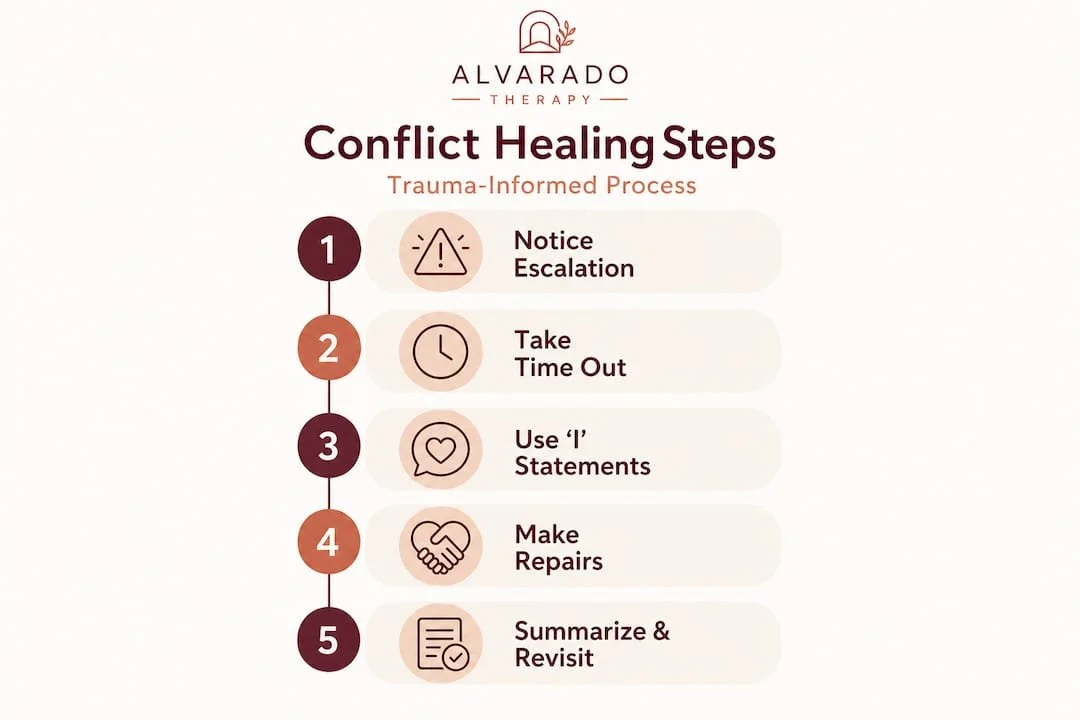
Step 1: Recognize escalation early. Notice when you or your partner is entering the red zone. Raised voices, sarcasm, stonewalling, or rapid-fire accusations are all signs. Recognizing this before it peaks gives you the ability to choose a different path.
Step 2: Use a time-out intentionally. This is not about walking away and never returning. A good time-out includes a specific return time. Say something like, "I'm getting overwhelmed. Can we pause for 30 minutes and come back to this?" During that break, use slow breathing, a short walk, or another self-soothing technique, not ruminating on who was wrong.
Step 3: Structure the conversation with "I" statements. When you re-engage, lead with your experience rather than accusations. Instead of "You never listen to me," try "I feel dismissed when I'm talking and you look at your phone." The first closes a door. The second opens one. Clarify your intention at the start: "I want us to understand each other, not to prove a point."
Step 4: Use repair attempts. This is a concept from Gottman-based practice. A repair attempt is any gesture designed to reduce tension and reconnect, whether that's a touch on the arm, a moment of humor, or simply saying, "I'm sorry, I got defensive there." The ratio of positive to negative interactions in stable couples is roughly 5:1. That means for every critical or negative exchange, five positive ones are needed to maintain a healthy emotional balance.
Step 5: Summarize and agree to revisit. At the close of the conversation, briefly summarize what you each heard. "So you're saying you felt ignored when I didn't respond right away. Did I get that right?" Then agree on whether the issue is resolved or whether you'll revisit it at a specific time.
| Step | Action | Purpose |
|---|---|---|
| 1. Recognize | Notice escalation cues | Stop the spiral early |
| 2. Time-out | Pause with a set return time | Regulate the nervous system |
| 3. Structure | Use "I" statements, clarify intent | Reduce blame, increase clarity |
| 4. Repair | Attempt de-escalation gestures | Rebuild connection mid-conflict |
| 5. Summarize | Reflect and confirm understanding | Close the loop or set next steps |
Pro Tip: Keep a few scripted phrases handy. "I need a break but I'm not leaving this conversation." "I hear that you're hurt. I want to understand more." "That came out wrong. Can I try again?" These feel awkward at first but become natural with practice.
"Healthy anger management emphasizes stepping away to regain calm, using relaxation strategies, and not returning to the discussion until you can communicate without reactivity." — American Psychological Association
Exploring couples therapy techniques can deepen your understanding of these steps, and reading about why therapy helps conflict may help you decide when professional support makes sense.
Common pitfalls and how to handle them
Even with good strategies, real-life relationships hit snags. Here's how you can prepare for, and bounce back from, the most common ones.
Confusing regulation with avoidance. One of the most damaging misreads in conflict is when a partner calls a time-out and the other person interprets it as stonewalling or abandonment. These are very different things. Avoidance means never returning to the conversation. A regulation break means stepping away to come back in better shape. When you take a regulation break, postponing resolution when overwhelmed is not cowardice. It's a clinically supported strategy that makes communication more effective when you return.
Getting stuck in criticism and defensiveness loops. John Gottman identified these as two of the "Four Horsemen" of relationship breakdown. Criticism sounds like "You always do this." Defensiveness sounds like "Well you never do that either." Both close off genuine listening. The antidote to criticism is a complaint framed around your feeling. The antidote to defensiveness is taking even partial accountability: "You're right that I forgot to follow through on that."
Neglecting nervous system recovery. After a big conflict, your body needs time to reset. Cortisol, the stress hormone, can stay elevated for hours. Skipping this recovery, jumping back into discussion too quickly, or using the calm period to plan your next argument all delay healing. Sleep, movement, and time in nature are not luxuries here. They're part of the repair process.
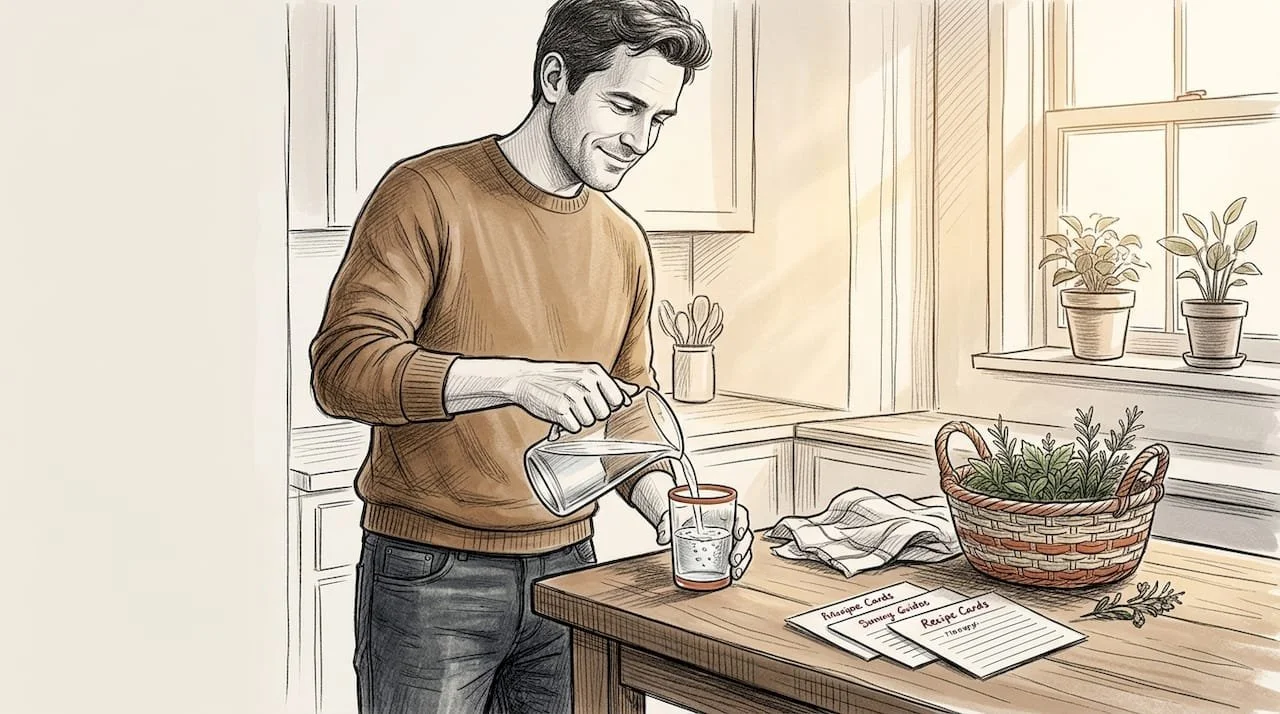
Letting unresolved anger silence repair attempts. Sometimes we are so hurt that we reject a partner's attempt to reconnect. This is understandable, but it breaks the repair cycle. You don't have to be fully healed to accept a bid for reconnection. You can say, "I'm still upset, but I appreciate that you're trying."
Common pitfalls at a glance:
Taking time-outs without communicating the intent to return
Using "I" statements but still loading them with blame ("I feel like you're selfish")
Skipping the summarize step and assuming you were both heard
Waiting for the other person to repair first
Discussing major issues when either person is tired, hungry, or already stressed
Pro Tip: When a time-out turns into hours of silence, check in with yourself. Are you genuinely calming down, or are you rehearsing your argument? Productive breaks involve intentional calming. Unproductive ones involve building your case. The difference matters more than the length of the break.
For more on patterns that show up in ongoing conflict, the article on common relationship issues offers useful context, and coping with relationship anxiety can help you identify anxious patterns that may be feeding the cycle.
How to know if it's working: Measuring progress and outcomes
Now that you're troubleshooting, let's pinpoint how you'll know your new approach is actually paying off. Change in relationships is rarely dramatic. More often it's quiet and gradual. A softer tone here. A shorter recovery time there. Knowing what to look for keeps you from giving up right before things shift.
Signs your approach is working:
Arguments happen less frequently, or the same triggers produce smaller reactions
Recovery time after conflict shortens from days to hours
You notice more bids for connection after difficult moments, not fewer
You begin to recognize your own escalation before it peaks
Both partners feel more willing to bring up concerns rather than suppress them
Research in Gottman-based frameworks confirms that repair attempts are among the strongest predictors of relationship stability. When you and your partner start catching them and accepting them more often, that's a measurable sign of progress.
| Indicator | Healthy conflict navigation | Unhealthy conflict navigation |
|---|---|---|
| After a fight | Recovery within hours | Days of silence or resentment |
| During conflict | Repair attempts made and accepted | Escalation with no reset |
| In daily life | More positive than negative interactions | Negativity dominates daily tone |
| On recurring issues | Able to revisit and make progress | Same fight, same outcome, every time |
| Seeking help | Willing to reach out for support | Refusing help or minimizing problems |
If you recognize more of the unhealthy patterns than the healthy ones in your relationship right now, that is honest information, not a reason to give up. It's a sign that you may benefit from therapy support for couples who understand trauma and its role in conflict. Professional support is not a last resort. It's often the most efficient path forward.
A trauma therapist's take: What most conflict advice misses
Here's the hard truth that most conflict resolution guides skip over: the strategies only work when your nervous system is regulated enough to use them. And for many people, especially those with histories of childhood trauma, domestic instability, or attachment wounds, that regulated state is hard to reach without first doing deeper work.
Standard advice says "communicate better." But what happens when a raised voice sends someone straight back to being eight years old in an unsafe home? The body doesn't know it's 2026. It just knows threat. And when the threat response fires, no amount of "I" statements will land. Understanding emotional overwhelm as a nervous system event rather than a character flaw changes everything about how you approach conflict.
We also see many people try to push through conflict resolution while their bodies are completely dysregulated. They force the conversation, use all the right phrases, and still walk away feeling worse. That's because technique without regulation is like trying to paint while the canvas is on fire.
The permission to pause, step back, or say "I can't do this right now" is not weakness. In trauma-informed practice, it's considered a skilled act of self-awareness. The goal is not to avoid conflict. It's to create the conditions where real communication is actually possible.
What we want for every person we work with is this: a shift in the goal itself. Moving from "solving the argument" to "rebuilding safety and trust" changes your entire orientation. You stop trying to win and start trying to understand. That is the difference between recurring arguments and genuine healing.
Be compassionate with yourself and with your partner. You are both bringing your histories into every hard conversation. That is not a flaw. It's human.
Get support for healing and moving forward
If you find that DIY strategies are not enough, there is help available from trauma-focused professionals who understand exactly what you're working through.
At Alvarado Therapy, we work with individuals and couples across California who are ready to move beyond recurring conflict and toward real healing. Whether you're navigating persistent communication struggles, processing old wounds that keep surfacing in your relationship, or simply feeling stuck, our licensed therapists are here to help. Explore our couples therapy options designed specifically for relational healing. If trauma is at the root of your patterns, our trauma therapy resources including EMDR can help you address what other approaches may have missed. Not sure where to start? Visit our page on what to expect from trauma therapy to feel more prepared before your first session.
Frequently asked questions
What is a trauma-informed approach to conflict?
A trauma-informed approach considers how past trauma shapes current emotional responses, and it prioritizes regulation, safety, and compassion before moving into communication. The APA's anger regulation guidance reinforces stepping back before engaging when emotions are high.
How does taking a break help manage heated arguments?
Taking a break allows your nervous system to calm down, which makes it possible to think more clearly and communicate without reactivity. A regulation break is clinically supported as a way to make later communication more productive.
What is a "repair attempt" in conflict resolution?
A repair attempt is any gesture meant to de-escalate tension or reconnect during or after a conflict, such as an apology, a touch, or a moment of humor. Research shows that stable couples rely on effective repair attempts as a key marker of relationship health.
How do I know if my conflict resolution skills have improved?
Look for fewer explosive arguments, faster emotional recovery after fights, and a noticeable increase in positive interactions relative to negative ones. If you're accepting more repair attempts and feeling safer to bring up concerns, those are strong indicators of growth.
When should we seek therapy for relationship conflict?
If conflict cycles repeat without resolution, one or both partners feel emotionally unsafe, or repair attempts consistently fail, it's time to seek professional support from a trauma-informed therapist who can help you address the root causes.
