
How Trauma Affects Partnerships: Healing in 2026

How trauma affects partnerships at their core
Trauma reshapes intimate relationships in ways that go far beyond individual symptoms. It disrupts the very mechanisms that make closeness possible: trust, emotional safety, communication, and physical connection. A meta-analysis from the VA found medium-sized correlations between PTSD and relationship problems, with true score correlations showing medium-sized associations for relationship discord, physical aggression, and psychological aggression. These numbers hold across both military and civilian populations.
The core effects on partnerships include:
Communication breakdown: Fear of strong emotions drives withdrawal, conflict escalation, and demand-withdraw cycles where one partner pushes for connection while the other pulls away.
Emotional safety erosion: Trauma survivors often struggle to feel safe enough to be vulnerable, making genuine closeness feel threatening rather than comforting.
Disrupted physical intimacy: Sexual connection and physical affection frequently suffer when the nervous system is stuck in a protective state.
Trauma triggers: Neutral behaviors from a partner can activate survival responses, turning ordinary moments into perceived threats.
Caregiver burden: Partners of trauma survivors often absorb extra emotional labor, leading to frustration and isolation over time.
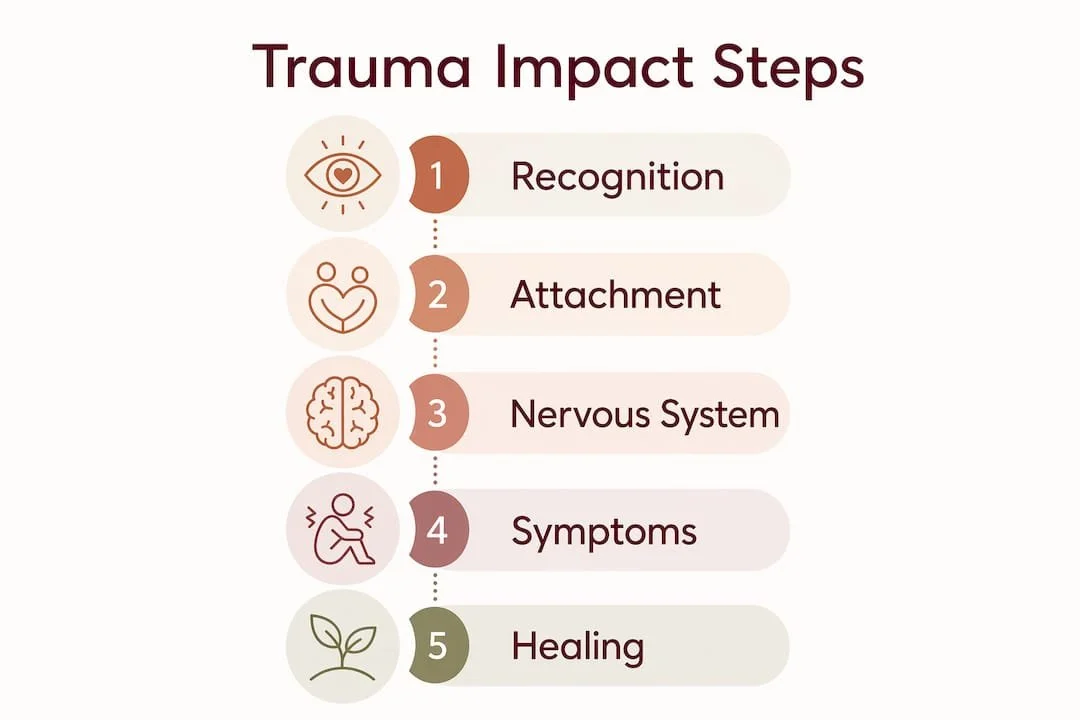
Attachment disruption: Early trauma shapes how adults attach to partners, often producing anxious, avoidant, or disorganized patterns.
Nervous system dysregulation: The body's threat-detection system stays on high alert, making calm, connected interaction genuinely difficult.
Trauma-informed therapy, including EMDR and couples counseling offers real pathways through all of this.
Table of Contents
What psychology tells us about trauma and intimate relationships
Alvaradotherapy: a clear next step for couples ready to heal
Signs that trauma is showing up in your relationship
Recognizing trauma's fingerprints in a relationship is the first step toward changing the pattern. Many couples spend years cycling through the same arguments without realizing a trauma response is driving the loop.
Common signs include:
Frequent misunderstandings: One partner reads a neutral tone or expression as criticism, anger, or rejection, and reacts accordingly.
Emotional flooding: Conversations escalate quickly because one or both partners become overwhelmed before they can think clearly.
Demand-withdraw dynamics: Research with 64 couples found that higher PTSD symptoms predicted greater fear of emotions, which directly linked to less constructive communication and more demand-withdraw patterns.
Emotional numbness or withdrawal: A survivor may go quiet or shut down during conflict, not out of indifference but because the nervous system is protecting itself.
Trust and jealousy issues: Difficulty believing a partner's intentions are good, even with consistent evidence to the contrary.
Repetitive unresolved arguments: The same fight keeps returning because the underlying trigger, not the surface topic, is never addressed.
Physical intimacy avoidance: Touch, sex, or closeness can feel unsafe when the body associates vulnerability with past harm.
Caregiver fatigue in the non-traumatized partner: Feeling responsible for managing a partner's emotional state, often at the cost of one's own wellbeing.
Pro Tip: If you notice that certain topics, tones of voice, or even times of day reliably trigger conflict, you may be dealing with trauma responses rather than personality clashes. Tracking these patterns in a journal can help you bring concrete observations into therapy.
What psychology tells us about trauma and intimate relationships
Several well-established frameworks explain why trauma hits relationships so hard. Understanding the theory makes the experience feel less like personal failure and more like a predictable, treatable pattern.

Attachment theory is foundational here. Early experiences of abuse, neglect, or inconsistent caregiving shape the attachment styles people carry into adult relationships. Insecure attachment, whether anxious, avoidant, or disorganized, makes it harder to trust a partner's availability and respond to conflict without panic or shutdown.
Polyvagal theory, developed by Dr. Stephen Porges, describes how the autonomic nervous system governs social engagement. When the nervous system detects threat, it shifts out of the "social engagement" state into fight, flight, or freeze. For trauma survivors, this shift can happen in response to a partner's raised voice or even a long silence, making genuine connection physiologically difficult in those moments.
Complex PTSD (CPTSD) adds another layer. Research published in Frontiers in Psychology found that CPTSD symptoms were negatively associated with relationship quality, mentalization, and playfulness, with both mentalization and playfulness serving as parallel mediators. In plain terms: complex trauma reduces a person's ability to understand their partner's inner world and to engage with lightness and spontaneity, two things that sustain long-term intimacy.
Childhood trauma also casts a long shadow. A secondary analysis of 1,370 married participants found that childhood trauma was indirectly linked to marital discord through problematic partner behaviors, including nonviolent negative behavior and intimate partner violence. The trauma does not cause discord directly; it shapes behavioral patterns that then erode the relationship over time.
One counterintuitive finding: trauma reactions sometimes surface years into a stable relationship. This often signals that the nervous system finally feels safe enough to process older wounds, not that the relationship is deteriorating. Therapists who work with long-term couples describe this as a sign of growth, not relapse.
How trauma-informed couples therapy helps you rebuild
Trauma-informed couples therapy works differently from standard relationship counseling. The focus is not on relitigating past arguments or assigning blame. It is on creating enough safety that both partners can actually hear each other.
Key elements of effective trauma-informed couples work:
Safety first: Therapists prioritize avoiding retraumatization. Sessions focus on present triggers and nervous system cues rather than requiring survivors to recount trauma details in front of their partner.
Co-regulation: Techniques like calm speech, slowing the pace of interaction, and deliberate reassurance help both partners move from reactive states to regulated ones. Therapists teach these skills so couples can use them at home.
EMDR therapy: Eye Movement Desensitization and Reprocessing targets the stored trauma memories that fuel triggers. When those memories lose their charge, the automatic reactions they produce in relationships often diminish significantly.
New communication patterns: Therapy builds skills for expressing needs without triggering the other person's defenses, and for listening without flooding.
Addressing caregiver burden: The non-traumatized partner's experience matters too. Effective therapy makes space for their frustration, grief, and exhaustion without framing those feelings as a betrayal of the survivor.
Rebuilding physical intimacy: Therapists help couples approach physical closeness gradually, with clear communication and mutual consent guiding the pace.
Treating trauma reactions as information: Rather than viewing a partner's shutdown or anger as a character flaw, therapy reframes these as nervous system responses that can be understood and worked with.
Research by Steffany Fredman at Penn State confirms that couple-based PTSD treatment can reduce symptoms and improve communication, sometimes within a single intensive weekend format.
What Alvaradotherapy offers couples healing from trauma
Alvaradotherapy is a trauma-informed mental health practice serving clients in California and New York, with licensed therapists available online throughout both states and in-person in Pasadena and Ventura.
The practice's approach to couples therapy centers on trauma-sensitive care, meaning sessions are structured to build safety before anything else. Therapists work with both partners to identify triggers, understand nervous system responses, and develop communication patterns that do not reactivate old wounds.
Services relevant to couples include:
Couples therapy: Structured sessions addressing trauma's impact on trust, communication, and intimacy, with a focus on co-regulation and mutual understanding.
EMDR therapy and EMDR Intensives: Individual EMDR work that reduces the emotional charge of traumatic memories, which directly benefits relationship dynamics. Clients can learn what to expect from EMDR sessions before committing.
Support for complex trauma and PTSD: Specialized care for those whose trauma history runs deep, including childhood abuse, neglect, and interpersonal violence.
Bilingual care: Therapy in both English and Spanish, with a commitment to culturally responsive, identity-affirming practice.
Educational resources: Blogs, downloadable worksheets, and therapy preparation guides available on the website, including detailed guidance on trauma recovery in couples.
The practice also offers resources on rebuilding trust and practical communication strategies for couples navigating trauma together.
Alvaradotherapy: a clear next step for couples ready to heal
Trauma does not have to define your relationship's future. Alvaradotherapy offers couples a concrete path forward, one built on licensed clinical expertise, EMDR-informed care, and a genuine understanding of how trauma operates inside intimate partnerships.
What sets Alvaradotherapy apart for couples coming from this kind of pain is the combination of individual trauma treatment and relational work under one roof. You do not have to coordinate between separate providers or explain your history from scratch to multiple clinicians. The practice handles both the individual nervous system work and the relational repair, in English or Spanish, online or in person across California and New York.
If you are ready to stop cycling through the same patterns and start building something different, schedule a consultation with Alvaradotherapy. The first step is simply finding out whether the fit is right.
Key takeaways
Trauma consistently disrupts intimate partnerships through nervous system dysregulation, fear of emotions, and attachment disruption, all of which respond well to trauma-informed therapy including EMDR and couples counseling.
| Point | Details |
|---|---|
| PTSD and relationship discord | A meta-analysis found medium-sized correlations between PTSD and relationship discord, present in both military and civilian couples. |
| Fear of emotions drives conflict | A study involving couples found that higher PTSD symptoms predicted greater fear of emotions, leading to demand-withdraw communication patterns. |
| Complex trauma reduces mentalization | CPTSD symptoms negatively associate with mentalization and playfulness, both of which mediate relationship quality and satisfaction. |
| Childhood trauma has long reach | Analysis of married participants found childhood trauma indirectly linked to marital discord through problematic partner behaviors. |
| Alvarado therapy for couples | Alvarado therapy offers trauma-informed couples therapy and EMDR in California and New York, in English and Spanish, online and in person. |
