
Trauma Recovery in Couples: A 2026 Healing Guide
TL;DR:
Trauma recovery in couples involves a structured process of healing emotional wounds, often with professional support. It emphasizes nervous system regulation and safety before trauma reprocessing using tools like EMDR and EFT. Progress depends on deliberate sequencing, daily safety practices, and mutual willingness to heal from trauma together.
Trauma recovery in couples is defined as the structured process by which two partners work together, and often with professional support, to heal the emotional wounds that trauma has created in their relationship. This is not simply about resolving conflict. Trauma-informed couples therapy, the clinical standard for this work, addresses the nervous system dysregulation, emotional withdrawal, and survival-driven patterns that ordinary relationship counseling often misses. Frameworks like EMDR (Eye Movement Desensitization and Reprocessing) and EFT (Emotionally Focused Therapy) are the most evidence-supported tools for this process. Safety and nervous system regulation are not optional starting points. They are the foundation everything else is built on.
How does trauma impact couples' relationships and communication?
Trauma rewires the brain's threat-detection system, and that rewiring shows up directly in how partners interact. The fight, flight, and freeze responses that once protected a person from danger do not turn off when the danger is gone. They activate during ordinary relationship friction, turning a disagreement about dishes into a felt experience of abandonment or attack.
Several patterns appear consistently in trauma-impacted relationships:
Emotional withdrawal: One partner shuts down to avoid feeling overwhelmed, which the other reads as rejection or indifference.
Hypervigilance: A partner scans constantly for signs of threat, interpreting neutral expressions or tone shifts as danger.
Misreading conflict: Trauma causes couples to misinterpret normal friction as catastrophic, escalating arguments that would otherwise resolve quickly.
Emotional flooding: Physiological arousal spikes so fast that rational conversation becomes impossible mid-conflict.
Repetitive cycles: The same argument replays because neither partner recognizes the trauma trigger underneath it.
The critical distinction here is between trauma reactions and compatibility problems. Two people can be deeply compatible and still find themselves locked in painful cycles. Understanding that fights often stem from unprocessed pain rather than fundamental incompatibility is itself a stabilizing shift. It moves the conversation from "What is wrong with us?" to "What happened to us, and how do we respond to it together?"
The role of trauma in relationships also includes disrupted attachment. When one or both partners carry childhood trauma, their nervous systems learned early that closeness is unsafe. Adult intimacy then triggers those same old alarms, creating distance at the exact moments connection is most needed.

What are the key steps in trauma-informed couples therapy?
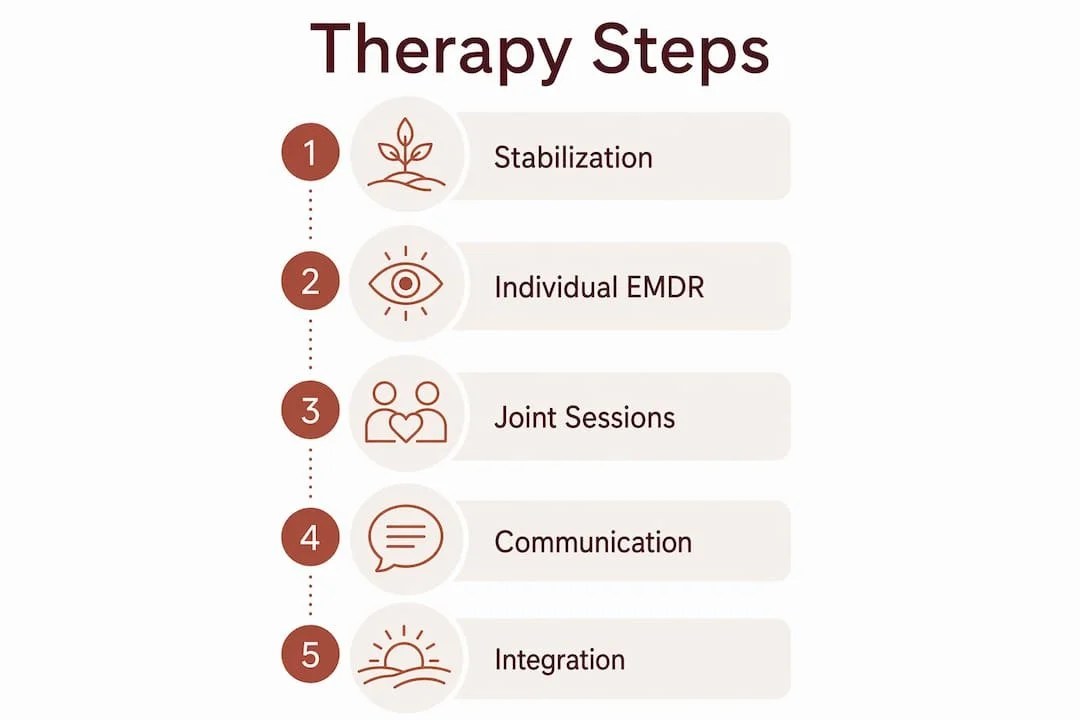
Effective trauma-informed couples therapy avoids retraumatization by following a deliberate sequence: stabilization first, safe relational exploration second, and trauma reprocessing only after both conditions are met. Skipping this order is one of the most common mistakes in couples work, and it can make things significantly worse.
Here is how the clinical sequence typically unfolds:
Individual stabilization. Before joint sessions address trauma directly, each partner builds grounding and affect regulation skills. Individual EMDR therapy prior to joint sessions lowers activation levels, making couples therapy safer and more productive. Many couples benefit from months of this individual work before moving forward together.
Establishing relational safety. The therapist helps both partners identify their triggers and create agreements about how to slow down or pause when sessions become overwhelming. The EMDR with Couples protocol emphasizes relational safety before trauma targeting and understanding before intervention.
Paced emotional exploration. Using EFT principles, the therapist guides partners toward turning into vulnerability rather than away from it. EFT shifts partners from reactive survival patterns to turning toward each other during emotional moments. This is the foundation of secure attachment.
Shared understanding and validation. Each partner learns to see the other's reactions as trauma responses, not personal attacks. This reframe disrupts the cycle of escalation and withdrawal.
Trauma reprocessing. With safety and understanding in place, deeper trauma work, including EMDR reprocessing, can proceed without triggering survival responses in either partner.
Pro Tip:If you are beginning couples therapy and one or both of you carries significant trauma history, ask your therapist explicitly whether individual stabilization work is part of the plan. Starting joint trauma processing too early is a known risk factor for retraumatization.
Trauma-informed therapy integrates EMDR, CBT, and EFT to address both trauma and relational dynamics at the same time. That integration is what separates it from standard couples counseling, which typically focuses on communication skills without addressing the nervous system patterns underneath.
How can couples practice healing trauma together at home?
Therapy sessions are typically one hour per week. The other 167 hours belong to you. What you do in that time shapes how quickly and deeply healing progresses.
These strategies support connection and emotional safety between sessions:
Use a "pause and name" protocol. When tension rises, one partner says "I'm getting activated" rather than pushing through. This signals the nervous system to slow down before the conversation escalates.
Practice co-regulation. Sit close, synchronize breathing, or make brief physical contact during calm moments. Co-regulation is the process by which one nervous system helps settle another. It is one of the most direct ways partners support each other's healing.
Create a daily check-in ritual. A five-minute structured conversation, using prompts like "One thing I appreciated today" and "One thing I need tonight," builds the habit of emotional attunement without requiring big vulnerability.
Learn each other's triggers. Communication tips for couples healing from trauma consistently emphasize knowing your partner's specific triggers and responding with curiosity rather than defensiveness.
Repair quickly and specifically. After a rupture, a repair is most effective when it names what happened: "I raised my voice and I can see that scared you. I'm sorry." Generic apologies do not reach the nervous system the way specific ones do.
Pro Tip: Keep a shared "repair log" where both partners briefly note what caused a rupture and what helped resolve it. Over time, this becomes a personalized map of your relationship's healing patterns.
Supporting a partner through trauma also means knowing when to step back. You are not your partner's therapist. Your role is to be a safe, consistent presence, not to process their trauma for them. That distinction protects both of you.
What challenges do couples face during trauma recovery?
Trauma healing is not linear. Most couples hit a point where progress seems to reverse, and that moment is where many give up. Understanding the common obstacles in advance makes them far less destabilizing when they arrive.
The most frequent challenge is misreading a trauma trigger as a relationship problem. When one partner withdraws after a difficult session, the other often interprets it as rejection. In reality, withdrawal is usually a nervous system response to overwhelm, not a statement about the relationship. Recognizing this difference requires ongoing practice and, often, direct coaching from a therapist.
Emotional overwhelm is another consistent barrier. Vulnerability is genuinely frightening for people with trauma histories. Opening up can feel more dangerous than staying closed off, even when the relationship is safe. This is not resistance. It is the nervous system doing exactly what it learned to do.
"Healing after trauma is not about returning to who you were before. It is about building something new together, something more honest, more resilient, and more deeply connected than what existed before the wound."
Healing from trauma in couples is about creating a new, resilient relationship dynamic rather than returning to previous patterns. Growth shows up as more successful repairs, not as the absence of conflict. That reframe matters enormously when couples feel discouraged by setbacks.
Patience is not passive. It is an active choice to stay present through discomfort without demanding that healing move faster than it can. When overwhelm becomes unmanageable, or when one partner's trauma symptoms are significantly worsening, that is the signal to seek additional professional support rather than push through alone. PTSD effects on relationships can intensify during recovery before they improve, and a skilled clinician can help you distinguish normal difficulty from a sign that the current approach needs adjustment.
Key takeaways
Trauma recovery in couples succeeds when nervous system stabilization comes first, therapy follows a deliberate clinical sequence, and both partners commit to practicing safety and repair in daily life.
| Point | Details |
|---|---|
| Stabilization before processing | Nervous system regulation must come before joint trauma work to prevent retraumatization. |
| Individual work supports couples work | EMDR or stabilization therapy done individually makes joint sessions safer and more effective. |
| EFT builds secure attachment | Emotionally Focused Therapy helps partners turn toward vulnerability instead of reacting from survival mode. |
| Setbacks are part of healing | Nonlinear progress is normal; growth is measured by successful repairs, not the absence of conflict. |
| Daily practice accelerates recovery | Co-regulation, structured check-ins, and specific repair conversations build safety between therapy sessions. |
What i've learned watching couples do this hard work
The couples who make the most progress are rarely the ones with the least trauma. They are the ones who stop trying to win arguments and start getting curious about what is underneath them. That shift, from "you are the problem" to "we are both responding to pain," is where real healing begins.
What I see most often in trauma-impacted relationships is a profound mismatch between intent and impact. One partner reaches out and the other flinches. One partner goes quiet to protect the other and the other feels abandoned. Neither person is wrong. Both are responding from a nervous system shaped by experiences that happened long before this relationship existed.
The clinical frameworks matter. EMDR, EFT, and trauma-informed sequencing are not interchangeable with general couples counseling. But the frameworks only work when both partners are willing to be seen, even when being seen feels terrifying. That courage is not something a therapist can give you. It is something you choose, repeatedly, in small moments.
Healing trauma in relationships does not mean erasing the past. It means building a present that is no longer controlled by it. That is genuinely possible, and the couples who do this work consistently describe their relationships as stronger and more honest than they were before trauma entered the picture. Post-traumatic growth for couples is real. It requires collaboration, honesty, and the willingness to stay when staying is hard.
— Juiced
Ready to start healing together? Alvaradotherapy can help
Alvaradotherapy is a California-based trauma-informed practice with licensed therapists specializing in EMDR, couples therapy, and complex trauma. The team serves clients in Pasadena, Ventura, and online throughout California, with bilingual care available in English and Spanish.
If you and your partner are ready to move from survival mode to genuine connection, Alvaradotherapy offers online couples therapy designed specifically for trauma-impacted relationships. For those carrying significant individual trauma, EMDR trauma therapy provides the stabilization foundation that makes couples work safer and more effective. Seeking professional support is not a sign that your relationship has failed. It is a sign that you are serious about building something better.
FAQ
What is trauma-informed couples therapy?
Trauma-informed couples therapy is a clinical approach that addresses the nervous system dysregulation and survival-driven patterns trauma creates in relationships. It integrates frameworks like EMDR and EFT to build safety, regulate emotional responses, and support deeper connection.
How does EMDR help with couples trauma recovery?
Individual EMDR therapy lowers each partner's activation levels before joint sessions begin, making couples therapy safer and reducing the risk of retraumatization. It processes the root trauma memories that drive reactive patterns in the relationship.
Can both partners have trauma and still heal together?
Yes. When both partners carry trauma, the therapy sequencing simply requires more careful pacing. Individual stabilization work for each partner typically precedes joint processing, and EFT principles help both people build the secure attachment needed for shared healing.
How long does trauma recovery in couples take?
There is no fixed timeline. Many couples benefit from months of individual stabilization before beginning joint trauma work. Progress is measured by the quality and frequency of successful repairs, not by the absence of difficult moments.
What is the difference between trauma bonding and healing trauma together?
Trauma bonding refers to a psychological attachment formed through cycles of abuse and intermittent reinforcement, often in harmful relationships. Healing trauma together describes two partners in a safe relationship working collaboratively to process past wounds and build a healthier dynamic.
