
PTSD Effects on Relationships: What You Need to Know
TL;DR:
PTSD significantly damages relationships by impairing emotional connection, trust, and intimacy through symptoms like emotional numbness and hypervigilance. Recent research indicates that rebuilding mentalization and playfulness is crucial for improving relationship quality, beyond just symptom management. Understanding and addressing these mechanisms are essential steps for couples healing from trauma.
Post-traumatic stress disorder (PTSD) is defined clinically as a trauma response that fundamentally alters how a person connects, communicates, and trusts within their closest relationships. The PTSD effects on relationships are not subtle. Symptoms like emotional numbing, hypervigilance, irritability, and avoidance directly erode the safety, trust, and intimacy that healthy partnerships depend on. Research published in 2026 identifies mentalization and playfulness as two critical mediators between PTSD symptoms and relationship quality, offering a more targeted path to healing than symptom reduction alone. Whether you are living with PTSD or loving someone who is, understanding these mechanisms is the first step toward rebuilding genuine connection.
How do PTSD symptoms specifically disrupt relationship dynamics?
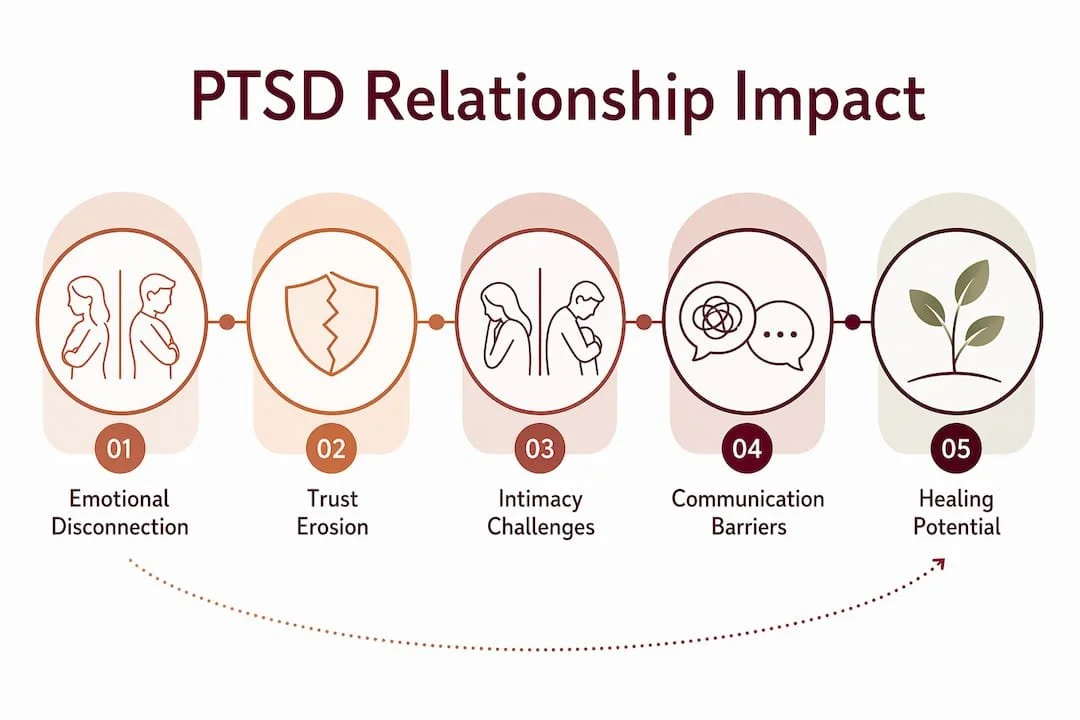
PTSD disrupts essential relationship pillars including safety, trust, respect, and intimacy, frequently causing both physical and emotional distancing between partners. These disruptions are not character flaws or failures of love. They are predictable neurological and psychological responses to unresolved trauma.
The most common symptoms that strain relationships include:
Emotional numbing and avoidance. When the nervous system shuts down to protect itself, warmth and affection become difficult to access. Partners often interpret this withdrawal as rejection, even when the person with PTSD is simply trying to survive internally.
Irritability and anger. Trauma keeps the brain in a state of threat detection. Small frustrations can trigger disproportionate reactions, creating a cycle of conflict that leaves both partners feeling unsafe.
Insomnia and hypervigilance. Chronic sleep disruption and constant alertness reduce the capacity for patience, humor, and emotional generosity. These are the exact qualities that sustain long-term relationships.
Avoidance of shared activities. Symptoms like irritability and emotional numbing reduce shared pleasurable activities, which are the connective tissue of any partnership. When couples stop doing things together that feel good, disconnection accelerates.
The result is a self-reinforcing cycle. The person with PTSD withdraws to manage overwhelming internal states. Their partner feels shut out and either pursues harder or also withdraws. Both people end up lonelier than before, and neither fully understands why.
Pro Tip: If you notice yourself pulling away from your partner during stress, try naming it out loud. "I'm feeling overwhelmed right now and I need 20 minutes" is far less damaging than silent withdrawal.

What do recent studies reveal about PTSD and relationship quality?
A 2026 study published in Frontiers in Psychology provides the clearest picture yet of how complex PTSD (C-PTSD) undermines relationship quality. Understanding the difference between PTSD and C-PTSD matters here, because C-PTSD involves more pervasive disruptions to identity and emotional regulation that compound relational harm.
The study found that C-PTSD negatively affects relationship quality with a standardized coefficient of β = -0.35, and that this effect is largely explained by two mediating factors: mentalization (β = -0.72) and playfulness (β = -0.65). This means the damage PTSD does to relationships runs primarily through these two channels, not just through symptom severity alone.
| Mediator | Effect on relationship quality | What it means in practice |
|---|---|---|
| Mentalization | Accounts for 27% of the effect | Difficulty understanding your own and your partner’s emotional states leads to misreads and conflict |
| Playfulness | Accounts for 18% of the effect | Loss of lightness and spontaneity removes a key source of bonding and repair |
| Combined effect | 45% of total impact explained | Nearly half of PTSD’s relational damage flows through these two pathways |
The practical implication is significant. Reducing PTSD symptoms alone often does not improve relationship quality. Couples need targeted work on rebuilding the capacity to understand each other and to experience joy together. Symptom management is necessary but not sufficient.
"Healing relationships impacted by PTSD requires both symptom management and specific efforts to rebuild mentalization and playfulness in interactions." — Frontiers in Psychology, 2026
This reframes what recovery looks like. It is not just about reducing flashbacks or managing anxiety. It is about rebuilding the cognitive and emotional infrastructure that allows two people to truly see each other.
How does PTSD affect intimacy and trust in couples?
PTSD and intimacy issues are among the most painful and least discussed consequences of trauma. Emotional numbing, avoidance, and irritability significantly reduce both emotional and physical intimacy, creating a gap that partners often struggle to name or address.
The specific ways PTSD undermines intimacy and trust include:
Hypervigilance and fear of rejection. When the brain is constantly scanning for danger, vulnerability feels genuinely threatening. Opening up emotionally to a partner requires a felt sense of safety that trauma disrupts at a neurological level.
Ambiguous loss. Partners may feel helpless or frustrated when their loved one is physically present but psychologically absent. This experience, sometimes called ambiguous loss, complicates caregiving roles and creates grief without a clear source.
Communication breakdowns. Trauma survivors often struggle to articulate their internal states, not because they are unwilling, but because trauma affects the brain regions responsible for language and self-awareness. This makes conflict resolution harder and misunderstandings more frequent.
Reduced respect and increased contempt. Chronic conflict and emotional unavailability can erode the baseline respect that holds relationships together. Research by the Gottman Institute identifies contempt as the single strongest predictor of relationship dissolution.
The good news is that partner understanding and validation of PTSD severity actively promotes healing and relational well-being. When a partner says "I see how hard this is for you" rather than "why can't you just move on," it shifts the relational dynamic from adversarial to collaborative.
What communication and coping strategies help couples manage PTSD effects?
Healing relationships after PTSD is possible, but it requires deliberate effort from both partners. The following strategies are grounded in current clinical evidence and address the specific mechanisms that PTSD disrupts.
Name your triggers before they escalate. Recognizing the early signs of a trauma response, such as a racing heart, sudden irritability, or the urge to shut down, gives you a window to communicate before the reaction takes over. Saying "I think I'm getting triggered" is a skill that takes practice but dramatically reduces conflict.
Practice mentalization daily. Mentalization means asking yourself: what is my partner feeling right now, and why? It also means checking your own assumptions. Trauma distorts perception, so what feels like rejection may be your partner simply being tired. The PTSD in relationships guide from Alvarado Therapy offers concrete exercises for building this capacity.
Reintroduce playfulness intentionally. Given that playfulness accounts for 18% of PTSD's relational impact, rebuilding it is not optional. Schedule low-stakes activities that have no agenda: a walk, a board game, cooking together. The goal is shared positive experience, not deep emotional processing.
Learn co-regulation techniques together. Co-regulation between partners can regulate the nervous system and improve emotional connection even during difficult moments. This includes synchronized breathing, physical touch when safe and welcome, and calm, slow speech during conflict.
Seek evidence-based therapy early. Couple satisfaction is higher when the person with PTSD is actively engaged in professional treatment. Approaches like EMDR, trauma-focused cognitive behavioral therapy (TF-CBT), and trauma-informed couples counseling address both individual symptoms and relational functioning simultaneously.
Pro Tip: Use the 7 communication tips from Alvarado Therapy as a starting framework. Reading them together with your partner creates a shared language for navigating hard conversations.
The PTSD communication challenges that feel most impossible, such as talking about triggers, expressing needs, or repairing after conflict, are exactly the skills that therapy builds. You do not have to figure this out alone.
Key takeaways
PTSD damages relationships primarily through disrupted mentalization and playfulness, not symptom severity alone. Targeting these two pathways is the most direct route to relational recovery.
| Point | Details |
|---|---|
| Symptoms cause disconnection | Emotional numbing, avoidance, and irritability reduce shared positive experiences and increase relational distance. |
| Mentalization is the biggest mediator | Impaired ability to understand your own and your partner’s emotions accounts for 27% of PTSD’s relational impact. |
| Playfulness matters more than expected | Loss of lightness and spontaneity explains 18% of relationship quality decline in couples affected by PTSD. |
| Partner validation accelerates healing | When partners acknowledge PTSD severity with empathy rather than frustration, relational well-being improves measurably. |
| Therapy works best when started early | Couples who pursue evidence-based treatment early in the process report higher satisfaction and better relational outcomes. |
What working with trauma-affected couples has taught me
The most common misconception I see is that PTSD is a problem one person has and the other person simply tolerates. That framing sets both partners up to fail. Trauma lives in the nervous system, but it plays out in the space between two people. The relationship itself becomes a site of both wounding and healing.
What actually moves the needle is not grand gestures or perfect communication. It is the small, repeated choice to stay curious about your partner instead of certain. Certainty in a trauma-affected relationship usually means "I know you're going to hurt me" or "I know this is going to go badly." Curiosity means "I wonder what's happening for them right now." That shift is mentalization in practice, and it changes everything.
I also want to be honest about something the research confirms but therapists sometimes soften: symptom reduction alone is not enough. You can get your PTSD under better control and still have a struggling relationship if you have not rebuilt the capacity for play, humor, and genuine emotional attunement. Those are not luxuries. They are the architecture of lasting connection.
The path forward requires patience, and it requires both people to be willing to grow. That is hard. It is also completely possible with the right support.
— Alvaradotherapy
Ready to rebuild connection with professional support?
If the impact of PTSD on your relationship feels overwhelming, you do not have to work through it without guidance. Alvarado Therapy is a California-based, trauma-informed practice with licensed therapists who specialize in exactly this intersection of trauma and relational healing.
Whether you are looking for individual trauma therapy or couples therapy for trauma recovery, Alvarado Therapy offers EMDR Intensives, trauma-informed couples counseling, and bilingual care in English and Spanish. Services are available in Pasadena, Ventura, and online throughout California. If you are ready to take the first step, explore what to expect in therapy or book a consultation to find the right fit for your needs.
FAQ
What are the main PTSD effects on relationships?
PTSD disrupts the core pillars of healthy relationships, including safety, trust, intimacy, and communication, through symptoms like emotional numbing, hypervigilance, and avoidance. These symptoms reduce shared positive experiences and increase emotional distance between partners.
Can a relationship survive PTSD?
Yes. Research shows that couples who pursue evidence-based therapy early report higher satisfaction and improved relational functioning. Healing requires targeted work on both symptom management and rebuilding mentalization and playfulness.
How does PTSD affect intimacy specifically?
PTSD and intimacy issues are closely linked because hypervigilance makes vulnerability feel threatening, and emotional numbing reduces both physical and emotional closeness. Partners often experience this as rejection even when the person with PTSD is simply managing an overwhelmed nervous system.
What is mentalization and why does it matter for couples?
Mentalization is the ability to understand your own and your partner's emotional states accurately. A 2026 study found that impaired mentalization accounts for 27% of the negative effect C-PTSD has on relationship quality, making it one of the most important skills to rebuild in therapy.
How can partners support someone with PTSD without burning out?
Partners who validate the severity of PTSD symptoms rather than minimizing them actively promote relational healing. Learning co-regulation skills together and setting clear boundaries around emotional capacity helps both people sustain the relationship without one person carrying the full weight.
