
A Practical Guide to Rebuilding Trust After Betrayal

TL;DR:
Rebuilding trust involves consistent transparency, accountability, and patience through a slow process of emotional repair. Essential steps include stabilizing mental health, setting protective boundaries, and acknowledging specific harm without defensiveness. Daily practices like honest communication, mindfulness, and rituals of connection support healing, while empathy for trauma responses fosters genuine progress.
Trust restoration is defined as the deliberate process of reestablishing emotional safety through transparency, accountability, remorse, and consistent behavior over time. This guide to rebuilding trust draws on clinical consensus from trauma-informed therapy and research published in Psychology Today and Positive Psychology to give you a clear, honest map of what recovery actually looks like. Rebuilding trust in relationships is not a single conversation or a grand gesture. It is slow, daily, and often uncomfortable work. The good news is that it is achievable when both partners commit to the process with honesty and patience.
What foundational steps are necessary before rebuilding trust?
Mental health stabilization and boundary setting are the prerequisite stages in any trust repair process. Skipping this foundation is like building on sand. Before any meaningful repair can begin, both partners need to feel physically and emotionally safe enough to engage.

The first step is stabilizing your mental health. Acute anxiety, depression, or trauma responses make honest dialogue nearly impossible. Working with a therapist, practicing grounding techniques, or even temporarily reducing contact can create enough calm to move forward.
Boundaries come next, and they are protective, not punitive. A boundary is not a punishment for the offending partner. It is a structure that allows the hurt partner to stay in the relationship without constantly re-experiencing the original wound. For example, agreeing that phones are accessible and that whereabouts are shared openly is a boundary that creates safety, not surveillance.
Acknowledging the harm is the third prerequisite, and it requires the offending partner to resist every defensive impulse. Defensive posturing is the primary obstacle to restoring emotional safety. Saying "I understand why you're hurt" without adding "but you have to understand my side too" is harder than it sounds, and it matters more than almost anything else in the early stages.
Stabilize mental health before attempting deep repair conversations
Set protective boundaries that create safety for both partners
Acknowledge the specific harm caused without minimizing or deflecting
Separate contributing factors from personal accountability. Context can be shared, but it cannot replace ownership.
Pro Tip: Write down the specific harm you caused before your first accountability conversation. Reading it aloud to your partner, without editing or softening, signals genuine remorse far more powerfully than improvised words.
Which concrete daily practices help rebuild trust effectively?
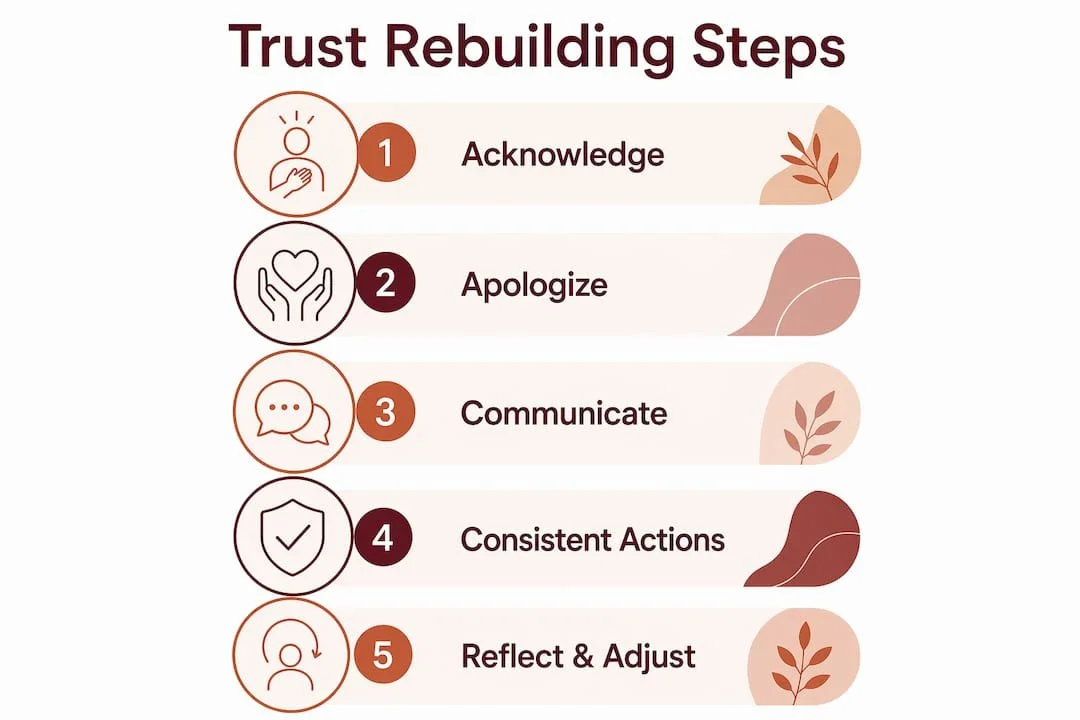
Trust is not restored by stopping harmful behavior alone. Unless the secrecy system is replaced with a communication system, the emotional chasm persists regardless of how well someone behaves. This is one of the most counterintuitive insights in trust repair, and it changes everything about how you approach daily practice.
Here are four research-backed practices to implement every day:
Five-minute mindfulness check-in. Spend five minutes each morning with focused breathing and honest self-reflection. Ask yourself: "Am I carrying anything today that my partner deserves to know?" This practice builds self-awareness and catches internal shifts before they become secrets. Mindfulness and self-awareness exercises prescribed by therapists are consistently linked to stronger trust recovery outcomes.
One honest daily conversation. Before any situation arises that could trigger old patterns, have a brief, proactive check-in with your partner. Share your plans, your feelings, and anything that feels uncomfortable to say. Discomfort is a signal that the conversation is necessary, not optional.
Transparent sharing of schedules and decisions. This does not mean surrendering privacy forever. It means, during the repair period, choosing openness over convenience. Text when you arrive somewhere. Share calendar access. These small acts accumulate into a new pattern of reliability.
Rituals of connection and gratitude. End each day by naming one thing you appreciate about your partner. This is not toxic positivity. It is a deliberate reorientation of attention toward what is being built rather than only what was broken. Couples therapy research consistently shows that rituals of connection accelerate emotional repair.
Pro Tip: Set a shared calendar reminder for your daily check-in at the same time each day. Consistency in timing signals reliability, which is exactly what trust is built on.
How to navigate emotional challenges after deeper betrayals like infidelity?
Betrayal trauma is a recognized psychological response to violations of trust by someone in a close relationship, and it produces symptoms that closely resemble PTSD, including hypervigilance, intrusive thoughts, and emotional numbness. Understanding this framing changes how both partners interpret the hurt partner's reactions.
Hypervigilance after betrayal is a survival mechanism, not manipulation or weakness. When a hurt partner checks a phone repeatedly or asks the same question multiple times, that behavior comes from a nervous system trying to prevent further harm. Meeting it with empathy rather than frustration is one of the most powerful things an offending partner can do.
The offending partner's role here is to remain emotionally present without becoming defensive. This requires genuine vulnerability. Saying "I see how much pain I caused, and I'm not going anywhere" is not weakness. It is the foundation of repair.
"Rebuilding trust is not a single conversation or apology but a slow, non-linear process needing consistent presence with the partner's pain." — Psychology Today
Using metaphors and emotional language helps couples move from accusation to shared understanding. One clinical approach involves asking each partner to describe the betrayal using an image or metaphor. One partner might say, "It felt like the floor disappeared." The other responds to that image rather than to the accusation, which shifts the conversation from blame to empathy.
Recognize hypervigilance as a trauma response, not a character flaw
Offer consistent emotional presence without defensiveness or withdrawal
Use metaphor and imagery to move difficult conversations toward empathy
Accept that healing trust after betrayal is an investment requiring patience and real change
Understand that progress will not be linear. Some days will feel like regression, and that is normal.
What communication strategies support rebuilding and maintaining trust?
Communication is the mechanism through which trust is either rebuilt or repeatedly broken. The quality of your conversations matters more than their frequency. Effective communication includes admitting mistakes openly, expressing gratitude, accepting influence from your partner, and maintaining emotional responsiveness across time.
The table below contrasts communication patterns that damage trust with those that repair it:
| Damaging pattern | Repairing pattern |
|---|---|
| Justifying the harmful behavior | Owning the behavior without explanation |
| Deflecting with "you always" or "you never" | Staying focused on the specific incident |
| Shutting down when emotions escalate | Staying present and naming your own feelings |
| Promising change without behavioral follow-through | Making small, specific commitments and keeping them |
| Minimizing the hurt partner's pain | Validating the pain before offering any perspective |
Accepting influence is a concept from the Gottman Institute's research on couples and it means genuinely allowing your partner's perspective to change your thinking. When a hurt partner says "I need more check-ins this week," the repairing response is not "that seems excessive" but "okay, let's figure out what that looks like." That shift from resistance to receptivity is what steps to regain trust look like in practice.
Integrity in dialogue means your words and actions match. If you say you will call at 6 p.m., you call at 6 p.m. If you cannot, you communicate proactively. These small alignments are the building blocks of restored credibility.
How to recognize progress and avoid common pitfalls when rebuilding trust?
Trust grows when pain is met without defensiveness or withdrawal. Progress in trust repair does not look like the absence of hard conversations. It looks like hard conversations that end with both partners feeling heard rather than defeated.
Signs of genuine progress include the hurt partner initiating positive interactions, a reduction in the frequency or intensity of hypervigilant behaviors, and the offending partner proactively sharing information without being asked. These are not dramatic milestones. They are quiet shifts that accumulate over weeks and months.
Red flags that signal stagnation include repeated defensiveness when accountability is requested, refusal to engage in agreed-upon transparency practices, and minimizing the hurt partner's ongoing pain. If these patterns persist, professional support is not optional. It is necessary.
Celebrate small repair moments, not just major milestones
Watch for defensive behaviors as early warning signs of regression
Accept that fluctuating emotions are part of the process, not evidence of failure
Avoid expecting a fixed timeline. Trust restoration techniques work on the relationship's schedule, not yours.
Pro Tip: Keep a brief weekly log of positive repair moments, such as a conversation that went well or a commitment that was kept. Reviewing it during difficult weeks provides concrete evidence that progress is real.
Key takeaways
Rebuilding trust requires replacing secrecy with a consistent communication system, taking full accountability without defensiveness, and showing up with empathy and patience through a non-linear healing process.
| Point | Details |
|---|---|
| Transparency over silence | Replace secrecy with proactive daily communication to close the trust gap. |
| Accountability without deflection | Acknowledge specific harm caused without minimizing, justifying, or redirecting blame. |
| Hypervigilance as trauma | Treat the hurt partner's vigilance as a survival response, not manipulation, and respond with empathy. |
| Consistency builds credibility | Small, repeated actions that align words and behavior rebuild trust faster than grand gestures. |
| Progress is non-linear | Expect setbacks, celebrate small wins, and seek professional support when patterns stagnate. |
What I've learned about trust repair that most articles won't tell you
Most content on how to rebuild trust focuses on the offending partner's behavior, and that focus is correct but incomplete. What I've observed, both through clinical work and in the research, is that the hurt partner also carries a hidden burden: the pressure to "get over it" on a timeline that feels reasonable to everyone except them.
The clinical reality is that remorse, repentance, and active recompense are all required from the offending partner. But the hurt partner needs permission to grieve at their own pace without being made to feel that their pain is an obstacle to progress. Those two truths have to coexist.
The other thing most guides understate is how much the offending partner's internal work matters. Behavioral compliance without genuine remorse is detectable. Partners sense when transparency is performative rather than sincere. The daily mindfulness practice described earlier is not just a communication tool. It is a way of developing the self-awareness needed to show up with real honesty rather than managed appearances.
Trust repair is one of the most demanding things two people can attempt together. It requires vulnerability from both sides, patience with a process that does not follow a schedule, and the courage to stay present with discomfort rather than retreat into old patterns. The couples who succeed are not the ones who never slip. They are the ones who repair quickly, honestly, and without shame.
— Alvaradotherapy
Professional support for rebuilding trust
Rebuilding trust after betrayal is work that benefits enormously from professional guidance. At Alvaradotherapy, licensed therapists offer online couples therapy specifically designed for partners navigating betrayal, communication breakdown, and trauma responses. For individuals carrying deeper wounds, EMDR trauma therapy addresses the nervous system patterns that make trust repair feel impossible without clinical support. Serving clients across Pasadena, Ventura, and throughout California via telehealth, Alvaradotherapy provides bilingual, trauma-informed care in both English and Spanish. If you are ready to move from surviving the betrayal to genuinely rebuilding, schedule a consultation and take the first concrete step.
FAQ
What does rebuilding trust actually require?
Trust restoration requires remorse, repentance, and active recompense from the offending partner, combined with consistent transparency and open communication over time. Stopping harmful behavior alone is not sufficient.
How long does it take to rebuild trust after betrayal?
There is no fixed timeline. Research confirms that trust repair is a non-linear process measured in months to years, depending on the severity of the betrayal and the consistency of repair efforts.
What is the biggest obstacle to rebuilding trust?
Defensive posturing is the primary obstacle to restoring emotional safety. When the offending partner deflects, minimizes, or justifies the harm, the hurt partner's nervous system cannot begin to relax into safety.
Can trust be rebuilt after infidelity specifically?
Yes, but it requires both partners to engage with the trauma responses involved, including hypervigilance and intrusive thoughts, with empathy and patience rather than frustration. Professional couples therapy significantly improves outcomes.
What role does mindfulness play in trust repair?
Daily mindfulness practice builds the self-awareness needed to catch internal shifts before they become secrets, and it supports the emotional regulation required for honest, non-defensive conversations with a partner.
