
How Does Couples Counseling Help Your Relationship

TL;DR:
Couples counseling is an evidence-based process that improves communication, resolves conflict, and rebuilds emotional bonds. It teaches structured skills like listening, repair attempts, and cycle identification to transform harmful interaction patterns. Early engagement and therapist specialization significantly enhance outcomes, making therapy a proactive tool for lifelong relationship health.
Couples counseling is a structured, evidence-based therapeutic process that helps partners improve communication, resolve conflict, and rebuild emotional connection. The formal clinical term is couples therapy, and it draws on proven models like Emotionally Focused Therapy (EFT) and the Gottman Method to change the patterns that keep relationships stuck. Research shows 70% to 80% of couples report meaningful improvement after completing evidence-based therapy. That figure holds at two-year follow-up, meaning the gains are not temporary. If you are wondering whether counseling can actually move the needle for your relationship, the short answer is yes, and the longer answer is what this article is about.
How does couples counseling help communication and conflict?
Most couples do not struggle because they stopped loving each other. They struggle because they lack the tools to communicate safely under pressure. Counseling reframes partners as allies fighting a shared pattern, not opponents fighting each other. That single shift changes everything about how sessions feel and what becomes possible.

Therapists trained in the Gottman Method and EFT teach specific, repeatable skills that couples can use outside the therapy room. These are not vague suggestions. They are structured techniques with clear steps.
The core skills taught in counseling include:
Structured listening. One partner speaks without interruption while the other reflects back what they heard before responding. This slows the conversation enough to prevent the defensive spiral that shuts dialogue down.
Repair attempts. These are small, immediate actions taken during a conflict to reduce tension before it escalates. A repair attempt can be as simple as saying "I need a minute" or touching your partner's hand. Repair attempts and structured listening are among the most researched tools in couples work.
Identifying negative cycles. Therapists help couples name their pattern, whether it is pursue-withdraw, attack-defend, or the Gottman Method's "Four Horsemen" (criticism, contempt, defensiveness, stonewalling). Naming the cycle makes it visible and therefore interruptible.
Translating complaints into needs. A complaint like "you never listen to me" usually carries an underlying emotional need for connection or respect. Counselors teach couples to surface that need directly instead of leading with blame.
Pro Tip: Before your first session, each partner should write down one recurring argument and one thing they wish their partner understood about them. Bringing that into the room gives the therapist a concrete starting point and saves weeks of circling.
Learning these skills is not about becoming a perfect communicator overnight. It is about having a shared language and a set of moves you both recognize, so conflict becomes a problem you solve together rather than a wound you keep reopening. For a deeper look at how conflict resolution in counseling works in practice, Alvaradotherapy's resource library covers the mechanics in detail.
What therapy approaches actually work?
Not all couples therapy is the same. The model your therapist uses matters, and understanding the differences helps you ask better questions when choosing a provider.
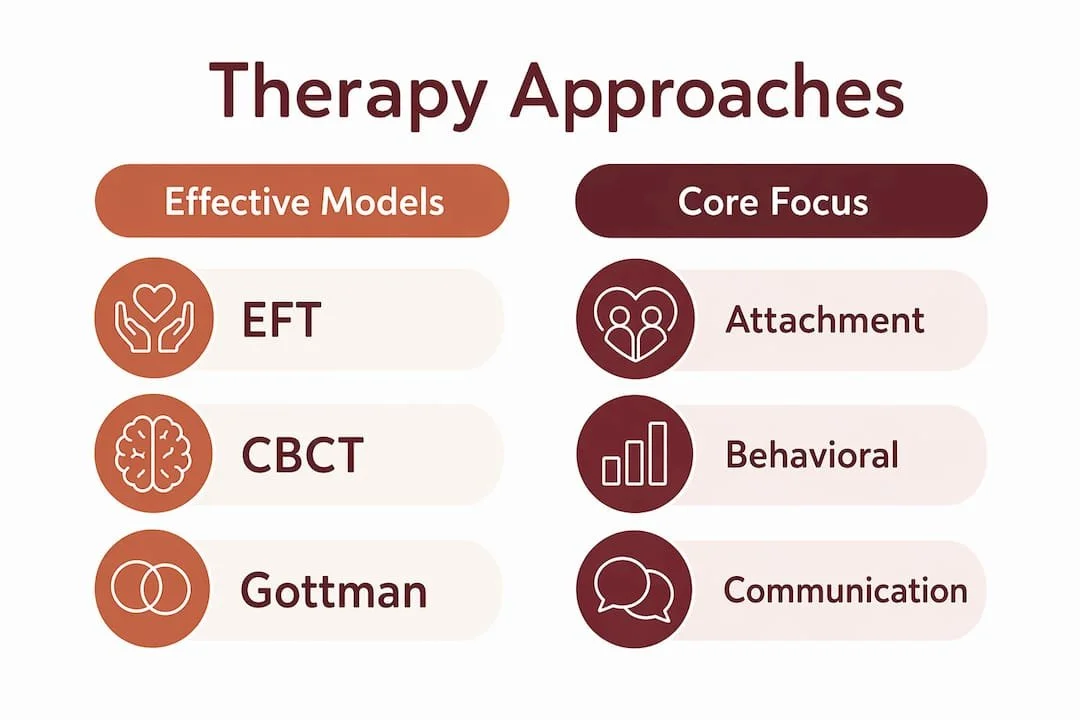
| Approach | Core Focus | Evidence Strength | Best For |
|---|---|---|---|
| Emotionally Focused Therapy (EFT) | Attachment and emotional responsiveness | 70–75% recovery rate | Emotional disconnection, attachment injuries |
| Gottman Method | Communication skills and conflict management | Strong research base | Recurring arguments, contempt patterns |
| Cognitive Behavioral Couples Therapy (CBCT) | Cognitive and behavioral patterns | Effective for targeted issues | Anxiety-driven conflict, specific behavioral problems |
| Discernment Counseling | Decision-making for ambivalent couples | Specialized use | Couples unsure whether to stay or separate |
EFT, developed by Dr. Sue Johnson, produces some of the strongest outcomes in the field. Its 70 to 75% recovery rate reflects its focus on the emotional bond beneath surface arguments. When partners feel securely attached, the arguments that once felt catastrophic become manageable. The Gottman Method, built on decades of observational research by Drs. John and Julie Gottman, targets the specific communication behaviors that predict relationship breakdown. Both approaches are well-suited to the trauma-informed framework that practices like Alvaradotherapy use with couples.
Cognitive Behavioral Couples Therapy works well when one or both partners bring anxiety, rigid thinking patterns, or specific behavioral issues into the relationship. Discernment Counseling is a short-term model designed not to save the relationship but to help ambivalent couples make a clear, informed decision about their future.
Pro Tip: Ask any prospective therapist directly: "What model do you use with couples, and what training have you completed in it?" A well-trained couples therapist will answer without hesitation. Vague answers about "an eclectic approach" without named frameworks are a yellow flag.
You can review evidence-based therapy methods in more depth through Alvaradotherapy's blog, which breaks down what each approach looks like session by session.
How counseling helps rebuild trust after a rupture
Trust breaks in different ways. Infidelity is the most visible rupture, but emotional affairs, chronic emotional unavailability, and repeated broken promises cause equal damage over time. Counseling creates a structured path back to trust that does not rely on promises alone.
The process of trust repair in therapy rests on four consistent elements:
Accountability without minimizing. The partner who caused harm must own the full impact of their actions, not just their intentions. Saying "I didn't mean to hurt you" without acknowledging the actual hurt keeps the injured partner stuck.
Transparency and openness. Trust rebuilds through consistent patterns of safety over time, not through a single conversation. Transparency means making your actions legible to your partner during the repair period, even when it feels uncomfortable.
Preventing endless rehashing. One of the therapist's most important roles is to hold the container. Without structure, conversations about betrayal loop endlessly, re-traumatizing the injured partner without producing forward movement. A skilled therapist redirects the conversation toward what healing requires next.
Building new safety. Repeated, consistent behavior over months matters more than any single gesture. Counseling helps couples identify what safety looks and feels like for each partner specifically, because it is not the same for everyone.
Couples who have experienced infidelity or emotional affairs often find that what to expect from couples counseling is different from what they feared. Sessions are not about relitigating every detail. They are about creating enough safety for both partners to be honest and present.
When is couples counseling most effective?
Timing and engagement are the two variables that most reliably predict whether therapy works. Therapy is most effective when couples enter early, before resentment has calcified into contempt, and when both partners are genuinely willing to participate.
Here is what the research and clinical experience point to as the key success factors:
Early entry. Couples who seek counseling at the first signs of persistent conflict have significantly better outcomes than those who wait years. Resentment that has built over a decade is harder to shift than patterns that are six months old.
Mutual engagement. One partner dragging the other through sessions rarely produces lasting change. Both people need to show up willing to examine their own role in the dynamic, not just their partner's.
Therapist specialization. A therapist trained specifically in couples work produces better outcomes than a general practitioner who occasionally sees couples. Credentials to look for include training in EFT, Gottman Level 1 or 2 certification, or a specialization in relational therapy.
Safety as a prerequisite. Counseling is not appropriate in relationships where domestic violence or coercive control is present. In those situations, individual safety planning takes priority over couples work. A qualified therapist will screen for this before beginning joint sessions.
Clarity, not just repair. Therapy can also support amicable separation, reducing conflict and trauma, particularly when children are involved. Not every couple leaves therapy together, but most leave with more clarity and less damage than they came in with.
Counseling is also a strong tool during major life transitions. Retirement, new parenthood, career upheaval, and immigration all place stress on relationship dynamics that were working fine before. Therapy during life transitions is a proactive investment, not a sign that something is broken.
Pro Tip: If one partner is reluctant, a single individual session with a couples-trained therapist can help that person understand what the process actually involves. Fear of being blamed or ganged up on is the most common barrier. One honest conversation with a skilled therapist usually dissolves it.
Key takeaways
Couples counseling works because it replaces harmful interaction patterns with concrete skills, emotional safety, and a shared framework for conflict and connection.
| Point | Details |
|---|---|
| Therapy success rates are high | 70–80% of couples report meaningful improvement after evidence-based therapy, maintained at two years. |
| Skills are the core product | Repair attempts, structured listening, and cycle identification are the tools that change daily interaction. |
| Model matters | EFT and the Gottman Method have the strongest research backing; ask your therapist which they use. |
| Early entry improves outcomes | Couples who seek help before resentment becomes contempt have significantly better results. |
| Counseling is not only for crises | Therapy during life transitions and before major conflicts escalate is a proactive relationship investment. |
Why I think couples counseling is underused as a relationship tool
Most couples wait an average of six years after problems begin before seeking therapy. That statistic is not a judgment. It reflects how much stigma still surrounds asking for help, and how easy it is to believe that things will improve on their own.
What I have seen, working with couples at various stages, is that the couples who benefit most are not always the ones in crisis. They are the ones who come in saying "we are mostly fine, but we keep having the same argument and we want to understand why." Those couples leave with tools they use for decades. The couples who wait until contempt has set in face a harder road, though not an impossible one.
The framing that counseling is about "fixing" something broken is the wrong frame entirely. Most relationship conflicts stem from a lack of tools and safety, not a lack of love. Therapy gives you both the tools and the safety. What you do with them is yours.
One more thing worth saying: therapy is not neutral territory where the therapist decides who is right. A skilled couples therapist holds both partners' experiences with equal care. The goal is never to assign blame. It is to help you both see the pattern clearly enough to change it together.
— Juiced
Ready to take the next step with couples counseling?
If anything in this article resonated, the next step is simpler than it might feel right now. Alvaradotherapy offers couples therapy online for clients across California, with licensed therapists trained in trauma-informed, evidence-based approaches. Whether you are navigating a specific rupture, a recurring conflict, or simply want to strengthen your relationship before problems deepen, the practice provides structured support in both English and Spanish.
Sessions are available online, making it accessible regardless of where you are in California. Booking is straightforward through the Alvaradotherapy website, and the team is experienced with couples at every stage, from early friction to complex relational trauma.
FAQ
How does couples counseling help communication?
Couples counseling teaches structured listening, repair attempts, and cycle identification to replace reactive patterns with constructive dialogue. These skills give partners a shared language for conflict that reduces escalation and increases understanding.
Do couples really benefit from counseling?
Yes. 70% to 80% of couples report meaningful improvement after evidence-based therapy, with results maintained at two-year follow-up. Outcomes improve further when both partners engage fully and the therapist specializes in couples work.
Can therapy save a relationship after infidelity?
Therapy can support trust repair after infidelity through structured accountability, transparency, and rebuilding emotional safety over time. Recovery is possible, though it requires genuine commitment from both partners and a therapist experienced with betrayal trauma.
Is online couples therapy as effective as in-person?
Online couples therapy produces similar satisfaction and outcome improvements as in-person sessions, confirmed by multiple studies. It also removes barriers like scheduling conflicts and geographic distance, making it a practical option for many couples.
When should a couple seek counseling?
The earlier the better. Couples who enter therapy at the first signs of persistent conflict have significantly better outcomes than those who wait years. Counseling is also appropriate during major life transitions, not only during crises.
