How Does Couples Therapy Help Your Relationship
TL;DR:
Couples therapy is a structured, evidence-based process that improves communication and helps resolve conflicts. Approximately 70% of couples report meaningful improvements, demonstrating its effectiveness across various relationship challenges. Engaging early and both partners' active participation significantly enhances therapy outcomes and long-term relationship health.
Couples therapy is a structured, evidence-based process that helps partners improve communication, resolve conflicts, and rebuild emotional connection with the guidance of a licensed therapist. Research confirms that roughly 70% of couples who engage in evidence-based treatment report meaningful improvement in relationship satisfaction. That number matters because it tells you therapy is not a last resort. It is a proven clinical tool that works across a wide range of relationship challenges, from recurring arguments to trust repair after infidelity. Understanding how does couples therapy help, and what actually happens inside those sessions, gives you a real basis for deciding whether it fits your situation.
How does couples therapy help relationships improve?
Couples therapy, also called couples counseling, works because it replaces guesswork with structure. Harvard Health describes therapy as a supervised environment where partners work through conflict and communication challenges with professional support. That supervision is the key variable. Without it, most couples repeat the same argument patterns indefinitely, each partner convinced the other is the problem.
The core mechanisms that make therapy effective include:
Structured assessment. Early sessions map existing patterns before any problem-solving begins. Therapists using the Gottman Method, for example, conduct a joint session, separate individual interviews, and a feedback session before active intervention starts. This phased intake process prevents therapists from jumping to solutions before they understand the full picture.
Evidence-based models. Emotionally Focused Therapy (EFT), the Gottman Method, and Cognitive Behavioral Therapy (CBT) each have strong research support. EFT alone shows 70 to 75% recovery rates for couples in distress. These are not loosely defined talk sessions. They are structured clinical protocols.
Skill-building over venting. Therapy is more than a space to air grievances. Therapists guide partners toward constructive discussion and teach measurable skills including emotional regulation, conflict de-escalation, and clear expression of needs.
Both partners' engagement. Outcomes depend significantly on mutual commitment. When both partners genuinely want to improve the relationship, therapy works best and progress accelerates.
Pro Tip: If one partner is reluctant, a skilled therapist will spend early sessions building psychological safety rather than pushing for immediate change. Resistance is not a dealbreaker. It is data.
The benefits of couples therapy extend beyond crisis moments. Couples who enter therapy before patterns become entrenched tend to make faster progress and sustain gains longer.
How therapy teaches communication and reduces conflict
Communication breakdown is the most common reason couples seek help, and it is also where therapy delivers the most visible results. Harvard Health notes that therapy helps couples discuss difficult topics without escalation, a skill most people were never explicitly taught.
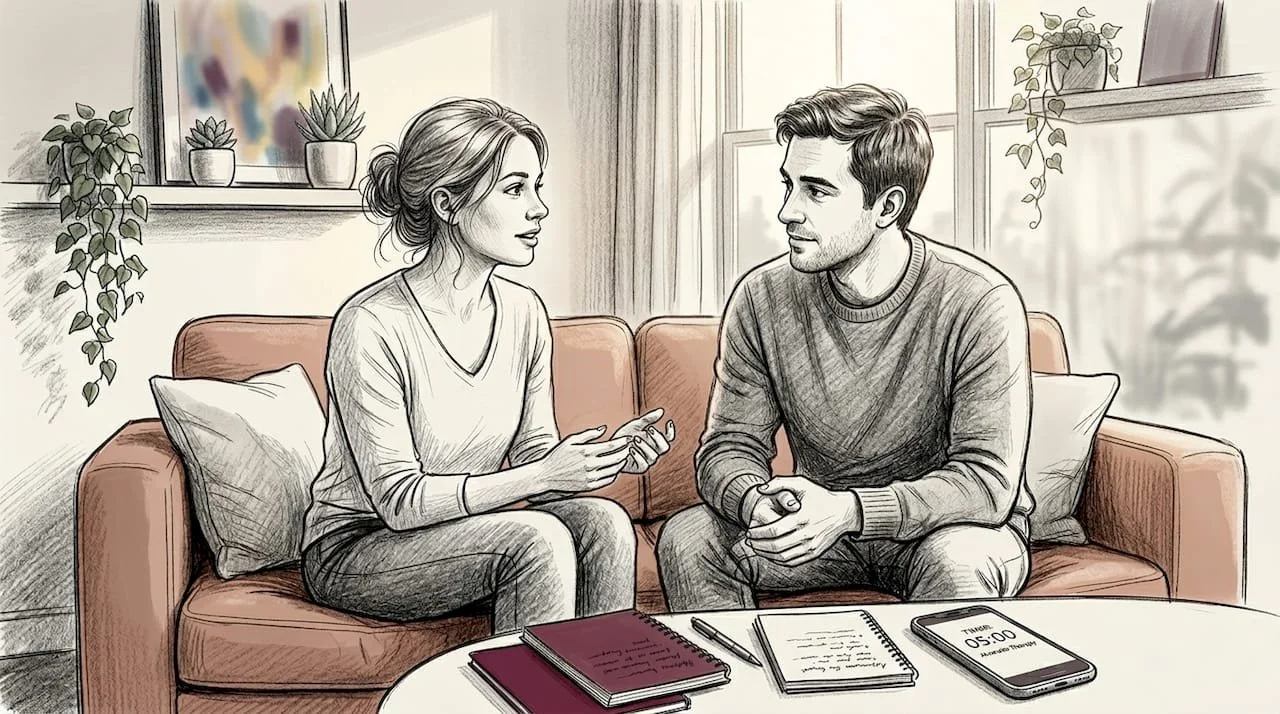
Here is how that process typically unfolds in sessions:
Identifying triggers. The therapist slows down a conflict in real time, asking each partner to name what they felt at specific moments. This interrupts the automatic escalation cycle and creates space for reflection.
Structured listening practice. Partners learn to listen without formulating a rebuttal. Techniques like reflective listening and the speaker-listener method give each person a defined role, which reduces the feeling of being talked over.
Assertive expression. Therapy teaches partners to express needs and emotions directly without blame. Replacing "You never listen" with "I feel unheard when I'm interrupted" changes the entire emotional register of a conversation.
Perspective-taking exercises. Therapists use guided exercises to help each partner articulate the other's point of view. This is particularly effective for couples who have developed rigid narratives about who is right and who is wrong.
In-session practice. New communication patterns are rehearsed inside the session, where the therapist can intervene, redirect, and reinforce. This real-time coaching is what separates therapy from self-help books.
The communication exercises couples practice in sessions are designed to transfer to daily life. Therapy is goal-focused with measurable progress, targeting clear feelings expression and emotional reconnection as concrete outcomes, not abstract ideals.
Pro Tip: Keep a short journal between sessions noting moments when you used a new communication skill, even imperfectly. Bringing those examples to your next session accelerates learning faster than any homework assignment.
What relationship challenges can couples therapy address?
Couples counseling is not reserved for relationships on the verge of collapse. It addresses a wide spectrum of challenges, many of which couples normalize until they become serious.
| Challenge | How therapy helps |
|---|---|
| Communication breakdowns | Teaches structured listening, assertive expression, and conflict de-escalation skills |
| Infidelity and trust repair | Guides partners through accountability, grief processing, and rebuilding trust step by step |
| Parenting and co-parenting conflict | Aligns values and creates shared decision-making frameworks for raising children |
| Intimacy and sexual disconnect | Addresses emotional distance and physical intimacy barriers in a clinically safe space |
| Major life transitions | Supports couples navigating job loss, relocation, illness, or loss of a loved one |
| Co-occurring mental health issues | Integrates awareness of anxiety or depression as relational factors, not just individual ones |
| Pre-marital preparation | Identifies potential conflict areas and builds communication tools before marriage begins |
The range here is significant. Couples often assume therapy is only for crisis situations, but pre-marital counseling and transition support are among the most effective uses of the process. Addressing patterns early, before they calcify into resentment, is consistently linked to better long-term outcomes. Early therapy engagement leads to faster progress precisely because conflict patterns have not yet become entrenched.
Trauma also plays a larger role in relationship difficulties than most couples recognize. When one or both partners carry unresolved trauma, it shapes how they interpret conflict, closeness, and safety. A trauma-informed approach, like the one used at Alvarado Therapy, accounts for this layer rather than treating relationship problems in isolation.
What to expect during the couples therapy process
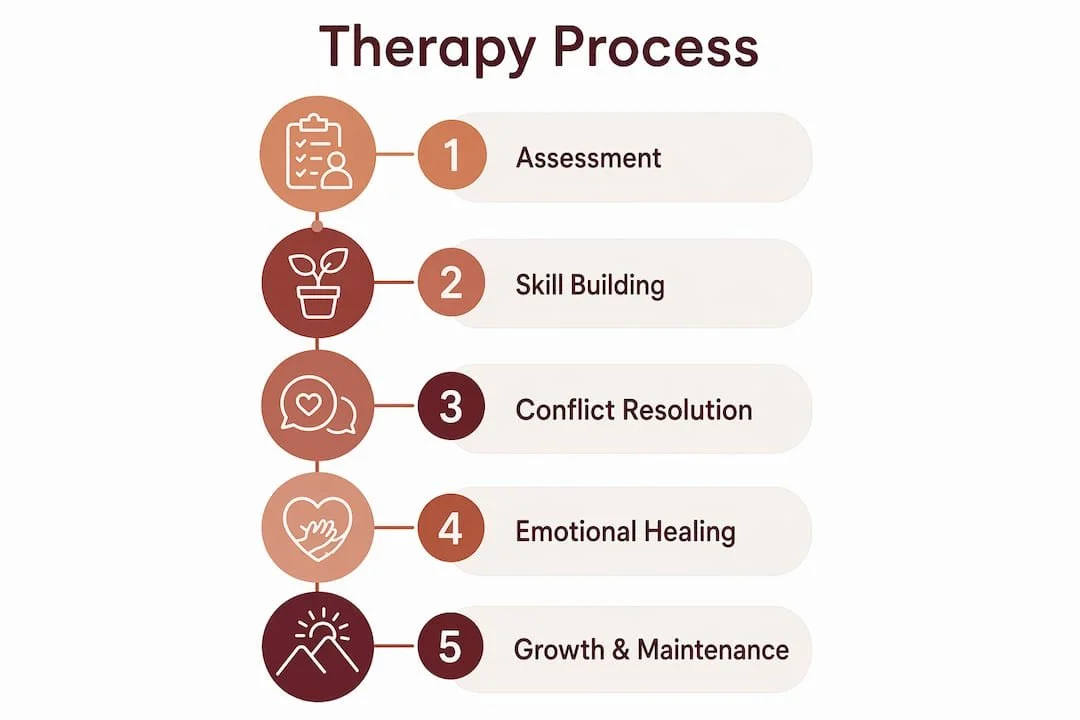
Knowing what actually happens in sessions removes a significant barrier for couples who feel uncertain about starting. The process is more structured than most people expect, and that structure is precisely what makes it effective.
Joint intake session. The first meeting typically involves both partners together. The therapist gathers background on the relationship history, current concerns, and each person's goals. This session establishes the working relationship and sets the tone for safety and respect.
Separate individual interviews. Most evidence-based approaches, including the Gottman Method, include individual sessions with each partner. These allow each person to share perspectives they might not voice in front of their partner, and they help the therapist understand each person's internal experience of the relationship.
Assessment tools. The Gottman Love Lab uses encrypted questionnaires and video recordings submitted separately by each partner to identify relationship dynamics that might not surface in conversation alone. This technology-supported assessment reveals misalignments that couples themselves often cannot see.
Feedback session. After the assessment phase, the therapist shares observed patterns, identifies strengths, and proposes a treatment focus. This session gives couples a clear map of where they are and where therapy is headed.
Active intervention phase. Subsequent sessions target specific skills and interaction patterns. This is where the real work happens: practicing new behaviors, processing difficult emotions, and building the habits that replace old conflict cycles.
Couples can also choose between traditional weekly sessions and concentrated intensives, which compress several weeks of work into a few days. Intensives suit couples with limited scheduling flexibility or those who want faster momentum. The couples counseling process at Alvarado Therapy follows this structured, goal-oriented model with licensed therapists trained in trauma-informed care.
Key takeaways
Couples therapy works because it replaces repeated, unproductive conflict cycles with structured, skill-based interventions guided by a licensed therapist.
| Point | Details |
|---|---|
| Proven effectiveness | Around 70% of couples show meaningful improvement after evidence-based therapy. |
| Structured process | Assessment, individual interviews, and feedback sessions precede active skill-building work. |
| Communication is the core skill | Therapy teaches listening, assertive expression, and real-time conflict de-escalation. |
| Wide range of challenges | Therapy addresses everything from infidelity to pre-marital preparation and life transitions. |
| Early engagement matters | Starting therapy before patterns harden leads to faster progress and longer-lasting results. |