
Relationship Challenges After Trauma: A 2026 Guide

TL;DR:
Trauma triggers nervous system responses that disrupt trust and intimacy in relationships. These patterns are protective, not signs of character flaws, and often intensify in safe relationships as the nervous system processes past wounds. Healing requires understanding these responses, supporting both partners, and combining individual trauma therapy with couples work.
Relationship challenges after trauma are defined by nervous system responses that disrupt trust, communication, and intimacy long after the original wound has passed. These responses are not character flaws or signs of a failing relationship. They are protective patterns the brain learned to survive danger, and they activate automatically in close partnerships. Clinical guidance from 2026 confirms that understanding these patterns is the first step toward changing them. Trauma, formally described in clinical settings as post-traumatic stress disorder (PTSD) or complex trauma, reshapes how people read safety, interpret others' intentions, and regulate emotion. Both partners feel the weight of this, often without knowing why.
What are the most common relationship challenges after trauma?
Trauma shows up in relationships through predictable emotional and behavioral patterns. Recognizing them is not about assigning blame. It is about understanding what the nervous system is doing and why.
Common signs include:
Emotional reactivity: A small disagreement triggers a response that feels catastrophic. The nervous system reads conflict as danger and responds accordingly.
Withdrawal and shutdown: One partner goes silent or physically leaves during stress. This is a freeze response, not indifference.
Misreading neutral cues: A partner's quiet mood gets interpreted as rejection or anger. The traumatized nervous system scans constantly for threat.
Repetitive arguments: The same fight happens over and over because the underlying nervous system pattern never gets resolved, only temporarily suppressed.
Mismatched stress tolerance: One partner can handle conflict calmly while the other becomes flooded. This gap creates chronic frustration on both sides.
These behaviors are nervous system protections, not reflections of decreased love or commitment. Logical reassurance often fails until the nervous system itself feels safe. That distinction matters enormously for how couples approach conflict.
Common signs of PTSD in relationships also include flashbacks, nightmares, fear, guilt, shame, and difficulties with intimacy and trust. These symptoms do not stay contained to the individual. They ripple outward and shape every interaction a couple has.

Pro Tip: When a conflict escalates fast, try naming the pattern out loud rather than the grievance. "I think we just hit one of our loops" is far less activating than "You always do this."
Why do trauma responses sometimes get worse in safe relationships?
This is one of the most disorienting experiences couples face. A relationship grows more stable and loving, and then suddenly the trauma symptoms intensify. Partners often interpret this as evidence that something is wrong between them. The opposite is true.
Trauma responses re-emerge in stable relationships because the nervous system finally feels secure enough to process remaining trauma layers. This can lead to sudden emotional reactivity, distance, or conflict even years into a relationship. Safety, paradoxically, is what gives the nervous system permission to surface what it previously had to suppress.
Attachment and intimacy activate early trauma patterns. A person who experienced abandonment in childhood may feel overwhelming panic when a partner travels for work, not because the partner is leaving, but because the nervous system is replaying an old wound. Increased closeness can trigger this kind of flooding precisely because closeness is what was once dangerous or unavailable.
Trauma can resurface unexpectedly in stable relationships because the nervous system finally feels secure enough to face hidden emotional wounds. This complicates intimacy in the short term but creates genuine opportunities for growth when both partners understand what is happening.
The key distinction is between a trauma response and an actual partner threat. A trauma response belongs to the past. It uses present-day triggers as a doorway. Couples who learn to tell the difference stop fighting each other and start addressing the real source of distress together.
How does trauma affect both partners, not just the survivor?
Partners of trauma survivors often experience emotional exhaustion, isolation, and helplessness. These experiences are real and valid. Supporting the non-traumatized partner is as critical as treating the survivor's symptoms for relationship survival.
The non-traumatized partner frequently absorbs the emotional weight of the relationship. They may walk on eggshells to avoid triggering a reaction. They may suppress their own needs to maintain calm. Over time, this creates caregiver burnout, a state where the supportive partner loses their own emotional footing. Research on traumatic brain injury and depression shows a parallel pattern: when one person carries a heavy neurological burden, those closest to them absorb significant secondary stress.
Practical ways to support both partners include:
Validate both experiences: The survivor's pain is real. So is the partner's exhaustion. Neither cancels the other out.
Set healthy limits: The non-traumatized partner cannot be the sole source of regulation for the survivor. That role belongs to a therapist and a broader support system.
Avoid the rescuer trap: Trying to fix a partner's trauma response often backfires. Presence and calm are more useful than solutions.
Maintain individual support: Both partners benefit from their own therapy, friendships, and outlets outside the relationship.
Pro Tip: If you are the non-traumatized partner, schedule regular check-ins with yourself. Ask: "Am I shrinking my needs to manage my partner's reactions?" Honest answers to that question protect the relationship long-term.
Untreated trauma in one partner affects the emotional well-being of the other, with direct implications for relationship stability. Mutual care is not a luxury. It is what keeps the relationship functional while healing happens.
What strategies actually help couples heal from trauma together?
Healing from trauma together requires specific, repeatable practices. General goodwill is not enough. Couples need concrete tools that address the nervous system directly.
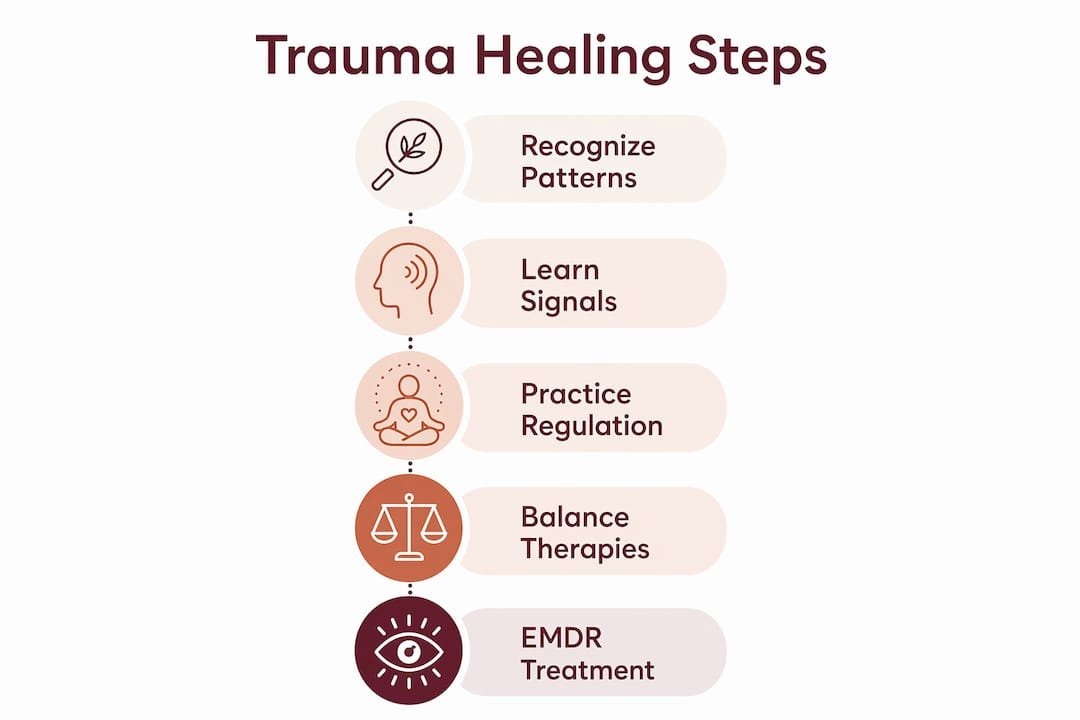
Name patterns, not people
The most effective communication shift couples can make is naming the pattern instead of blaming the person. "We're in the loop where I pursue and you shut down" is a shared observation. "You always shut me out" is an accusation. Naming patterns rather than blaming builds shared understanding and reduces the threat response in both partners.
Learn each other's stress signals
Every person has early warning signs that they are approaching overwhelm. A partner's jaw tightening, a shift to one-word answers, or a sudden need to clean the kitchen are all signals. Learning to read these cues allows couples to intervene before a full activation occurs. Steady, manageable shifts in relationship dynamics support nervous system healing better than rapid changes.
Practice co-regulation
Co-regulation is the process of using a partner's calm presence and tone to regulate one's own nervous system. Co-regulation is often more effective than talk therapy alone for trauma survivors. Practical co-regulation looks like sitting close without speaking, matching slow breathing, or making steady eye contact during a moment of distress. It does not require words. It requires presence.
Balance individual and couples work
The table below outlines how individual and couples therapy serve different but complementary functions in trauma recovery.
| Focus area | Individual therapy | Couples therapy |
|---|---|---|
| Primary goal | Process personal trauma history | Build shared safety and communication |
| Who attends | One partner | Both partners |
| Core method | EMDR, somatic work, CBT | Co-regulation, pattern naming, trust repair |
| Best for | Reprocessing past wounds | Changing relational dynamics together |
| Timeline | Ongoing, parallel to couples work | Concurrent with individual work |
Combining individual trauma work with couples therapy is the most effective therapeutic approach for managing trauma’s impact on relationships. Even when only one partner receives individual trauma-informed therapy, it often shifts the relational dynamic through improved emotional steadiness.
Use EMDR for trauma reprocessing
Eye Movement Desensitization and Reprocessing (EMDR) is an evidence-based therapy that targets the stored memory networks driving trauma responses. EMDR does not require a person to talk through every detail of their trauma. It uses bilateral stimulation to help the brain reprocess distressing memories so they lose their automatic charge. For couples, trauma-informed couples therapy integrates this individual reprocessing with relational work, so that healing in the therapy room translates into healing at home.
Effective communication in trauma recovery focuses on safety and mutual regulation rather than confrontation. Therapy helps couples build new patterns where conflict does not equate to abandonment or threat. That reframe alone changes the entire emotional architecture of a relationship.
Key Takeaways
Healing relationship challenges after trauma requires addressing the nervous system directly, supporting both partners equally, and combining individual trauma therapy with couples work.
| Point | Details |
|---|---|
| Trauma drives behavior, not character | Distance, reactivity, and mistrust are nervous system responses, not signs of a failing relationship. |
| Safety can intensify symptoms | Trauma often resurfaces in stable relationships as the nervous system finally processes old wounds. |
| Both partners need support | Caregiver burnout is real; the non-traumatized partner requires their own outlets and therapy. |
| Co-regulation outperforms talk alone | A partner’s calm presence regulates the nervous system more effectively than verbal reassurance. |
| Combined therapy works best | Pairing individual trauma work with couples therapy produces the most durable relational change. |
What I've learned from watching couples work through this
The couples I have seen make real progress share one quality: they stopped treating trauma symptoms as relationship problems and started treating them as nervous system problems. That shift sounds small. It is not. It changes who the enemy is. Instead of fighting each other, they start working together against the pattern.
What surprises most people is how much patience this requires, not just with a partner, but with the process itself. Trauma reprocessing is not linear. A couple can have three good months and then hit a week that feels like they are back at square one. That week is not failure. It is the nervous system working through another layer. Understanding that distinction keeps couples from giving up at exactly the wrong moment.
The other thing I have seen consistently is that the non-traumatized partner's healing matters just as much. When that partner gets their own support, stops shrinking, and shows up with genuine steadiness rather than anxious caretaking, the whole system shifts. The survivor feels less like a burden. The dynamic becomes more equal. That equality is what makes long-term healing possible.
Seeking trauma-informed couples therapy is not an admission that a relationship is broken. It is the most direct path to understanding what is actually happening and building something more durable together. The couples who do this work do not just survive trauma. They build a relationship that neither of them had before.
— Juiced
Alvaradotherapy supports healing from relationship challenges after trauma
Alvaradotherapy is a California-based trauma-informed practice offering online EMDR therapy and specialized couples therapy for adults working through the relational impact of trauma. Licensed therapists serve clients across Pasadena, Ventura, and throughout California via secure online sessions, in both English and Spanish.
Whether you are the trauma survivor or the partner trying to understand what is happening, Alvaradotherapy provides care that addresses both experiences. Services include EMDR Intensives, trauma-informed couples therapy, and individual counseling designed to work alongside each other. If you are ready to take a first step, a consultation with Alvaradotherapy gives you a clear picture of what to expect and how to begin.
FAQ
What are the main relationship challenges after trauma?
The most common challenges include emotional reactivity, withdrawal during conflict, difficulty trusting a partner, and repetitive arguments that never fully resolve. These patterns stem from nervous system responses, not personal failings.
Why does trauma get worse in a loving relationship?
Trauma responses intensify in safe relationships because the nervous system finally feels secure enough to process unresolved wounds. This is a sign of growing safety, not a sign that the relationship is failing.
How does trauma affect the non-traumatized partner?
Partners of trauma survivors frequently experience emotional exhaustion, isolation, and helplessness. Without their own support, they risk caregiver burnout, which destabilizes the relationship for both people.
What is co-regulation and why does it matter?
Co-regulation is the process of using a partner's calm presence and tone to help regulate the other person's nervous system. It is often more effective than verbal reassurance alone and forms a core technique in trauma-informed couples therapy.
Is EMDR effective for relationship trauma?
EMDR is an evidence-based therapy that reprocesses stored trauma memories, reducing their automatic emotional charge. When combined with couples therapy, it helps translate individual healing into lasting relational change.
