
Signs of PTSD in Relationships: What to Look For

TL;DR:
PTSD in relationships often presents as emotional withdrawal, hypervigilance, and avoidance, which require understanding as symptoms rather than character flaws. These symptoms disrupt intimacy, communication, and create cycles of misunderstanding, but treatment and support can foster recovery. Recognizing trauma types and supporting evidence-based therapies are key to helping partners heal and rebuild trust.
Post-traumatic stress disorder (PTSD) is a clinical condition defined by intrusive memories, avoidance, emotional numbing, and hyperarousal following traumatic events. The signs of PTSD in relationships are often subtle enough to be mistaken for personality flaws or emotional distance, which makes early recognition critical. PTSD affects roughly 6% of U.S. adults, and the good news is that 60–80% of those who pursue evidence-based treatments like EMDR, CPT, or Prolonged Exposure see significant symptom recovery. Understanding what you are seeing in your partner is not about diagnosing them. It is about responding with clarity instead of confusion.
What are the common signs of PTSD in a relationship?
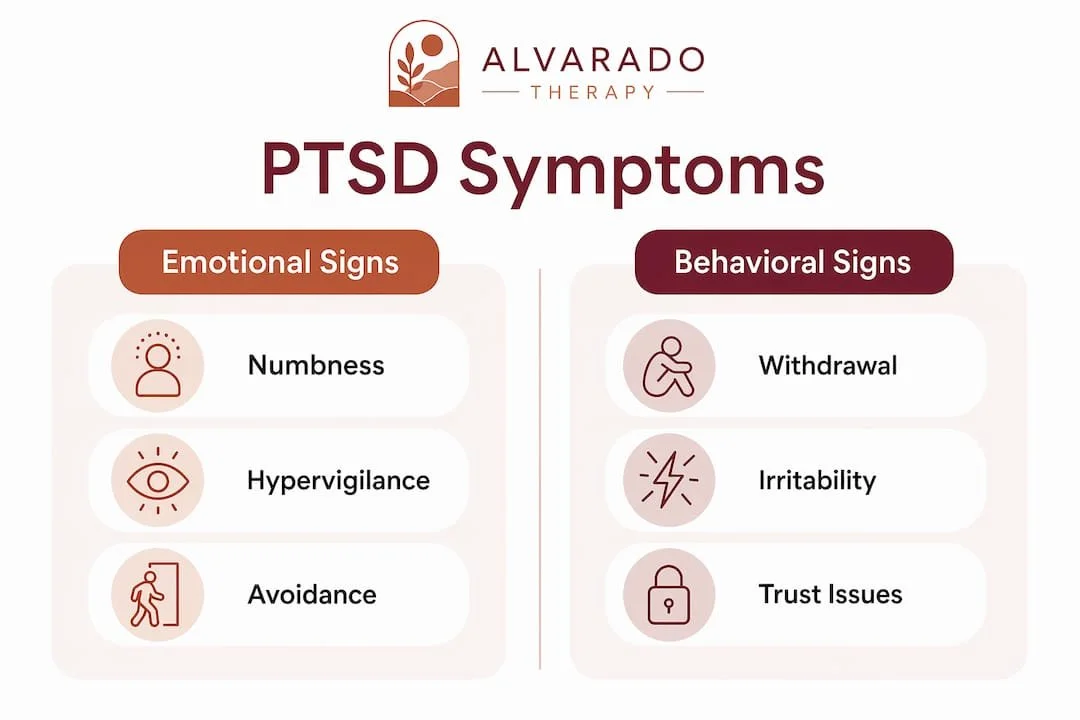
PTSD symptoms fall into four DSM-5 clusters: intrusion, avoidance, negative cognition and mood, and hyperarousal. Each cluster shapes relationship dysfunction in a distinct way. Knowing which cluster drives a behavior helps you respond to the symptom rather than react to the surface action.
The most visible signs include:
Hypervigilance. Your partner scans rooms when entering, startles at sudden sounds, or sits with their back to the wall. This is not paranoia. It is a nervous system stuck in threat-detection mode.
Emotional numbness. They seem checked out, flat, or unreachable during moments that should feel connecting. Emotional withdrawal and startle response are among the most common PTSD presentations in couples.
Avoidance. They refuse to visit certain places, change the subject when specific topics arise, or pull back from physical closeness without explanation.
Flashbacks and intrusive memories. They may go quiet mid-conversation, seem suddenly distressed, or become irritable without an obvious trigger.
Sleep disturbances. Nightmares, insomnia, or restless sleep affect mood and patience the next day, creating friction that feels unrelated to trauma.
Sexual withdrawal. Reduced interest in physical intimacy is common when trauma history involves the body or when hyperarousal makes closeness feel unsafe.
Mood swings and irritability. Sudden anger or emotional shutdown often signals a trauma response, not a character problem.
Pro Tip: Write down specific behaviors you notice and when they occur. Patterns are easier to see on paper than in the moment, and a therapist can use that log to identify PTSD clusters quickly.
The most important reframe is this: none of these behaviors are personal. They are symptoms. Treating them as character flaws leads to conflict. Treating them as signals leads to support.
How does PTSD affect intimacy and communication?
PTSD disrupts intimacy and communication through three overlapping mechanisms: emotional numbing, hyperarousal, and avoidance. Each one creates a different kind of relational damage.
Emotional numbing blocks vulnerability. A partner with PTSD may genuinely want closeness but feel emotionally frozen. They cannot access warmth or affection on demand. Partners often read this as rejection, which triggers their own withdrawal, creating a cycle where both people feel alone.
Hyperarousal escalates conflict. When the nervous system is chronically on alert, small disagreements feel like threats. A raised voice or a disappointed look can trigger a fight-or-flight response. Arguments escalate faster and de-escalate slower than in relationships without trauma.
Avoidance shrinks the relationship. Over time, the couple stops going to certain places, stops discussing certain topics, and stops initiating physical contact. The relationship becomes smaller to accommodate the trauma, which breeds resentment on both sides.
Misreading symptoms causes secondary damage. When partners do not understand PTSD, they personalize the symptoms. "You never want to touch me" lands differently than "I notice closeness feels hard for you right now." The first creates shame. The second creates space.
Secondary trauma strains the caregiver. Partner emotional exhaustion leads to relationship strain. Supporting someone with PTSD without your own support system is a direct path to caregiver burnout, which harms both people.
Pro Tip: If you are the supporting partner, individual therapy is not optional. It is protective. Your emotional health directly affects the quality of support you can offer.
The goal is not perfect communication. The goal is communication that does not make the trauma worse. That requires both partners to understand what PTSD actually does to a nervous system.
PTSD vs. CPTSD vs. PTRS: what is the difference in relationships?
Three overlapping conditions shape how trauma shows up in romantic relationships. Knowing the difference helps you recognize what you are dealing with and what kind of support actually fits.
| Condition | Cause | Key relational symptoms | Avoidance vs. confrontation |
|---|---|---|---|
| PTSD | Single or discrete traumatic event | Hypervigilance, flashbacks, emotional numbing, withdrawal | Strong avoidance of trauma reminders |
| Complex PTSD (CPTSD) | Chronic, repeated trauma (childhood abuse, prolonged captivity) | Emotional dysregulation, attachment disruption, shame, identity confusion | Avoidance plus collapse under stress |
| Post-Traumatic Relationship Syndrome (PTRS) | Repeated relational trauma within a romantic relationship | Hypervigilance, insomnia, sexual dysfunction, self-blame | Confrontation tendency rather than avoidance |
CPTSD is strongly negatively associated with relationship quality, with lower mentalization and reduced playfulness mediating relational breakdown. Mentalization is the ability to understand your own and your partner’s mental states. When CPTSD erodes that capacity, misreads multiply and repair becomes harder.
PTRS is a distinct condition. It occurs from repeated relational trauma rather than a single incident, and it lacks the emotional numbing that defines standard PTSD. People with PTRS tend to confront their trauma rather than avoid it, which can look like repeated arguments about past events or an inability to let go of relational injuries. This is a meaningful clinical difference because avoidance-focused treatments like Prolonged Exposure may not be the right fit.
Understanding which condition is present changes everything about how you respond. A partner with CPTSD needs consistency and predictability above all else. A partner with PTRS may need space to process relational events rather than being asked to move on quickly. For a deeper look at PTSD versus CPTSD distinctions, Alvaradotherapy's blog breaks down the clinical differences in plain language.
How can you recognize and support healing from PTSD in a relationship?
Recognition starts with observation, not diagnosis. You are not trying to label your partner. You are trying to understand what is driving behavior that confuses or hurts you.
Watch for these patterns over time:
Consistent avoidance of specific topics, places, or types of physical contact
Emotional shutdown that follows a predictable trigger rather than appearing random
Sleep problems that worsen after stressful events or intimacy
Irritability that spikes in environments with loud noise, crowds, or unpredictability
Statements of self-blame or worthlessness that feel disproportionate to the situation
Once you recognize the pattern, the most effective response is to support treatment logistics rather than try to process trauma content yourself. That means helping schedule appointments, offering transportation, and creating a calm home environment. It does not mean becoming your partner's therapist. Attempting to process trauma content without clinical training risks re-traumatization.
Evidence-based treatments for PTSD include EMDR (Eye Movement Desensitization and Reprocessing), Cognitive Processing Therapy (CPT), and Prolonged Exposure (PE). All three have strong recovery records. Alvaradotherapy's PTSD management strategies resource outlines what each approach involves and who benefits most from each.
One counterintuitive truth: trauma symptoms often resurface when a relationship becomes safe enough for vulnerability. If your partner's symptoms seem to increase as your relationship deepens, that is not failure. It is the nervous system finally relaxing enough to process what it has been holding. Recognizing this prevents misreading progress as regression.
Pro Tip: Avoid asking your partner to explain their trauma. Instead, ask what they need right now. "Do you want space or company?" is a question they can answer without reliving the event.
For partners carrying the support role, daily coping strategies designed for PTSD recovery can help both of you build a shared language around symptoms and needs.
Key Takeaways
Recognizing PTSD symptoms in a relationship requires separating trauma-driven behavior from character, and responding with structure and support rather than personalization or pressure.
| Point | Details |
|---|---|
| PTSD symptoms are behavioral, not personal | Emotional numbness, hypervigilance, and avoidance are symptoms, not character flaws or signs of disinterest. |
| Intimacy and communication suffer predictably | Numbing, hyperarousal, and avoidance each damage closeness in distinct ways that worsen without awareness. |
| CPTSD and PTRS differ from standard PTSD | Chronic trauma and relational trauma produce different symptom profiles that require different support approaches. |
| Support logistics, not trauma content | Helping with appointments and creating calm environments is more effective and safer than processing trauma together. |
| Partner self-care is non-negotiable | Secondary trauma and caregiver burnout are real risks; individual therapy protects both partners. |
What I have learned about PTSD symptoms in relationships
The most common mistake I see is partners interpreting emotional absence as emotional indifference. PTSD symptoms in relationships are often quiet withdrawal rather than visible aggression. That quietness is disorienting. It leaves the other person wondering what they did wrong, when the answer is that trauma is simply doing what trauma does.
What actually helps is patience paired with structure. Not endless patience that erases your own needs, but the kind that comes from genuinely understanding what you are looking at. When you know that a partner's shutdown is a hyperarousal response rather than contempt, you stop fighting the symptom and start making room for it.
The other thing worth saying plainly: healing is not linear. A partner who seems to be doing better may suddenly struggle more as the relationship deepens. That pattern, where symptoms flare as the nervous system relaxes, is a sign of emerging safety. Treating it as failure ends relationships that were actually on the right track.
If you are the supporting partner, please get your own support. The couples I have seen navigate PTSD most successfully are the ones where both people are in some form of care. That is not a luxury. It is the foundation.
— Juiced
Therapy options for PTSD and relationship healing at Alvaradotherapy
Alvaradotherapy works with individuals and couples across California who are navigating exactly what this article describes.
The practice offers online EMDR therapy for trauma processing, as well as couples therapy focused on rebuilding trust and communication after trauma. For those dealing with complex or relational trauma, the PTSD and complex trauma program provides structured, evidence-based care in both English and Spanish. Services are available online throughout California, with licensed therapists who specialize in trauma-informed, identity-affirming care. A personalized consultation is the first step toward understanding what kind of support fits your situation.
FAQ
What are the first signs of PTSD in a relationship?
The earliest signs are typically emotional withdrawal, hypervigilance, and avoidance of intimacy or specific topics. These behaviors often appear inconsistent or confusing before a PTSD pattern becomes clear.
Can PTSD cause trust issues in a relationship?
Yes. Hyperarousal and negative cognition clusters in PTSD directly erode trust by making the nervous system read safe situations as threatening. This leads to misread intentions and repeated conflict.
What is the difference between PTSD and PTRS in a relationship?
PTSD typically follows a single traumatic event and involves emotional numbing and avoidance. PTRS results from repeated relational trauma and features confrontation rather than avoidance, along with self-blame and sexual dysfunction.
How does PTSD affect sexual intimacy?
PTSD reduces sexual desire and comfort with physical closeness, particularly when trauma involves the body. Avoidance of intimacy is a recognized PTSD symptom, not a reflection of attraction or love.
How can I support a partner with PTSD without burning out?
Focus on supporting treatment logistics like scheduling and transportation rather than processing trauma content yourself. Individual therapy for the supporting partner is strongly recommended to prevent secondary trauma and caregiver burnout.
