

TL;DR:
PTSD significantly harms relationship quality through emotional withdrawal, communication issues, and intimacy disruption. Attuned partner support and involving loved ones in therapy help rebuild trust and improve relationship outcomes.
Post-traumatic stress disorder (PTSD) is defined as a trauma-driven condition that reshapes how a person thinks, feels, and connects with others, and its effects on romantic relationships are direct and measurable. How PTSD impacts relationships shows up in emotional withdrawal, communication breakdowns, and behaviors that can feel confusing or hurtful to a partner who does not understand their source. Research published in Frontiers in Psychology confirms that higher complex PTSD symptoms significantly reduce intimate relationship quality (β = −0.35, p < 0.001). That single finding captures what many couples experience but struggle to name. Understanding the mechanisms behind these changes is the first step toward building real empathy and better communication.
How PTSD symptoms disrupt romantic relationships
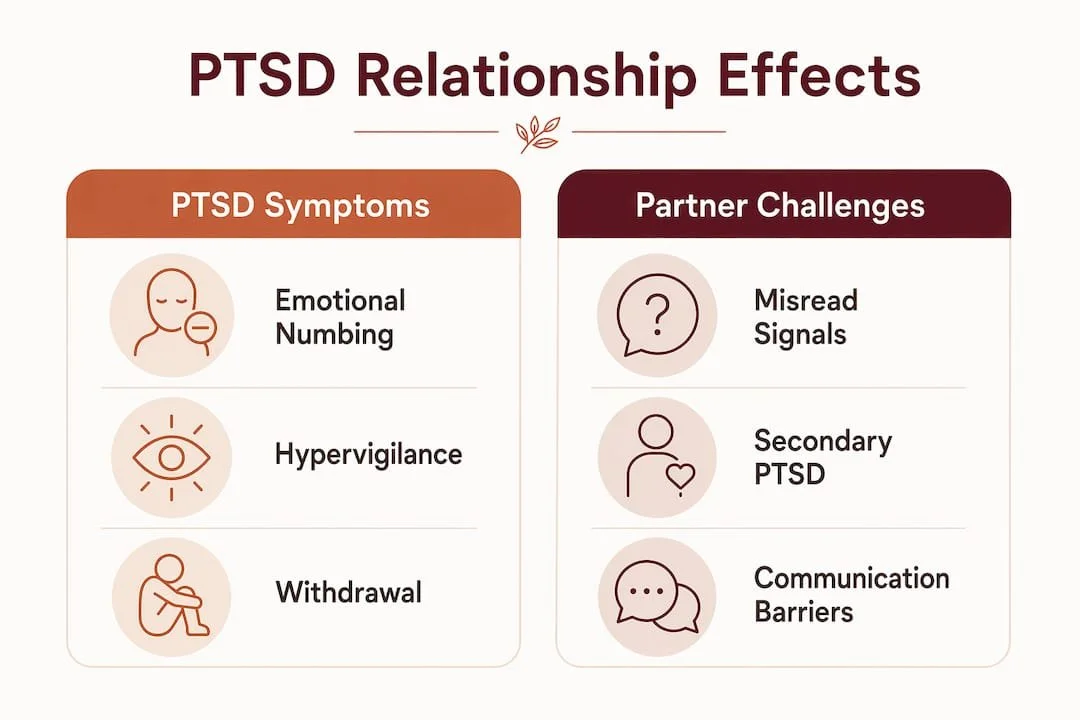
PTSD symptoms do not stay contained to the person who experienced the trauma. They spill into daily interactions, shaping how a person communicates, responds to closeness, and tolerates stress. The most common PTSD and relationship issues involve emotional numbing, hypervigilance, irritability, and avoidance, each of which creates a different kind of distance between partners.

Emotional numbing is one of the most disorienting effects for partners. A person with PTSD may genuinely want closeness but feel emotionally flat or disconnected, not because they stopped caring, but because their nervous system has learned to suppress feeling as a protective response. Trauma changes threat perception, making intimacy feel dangerous even when the environment is safe. That means the warmth and responsiveness a partner expects may simply not be accessible in certain moments.
Hypervigilance creates a different problem. A person scanning constantly for danger reads neutral facial expressions as threatening, interprets silence as anger, and may react to minor conflict as if it were a crisis. This makes calm, productive conversations difficult to sustain. Irritability and emotional reactivity follow the same pattern, often leaving partners feeling they are walking on eggshells without knowing why.
How trauma affects intimacy also extends to sexual connection. PTSD frequently disrupts sexual function and desire, particularly when physical closeness triggers trauma-related memories. Partners may interpret this withdrawal as personal rejection rather than a symptom.
Reduced mentalization compounds all of these effects. Mentalization is the ability to understand your own and others' mental states, and PTSD impairs this capacity, making it harder for a person to read relational cues, respond with warmth, or repair ruptures after conflict. Research shows that rebuilding mentalization (β = 0.24, p < 0.01) and playfulness (β = 0.18, p < 0.05) are both associated with better relationship quality despite PTSD symptoms. These are not soft concepts. They are measurable factors that clinicians now treat as direct targets in PTSD effects on relationships.
Emotional numbing: Flat affect and disconnection that partners may misread as indifference
Hypervigilance: Constant threat-scanning that makes neutral interactions feel charged
Avoidance: Steering away from people, places, or conversations that trigger trauma memories
Irritability: Rapid emotional escalation that disrupts conflict resolution
Intimacy disruption: Physical and emotional withdrawal that affects sexual and relational closeness
Pro Tip: When your partner seems emotionally unavailable, try naming what you observe without assigning intent. "I notice you seem far away right now" opens a door. "You never want to connect" closes it.
How does partner support affect trauma disclosure?
Supporting a partner with PTSD is not simply a matter of offering more care. Research from SUNY shows that support adequacy moderates disclosure avoidance, and the relationship between support and openness is more nuanced than most people expect. Both too little and too much support can cause a person with PTSD to pull back from sharing their trauma experience.
The findings break down this way:
When relationship distress is low: Underprovision of support, meaning not enough emotional presence or responsiveness, is linked to greater trauma disclosure avoidance. The person with PTSD does not feel safe enough to open up.
When relationship distress is high: Overprovision of support, meaning excessive checking in, pressing for details, or hovering, is linked to greater avoidance. The person with PTSD feels overwhelmed or controlled rather than supported.
The implication: Attuned support, calibrated to the current state of the relationship, is more effective than simply increasing the amount of care offered.
The practical takeaway: Asking "What do you need right now?" is more useful than assuming you know what your partner needs in a given moment.
This research matters because many partners of people with PTSD operate on the assumption that more support is always better. Over-support during high distress can actually increase the likelihood that a person avoids talking about their trauma altogether. That is a counterintuitive finding with real consequences for how couples communicate.
The goal is not to become a therapist to your partner. The goal is to stay present, read the room, and follow your partner's lead on how much space or closeness they need at any given time.
Pro Tip: If your partner shuts down when you ask about their trauma, try shifting from questions to statements. "I'm here whenever you're ready" removes pressure while keeping the door open.
What is secondary PTSD and how does it affect partners?
Secondary PTSD is defined as a trauma-related stress response that develops in people who are repeatedly exposed to a loved one's trauma symptoms, without having experienced the original traumatic event themselves. The Wounded Warrior Project identifies secondary PTSD as a real and documented risk for partners and family members of people living with PTSD.
The symptoms of secondary PTSD closely mirror those of primary PTSD and include:
Anxiety and hypervigilance: Constant worry about the partner's emotional state or potential triggers
Emotional withdrawal: Pulling back from friends, family, or social activities to manage stress at home
Compassion fatigue: Emotional exhaustion from sustained caregiving and emotional labor
Sleep disruption: Difficulty sleeping due to the partner's nightmares, restlessness, or nighttime distress
Relationship resentment: Frustration that builds when the non-PTSD partner's needs go unmet over time
Secondary PTSD is frequently misread as relationship conflict. A partner who has developed anxiety, withdrawal, and irritability may be labeled as "difficult" or "unsupportive" when they are actually experiencing a mental health response to chronic stress exposure. Chronic exposure without self-care erodes the non-PTSD partner's mental health in measurable ways.
Self-care for the non-PTSD partner is not optional. Individual therapy, peer support groups, and clear personal boundaries are protective factors that reduce secondary PTSD risk and preserve the relationship's long-term stability.
What communication strategies help couples manage PTSD together?
The effects of PTSD on couples are most visible during moments of acute distress, particularly flashbacks and emotional escalation. Mind.org.uk recommends calm, gentle responses and slow breathing support during PTSD flashbacks, specifically because confrontation or urgency intensifies nervous system dysregulation rather than reducing it. The goal during a flashback is co-regulation, not problem-solving.
Outside of crisis moments, couples benefit from structured communication practices that reduce the pressure around trauma disclosure and build relational safety over time. These include:
Scheduled check-ins: Setting aside 10–15 minutes a few times a week for low-stakes emotional connection, separate from conflict or trauma discussion
Avoiding pressure to disclose: Letting the person with PTSD lead conversations about their trauma rather than prompting or probing
Naming emotions without blame: Using "I feel" statements to describe your experience without attributing intent to your partner
Rebuilding playfulness: Engaging in shared activities that are light and enjoyable, which research links to better relationship quality even under PTSD stress
Psychoeducation together: Learning about PTSD symptoms as a couple reduces misattribution and builds a shared framework for understanding behavior
"When partners understand that withdrawal, irritability, and emotional distance are symptoms of a nervous system under stress, not personal rejection, the entire relational dynamic shifts. Empathy becomes possible where frustration once lived."
Family-involved therapy produces measurable results. 80% of Veterans with PTSD want their family included in treatment, and family-based intervention reduces therapy dropout by 50% in cognitive processing and prolonged exposure programs. That statistic reflects something clinicians observe consistently: recovery from PTSD is not a solo process. Partners who participate in treatment become part of the healing rather than bystanders to it.
For couples ready to take structured steps, trauma recovery guides for couples and communication tips for healing offer practical frameworks grounded in clinical evidence.
Key takeaways
PTSD directly reduces relationship quality through emotional withdrawal, impaired mentalization, and communication barriers, but attuned partner support and shared therapeutic work can meaningfully reverse these effects.
| Point | Details |
|---|---|
| PTSD reduces relationship quality | Research confirms a direct link between complex PTSD symptoms and lower intimate relationship quality. |
| Mentalization and playfulness matter | Rebuilding these two capacities is associated with measurably better relationship outcomes despite PTSD. |
| Support calibration is critical | Both too little and too much partner support can increase trauma disclosure avoidance. |
| Secondary PTSD is a real risk | Partners exposed to trauma symptoms over time can develop anxiety, withdrawal, and compassion fatigue. |
| Family involvement aids recovery | Including partners in PTSD treatment reduces therapy dropout by 50% and improves outcomes. |
What I've learned working with couples affected by PTSD
The couples I see at Alvaradotherapy who make the most progress share one quality: they stop trying to fix each other and start trying to understand each other. That sounds simple. It is not.
The hardest clinical pattern to shift is the well-meaning partner who over-supports. They ask questions constantly, check in repeatedly, and interpret silence as a sign that something is wrong. Research confirms what I observe in session: this approach often causes the person with PTSD to disclose less, not more. Pressure, even loving pressure, activates avoidance.
The second pattern I watch for is secondary PTSD in the non-PTSD partner. By the time couples reach therapy, the partner without a PTSD diagnosis is often carrying significant anxiety, hypervigilance, and emotional exhaustion of their own. Treating only one person in the room misses half the picture.
What actually moves the needle is rebuilding mentalization, the capacity to hold your partner's inner world in mind with curiosity rather than fear. When both partners can do that, even imperfectly, the relationship becomes a place of repair rather than a source of additional stress. Healing is not a destination either partner reaches alone. It is something a couple builds together, one attuned interaction at a time.
— Juiced
Therapy options for couples navigating PTSD
Alvaradotherapy offers trauma-informed care specifically designed for the challenges described in this article, including online EMDR trauma therapy and couples therapy in California and New York for partners working through PTSD together.
Licensed therapists at Alvaradotherapy work with individuals and couples to address PTSD symptoms, rebuild communication, and reduce the risk of secondary PTSD in partners. Services are available in English and Spanish, online throughout California, with in-person options in Pasadena and Ventura. If you are ready to take a structured next step, a personalized consultation can help you identify the right care path for your relationship.
FAQ
What are the main signs that PTSD is affecting a relationship?
The most common signs include emotional withdrawal, communication breakdowns, irritability, avoidance of intimacy, and hypervigilance. These behaviors stem directly from PTSD symptoms rather than a lack of care for the relationship.
Can a partner develop PTSD from supporting someone with PTSD?
Yes. Secondary PTSD can develop in partners who are repeatedly exposed to a loved one's trauma symptoms, producing anxiety, withdrawal, and compassion fatigue over time.
How should I respond when my partner has a flashback?
Stay calm, speak gently, and avoid physical contact unless your partner asks for it. Mind.org.uk recommends slow breathing and a quiet presence to support nervous system regulation during a flashback.
Does involving a partner in PTSD therapy actually help?
Research shows that family-involved PTSD treatment reduces therapy dropout by 50%. Partners who participate in treatment become active contributors to recovery rather than observers.
Is it possible to have a healthy relationship when one partner has PTSD?
Yes. Research identifies mentalization and playfulness as measurable factors that improve relationship quality even when PTSD symptoms are present. Couples therapy and psychoeducation significantly improve outcomes for both partners.
