
Online Therapy Guide for Adults: Find the Right Fit

TL;DR:
Online therapy offers licensed mental health care through digital means, with outcomes comparable to face-to-face treatment for most adults. Various formats like video, phone, and text suit different needs, but the therapeutic relationship remains the key predictor of success. Proper preparation and verification of licensing, credentials, and insurance ensure a productive and accessible experience.
Online therapy is the delivery of licensed mental health care through digital means, including video, phone, and text, and research confirms it produces outcomes comparable to face-to-face treatment for most adults. This online therapy guide is built for adults managing anxiety, PTSD, trauma, or grief who want to make an informed choice before booking their first session. You will learn which formats exist, what the evidence actually says, how to verify a therapist's credentials, and what to do before your first call. Alvaradotherapy, a trauma-informed California practice specializing in EMDR and individual counseling, contributed clinical perspective throughout.
What formats does online therapy offer?
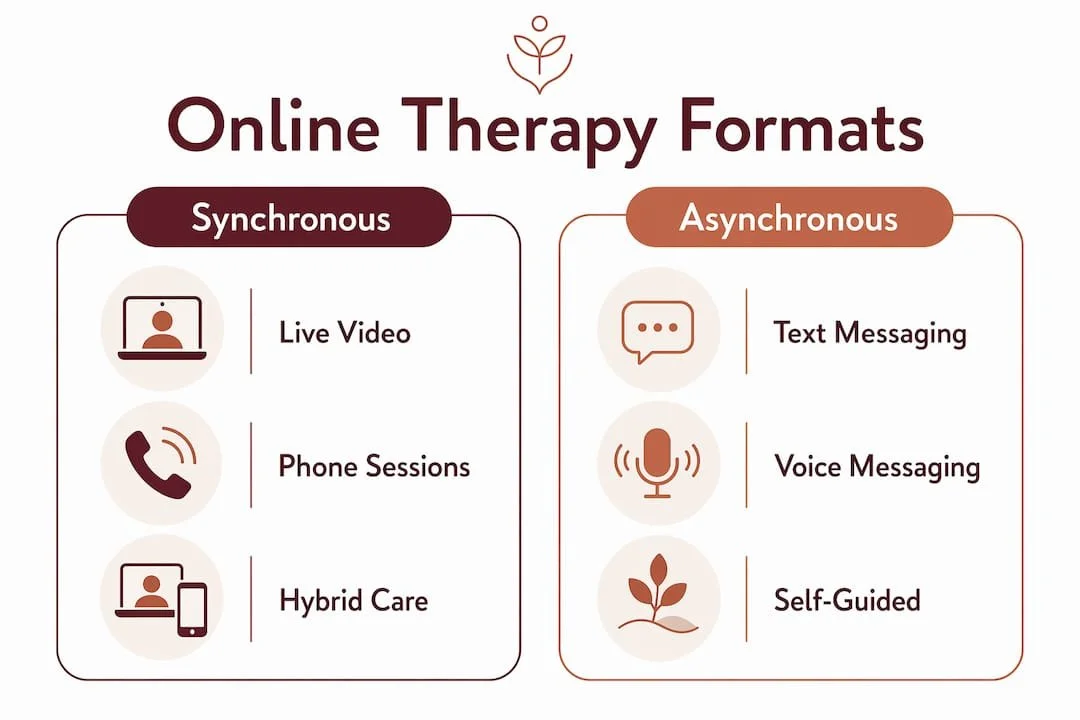
Online therapy formats include live video, phone sessions, asynchronous text or voice messaging, hybrid care, and digital-first specialty programs. Each format suits a different lifestyle and clinical need.
| Format | Best use case | Main limitation |
|---|---|---|
| Live video | Complex trauma, PTSD, nuanced emotional work | Requires stable internet and private space |
| Phone session | Mobility limits, camera discomfort | Therapist cannot read body language |
| Asynchronous text/voice | Busy schedules, mild anxiety or stress | Slower feedback loop, less suited to crisis |
| Hybrid (video + text) | Ongoing support between weekly sessions | Requires clear boundaries on response times |
| Digital-first specialty | Structured programs for specific conditions | Less personalized than one-on-one care |
Live video is the closest match to in-person therapy. The therapist can observe facial expressions and posture, which matters most when processing trauma or grief. Phone sessions work well for people who feel self-conscious on camera, though the loss of visual cues is a real trade-off.
Asynchronous formats let you write or record a message and receive a response within a set window, often 24 hours. They suit adults with unpredictable schedules but are not appropriate for acute distress or crisis situations.
Pro Tip: Before your first session, test your internet connection, close unnecessary browser tabs, and use headphones. A dropped call mid-session disrupts the emotional momentum you and your therapist are building.
Privacy is a separate concern from technology. A parked car, a bedroom with a white noise machine outside the door, or a lunch break in an empty conference room all work. The goal is a space where you can speak freely without fear of being overheard.
How effective is online therapy compared to in-person care?
A meta-analysis of 108 studies found no significant difference in treatment outcomes between video-based therapy and face-to-face therapy for depression, anxiety, PTSD, and relationship difficulties. That is not a minor finding. It means the medium itself is not the limiting factor in your recovery.
Online therapy works best for mild to moderate anxiety or depression. Severe crises, active suicidal ideation, or conditions requiring medication management typically need in-person or intensive outpatient care. Knowing where you fall on that spectrum helps you choose the right level of support from the start.
The single biggest predictor of a good outcome is therapeutic alliance, the quality of the working relationship between you and your therapist. That alliance forms just as reliably over video as it does in a physical office. What it requires is consistency, honesty, and enough sessions to let trust develop.
Online therapy also reduces no-show rates by about 15% compared to in-person care, largely because travel and scheduling barriers disappear. Higher attendance directly improves outcomes. Showing up consistently is one of the most underrated factors in therapy success.
One nuance worth naming: some people find the home environment distracting or emotionally loaded. If your home is a source of stress rather than safety, a phone session from a neutral location may serve you better than video from your living room.
How do you choose the right online therapist?
Licensing is the first filter. Therapists must be licensed in the state where you are physically located at the time of each session, not where the therapist is based. This is a legal requirement, not a preference. Always confirm your therapist holds an active license in your state before booking.

Specialized training matters more than general experience. Certifications like EMDR, DBT, and EFT are significantly more effective than a generalist approach for specific conditions. If you are processing trauma, look for EMDR certification. If emotional regulation is your primary struggle, DBT training is the relevant credential. You can find EMDR-certified specialists in California through Alvaradotherapy's published guidance.
Use the initial consultation as a clinical tool, not just a scheduling call. Most reputable therapists offer a free 15–20-minute consultation for evaluating fit. That window is your chance to assess whether you feel heard, whether the therapist's style matches your communication preferences, and whether their stated approach aligns with your goals.
Questions to ask during that first call:
What license do you hold, and in which states are you currently licensed?
What is your primary therapeutic approach for anxiety, trauma, or grief?
Do you have specific training in EMDR, DBT, or another evidence-based modality?
How do you handle between-session crises or urgent concerns?
What does a typical session look like with you?
How do you measure progress over time?
Pro Tip: Pay attention to how the therapist responds to your questions, not just what they say. A therapist who listens carefully, asks clarifying questions, and avoids jargon is already demonstrating the skills that build a strong alliance.
The therapist selection process deserves the same care you would give any significant health decision. Fit is not a luxury. It is the mechanism through which therapy works.
How do you prepare for online therapy sessions?
Your physical setup directly affects your ability to engage. A quiet, private space with good lighting and a stable internet connection removes friction before the session even starts. Sitting at eye level with your camera, rather than looking down at a laptop on a desk, makes the conversation feel more natural for both you and your therapist.
Practical preparation steps:
Choose a consistent location for sessions to build a mental association with therapy work.
Use headphones to improve audio clarity and reduce the chance of being overheard.
Close social media and notifications before the session starts.
Keep a glass of water nearby. Emotional conversations are physically demanding.
Have a notebook available for any insights or homework your therapist assigns.
Set realistic expectations for the first few sessions. Early sessions focus on building rapport and gathering your history. You will not solve a decade of anxiety in session one. That is not a failure of the process. It is the process working correctly.
Alvaradotherapy's step-by-step preparation guide covers the full intake workflow, including what to bring to your first session and how to communicate your goals clearly. Reading it before you start saves time and reduces first-session nerves.
Scheduling consistency matters more than most people expect. Weekly sessions at the same time create a rhythm that supports the therapeutic relationship. Irregular attendance slows progress and makes it harder for your therapist to track patterns in your experience.
What should you know about online therapy costs and insurance?
Insurance parity laws require many insurers to cover virtual therapy at rates similar to in-person visits. Medicare and most commercial insurers now cover telehealth therapy equivalently. That coverage is not automatic. You need to verify it before your first session.
Key steps before your first paid session:
Call your insurer and ask specifically whether telehealth behavioral health services are covered under your plan.
Confirm the therapist is in-network or ask about out-of-network reimbursement rates.
Ask the practice about sliding-scale fees if cost is a barrier.
Request a superbill if you plan to seek reimbursement independently.
Online therapy also eliminates costs that rarely appear in the price comparison: gas, parking, transit fares, and the time lost to commuting. For adults managing a full schedule alongside a mental health condition, that time savings is real and meaningful.
Access improvements extend beyond cost. Adults in rural areas, those with mobility limitations, and people who cannot take time off work mid-day all benefit from remote therapy in ways that go beyond convenience. For many, virtual care is the only realistic path to consistent support.
Pro Tip: Ask your therapist's office to verify your insurance benefits directly before your first session. Practices that handle this routinely can often confirm coverage faster than calling your insurer yourself.
Key Takeaways
Online therapy produces outcomes equivalent to in-person care for most adults, and the quality of the therapist-patient relationship determines success far more than the platform or format used.
| Point | Details |
|---|---|
| Equivalent outcomes | A meta-analysis of 108 studies found no significant difference between video and in-person therapy results. |
| Licensing is non-negotiable | Your therapist must hold an active license in the state where you are physically located during sessions. |
| Specialized credentials matter | Seek EMDR for trauma, DBT for emotional regulation, rather than a generalist approach. |
| Use the free consultation | Most therapists offer a 15–20-minute fit check. Use it to assess communication style and approach. |
| Verify insurance before session one | Parity laws often cover telehealth, but coverage requires direct confirmation with your insurer. |
What I've learned about patience and fit in online therapy
The most common mistake I see adults make when starting online therapy is quitting after two sessions because it "doesn't feel like it's working." That timeline is almost always too short. Therapeutic alliance takes multiple sessions to form, and the first few appointments are often spent on history-gathering rather than active processing. Judging therapy at session two is like judging a book by the table of contents.
What I have observed, both clinically and in the broader research, is that the adults who benefit most from online therapy are the ones who treat the first three sessions as a trial period rather than a verdict. They show up, they communicate honestly about what feels off, and they give the relationship time to develop. That patience is not passive. It is an active investment in your own care.
The accessibility shift that online therapy represents is genuinely significant. Adults who previously could not access care because of geography, disability, or schedule constraints now have a realistic path to consistent, evidence-based support. That is worth taking seriously, even if the first session feels awkward or uncertain.
If you are unsure whether online therapy is the right format for your situation, read through Alvaradotherapy's guide on flexibility and healing before making a decision. The format question matters less than finding a therapist whose training matches your specific needs.
— Juiced
Alvaradotherapy's online trauma and PTSD care
Alvaradotherapy specializes in trauma-informed care delivered online across California and New York, with licensed therapists trained in EMDR, complex trauma, PTSD, grief, and anxiety. The practice offers bilingual services in English and Spanish, with a clinical approach built around identity-affirming, trauma-sensitive therapy.

If you are ready to understand what working with a trauma-informed therapist looks like in practice, the what to expect page walks through the full process from intake to ongoing sessions. Adults managing PTSD or complex trauma can also review the dedicated PTSD and complex trauma services page for a detailed overview of the clinical approach. Initial consultations are available to assess fit before committing to ongoing care.
FAQ
What is online therapy, exactly?
Online therapy is licensed mental health care delivered through video, phone, or text rather than an in-person office. It follows the same clinical standards as traditional therapy and produces comparable outcomes for most conditions.
Is online therapy as effective as in-person therapy?
A meta-analysis of 108 studies found no significant difference in outcomes between video-based and face-to-face therapy for depression, anxiety, PTSD, and relationship difficulties. Effectiveness depends primarily on therapeutic alliance, not the delivery format.
How do I verify that an online therapist is licensed?
Confirm the therapist holds an active license in the state where you will be physically located during sessions. Most state licensing boards maintain a public directory you can search by name or license number.
What credentials should I look for when choosing a therapist for trauma?
Look for EMDR certification for trauma and PTSD, or DBT training for emotional regulation. Specialized certifications like PMH-C, EFT, or Gottman training are more predictive of good outcomes than general counseling experience alone.
Does insurance cover online therapy?
Insurance parity laws require many insurers, including Medicare and most commercial plans, to cover telehealth therapy at rates similar to in-person visits. Always call your insurer directly to confirm your specific plan's telehealth benefits before your first session.
